

The Feeling stormed the charts with a debut album recorded in a shed. For their follow–up, they relocated to a country mansion, but elected to stick with the DIY approach.
 The Feeling outside Bradley House, their ‘home studio’ for the summer. From left: drummer Paul Stewart, keyboard player Ciaran Jeremiah, singer Dan Gillespie Sells, bass player Richard Jones and guitarist Kevin Jeremiah. Photo: Richard EcclestoneThere can’t be many people sneaking elements of Supertramp, Jellyfish and ELO into the charts, and certainly not with as much pop savvy as the Feeling. What makes this feat all the more surprising is that the band recorded much of their debut album Twelve Stops And Home in their own homes, using project–studio gear that will be very familiar to SOS readers.
Despite their subsequent success, the group stuck to this self–op ethos for the recording of their new album Join With Us, albeit within the salubrious surroundings of Bradley House, home of the Duke of Somerset, and with the help of a few more studio toys. I joined Dan Gillespie Sells (vocals/guitar), Kevin Jeremiah (guitars/vocals), Ciaran Jeremiah (keyboards/vocals), Richard Jones (bass/vocals) and Paul Stewart (drums) several weeks into the sessions, to see how things were progressing with the new songs and to find out more about how they had produced Twelve Stops And Home.
Us & Us Only
Paul: “For this record, it was a case of expanding on the bits we enjoyed about making the last record. We’re doing the same thing again, really — just us in the countryside — but back then we were effectively in a large shed and now we’re in this place! We also never really had a direction for the last record — we just followed our noses. We didn’t think we’d be making a commercial record, just the music we wanted to make, so we thought we might as well do the same this time.”
“We had the ‘go and work with this guy or that guy’ and ‘go to LA and make and album’,” adds Richard. “All that kind of stuff came up, but we felt that the best thing to do was what we did last time. We have enough ideas between the five of us at this stage — it’s only our second record!”
During the two–year period of touring Twelve Stops And Home, Dan had been busy writing material, which meant that most of his new songs were already written before the recording sessions began. Richard explains the different ways Dan’s ideas were developed by the band as a whole: “We’ve got two techniques for how we tend to record. For some of the stuff, Dan would have been beavering away working on a demo, forming a good starting point, and then we’d take this and start laying things on top, adding parts, replacing parts.
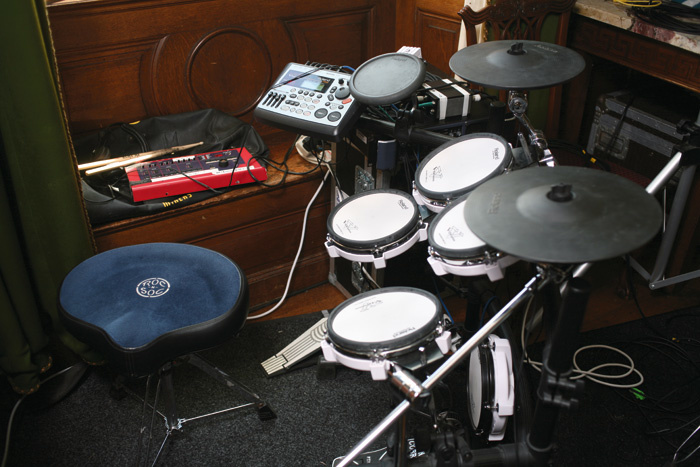 The Feeling’s unusual tracking approach involves laying down basic takes as a band, but with Paul Stewart playing V–Drums to avoid spill. These are later replaced by real drums.“In other cases it would be more of just a straight song idea, and then we’d just sit down together and start putting things down. We’ve got this V–Drums technique we use, where we get the arrangement roughly, and then record a take together using the V–Drums so that you don’t have the drums on the other tracks. Paul records real drums along to those parts, so it’s almost like you’re playing together, and then we’ll start laying on all the other parts from there. That way we can focus on getting the drums right, because we don’t have to all sit there and play at the same time. Besides, we definitely prefer the layering approach — it suits our music more — rather than doing three takes all together and choosing one of them.”
Paul: “We used the V–Drums on the previous record too. One of the main reasons was that we didn’t have as many mics then, and it wasn’t easy to pull in lots of mics when we were borrowing them from friends. The V–Drums were also good from a noise perspective when doing demos — we’d use V–Drums for kick, snare and toms, and then have some nice cymbals so we only had to use three mics.”
Richard laughs. “It never sounded that good though! We started off initially doing our demos with our Delta 1010 and some crap mics we’d borrowed, and ended up with a pretty badly recorded kit. To try to make it more convenient we started using the V–Drums, but they actually sounded not as good as the crap recording of the live kit, funnily enough!”
“As good as V–Drums are,” adds Paul, “and they are brilliant, it’s very difficult to get the kind of sound we’re after with them. Certainly cymbals–wise, there’s absolutely no substitute for the real thing.” In the end, a lot of the first album’s drum parts ended up being replaced during overdubbing sessions at Olympic studios. “The drum recordings we did in the shed were awful,” emphasises Richard, “but if the performance was really special, then we’d find a way to keep it — Spike Stent [mix engineer for several songs on the album] did all kinds of stuff at the mix, like miking up a speaker in his bathroom and playing the kit through that.”
Everyone’s An Engineer
Although engineering their own recordings has involved developing a few unorthodox strategies (like their V–Drums technique), the band were keen to stick with this approach even as their career took off and budgets expanded. Richard: “We’re still engineering most of the recordings for ourselves, although we do have Owen, our technical handyman, who’s around to stop us going mad setting everything up and plugging everything in. But all the mic placements and so on we deal with ourselves, and for comping or editing it’s actually a lot quicker to do it ourselves half the time. You don’t have to explain things and point at the screen, and someone else doesn’t have to try to interpret what you’re saying.”
“We’ve known Owen since childhood,” says Paul. “He’s an old school friend, so it doesn’t change the dynamic of the session. Having someone who’s just being paid to be there feels a bit too much like being in a studio to us. The whole reason for recording the way we do is that we get left alone.”
Richard: “We’ve always just picked stuff up and learnt things as we went along, ever since recording on four–tracks when we were 15 years old. We also learnt a lot about angles of mics and their placement from a great engineer called Cenzo Townsend, who recorded a lot of the overdubs on the last album.” Paul nods his agreement: “First time around we didn’t really know what we were doing, but we’ve learnt a lot, and now we think we know what we’re doing!”
Perhaps surprisingly, every member of the band is happy to take on the role of engineer as required. “We call it ‘Fatsing’ — being the Fat Controller — and you normally have to wear the hat,” laughs Dan, indicating the dapper bowler perched on his head. “We quite often end up Fatsing ourselves as well.”
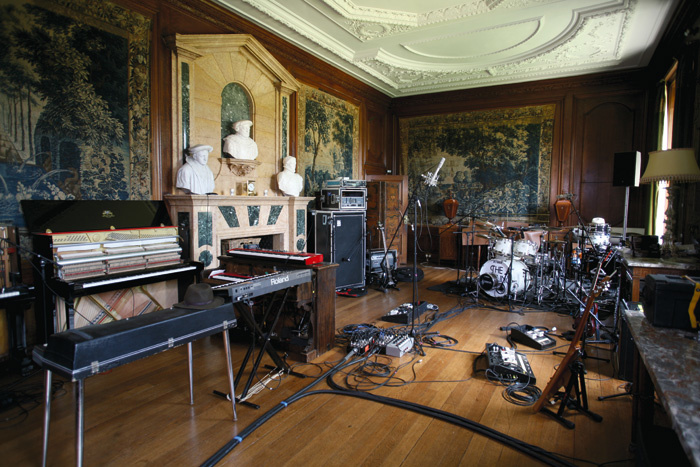 The larger live room at Bradley House.When it comes to making production decisions, all members of the band play an important part, as Richard explains: “It’s a very natural process. We’ve got a good symbiotic relationship in the band, and various roles that everyone has. Everyone’s got a good set of ears, but slightly different tastes, so when something sounds good, and we all agree on it, then you know it’s right. But if something’s not quite right, then one of us will normally point it out. It’s a good filter, a five–man filter.”
Despite this even–handed approach, there’s still space for each person to play to their strengths. “For example,” says Richard, “Dan, as chief songwriter, is the primary Musical Director, while Kev is the best engineer and is getting really good at mixing — he mixed most of our demos and some of the ‘B’ sides on the first album. I tend to be in the producer’s seat, the man with the clipboard! Anything from booking other musicians, like string quartets, to steering the recordings in a certain direction, giving them colour and shape, so to speak. All these roles cross over, of course, but I think the fact that we have different strengths individually is what makes the process work so well when we are all together.”
Stately Home Studio
The recording setup at Bradley House revolved around three main rooms, two set up for recording, and the other one between them acting as a control room. The larger live room was used for the drums, guitars, bass, and most of the keyboards. “That room has great acoustics,” comments Paul, “because of the combination of all the wood and tapestries. It’s a really lovely live room.”
This live room was only separated from the control room by a small entrance hall, which had some practical advantages, as Richard made clear: “We set up all the amps in the live room so that we could all sit in a circle and jam, but with guitar overdubs we’d just run a lead into the control room. We wanted the best of both worlds, really.”
The smaller carpeted room to the other side of the control room was used for a variety of overdubbed instruments. Kevin: “There’s a honky–tonk piano that Dan brought down, an accordion, a harmonium, and we also do vocals in there. It’s a deader room, a bit more like a living room — we were used to singing in a living room from before...” The room was also used to capture acoustic guitar and mandolin parts.
Taking pride of place in the control room was a 48–channel Mackie Onyx console, a straightforward choice for the band. “I’ve got the 16–channel Mackie Onyx mixer at home,” mentions Richard, “which we used a lot on the first record for the vocals and things, so the new desk has been a natural step up. We know how to work with it — it’s just been an extension of what we were already using. We don’t really need that many channels, only it saves time because everything’s always plugged in. If we want to do guitars, we can just get going, rather than spending 20 minutes moving mics and cables.”
“The mixer’s great,” agrees Kevin. “We got it because basically we needed preamps, and for the money you get so many really clean, really nice preamps. We can’t afford to buy a vintage EMI desk, and we know that if Spike mixes for us he’s going to run things through all his vintage stuff anyway, so we might as well just record it clean. We also needed a desk with enough sends for the monitoring.”
Mics & Drum Setup
The band’s preferences in terms of microphones are constantly evolving. “We’ve been begging, stealing and borrowing mics for a long time,” remarks Paul. “Plus we’ve been taking note of what was used when we’ve been in places like Olympic, and our front–of–house guy has also been helping us out with our selection.”
“But the main thing that happened for this record,” continues Richard, “was that we developed a relationship with Sennheiser through touring, and they also look after the Neumann brand. So we put together a master wish–list, and although we did wonder what the hell we were doing, it was actually worth it.” Kevin chuckles: “The only thing we didn’t get was the dummy head! We considered it...”
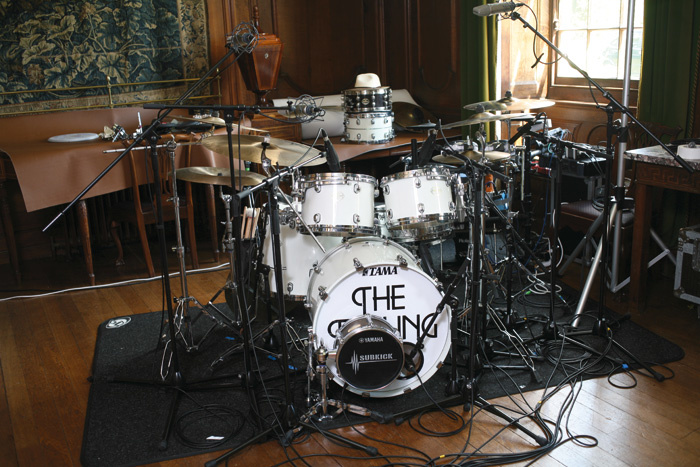 Paul Stewart’s acoustic drum kit is extensively close–miked, with a Yamaha Sub Kick adding extra substance to the kick sound.When it came to miking up the drums, Neumann U87s were used for overheads and for the ride cymbal, while Sennheiser MD421 close mics were deployed on the snare and each of the toms. A Sennheiser e602 was placed just in the hole in the kick’s front head, and was supplemented by a Yamaha Sub Kick. Richard: “We don’t really monitor the Sub Kick while we’re working, but when you give it to the mix engineer they’ve got something at the low end to work with, so we can try to avoid having to use samples.”
Equally crucial to the sound, though, has been Paul’s careful selection of key elements of the kit: “I’ve had this kit for a while now, but I recently managed to pick up a separate Ludwig 400 snare on eBay for £100. It looks like an old heap of crap, but that obviously doesn’t affect the sound, because it’s the best drum I’ve ever had! There are two more snares I’ve got over there, and probably another five outside, and for the first period of recording here I lined them all up and tried then all out on different tunes, but I’ve always ended up coming back to this. It’s brilliant — I’d swear by it! Certain cymbals also just don’t record as well as others, and I find yourself coming back to the same set of hats and the same ride.”
 Stewart’s favourite Ludwig snare, with U87 positioned to capture the ‘beef’.Casting a second glance over the kit, I noticed another Neumann U87 in an unusual position at the side of the snare drum, and asked Paul how it was being used: “We’ve only started doing that since we’ve been in here. It sounds great with that shell, because there’s no nasty ring off it like there would be off a brass shell or anything like that. Whenever you get really close to a drum head you get all sorts of strange frequencies you don’t hear from a distance, so it sounds really odd. The side mic gets a much more overall view, and captures the top and bottom sounds together, but without the real upfront sound.”
“It’s been much more useful having that side mic than even a bottom mic a lot of the time,” adds Richard. “What you get out of it is ‘beef’ — it’s the thing we’ve always been looking for. You get the ‘crack’ from the top mic, fizziness from the bottom mic, and then this side mic seems to find that ‘beef’ area. It’s the side of beef!”
In addition to the close microphones, three other mics were used to capture stereo ambience: a Neumann USM69i stereo mic, and a pair of boundary microphones. These ambient mics were also used for pianos, guitars, and other instruments, but were always recorded to separate tracks to keep the mixing options open.
Recording Guitars & Bass
 A variety of guitars, amps and mic placements contribute to the Feeling’s sound, often layered for extra depth.Although Richard talked of the band using a wide variety of different amp and microphone combinations for electric guitar recording, there were no real general rules he could pass on, because the mic setup was adjusted to suit each different sound. “It’s good to have all the options, but we laugh about the fact that sometimes all we’re using is an SM57 on the 4x12. The mic we’ve got on the Vox AC30 just now is the Sennheiser e606, which gives a good sort of gritty rasp to the amp.”
Despite changing mic setups, a trick to which the band frequently return is layering takes for a meatier sound. “Quite often we’ll do two takes of everything so that we can spread them,” says Richard “even if we’re using three to four mics on each guitar sound. So we’ll do two takes of each guitar sound, to give it a thickness, and even down–tune and do another take.”
For recording his bass, Richard has a tried and trusted approach based on his experiences making the last record: “I’ve got an all–valve Ampeg SVT2 re–issue, which is really warm, and it’s miked with a Sennheiser e602 on the 8x12 cab. I always DI and have another channel with a Tech 21 Sansamp, which is a trick I learnt from Spike Stent, who mixed some of the last album. Our first single was essentially our demo with a couple of extra parts, and he got an awesome bass sound. I said ‘What have you done to the bass? It sounds incredible!’ He just pointed at that box. He apparently uses it for every bass that comes through his studio, so I bought two straight away! I use it live as well now. It’s brilliant! The DI gives you the pure sound of the bass, the amp gives you the bottom end, the air moving, and the Sansamp just gives you some grit — but it’s good grit, not really distorted.”
Three Upright Pianos
Keyboards are of course vital to The Feeling’s sound, so it’s no surprise that the band have been using a lot of them for the latest sessions, not least three different upright pianos. Richard: “The Kawai is the one that we mainly use. It’s brighter, a better recording piano. In tracks where it’s just piano and vocal, the Bechstein gives better tone — it’s more vintage–sounding — but once the band’s in you need a brighter sound. There’s also the honky–tonk in the other room — we spent a couple of hours putting drawing pins into the hammers to get that sound!”
Dan goes into a bit more detail: “Bechstein pianos are great, but this one was knackered, so I had to have the whole lot restored: restrung, new pins, new mechanism. I wanted to have a piano with ivory keys, woody and old–fashioned. It’s a bit out of tune at the moment, which I quite like as well — it’s a textural thing. This piano’s got loads of character to it, it’s warm. You’d never get the same sound out of a modern piano, especially in the mid–range. It’s kind of honky and it reminds me of old records. The way they make modern pianos is just so different.
“But a modern piano is lovely for recording, because it’s bright and dynamic and it cuts through the band, and that’s what the Kawai’s for. This Kawai’s slightly warmer than most of them and it was slightly out of tune when we used it to record all the piano parts on Twelve Stops And Home — it was in my living room at the time. I always pull all the panels off the piano while recording. It just lets the sound get out a bit more.”
When it came to miking the uprights, Dan had a pair of U87s set up about 18 inches from the strings, over the keyboard on either side of his head and pointing at the hammers. “Miking the back of the piano and the underneath of it and all that stuff is a complete waste of time for us. I want to hear the click of the hammers, so I have the mics near my ears, over the keys. Otherwise you just have to EQ the hell out of a piano when you’re recording because it’s not bright enough. You get sniffles and funny little bits of noise from when you’re playing, but I like that. We have all sorts of background noise over the recordings, but you only really notice if you solo them. As long as it’s not car horns, you’re alright. There was quite a lot of traffic noise over the stuff we did for the first album back at Richard’s place. It helps having the room mic as well — if you get it the right distance away you get the brightness of the piano and the room. We normally have it about six foot away.”
Keyboard Playground
Other favourite keyboards include the Roland Juno 106 (Dan: “The best keyboard in the world — all over the last record.”), Wurlitzer, Rhodes, Hohner Clavinet and Moog Voyager. “We use the Moog a lot, and we used it on the first album as well,” recalls Richard. “It’s actually my wife’s, and it’s one of those things that if you have it lying around it just finds itself on tracks because it’s got such cool sounds. It kind of suits the way we’ve always worked. You surround yourselves with instruments, and then you pick up what’s around and it starts to colour the production of the track you’re working on. The more interesting instruments you have, the more they take you in different directions stylistically.”
 Being familiar with the layout of Mackie Onyx desks, the band chose to use one for the album sessions rather than investigate vintage or ultra high–end alternatives.And no other keyboard in The Feeling’s collection was provoking as much interest during my visit as the recently acquired Cordovox CDX–0632, dubbed the ‘Astro Sound’ by the guys on account of its front–panel legending. Richard explains how they came to own it: “When we were on tour in Cleveland there was a shop next to this quite famous venue, and all the bands go there so prices are a little bit higher than they would be, but they’ve got about five floors of stuff. I bought a Gibson Hummingbird acoustic there, which we’ve used on loads of stuff. They had a keyboard room with Wurlis and everything, and the Astro Sound was sitting in the corner. It was $1000, and the guy in the shop said that every band that had gone in there for two years had said ‘That’s amazing!’ and then walked out without buying it. So we got it, and we’ve already used it on about half the songs on the album!
 Pride of place among the band’s many keyboards goes to the vintage Cordovox.“It’s got a very unusual distinct sound to it. The only other person I think has one is Beck’s keyboard player, but he only has the shell, and he’s put a controller inside it to use live. I’ve been looking on eBay for another one as a spare, but I can’t find one — if it breaks we’re screwed! The Repeat function is really cool — it’s a sort of du–du–du–du sound which you can speed up and slow down. The Phase Shifter on it gives a real rotary–speaker feel, because you can really hear it speeding up and slowing down as you switch it on and off. I hope we can find another one of those, because we love it so much. It’s the way you can dynamically change the sound as you’re playing that makes it great.”
Finishing The Job
With most of the rhythm tracks completed at Bradley House, the band plan to head back to London to press on with overdubbing. Although Olympic was used for the last record, they’re planning to go it alone this time. Richard: “We’re looking to get a room in London — we’ve got all this gear, so we could just move it straight in — but it’s quite hard to find actually. We want something treated, ideally with a live room and control room, but with nothing in it. They exist, but they’re normally on leases that producers have.
“We’ll do a lot of stuff at home as well: keyboards and a lot of vocals. Dan particularly enjoys working on his own on his lead vocals, because he can have his own space, and when his voice feels right he can just go. For BVs we just all get together for an afternoon to do them.”
Plans are also already forming for the next stage once tracking is complete. “There’s a couple of mix engineers in the frame at the moment,” says Richard. “When the tracks are at the point where we feel they’re ready to mix we’re going to get them to a couple of guys and hopefully go in with Spike and do something with him. A lot of the time it’s the mix which really shows you whether you’ve got everything you need or not.”
Vocal Recording: Then & Now
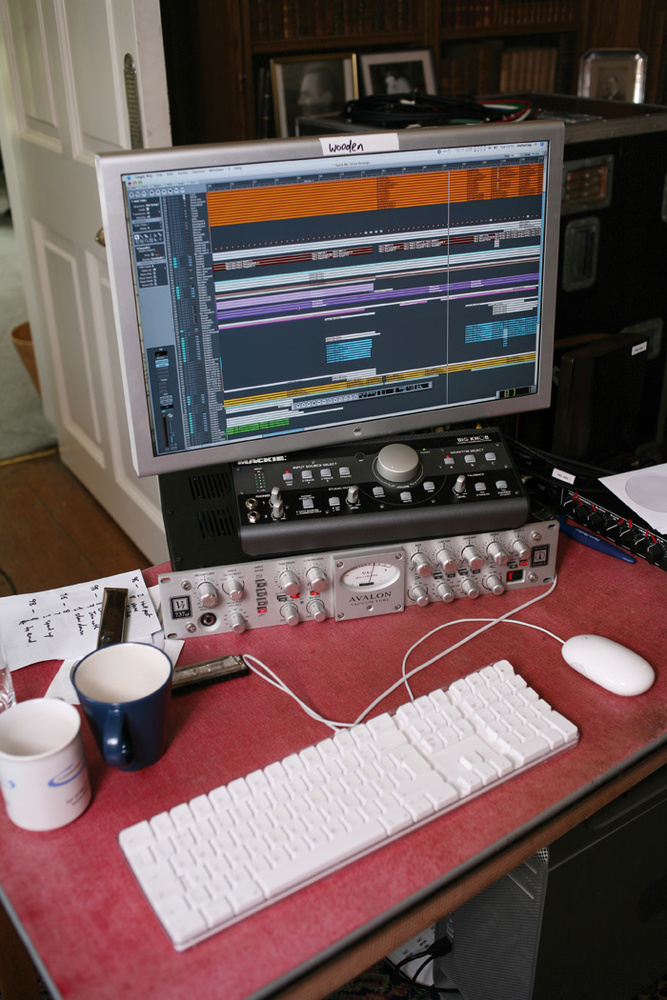 The band are advocates of Avalon preamps for vocals. These feed Digidesign recording hardware, on a Mac running Logic.“The vocal mic we’re now using is a Neumann valve mic, the M149,” Richard reveals. “We used a Neumann TLM103 for the vocals on the last record — Kev, Dan and I have all got one, and we used them previously for drum overheads as well. The TLM103 became part of our vocal sound, and we thought we’d end up using it again, but the M149 is a very rich–sounding mic.
“That goes into the Avalon preamp, which is great. There’s a history with that. I did a tour with a front–of–house guy who swore by Avalon stuff for vocals, back when Avalon weren’t that well known. I heard one of those Neumann handheld vocal mics through one and thought it was brilliant, so I eventually got one for the studio. You get the warmth of the valve, that tiny bit of drive, and you can give it a bit of an EQ on the input — nothing too extreme.”
Logical Songwriters
For the new record, The Feeling invested in the latest rocket–powered Intel Mac and racks of MOTU and Digidesign interfaces, but it’s a far cry from where they started out. Richard reminisces: “I remember the moment when I got Logic on my first computer and I was thinking ‘Wow! This is amazing! I can’t believe I can do all this on a PC with a little 30–quid Soundblaster!’ We used to run ‘built in the shed’ 800MHz PCs — you’d put on three plug–ins and they would crash. The worst thing, though, was when you’d get some random crackle or click on the audio takes for no reason. We never got away from that — it was a curse. You’d do a great take and there’d be clicks on it. Plus most of the first record was done through an M–Audio Delta 1010, which meant that eight inputs was the maximum. We’d have to do one thing and then the next, which made the process much more long–winded.”
Despite the Digidesign hardware, the band are still committed to Apple’s Logic as their sequencer of choice. Richard: “We like the concept of working in Pro Tools, but we’ve spent so long in Logic that we don’t want to be slowed down by changing software. What we find with Logic is that it’s very easy to be creative with the effects and software instruments. It’s really quick. The Tape Delay plug–in in Logic is also incredible. I’ve played with the plug–ins in Pro Tools, and they’re not as easy to get the sound you want. I think that would hold us back creatively.”