

A fearless maverick who swears by the need to generate tension in the studio, Youth has made a name as one of the most creative producers to emerge from Britain in the last two decades.
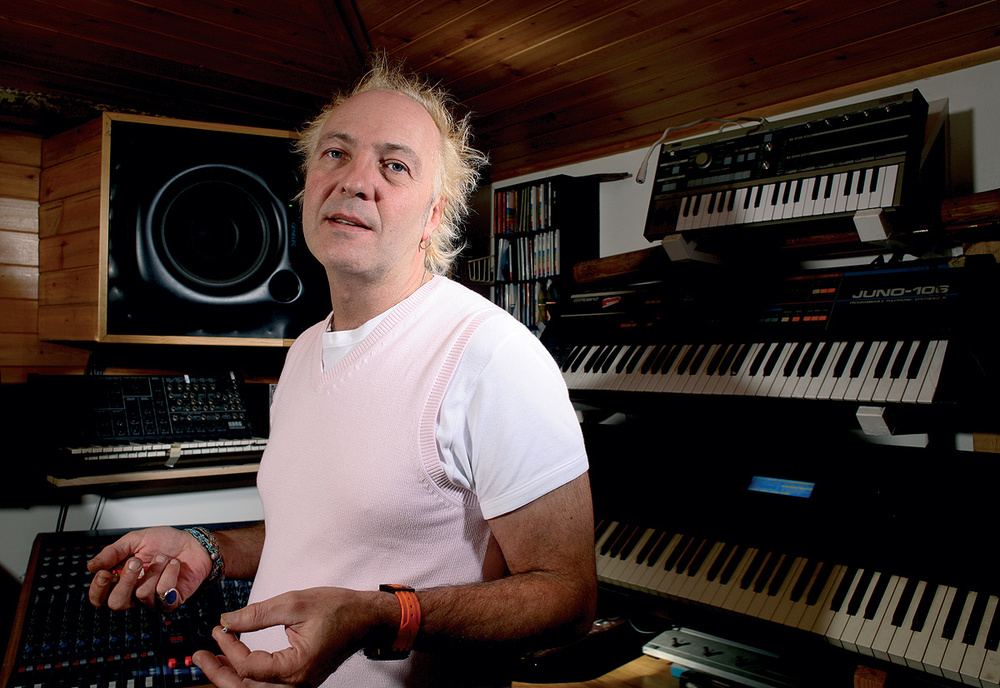 Photo: Richard Ecclestone
With a production career spanning 20 years and a CV that veers stylistically from Primal Scream, Crowded House, the Futureheads and the Verve to ambient dance work with the Orb and experimental collaborations with Paul McCartney as the Fireman, Youth is clearly nothing if not versatile. Resolutely unorthodox in his methods (more of which later), the 48‑year‑old born Martin Glover has earned himself a reputation as less a nuts‑and‑bolts engineering producer and more some kind of recording guru and studio vibesmaster.
"I can engineer and I do engineer a bit,” he insists, "but I like to think the role of the producer is really to think of the art of the piece primarily. But a lot of artists actually don't understand what a producer does — even when he's considering the arrangement or direction or whatever — unless he's knob‑twiddling.”
Given his history of diverse productions, it's no surprise to learn that, even two decades in, Youth doesn't employ one specific modus operandi when approaching an album. "The technique employed on any given day depends on the circumstances of that given project and context,” he says. "Music is always contextual, I think.”
Joking Aside
 Youth's main studio is in Spain, but he also has a project studio at his home in London. Both use Logic software as the primary recording tool.
Launching his musical career in 1979 as bassist with brooding post‑punk band Killing Joke, Youth left the group three years later at the age of 22, in his desire to explore other musical avenues. Nevertheless, the group clearly remains his first love, since he rejoined them in 2002. "They were sort of my university education when I was a kid,” he reasons. "As a musician I had to work a lot harder to get up to their steam. But then I think in terms of ideas and concept and arrangement, they maybe had to work a little harder to get up to my pace.”
Youth's fascination with the recording studio can be traced back further, to the all‑night dub mix sessions he would indulge in with his first, John Lydon‑produced band The 4 Be 2s. Still, it was his work on the first two, self‑made Killing Joke albums that made him realise that production might offer a career path. "I'd had more experience than the rest of the band, so I felt very naturally comfortable in the studio. I'd always been really fascinated with the production process.”
More interested in the methodology behind the creation of great records than developing a trademark sound, Youth is more than anything, he reckons, a catalyst in the studio. "I like to think my production is fairly invisible,” he states. "I don't think of myself as having a particular sound. When I do the Futureheads or Tom Jones or whoever, it's not gonna sound like Crowded House.”
Brilliant Pop
 Right: TL Audio's VTC valve desks are integral to both of Youth's studios.
The greatest single influence in Youth's early production career is perhaps a surprising one. Having in 1986 formed pop trio Brilliant along with future KLF member Jimmy Cauty and singer June Montana, he found himself in the studio with Stock, Aitken and Waterman, prior to the production team's late‑'80s chart ubiquity. "I really learned from Pete Waterman's fearless ability to just go straight to the heart of what he wanted to get,” Youth recalls. "They just had a Linn Drum, Mirage samplers and the Eventide Harmonizer. They hadn't become the pop legends they became. But we really liked them from Dead Or Alive's 'You Spin Me Round' and we wanted to get a New York Hi‑NRG disco sound.
"Pete would come in with an armful of New York import 12‑inch dance records and go, 'That's your bass line, that's your beat.' Then he'd play a Cyndi Lauper record and say, 'Take those chords,' and pick another song and say, 'Write a lyric like that'. This would be at half‑10 in the morning, and Stock and Aitken would start working it up. They'd do it in a day — we'd get the song voiced in the evening and at 10 o'clock Phil Harding would come in and mix through the night. We'd come in at 10 the next day and have a finished record. We thought, 'Wow, that is radical.' We were really inspired by their process. We suddenly realised this was the future of production and dance music.”
While Brilliant floundered commercially before splitting, Youth and Cauty used their experiences with SAW to begin experimenting with sample collages, which ultimately led to the former splintering off to form first the Jamms and then the KLF with Bill Drummond, while Youth began working with Alex Paterson on the project that would become the Orb. "To be honest, that experience with Stock, Aitken, Waterman totally shaped my next 20 years,” he stresses. "Initially me and Jimmy thought, 'Well, rather than copying, why don't we just sample the record?'”
It was this late‑'80s schooling in the more affordable sequencing and sampling options provided by Atari computers and Akai samplers that informed much of Youth's early productions. "I'd spent most of my '20s really wanting to be in the studio and making records,” he remembers. "But studios were so expensive and home recording was still pretty 'urgh'. I just didn't get those opportunities until the '80s, when samplers came out.”
Man In A Shed
 The London project studio houses a few of the vintage synths that Youth has collected over the years, including a Korg MS20.
These days Youth's studio in his garden shed at his home in Wandsworth — distinct from his main and far bigger recording facility Space Mountain in Andalusia — is centred around a Mac running Logic. "It's a bit of a Tardis,” he says. "But I've actually done drums and band masters in here. I've made a lot of acoustic records here, but I often just use it for pre‑ and post‑production. Sometimes if I'm just working with a singer, we'll do arrangements in here before we go into a rehearsal situation with a full band.
"But yeah, I'm a Logic‑head. Sometimes I use Logic with Pro Tools hardware, but they're so incompatible. It's very frustrating because it crashes all the time. I've started working with just Logic, because I think it's up to steam with Pro Tools almost. The quality's really high and it's a lot faster. I'm using Logic 8 on my Powerbook laptop for writing. I haven't used it yet on my main production rig, where I'm still using Logic 7.”
The other main features of both of Youth's studios are his TL Audio desks — the 12‑channel M1 for London and the 32‑channel VTC in Spain. "I just think they're like having a brand new vintage Neve or something, but they actually sound better, in a lot of ways. They've got a bit more crispness and clarity to them and they still have the really warm tones as well.”
Elsewhere, the producer claims to have an 'anything goes' approach to equipment. "I'm certainly not a snob with technology,” he says. "I'm very happy to use a Tandy £15 crap mic on a guitar as well as a £2000 Neumann. That applies to instruments as well. I've got a fairly extensive collection of crap guitars and amps that sound awesome. I have a bit of a schizophrenic relationship with gear. I've worked with [engineer] Clive Goddard for the last eight or nine years fairly consistently. He surprises me sometimes and pulls up a weird mic, but we tend to use fairly classic, standard things. Technically, it would be Neumanns, 57s, 56s. We do experiment with drum sounds and mic placement and try and recreate sounds from early '60s records or whatever. Clive has an amazing ability where I can play him a track and go, 'Gimme that drum sound' and he'll get it very quickly.”
Conflict Is Good
 Rack gear includes a Studio Electronics MIDIMini Minimoog clone.
Having gained experience and success as a pop producer with the likes of Yazz and Blue Pearl, in 1993 Youth enjoyed what he still regards as his big break when Crowded House chose him to produce Together Alone, the follow‑up to their hugely successful Woodface. He acknowledges that the band were backing a relative unknown. "They were already very established and had come off a huge album with Mitchell Froom,” he recalls. "I mean, they had the pick of every top producer in the world. So it was an amazing break that they chose me. I think they were looking for a challenge. There was one point in the album where it was getting a little fraught and I asked Neil [Finn], 'Why did you choose me?' And he looked me straight in the eye and said, 'Well when we had that initial meeting, I was going through your vinyl album collection and I was really impressed.' I can totally understand that — how that can make it all make sense and it have absolutely nothing to do with whether I can knob‑twiddle or whatever.”
For the Together Alone tracking sessions, Youth and Crowded House built a makeshift studio in a rented house in the starkly dramatic location of Kare Kare beach in New Zealand. "They found a great location and we hired in a vintage Neve and set up a very, very creative environment. I was exploring some fairly radical ideas of how to approach creativity in different ways, using different headsets and psychologies to bond the group. I made some major breakthroughs on that album. I learnt a lot from them as well. They were very patient with me and I was very naïve in working with artists on a diplomatic level.”
So is it true that as part of his bonding psychologies, he at one point encouraged the band to record naked? "I did, yeah,” he laughs. "To their eternal credit and respect, they fearlessly took up that challenge without blinking. We were recording 'Locked Out'. But unfortunately Neil was playing a Telecaster which had those tiny springs on the back. He went for this big power chord and ripped half his pubes out and ended up collapsing on the floor in total agony.
"My theory is that making records has to be a heroic and fearless cavalry charge into the unknown,” he adds. "If that means taking your clothes off, then that's what it'll be. It's really giving the band confidence to go beyond their normal parameters of expectation. And also getting them out of their comfort zone and out of their familiarity of routine.”
On an even more extreme level, Youth admits to being a firm believer in creating conflict in the studio. "Every album, there's gotta be some conflict and turbulence,” he reasons. "If there isn't any, I'll create it, because I think great work has to have a certain intensity to it.”
How will he create conflict then? "Well, if people get a bit too laissez faire or arrogant in their confidence, or too lazy or laid‑back, I'll do what I think's appropriate…”
You wind them up, basically? "Well, I won't do that just flippantly,” he laughs. "I like to think I've got a bit of tact and diplomacy, and I'll always try to end the session on a very good note. But I'm there to challenge the artist. I don't think you get the best out of an artist by being nice to them. I'm not there to be their friend. And that's out of respect for them. I'm there to give them the best creative feedback I can to make the best record they can make. And that's challenging, so I have to be challenging. I'm not, y'know, a vanity producer where I'm just gonna schmooze my way through and get the cheque at the end of it.”
Additional conflict was certainly not required on Youth's next big project, the Verve's 1997 smash Urban Hymns — the recording of which effectively killed the relationship between singer Richard Ashcroft and guitarist Nick McCabe, before their still‑fragile comeback in 2007. "Yeah, there was a lot of conflict and tension there,” Youth admits. "But it's an interesting comparable album. I've had many people say they can hear Together Alone in Urban Hymns and vice versa. They do follow similar arrangements.”
Olympic Feats
 Another classic synth: the Roland Juno 106.
Youth's chief discovery during the Urban Hymns sessions was Studio Two at Olympic, still his favourite commercial facility [and, sadly, rumoured to be closing soon — Ed]. "I love Studio Two, to the point where I kind of copied it for my studio in Spain, which is about a third smaller. The size of Studio Two is good and it's got a high and low ceiling. It's a good shape and the tone of the room is sweet. The control room is quite big — SSL [4000G] and big Genelecs, which started my love of them. I've got the same [10]35s in Spain and these weird oval‑shaped ones at home that they no longer make. What I love about Genelecs is they sound like the ultimate home hi‑fi, they don't hurt your ears like Ureis or Lockwoods can. They're very soft on your ears, but they also have really lush clarity. You can really hear everything, and at loud volume as well.”
In terms of mixing, Youth reckons the sheer man‑hours he clocked up in the '90s doing additional production mixes and remixes — for everyone from PM Dawn to Edwyn Collins to U2 — gave him a crash course in making records while under the pressure of a deadline. "I would often replace things,” he says. "Put extra guitars and basses and things on myself. But I would do it so that it would be subtle. Often the bands wouldn't notice. I think a lot of the thing with music is pilot hours. It's having a lot of experience to go through all your mistakes and know not to go up those cul‑de‑sacs and fall in those elephant traps. Mixing gave me 25 years' worth of recording experience in two years, with the amount of work I could get through.”
On the other hand, the producer claims to have no problem with the mixing of a record being farmed out, as was the case with both Together Alone and Urban Hymns. "Together Alone was mixed by Bob Clearmountain, but I was there with him when he was mixing. He never spent more than five hours on a mix. He's a genius. Bob would often start with the vocal and do the drums last, and I'd never seen that before. He would distil it down to its component parts — bass, middle, treble, rhythm, melody — and make it work. He'd also reinvent a track with maybe very minimal arrangement and overdubs and balance it in a way that I'd never considered or heard of before. And that would blow me away.
"Chris Potter, on the other hand, who mixed Urban Hymns, he's a very diligent engineer. He'd come from a more traditional angle and very much follow the artist and the production lead. There weren't so many reinterpreted surprises, but he had an amazing ability to take a lot of instruments — there were a lot more overdubs — and give them clarity and space. Epic without being bombastic, that's the hard thing to achieve. You have to have a lot of restraint.”
In Every Dream Home A Studio
These days Youth is in the enviable position of dividing his time between Britain and Spain, where in recent years he's recorded albums with the Futureheads, Primal Scream and Embrace at his Space Mountain studio, the construction of which came at the end of a period of career‑centred soul‑searching. "About 10 years ago I'd just started to have a family,” he explains, "and I couldn't really look forward to another 20 years of being in Olympic's basement. Even though it's my favourite studio, it's a dark, air‑conditioned electronic basement. And spending a lot of time in that kind of environment isn't good for you and it wasn't helping my art.
"So I thought the only way around it was to build a studio and do it somewhere really beautiful and have floor‑to‑ceiling glass windows with amazing views and clean air, and so that's what I did. I found this land in Andalusia overlooking the Sierra Nevada mountain range and designed and built my own ideal home and studio.”
In working with bands these days, Youth clearly still sees his role as being the producer with his eye on the bigger artistic picture, getting into rehearsal rooms with groups and often deconstructing their songs. Not surprisingly, he frequently meets resistance to some of his ideas. "Often it's the shock of the new that stops them digging it at first,” he reckons. "But if they don't like the suggestions, I'm not too precious. I hold bands in a certain sacred light and I encourage them as much as I can to do everything themselves. I don't really want to interfere with that. I don't care who's right, so long as we get it right.”
If there is one recurring them in his various approaches to recording, it is that speed is of the essence. "These days the technology allows us to work really quick or incredibly slowly, depending on where you wanna go with it. But I do find the muses respond best to swift feet.
"I sometimes think people misunderstand me being prolific and working with a lot of artists as being a bit of a slut,” he admits, laughing. "But my intention really is to get as good as I can to make the best records I can.”
Fighting Fire With Fireman

In the same year that he worked with Crowded House, Youth received a phone call from Paul McCartney, inviting him down to his private Hog Hill Studio at his home in Sussex. The former Beatle was, at the time, looking for remixers to rework tracks from his 1993 album Off The Ground. It would lead to the pair's ambient dance collaboration album, Strawberries Oceans Ships Forest, their first release under the name the Fireman.
"He'd read an interview I did and rang me up,” Youth remembers. "He said, 'How would you feel about going through my multitracks and sampling whatever you like and doing a mix out of it?' So I thought, fantastic. But I said, 'It'd be good for you to play some other things on this.' I couldn't resist getting him to play the Beatles' harpsichord or Mellotron. I got him to jam so much on it, we ended up using very few samples of the album in the end. And I ended up spending a few nights down there 'til four in the morning, doing really esoteric ambient mixes of some of the jams.
"One night him and Linda came back from a party and ended up staying up all night just listening to me doing these mixes. I planned to edit bits of these mixes together into one mix, because that's how we did the Orb stuff. We'd do a lot of mixes, radically different ideas, and then edit them together. Initially on tape, but eventually I got Sound Tools, the precursor to Pro Tools, the stereo one. We'd be putting mixes onto DAT and then go straight into Sound Tools and I'd spend two days editing them down into one epic mix. But then Paul came back and said 'We love these mixes so much I wanna put them all out as an album.' I was like, 'Who am I to disagree with this man?'”
In 1998, the pair took the idea further with the second more, dreamlike and hypnotic Fireman album, Rushes, for which Youth further encouraged McCartney to jam as he built up loops of his performances. "I was still just getting to know Paul, and I thought if I pushed him to write songs, we'd be in a situation of pressure and stress for him — which is one of the reasons he liked doing the Fireman, there wasn't any pressure or record‑company expectation. He could just really let go and have fun.”
"Fireman is very liberating,” McCartney told this writer during sessions for the pair's third and recently released album, Electric Arguments. "Youth is a great head. I used to say to him, 'This is exactly the opposite of how I normally am in the studio.' Normally I'm trying to figure out to sing the song and how to actually play the guitar part. But all we were doing was just throwing stuff at the tape, throwing stuff, throwing stuff. And he would just go, 'Yeah, I like that,' bang, and he'd pick a bit out and he'd loop it up. Just making his cake, gathering ingredients as we went along.”
Sessions for Electric Arguments again took place at Hog Hill. "It's amazing,” Youth says. "He's got a copy of Ringo's drum kit and loads of Beatles kit that he dug out of skips when Abbey Road were throwing them away in the early '70s. He's got a beautiful Neve and an incredible collection of microphones. He's got his Pro Tools rig, but I would take my Logic rig. It's a very lovely‑sounding room and he's very comfortable there.”
Electric Arguments takes the project one step further, being a more traditional vocal‑based, if no less atmospheric offering, reminiscent in some ways of McCartney's playful post‑Beatles albums McCartney (1970) and Ram (1971). "On this one I was determined that we would go further with it without it being a task for him,” Youth explains. "So I'd go in a few hours earlier and prepare some completely different loops. They were very specific directions — one might be delta blues, one might be English folk, one might be Irish, one might be more electronic. Then he'd come in and we'd find out which one he felt he resonated with most that day and then I'd say, 'Grab an acoustic and pick out the chords and change them if you want, and let's start jamming to this loop.' So we'd do a couple of overdubs and then get the bass and really I'd just keep him rolling.
"I'd bring down all these poetry books or play him some really old traditional folk music and say, 'Listen to this story and see if you can write some words.' Or I'd go, 'Take these poems and just pick out five words on that page and write a line out of those. (Laughs) And you've got 10 minutes!' And he did it! I'd arrange the music while he was getting the lyric and he'd throw down a few vocals and then he'd say, 'OK I've got to go home and cook Bea some tea.'
"Then I'd really radically arrange the vocal tracks, rearrange some of the words and double some up from different sections to create little backing vocals. So the next day, first thing, I'd go, 'OK we just need a couple of backing vocals on this and we're done'. And he'd hear it and go, 'Wow, fantastic.' Then we'd mix it, often the same day. We literally spent 13 days and we recorded 16 tracks. He's so incredibly fearless, maybe because he had the trust in me by then. But he was still making disclaimers, especially with vocals.”
For his part, during the sessions McCartney candidly admitted to finding this breathlessly spontaneous approach to recording thrilling, if a bit frightening at times. "It literally has been me walking in the studio and just saying to the engineers, 'Look, this could be really humiliating, 'cause I haven't got the slightest clue of what I'm about to do. So not too much laughing behind the desk! If you're gonna laugh, duck out of sight, 'cause I'm really gonna lay it on the line here.' But that's a natural thing for me to do. It's just a stretch, and if I get the opportunity to do something like that, I'll do it.”