

Following their unlikely breakthrough into the mainstream, Flaming Lips made a conscious return to the outer limits with their recent album Embryonic. Dave Fridmann manned the controls.
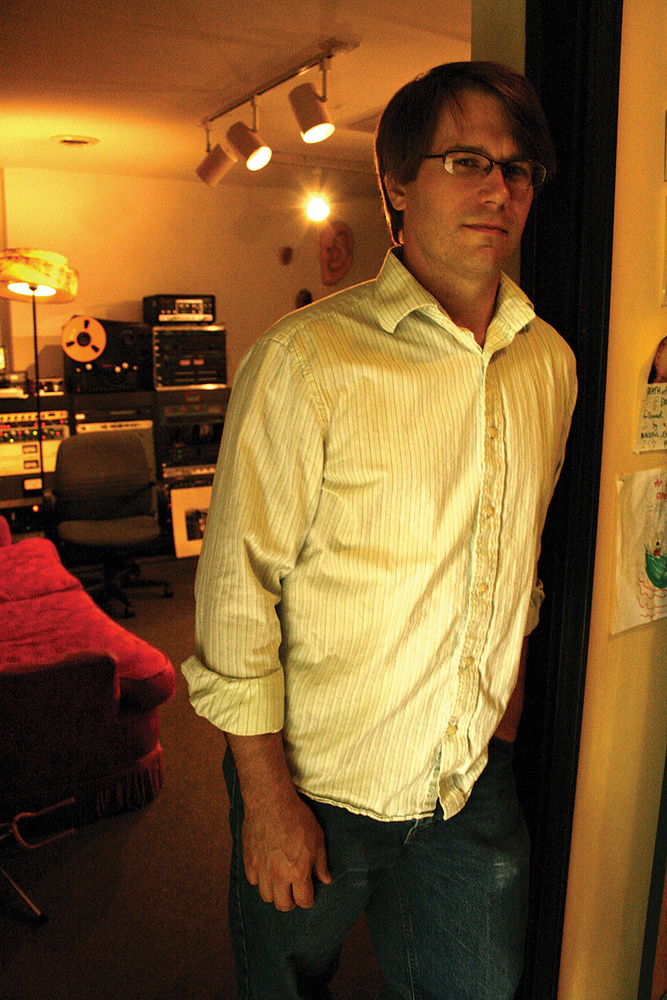 Dave Fridmann at Tarbox Road Studio.
The fact that his favourite word is "weird” perhaps tells you everything you need to know about the music Dave Fridmann produces. For the past two decades, the upstate New York‑based producer has been responsible for some of the most influential, genre‑blurring, sonically innovative — not to mention, frequently, weird — alternative rock music on the planet. His current roster of clients includes his former band Mercury Rev (which he quit in 1993 to concentrate on his recording career), alongside MGMT, Sparklehorse, Low, Mogwai and, perhaps most famously, the Flaming Lips, in an association stretching back 20 years.
Fridmann's penchant for the strange certainly served him well in the making of the Flaming Lips' 12th studio album, Embryonic. A double album freak-out that favours murky, hypnotic jams over obvious melody, while remaining as gripping and groundbreaking as ever, it serves as a reminder that the band were once purveyors of acid‑fried head music as opposed to spectral pop.
Right from the beginning, says Fridmann, the Flaming Lips conceived Embryonic as a double album. Together, the band and their producer began looking back at the classic double albums of the past. "Everything from Led Zeppelin [Physical Graffiti] to the Beatles to Frampton Comes Alive,” Fridmann laughs. "It runs the gamut… all the things we looked at and all the different possibilities that existed. We looked at all these other double records and it was like, 'Y'know, well I don't always listen to that track, but I'm glad it's on there.”
The producer says it was always the plan for the Flaming Lips to take an extreme, wholly experimental change in direction, even if it might prove to be a less commercial one. "Since we made the last one, we've been talking about this one,” he explains. "So we've known for quite a while we were heading toward some other new, weird area. It gave us the opportunity to just sort of expand and know that we weren't gonna worry about making these songs sound like something you could hear on the radio.”
Unsurprisingly, then, Embryonic found Fridmann and the Flaming Lips employing a variety of radical recording methods to achieve their slightly warped aims. Above all was their initial decision to edit down sections of extended freeform jams to form the foundations of the tracks, as opposed to their previous modus operandi of working up Pro Tools demos of songs brought in by the band. "In the past, we'd always build it up from some pre‑existing thing,” Fridmann says. "We always left room for the unknown in the other records. But the foundation of this one was the unknown right from the get‑go.”
In Embyro
 The Flaming Lips lay down a take at Tarbox road. From left: Kliph Scurlock, Michael Ivins, Steven Drozd and Wayne Coyne, here using a conventional close mic for scratch vocals.
Preliminary sessions for Embryonic began in summer 2008 in Oklahoma City, where the band's former drummer‑turned‑multi‑instrumentalist Steven Drozd began indulging in loose jam sessions with singer Wayne Coyne in the empty house that the former was at the time unsuccessfully attempting to sell. Free to make as much noise as they wanted, Drozd and Coyne cranked up the volume, the former crashing away on drums while the latter played simple, repetitive bass riffs. Drozd captured the jams in Pro Tools, cutting out a 30‑second snatch from one and bringing it to Fridmann, resulting in Embryonic's motorik opening track 'Convinced Of The Hex'. The artistic intent was to — as Wayne Coyne put it — meld "low‑fi distortion jams with hi‑fi computer overdubs”.
But Fridmann laughs when recalling how the original snippet from the jam actually sounded. Drozd, he says, used only one mic — his Shure KSM44 through a Universal Audio 6176 direct into Pro Tools — and the result was almost ludicrously distorted. "You can't even imagine how ridiculous this thing sounded,” he says. "It was literally one mic sitting in between a double stack of bass amps, some keyboard PA and a drum kit, all going at full blast. This is the foundation for the song, this totally distorted crazy thing. We were all sort of staring around, thinking, 'Can we turn this into something?' And once we've turned this into something… is this what we're really gonna do? But we liked it, so we said, 'Fuck it, let's do it.'”
Over the ensuing months, similar edits of increasingly elaborate jams — now featuring bassist Michael Ivins and new Lips drummer Kliph Scurlock — were worked on, though by this time Fridmann had developed a way to process this purposely raw material. Thrown such a demanding challenge by the band, he clearly relished the task. "I'd do everything I had to do,” he laughs. "Typically, if you looked at the board you'd see — even though there's only one track — four or five different returns into the console we'd multi‑signalled. It'd be, 'This one's kick drum, this one's snare, this one's bass, this one's vocal.' Really, I would just be isolating and EQ'ing and compressing different sections of the sound so that we had some semblance of control to bring out the elements we wanted to when we wanted to. If somebody said, 'I wish there was more kick drum,' instead of having to change everything, you could move over to that fader and be like, 'Well, alright, we're calling that one the kick drum, we can turn that one up.'”
From these jams, Fridmann and the band built dreamlike noise-rock instrumental 'Aquarius Sabotage', the spacey blues of 'Your Bats' and harp‑enhanced freeform wig‑out 'Scorpio Sword', the latter featuring Ivins on bass, Scurlock on drums, Drozd on wah‑wah Rhodes and Coyne on echoing 12‑string guitar.
"There was a bunch of different songs,” Fridmann recalls. "We would mix and match a lot. It'd be like, 'We've only got 30 seconds of this piece and two minutes of this other thing. Let's see if we can slam those together and figure out some way to connect them.' It was a strange, expansive sort of project like that.”
 Steven Drozd adjusts settings on the band's ARP 2600 synth.Highlighting the perhaps wilfully perverse artistic statement the Flaming Lips were now determined to make with Embryonic, at this stage all of the band's more traditional song‑based ideas for the album were scrapped. "When they first came in,” the producer says, "we'd sort of conceived of it as a bunch of normal songs that people would identify as songs. Then we were gonna have all these weird, alternate pieces that we get to do because it's a double record. Well, we took those 'song' songs and threw them all out. Because we were just like, 'These just seem boring in comparison.' It was like, 'This one's just piano and vocals, get rid of it.'”
If there is a trademark Dave Fridmann sound, it is surely his crunchy, overdriven drum sound. The producer turns coy when it's mentioned. "I appreciate that people credit me with things that they like,” he reasons. "But the truth is if Steely Dan came here and we ended up working together, it probably wouldn't sound that way. I have things that I do like more or less. But it's always dictated by the band.”
Still, hasn't that characteristic drum sound appeared on many Fridmann productions, for such disparate artists as MGMT and the Delgados? "Well, again, these bands specifically come to me and say, 'Hey, we like that sound, can you do that thing?' And I'm like, 'Yeah I know how to do that.'”
Distortion, in many ways, is the main colour on Fridmann's sonic palette. "Some of it is done in the console,” he explains. "But most of the pieces of gear that I have here at the studio all have some special, strange distortion when you use them wrong, like I have a tendency to do. Every piece of gear I have, no matter how nice and pristine it can be, I've figured out how to fuck it up.”
One of Fridmann's favourite tools for distorting sounds is an old pair of Ashly stereo 31‑band EQs. "The Flaming Lips bought them 15 years ago. When we first got them, they were cheap and we needed extra gear. I put something in them and said, 'Urgh, it just comes back distorted, no matter what I do.' And then at some point I realised, 'Hey, it comes back distorted, no matter what I do!' So I would just crank that thing up all the way, put all 31 bands up at +15dB and let it rip.”
Cat Power
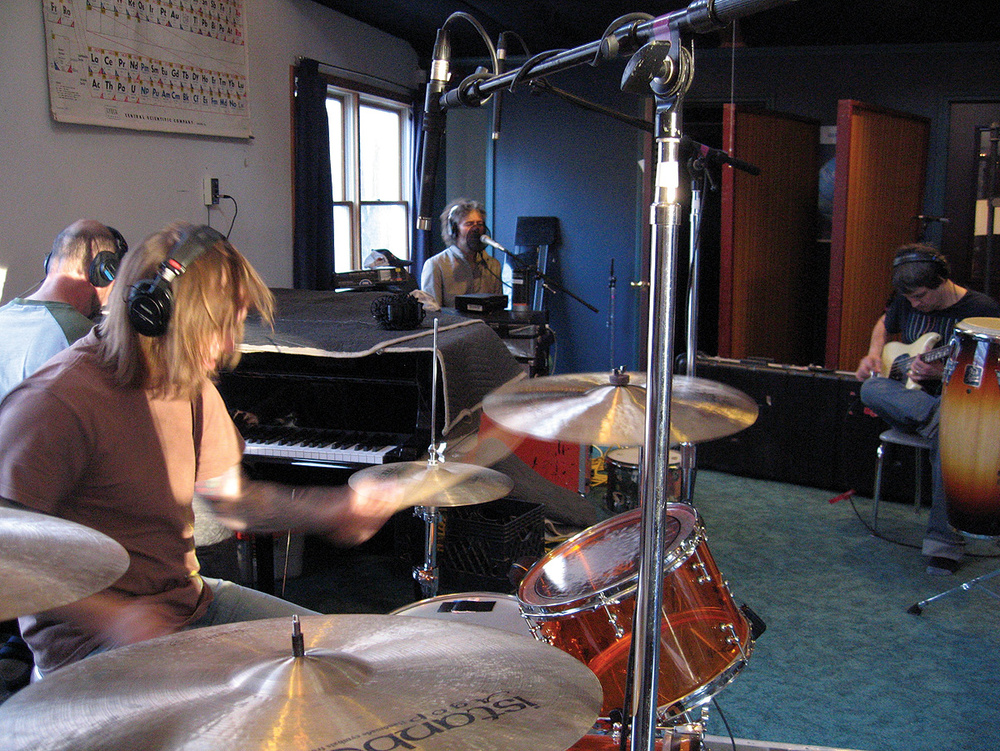 Minimal miking was often the order of the day for the Embryonic sessions. Here, Kliph Scurlock's kit is miked with just a pair of DPA 4006TLs.
It's exactly this kind of freewheeling invention that has led to Fridmann's idiosyncratic production sound. Choice new toys used in the making of Embryonic included the Korg Kaoss Pad Mini ("Fantastic”), the Suzuki Omnichord and, most indelibly, the rather rare Roland AG5 Funny Cat Harmonic Mover and Soft Distortion Sustainer, first produced by the company in 1973.
"That thing got used on every song on Embryonic,” the producer recalls. "Because if we started with a guitar track through the Funny Cat, compared to that, everything sounded clean unless you destroyed it. This thing is so filthy and crunchy and horrible — in a good way — that you had to run something else through six distortion boxes just to keep up.”
In fact, it was matching the levels of distortion captured on the initial jam loops that proved to be one of the biggest challenges for Fridmann. "The choice these guys have made is, 'Here's the beginning of the song and it's already the most incredibly distorted thing you've ever heard.' Just even to get in the ballpark, nothing else sounds right. A clean sound doesn't sound right next to that, so you have to crunch everything up along the way.”
The team's approach to recording Wayne Coyne's vocals was similarly unorthodox, resulting in a Motorola cab controller‑styled radio microphone being used for most of the takes. "We decided to record the vocals very distantly,” Fridmann explains. "We got that mic years ago and my tech also modified it, like he does everything. He built a compressor and pre‑amplifier into it. I don't know how he did it. All I know is I plug it in and it sounds crazy, so I love it.
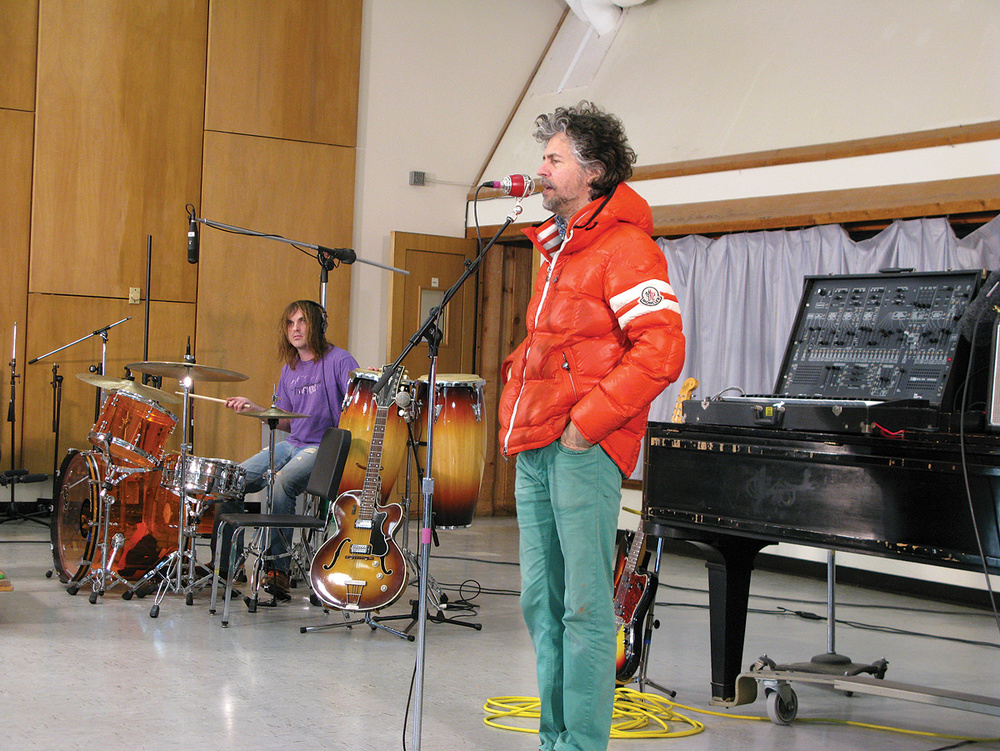 To publicise the album, the band set up for this photo and video shoot at SUNY Fredonia, where several earlier Lips albums had been recorded. "Wayne was usually about 15 feet away from the microphone and facing the other way. When we started recording, I had it behind him in the room and we thought, 'Let's see what it sounds like in conjunction with the real microphone.' Then after a while we just ditched the real microphone entirely. I had one set up so he had a target to sing into, but it wasn't plugged into anything.”
Fridmann also stresses that everyone was keen not to overcook the vocal performances, in the name of freshness and spontaneity. "At best we'd do three takes,” he states. "I mean, really almost all the vocals you're hearing on this record are one or two takes complete. We tried to take an attitude. Wayne has spoken about Miles Davis and the captured performances and how, hopefully, they just got lucky. They were great performers, but part of what's magic about their performances is that there are mistakes or an extra breath. We were just like, 'Let's live by this. If we like it right now, then we're not gonna make a safety take.'”
Additionally, Fridmann and the Flaming Lips freed themselves from the constraints of cutting the performances to tempo grids. "That was a big departure again,” the producer points out. "We made a conscious decision, like, 'We're not doing that this time, we're gonna forge ahead and make the machines conform to us.' It was more of an aesthetic decision than anything else. These guys obviously have all the time in the world that they'd ever want, but we wanted to do something that inherently sounded different.”
Likewise, virtually no MIDI was used in the making of Embryonic. "On occasion we would record parts that we were using as samples, but we'd record the MIDI and do that live. There's some MIDI used but it's really just a recording of a performance as opposed to sequencing.”
Among the synths used on the album are an ARP 2600, a Yamaha CS60 and — delivered to Tarbox Road only weeks before the record's completion — the new Korg Microsampler. Needless to say, perhaps, all were treated and manipulated in various ways. "Of course,” Fridmann laughs. "You hear a sound and you're like, 'That's a great sound — can we get it a little better? Yeah, guess we're gonna have to do something weird to it…'”
 Despite the experimental flavour of the sessions and the dense nature of the music, Fridmann says he and the band didn't indulge in the process of heavy layering and stripping back — as they have in the past — to create the results. "We did that very much less on this record. And again, it was a scary aesthetic decision to say, 'Well, let's just get one or two of the right sounds' — and obviously they're big weird sounds that take up a lot of space — and not cover them up with all these tiny other details and layering and all that stuff. Let's just let this thing hang out there and say, 'Yeah we know it's weird, we know it's exposed, we know it's not making layers like music is supposed to be now.'”
Embryonic is, however, filled with sonic motifs, such as the swirling harp figures and otherworldly 'ching!' sounds that recur throughout the tracks. "We wanted to try and make enough of the sounds cohesive from song to song,” says Fridmann, "so that it could be conceived as a whole bigger thing. So we definitely tried to purposely re-use — re‑use that Rhodes sound, reuse that Funny Cat sound. Steven had gone and made that weird 'ching' sound on his computer for something entirely different and so we brought that in. He stacked up a bunch of different single guitar notes and we could turn it to any chord we wanted to.”
The Frog Chorus
 The modified Motorola radio mic that was used for the bulk of Wayne Coyne's vocals.
From here, the making of Embryonic stumbled into a series of happy accidents. The Fender Rhodes part for the delicate, Steven Drozd‑sung 'I'f, for example, was captured when he placed a Tascam DR1 digital recorder on top of the keyboard to roughly record an idea. "He overdubbed the vocal on top of that,” says Fridmann, "but the actual performance of the Rhodes is a complete performance, warts and all.”
Then the team encouraged the Yeah Yeah Yeahs' Karen O to quite literally phone in her vocal contributions to anthemic album closer 'Watching The Planets'. "We had done a couple of takes with her over the phone for 'Watching The Planets',” the producer remembers. "But then in addition to that, Wayne says, 'What you did is awesome, thank you, but you also do all those weird noises, that freaky stuff, what about trying some of that?' So we did some of that and then we just turned it into a whole other song.”
The resulting track was the playful duet 'I Can Be A Frog', in which Coyne lists the names of various animals and Karen O makes the corresponding noises. "We'd been going through all these weird sounds and then Wayne was like, 'Hold on a minute, I've got an idea.' Ten minutes later we've got a new song. He actually wrote the lyrics listening to the sounds. We're like, 'What does that thing sound like? It sounds like a guillemonster.'”
Mixing? So Passé
When it came to mixing the 18 tracks that make up Embryonic, Fridmann and the Flaming Lips neatly negotiated what one might imagine to be a hugely daunting task by signing off on each song mix‑wise as soon as tracking was complete. "We've been doing that for a long time now. You sort of accumulate,” Fridmann explains. "And actually the mix of, say, 'Convinced Of The Hex' dictated how we were gonna even start the next song. We already knew what our end result was going to be. And we really never actually changed that mix. We did it in the first three days that we were working up here when we officially started the record, and never went back.
"So already you've got that landmark in place. Like, 'That's our gold standard here.' Now we're gonna do some things that are brighter, some things that are darker, some things that are more fucked up, some things that are less fucked up, but here's our gold standard. It's a lot easier. It's a luxury you rarely have, but it's a way that we've been working for the last several records with the Lips and it's very productive.”
Along with distortion, variously lush or lo‑fi reverb is the other key characteristic of the sound of Embryonic. For this, Fridmann favours his EMT 240 'gold' plate, his AKG BX20 spring reverb, the Lexicon 200 and even the Alesis Midiverb II. "There's a couple of presets on there that I love,” he says of the latter. "They crunch up in this really nice way.”
In the past, Fridmann has experimented with different ways of mastering — even printing to 35mm film — but these days he admits his experiments only go as far as flipping between his Lavry AD122 and Prism Sound ADA8XR converters. "I go back and forth,” he says. 'Whatever one sounds the best for any particular song. But basically we're just tracking it straight into Pro Tools. Once we got up to these really, really extra good converters, there was no going back. We knew how to make these things sound how we wanted them to sound in a way that, honestly, tape could no longer do. You definitely mix to the medium and now me and everybody else out there at this point is used to mixing down to a digital medium.”
In sequencing the 18 tracks, Fridmann again emphasises the importance of having mixed each in turn during the recording process. "You'd start to be like, 'That one is definitely the beginning of Side Two.' We started to break it down into what was gonna be on each CD and what would be the opener and closer for each CD. It was a jigsaw puzzle of clouds, for sure. But at least we knew what the clouds were supposed to look like at some level.”
In many ways, it's perhaps amazing that such a left-field album was released on a major label such as Warner Brothers. "Fortunately, there's such a long history with them,” Fridmann points out. "There's enough confidence in the band and their ability. Warner Brothers have always just sat there, hands in the air, like, 'Well we don't necessarily understand what the hell you're doing, but you sold the last one, so I guess go ahead with whatever you want to do.' It's definitely unusual in that regard. It's a bit like, 'We believe in you guys.' If you're serious and say, 'This is what we want to do, this is our statement.'”
Released to wildly mixed reactions, the head‑spinning Embryonic is clearly a polarising record. For his part, Fridmann insists that was entirely the point. "That's all we could hope for,” he says "Y'know, you have to aspire to create something that challenges people. Whether they like it or not is almost irrelevant. As long as we've challenged some of their ideas of what could or should be happening, then we win.”
Ultimately, though, are there any rules now left for Fridmann and the Flaming Lips to break? "Maybe not,” the producer laughs. "We really set a new low bar for ourselves!”
Under The Roof: Tarbox Road Studio
In the 10 years since SOS last spoke to Dave Fridmann, there have, he says, only been certain significant changes made to the recording and mixing operation he runs out of his rural studio, Tarbox Road, in Cassadaga, NY. Firstly, and perhaps most importantly, the studio has a new roof, resulting in less problems with melting snow come the spring months. "We had some leaking,” Fridmann laughs. "So the new roof is steel and it just slides right off now.”
Secondly, back in 2000, in terms of recording platforms, Fridmann was using a mixture of two‑inch analogue tape and eight‑track ADAT, along with Pro Tools and Otari RADAR. Now, perhaps inevitably, he uses Pro Tools almost exclusively. "There's certain bands still want to use tape, which frankly I prefer,” he admits. "It's a lot more like making music as opposed to staring at the Pro Tools screen, which can seem like a bit of a desk job. But some of the physical realities of tape are just trouble right now. There's only two manufacturers, neither one of which make the kind of tape I like. It's not like the tape I used to use. Not that the quality is inherently worse, but the characteristics are not the same as what I used to prefer.”
Further modifications have been made to Fridmann's 40‑channel Otari Concept Elite console over the years by Tarbox Road tech Greg Snow. "It's old enough now,” Dave says, "that we've had to recap it. Greg is always coming up with new, weird ways to modify it so it just keeps sounding better and better.”
Fridmann says he will use Logic only under duress ("The problem is Logic and Pro Tools hardware hate each other”) and as such has now become something of a Pro Tools devotee. "I'm on [version] 8 now. I like it a lot. I know they made a couple of changes under the hood and I like the fact that they've implemented some more basic plug‑ins. But fundamentally it doesn't seem dramatically different. The new multiple take feature is quite nice.”
Moreover, he sees great possibilities in Elastic Audio that may not be obvious now. "They already had Elastic Audio from 7.4 and I'm learning how to use it better now. It's a really powerful and interesting tool. I think it's like when Auto‑Tune first came out. It was like, 'Here's something that you can use to fix a problem.' And then everyone figured out new, interesting ways to use it instead. I'm assuming that somebody's going to start doing something interesting with Elastic Audio as well.”
Nevertheless, Fridmann still eschews Pro Tools plug‑ins in favour of outboard. "I have a standard suite of plug‑ins, just because people come in with pre‑existing projects or send me things to mix. But really I do almost all of my processing in the analogue realm still.”