


Arturia have broken away from their soft-synth roots with the MiniBrute, a 100 percent analogue monosynth. We put it to the test in our world-exclusive review.
If you're a keyboard player of a certain age, the release of a new analogue monosynth — especially if it has a keyboard sticking out of the front of it — is something to get excited about. Sometimes that excitement is justified, and sometimes it isn't. However, there seems to be something a bit special about the Arturia MiniBrute. Obviously, it's not the name, which sounds like an aftershave for 14-year-olds. It's the company's statement that they have gambled that the MiniBrute will be a commercial success and have geared up production accordingly, producing it in volume and passing the economies of scale on to the end user. Consequently, the MiniBrute lies bang in the middle of the price band that includes second-hand Roland SH09s and SH101s, as well as ARP Axxes and Explorers, and it's cheaper than a second-hand Roland SH1, ARP ProSoloist, or even something as modest as a Korg MS10. The fact that it hails from a plug-in manufacturer moving into analogue hardware (rather than the other way around) just adds to the intrigue. Are you excited yet?
Architecture
Arturia have never released an analogue product before this, and are very aware that, in their own words, "reproducing analogue circuitry [using DSPs] is not the same as designing great-sounding analogue circuits”. In developing the MiniBrute, therefore, they have entered into a partnership with Yves Usson of YuSynth, whom they call their analogue synthesizer guru. So maybe the second question to ask of this review is: does the MiniBrute suggest that the company is feeling its way into a strange new market, or have they come up with a mature analogue synthesizer at the first attempt?
Even before news of the MiniBrute was leaked on the day before the NAMM show began, a production prototype had arrived at the SOS office. The unit was complete except for a few final calibration tweaks, and near enough finished to conduct this review.
The first thing that I noticed about the MiniBrute was its size. It's tiny. Nonetheless, it feels solid and robust, the battleship-grey coating on the aluminium chassis looks professional, and the selection of knobs for most functions but sliders where sliders are more appropriate has allowed Arturia to cram a lot of features into the small space without anything feeling cramped or fiddly. Internally, it boasts a signal path in which a single analogue voltage-controlled oscillator (VCO) feeds a voltage-controlled multi-mode filter (VCF) and amplifier (VCA), with two analogue contour generators and two analogue modulators. However, it isn't entirely devoid of digital wotsits. There's a software-controlled arpeggiator, and the MiniBrute sends and receives MIDI as well as control voltage and gate signals.
Sound Sources
I chose the vintage synths listed in the introduction because they all share one important attribute with the MiniBrute: a single oscillator. However, the MiniBrute's may be the most advanced analogue oscillator that I have ever seen on a non-modular monosynth.
Firstly, every waveform — sawtooth, pulse, triangle and white noise — is available simultaneously, and you can control the contribution of each of these in the six-channel Oscillator Mixer, together with... ah, but that would be telling. We'll come to that in a moment.
Secondly, each of the three cyclic waveforms has a dedicated waveshaper. For the sawtooth, this is called Ultrasaw, and it adds two phase-shifted copies of the sawtooth wave into the signal. The first copy is modulated at a constant frequency of 1Hz, while you can control the modulation depth and rate (generated by a dedicated LFO, from 0.05Hz to 50Hz) of the second, resulting in anything from a gentle chorus to wild wibbliness. For the pulse wave, the waveshaping is in the form of pulse-width modulation (PWM), which can be applied from either the filter envelope with positive or negative polarity, or from the main LFO (low-frequency oscillator), or from both at the same time. For the triangle wave, the waveshaper is called the Metalizer. At low values, this introduces higher harmonics to create some unusual timbres. Then, as you increase the amount of warp, the timbre becomes harsher and brighter, and at high settings can even sound reminiscent of early, low-word-length digital synthesizers. Again, you can control the amount of waveshaping using the filter envelope and/or the main LFO, which makes it possible to produce sounds that recall the character of oscillator sync, but using just a single oscillator.
Thirdly, there's a sub-oscillator. This offers square or sine waves, one or two octaves below the oscillator pitch, as you choose. You may think, 'Yeah, a sub-oscillator. So what?' but adding a foundation below the other waveforms allows you to create solid timbres with a bit (or a lot) of waveshaped mayhem on top. This greatly extends the possibilities, and is superb for creating bass sounds aggressive enough to be arrested for GBH.
The final source is an audio input that allows the MiniBrute to process signals from external devices, adding anything from a bit of analogue warmth to extreme effects to any sounds that you present to it. The Gate Source switch on the rear panel allows you to pass the sound through the synth continuously (Hold), or use the keyboard to trigger the contour generators (KBD) for dynamic effects. A third position (Audio In), triggers the contour generators when the signal exceeds a user-defined level that you will be able to set when the MiniBrute software (see box) arrives.
Filter
The multi-mode filter offers a 12dB/octave low-pass mode, and 6dB/octave high-pass, band-pass and notch modes. It has a wide range of cutoff values (claimed to be from below 20Hz to approximately 18kHz), is resonant and will self-oscillate at high values of Q. I tested this and found that, without any help from other facilities on the synth, the waveform generated by the filter has a lowest frequency of around 260Hz and is clean up to 10kHz or thereabouts, after which it degenerates into noise.
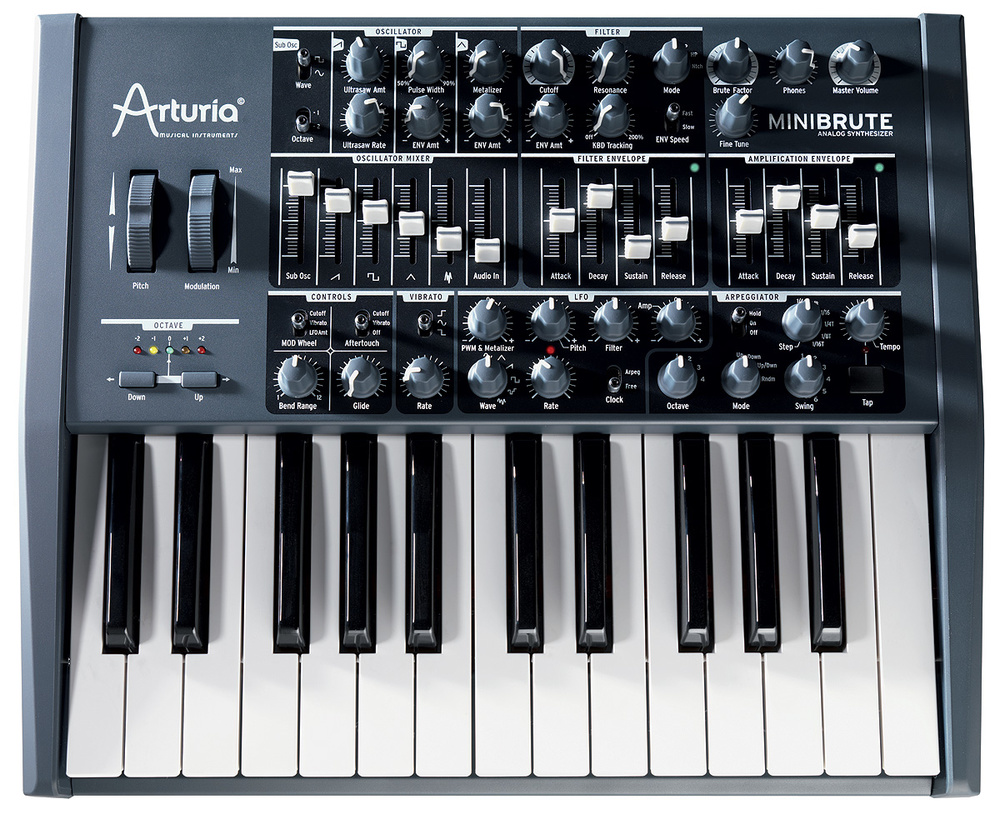 Although the MiniBrute is very compact (its main panel measuring just 325 by 390mm) it still manages to cram a lot of controls into the space available.
As for control of the cutoff frequency, there's no lack of this; it can be affected by its dedicated ADSR contour generator with positive or negative polarity, by the LFO, by key tracking between zero and 200 percent, by the mod wheel, and by aftertouch. There's even a switch to choose between a snappy contour response (quoted as 1ms to 1s) and a slower one (10ms to 10s) that allows you to create sounds with gentler sweeps.
It's an excellent package of facilities, but I find a 12dB/octave filter to be a strange choice for a synth of this nature. The world cries out for 24dB/octave filters that have the M-word at the front of them, and if Arturia had wanted to avoid these, other alternatives might have included emulations of ARP's 4012 and 4075 filters, or even something based on the SSM or CEM filters used in all manner of highly respected synths. However, flying in the face of all expectation, the MiniBrute's filter is a development of Nyle Steiner's Synthacon filter.
My concern with this is that the Synthacon is now deemed desirable not because it was a wonderful synth, but because it's rare. And the reason that it's rare is that Steiner-Parker didn't sell many. And part of the reason that they didn't sell many is because, while it was great for off-the-wall noises, strange tones and sound effects, its ability to produce conventional synth sounds and acoustic emulations was, umm... iffy.
I asked Arturia why they had made this decision and they told me, "We asked ourselves, 'How can we get the maximum range of sonic possibilities using the fewest functions, and how can we make the best of each function implemented?' We had to choose just one filter, and it seemed clear that this should be a multi-mode design. We could have created one from scratch, but it seemed more reasonable to adopt an existing design, so we looked at the filters used in other synthesizers and divided them into two groups. The first included the well-controlled 24dB/octave filters used by many American and Japanese manufacturers; the second included the less stable ones designed by the Russians, the English, and some other lesser-known manufacturers. We found that many of these tended to be 12dB/octave designs, were rather more aggressive than the first group, and less linear in their responses. Of course, many players want the Moog sound, but this seemed too safe a route. We also rejected the Russian and English filters because they are too characteristic of the original synths. Other filters also fell by the wayside for one reason or another until what we had left was the Steiner-Parker filter, which embodies a good compromise between versatility and savagery. The fact that it's not implemented in any other modern synth also meant that the MiniBrute would not sound like other synthesizers available today. But we didn't leave it at that, and the addition of the Brute Factor has taken the Synthacon filter into whole new areas, from gentle tone shaping to a storm of sound, with all the possible shades between the two.”
The what? The Brute Factor?
The end of the signal path is occupied, as it usually is, by a VCA controlled by a dedicated contour generator. Long ago, Minimoog aficionados discovered that they could take the output signal from the VCA (ie. the audio 'out') and route it back into the synth via the external signal input to create effects ranging from a mild thickening of the sound up to uncontrolled chaos, depending upon the gain of the external signal channel. Today, the MiniBrute provides this loop without patch cables, and the Brute Factor knob controls the gain. As you would imagine, this combination of the Steiner-Parker filter and this Moog-like characteristic is unique to the MiniBrute.
The MiniBrute Software

The MiniBrute software comprises just two pages. The first takes care of the synth configuration, with options for MIDI channel, access to three velocity and three aftertouch curves, LFO key-retriggering on/off, three options for the audio gate threshold, three more for the key trigger mode, legato on/off, and the arpeggiator hold type. In addition to these, the manual implies that there may also be a velocity on/off switch. The GUI shown here is also a prototype, but already shows that the screen will be clear and intuitive in use. The second page accesses the firmware update routine.

Modulation & Effects
The amount of modulation available on the MiniBrute is exceptional for a synth in this class. I have already mentioned the dedicated Ultrasaw LFO and the main, programmable LFO, but the MiniBrute also boasts a third LFO dedicated to vibrato effects. This generates three waveforms: a sine wave centred on zero, and a square wave that can generate trills of up to about four semitones above or below the played pitch. You can control the amplitude of the resulting effects using either the mod wheel, or aftertouch, or both, which can be very expressive.
Returning now for a closer look at the programmable LFO, this generates six waveforms (including sample & hold) and, as well as controlling the PWM and Metalizer effects, it can be routed to the oscillator pitch (for vibrato), the filter cutoff frequency (for growl) and the audio amplifier (for tremolo). Its internal clock generates frequencies of between (approximately) 0.1Hz and 100Hz (which is high enough to create frequency modulation, ring modulation and amplitude modulation-type effects), but it can also be synchronised to the arpeggiator clock, so that you can lock modulation effects to the timing of your arpeggios, which is always welcome.
Ah yes, the arpeggiator. This was unfinished on the prototype, but enough worked to demonstrate what we can soon expect. With Up, Down, Up/Down and Random modes, a range of one to four octaves, key sequencing for recreating tracks such as 'On The Run' and 'Karn Evil 9', MIDI sync (which, therefore, will also make MIDI-sync'ed modulation possible), six step ratios, six 'swing' settings, and 'tap' tempo, it will offer a remarkable range of features for such a small synth.
Now, I've just mentioned that aftertouch can be routed to vibrato amount, but it can also be routed to the filter cutoff frequency (although not both simultaneously). Likewise, the mod wheel can also determine the LFO amount (thus controlling things such as PWM and the Metalizer) or the cutoff frequency. As you might imagine, these take the MiniBrute far beyond most vintage synths in terms of expression. Consider brass sounds as an example: you can program 'rip' using the LFO controlled by the mod wheel, and add vibrato using the vibrato LFO controlled by aftertouch. Add pitch-bend of up to ±12 semitones and portamento, and you have a performance patch that would grace any stage or recording.
In Use
The MiniBrute is powered by an external 12VDC power supply of the 'snake that swallowed a badger' variety. I am not a fan of these, but the case would probably have had to be larger to accommodate an internal PSU, so I'll not criticise on this occasion. However, it would have been good to see a stress-relief thingy on the back panel alongside the power socket.
Arturia recommend that, once switched on, the MiniBrute should be allowed to enjoy a five-minute warm-up period. They're right, because it's unplayable for the first few minutes, and requires a few more before everything locks into tune. But once it has settled, it stays tuned and scaled, so all is well.
So what does it sound like? At first, I struggled to get the sounds that I wanted from it. The filter seemed rather too flaccid for my hardened 36dB/octave tastes, and the shape of the contours didn't quite work for me. But as time passed, things started to drop into place, and I found myself generating some sounds that I really liked.
The first was a deep, growling bass-pedal patch. This used just the sawtooth wave with maximum Ultrasaw at a slow rate, to create a unison/detuned dual-oscillator timbre. I was then able to sculpt this using the LPF with its contour set to Slow. No other modulation or control was needed and, with the Octave switch set to -2, the result was a deep, speaker-shredding bass that was more buffalo than bull. I loved it.
Once I had made friends with the MiniBrute, other great sounds started to pour forth. Orchestral imitations came in the form of trumpets, tubas and flutes, and then (changing course in mid-flow) I created some powerful lead-synth sounds that, courtesy of the Ultrasaw and the sub-oscillator together, sounded nothing like a single-oscillator synth. These then morphed into a range of snappy, cutting bass sounds.
Next, I experimented with the pulse wave, extracting some superb Selmer Claviolines by using the filter envelope to narrow the duty cycle further than could be achieved using the PW knob alone. Then I came to the triangle wave with its Metalizer. Crikey... the things you can do with this! One patch I tried used the Metalized triangle wave responding to an AD filter envelope and slow LFO modulation, with the filter at high Q also following the contour, and the Brute Factor at about half power. When arpeggiated, this raised the dead from under my 250-year-old house, and I'm still trying to get them to get back under the basement floor. More sensibly, you can coax anything from long, sweeping timbral changes to brittle and glassy timbres and, had I had the time, I'd have liked to see what I could have created by sampling some of my 'metalized' patches and playing them polyphonically. I suspect that they would have been delicious.
All this, and I hadn't even started mixing waveforms yet! Of course, not everything was rosy, and I had to remind myself occasionally that this was a prototype, and that the deficiencies I uncovered — for example, the modulation depths a bit high, the filter tracking rather non-linear — should be corrected before you lay hands on the MiniBrute. There was also an effect that sounded like phase cancellation when mixing the sawtooth and pulse waveforms at certain values, but I understand that this is inherent in the design, and won't be addressed. Of course, there were some genuine limitations too, such as the lack of a delay or any other dynamic control of the main LFO but, even so, these points were small when compared with the possibilities on offer. Playing with the MiniBrute, I started to remember how much fun synthesis was before punk rock turned keyboard players into dweebs.
Nonetheless, there is one thing that I have to get off my chest. For an old fart like me, the keyboard — which, thank the stars, has full-sized keys — is too narrow. Keeping it to two octaves makes the synth compact and will appeal to some users, but it won't be sufficient for others, so I'm already looking forward to a 37-key version (the MidiBrute?) and a 49-key version (the MaxiBrute?) with the pitch-bend and modulation wheels to the left of the keyboard itself. Come on Arturia, you know it makes sense!
In the meantime, we can use the MiniBrute as part of a modular system or as a MIDI sound module. When played from one of Arturia's own 49-note MIDI controllers, it responded perfectly to note on/off, octave shift, pitch-bend and aftertouch, and the extended keyboard turned the MiniBrute into a fab soloing instrument.
Conclusions
The MiniBrute has no presets, no menus, and none of the other paraphernalia that goes with a microprocessor-controlled operating system. In short, it's an analogue synthesizer of the old school. Happily, it offers a surprising array of features for such a small and affordable unit, and it sounds like an analogue synth should, lending itself to raw, edgy sounds as well as many standard synth patches. You have to applaud Arturia for avoiding the temptation to build yet another low-cost 'bass synth' (or, as I think of them, synths with limited capabilities that just happen to play low notes) and instead measure the MiniBrute against the company's claim that it built the MiniBrute with four goals: peerless analogue sound, intuitive operation, realistic cost and no compromises. I can't comment on whether any compromises were made but, even on this prototype, I can confirm that it has a 'real' analogue sound, it's easy to use and, at just £429$499, it's not expensive. In truth, if I were considering buying a second-hand SH101, Axxe or MS10 for the same price as a MiniBrute then, after agonising about the width of its keyboard, I would choose the MiniBrute. It has a much wider sonic palette, it offers far greater performance capabilities, and it has greater connectivity. So, to conclude, I can now answer my own questions: yes, you should be excited, and yes, this is a mature synthesizer. I suspect that Arturia's confidence may be justified. The MiniBrute could be a very successful product indeed.
Alternatives
Although we are living in a golden age for analogue synthesizers, I can think of no immediate alternatives to the MiniBrute. The closest, although neither compares directly on a spec-for-spec basis, might be the Leipzig keyboard from Analogue Solutions and the superb Mopho Keyboard from Dave Smith Instruments. Although more expensive than the MiniBrute, the Mopho is a much more powerful synth, but it lacks a 'one-function-per-knob' user interface and, while its signal path is also 100 percent analogue, many of the other functions are not, which may or may not bother you.
Patch Memories
Once upon a time, patch memories were scribbled instructions on the backs of beer mats or, if you were posh, printed on laminated sheets that overlaid the control panel of your synth and showed you where to set the knobs and sliders. In a wonderful return to the 1970s, Arturia will be supplying 10 MiniBrute 'presets' on overlays, together with 10 blanks on which users will be able to record their own sounds. I don't view these as a step backward. I learned much of what I know about patch programming by analysing why certain settings led to certain results on different synthesizers, and I love the idea that a new generation of players could learn how their synthesizers work rather than twiddling knobs aimlessly and hoping that something useful will emerge.
The Rear Panel
The MiniBrute boasts a cornucopia of I/O sockets. To the right of the panel you'll find the digital stuff: MIDI In and Out on five-pin DIN, plus the USB port that allows you to use the MiniBrute software. Next to these, there's the gate source switch and then three audio sockets: audio in, audio out, and headphones, all on unbalanced quarter-inch sockets. To the left, there are four control inputs (Gate In, pitch CV, filter cutoff frequency CV and VCA gain CV) and two control outputs (pitch CV and gate out) all on 3.5mm sockets.
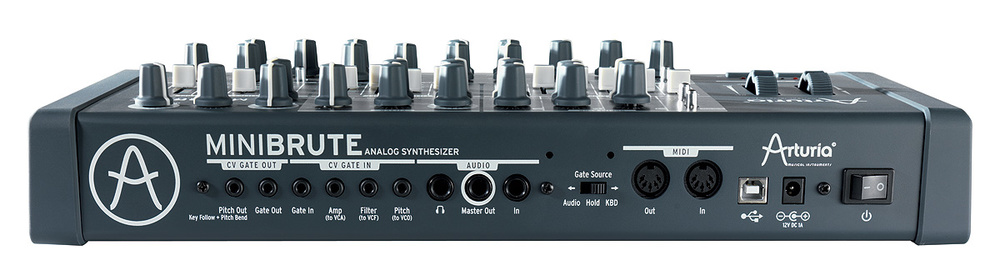 The MiniBrute's back panel includes CV and Gate I/O on 3.5mm jack sockets, headphone out, audio out and audio in on quarter-inch jack sockets, a Gate Source switch, MIDI I/O ports, a USB port and an input for the external 12V power supply.
Hold on a sec... MIDI Out? Remarkably, the MiniBrute can also serve as a polyphonic MIDI controller, sending note on/off, aftertouch, pitch-bend, mod wheel and... velocity! While nothing in the MiniBrute's sound generator responds to velocity, the keyboard itself generates this and transmits it via MIDI.
Pros
- It's small and neat, but feels solid and robust.
- It can sound excellent, and the sonic palette is wider than you might imagine.
- It offers good modulation and performance capabilities, and good connectivity.
- It's hands-on, immediate and fun.
Cons
- The keyboard will be too narrow for some players.
- Some expected sounds are unattainable due to the choice of filter.
- It would be nice if the keyboard's velocity sensitivity did something within the MiniBrute's own sound engine.
Summary
You might think that all the evolutionary niches for analogue synths were filled long ago, but the MiniBrute proves that that's not so. More than 40 years after the emergence of the genus, it offers a unique architecture and can sound excellent. At the price, it should be one of the success stories of 2012.