

Audio-Technica AT2031

Small-diaphragm Condenser Microphone


Reviews : Microphone
 
Audio-Technica’s latest ‘pencil’ mic is designed to provide a high-frequency boost. Could this help lift sources out of a busy mix?
Paul White
The AT2031’s frequency-response graph, showing the mic’s increased sensitivity around 12kHz.
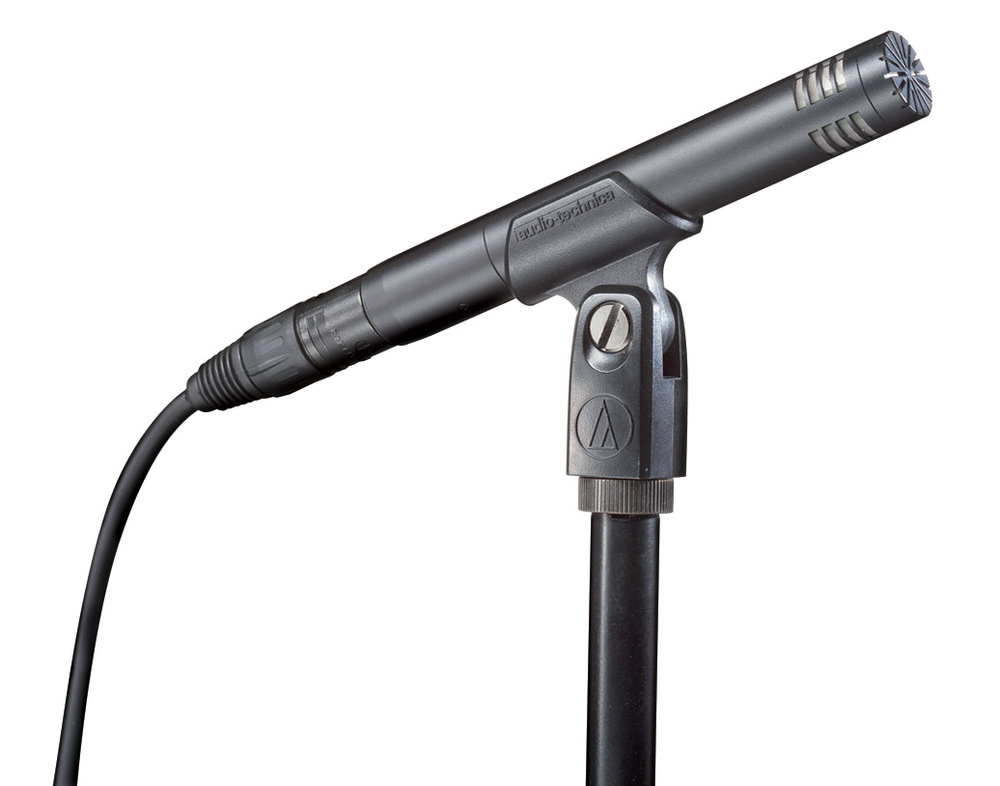
Introduced in 2011, Audio-Technica’s AT2031 small-diaphragm, cardioid condenser mic is optimised for use with stringed instruments (both bowed and plucked) and piano. It’s designed to provide a subtle high-frequency lift that will bring out articulation and detail and, like pretty much all Audio-Technica mics, it’s a back-electret design.
Constructionally, the AT2031 looks much like other Audio-Technica ‘stick’ mics: beautifully engineered, with unfussy styling and a satin-black finish. The weight is a reassuring but not excessive 134g, and the mic’s body is 143mm long and 21mm in diameter. A single switch, recessed into the side of the mic body, applies a gentle 150Hz, 6dB/octave low-cut filter, which may be useful in attenuating unnecessary low frequencies, or moderating the proximity effect when the mic is used close to the source.
Connection is via a conventionally wired three-pin XLR, and 48V phantom power is required for operation. The mic is supplied with an AT8405a stand clamp, a foam windscreen and a soft plastic storage pouch.
Tech Talk
The AT2031 has a reasonably low noise floor (EIN 17dB), enabling it to cope with quieter instruments. Having said that, it can also handle SPLs as high as 141dB. Its open-circuit sensitivity is -34dB, or 19.9mv (ref 1V at 1Pa), which is not untypical for this type of microphone.
The frequency response is quoted as extending from 20Hz to 20kHz, but this tells us very little about the mic’s tonality. Indeed, the majority of capacitor mics claim the same figure, and many sound noticeably different, due to small dips and bumps along the frequency axis. A response plot printed in the manual is more informative, showing a gentle lift above 3kHz and a sizeable presence peak (about +7dB, judging by the plot) centred around 12kHz. This is above the region where such a hefty boost would sound harsh, so it should contribute more of a sense of airiness. The off-axis response is nominally consistent up to 60 degrees off-axis, after which the high end drops away more rapidly than the low end, which is typical of cardioid mics.
Testing
I put the mic up alongside a similarly priced Rode NT55 as a point of comparison, as I’m very familiar with the sound of that mic. The NT55 has less of a high lift so, quite predictably, the AT2031 had a brighter overall sound, although the Rode, being a little more sensitive, needed less preamp gain. On acoustic guitar, both mics delivered a perfectly usable sound, with the AT2031 adding some high-end gloss that would be particularly welcome when trying to place the part in a mix. There’s evidently some musical flattery going on with the AT2031: although the overall sound was believable, the solid lows were balanced by pleasantly shimmery highs.
On hand percussion, both mics produced fine results again, with the AT pulling out more definition and detail — so there’s no reason to believe that it wouldn’t also make a fine drum overhead mic. Neither mic would be my first choice for recording electric guitar, but miking my combo from around 300mm, midway between the centre and edge of the speaker, produced surprisingly good results. The warmer sound of the NT55 was more to my taste, whereas the AT2031 delivered a creditable American rock sound, with its characteristic bite and edge. A little EQ tamed it nicely, to my ears, so I could work happily with it.
Conclusion
The AT2031 has clearly been designed to impart a definite tonal character, with a brighter and more detailed high end, and it achieves this without adding harshness or stridency. Because it has such a strong character, it won’t suit every application, but where high-frequency detail and a lively transient response are needed, it does a great job of adding a touch of gloss. It’s also very well made and affordably priced, so what’s not to like?    0

Alternatives
The alternatives may have different tonalities, because of the shape and extent of their respective presence peaks, but the Rode NT55 and the SE Electronics SE1A are probably the closest in terms of price and performance.


Home | Search | News | Current Issue | Tablet Mag | Articles | Forum | Subscribe | Shop | Readers Ads

Advertise | Information | Digital Editions | Privacy Policy | Support

Audio-Technica AT2031 £149$236
pros
Sounds lively without being harsh.
Affordably priced.
cons
Like any character microphone, the AT2031 will suit some sound sources better than others.
summary
The AT2031 is a useful microphone for those occasions when an instrument needs a little larger-than-life sparkle to help it cut through a mix. Audio-Technica have managed this really well by keeping most of the presence boost above those areas of the spectrum that can cause harshness.
information
£149 including VAT.
Audio-Technica +44 (0)1132 771441.
$236.
Audio Technica +1 330 686 2600

SOS Readers Ads
GRAB A BARGAIN

£867,715

of Second-User Gear for sale now — don't miss out!

Audio-Technica AT4047 MP

Multi-pattern Condenser Microphone

Audio-Technica have added multiple polar patterns to one of their already successful designs, bringing increased versatility in the studio.

Audio-Technica AT4047 MP | Media

Multi-pattern Condenser Microphone

These audio files accompany the Audio-Technica AT4047 MP review that featured in SOS December 2010.

Audio-Technica AT4050 ST

Stereo Condenser Microphone

Thumbnail for article: Audio-Technica AT4050 ST

There's more to this variation on Audio-Technica's flagship microphone than the simple addition of a second capsule...

Peavey Studio Pro M2

Condenser Microphone

Paul White explores the capabilities of the understated-yet-powerful Studio Pro M2.

Schoeps VSR5

Microphone Preamp

Thumbnail for article: Schoeps VSR5

Schoeps make some of the most revered mics on the planet, so when they release a commercial version of the mic preamp they use for testing, you have to take it seriously...

Schoeps VSR5 Mic Preamp

Test Measurements

The following charts, made using an Audio Precision Analyser, accompany our review of the Schoeps VSR5 microphone preamplifier.

Blue Encore 300

Handheld Condenser Microphone

Designed as a hand-held live vocal mic, this mic has a cardioid pickup pattern, and seems very robustly engineered.

Cartec EQP1A

Mono Valve Equaliser

Thumbnail for article: Cartec EQP1A

British 'boutique' outboard manufacturers seem to be rather thin on the ground these days, but if this Pultec clone is anything to go by, newcomers Cartec look set to make a big impression.

Prodipe TT1

Dynamic Microphone

Prodipe say they wanted to offer a high-quality, live-sound, cardioid-pattern dynamic mic at a very affordable price.

Sontronics Saturn

Multi-pattern Condenser Microphone

Thumbnail for article: Sontronics Saturn

Sontronics mics usually sound as distinctive as they look - and this one looks more distinctive than most!

MXL Revelation

Multi-pattern Valve Microphone

Thumbnail for article: MXL Revelation

Hot on the heels of the impressive Genesis cardioid valve mic, MXL have unveiled their flagship multi-pattern model, the Revelation. Does it live up to its name?

MXL Revelation | Audio Examples

Multi-pattern Valve Microphone

These audio files accompany the SOS September 2010 review of the MXL Revelation microphone.

Samson Go Mic

USB Microphone

AKG Perception 820

Valve Microphone

Thumbnail for article: AKG Perception 820

Does AKG’s Chinese-made Perception 820 maintain the Austrian company’s impressive reputation?

AKG Perception 820 | Audio

Audio Examples

Hear for yourself how this mic performed during the SOS tests.

Audio-Technica AT4080 & AT4081

Ribbon Microphones

A-T’s brand-new transducer technology has produced a robust design intended to deliver high signal levels as well as that prized ribbon character...

Earthworks DP25C & DP30C

Snare & Tom Condenser Microphones

Despite the ubiquity of the SM57 for use on snare, there are other options — and Earthworks aim to help you capture a more natural sound.

MXL Genesis

Cardioid Valve Microphone

Thumbnail for article: MXL Genesis

We put MXL’s Genesis through its paces alongside a much pricier model, to find out just how good a tube mic can be at this price.

MXL Genesis Mic | Audio Files

Hear For Yourself

To accompany our July 2010 Genesis review, we recorded a series of standard tests with the review mic alongside a more established mic (in this case, the AKG C12 VR).

WIN Great Prizes in SOS Competitions!
 

Email: Contact SOS

Telephone: +44 (0)1954 789888

Fax: +44 (0)1954 789895

Registered Office: Media House, Trafalgar Way, Bar Hill, Cambridge, CB23 8SQ, United Kingdom.

Sound On Sound Ltd is registered in England and Wales.

Company number: 3015516 VAT number: GB 638 5307 26


All contents copyright © SOS Publications Group and/or its licensors, 1985-2013. All rights reserved.
The contents of this article are subject to worldwide copyright protection and reproduction in whole or part, whether mechanical or electronic, is expressly forbidden without the prior written consent of the Publishers. Great care has been taken to ensure accuracy in the preparation of this article but neither Sound On Sound Limited nor the publishers can be held responsible for its contents. The views expressed are those of the contributors and not necessarily those of the publishers.

Web site designed & maintained by PB Associates | SOS | Relative Media