

Would you hire a mixer who doesn't believe in panning? The Lumineers did — and were rewarded with a hit album.
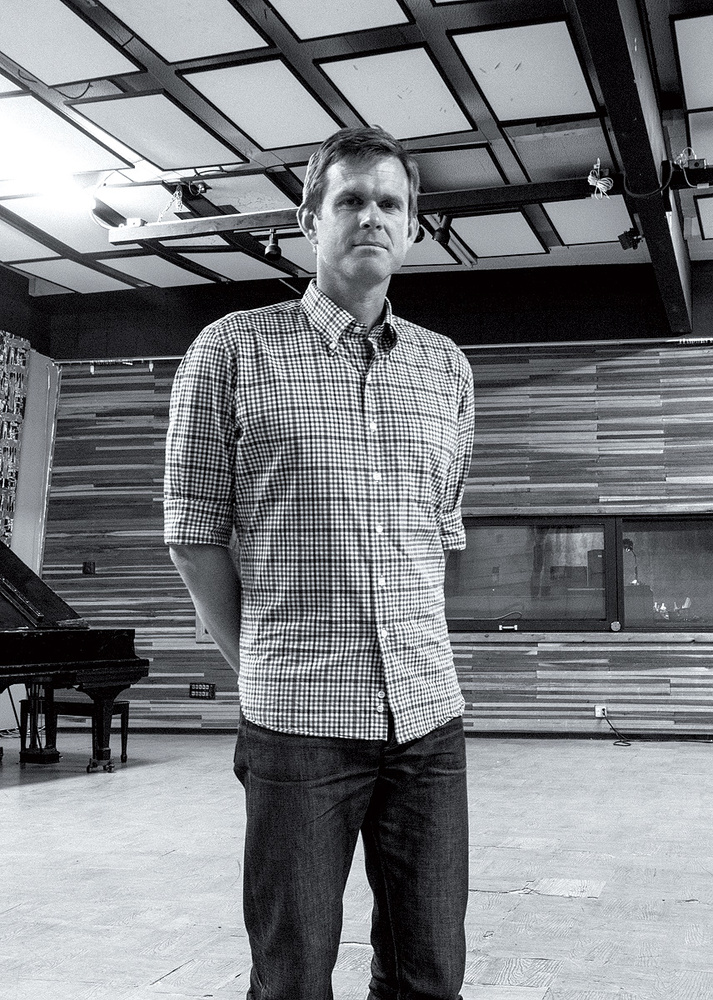 Kevin Augunas in his Fairfax Recording facility.Photo: Matt Wignall
Every month the Inside Track series poses the question "How did you mix that hit?” The answers given by different mix engineers can vary greatly, but nearly always involve a state-of-the-art DAW, hundreds of tracks and plug-ins, and frequently a massive automated mixer and a huge quantity of outboard gear too. However, some people still wave the flag for different ways of working, one of them being Kevin Augunas. The producer, mixer and engineer has worked with the Black Keys, Lostprophets, Melissa auf der Maur, Cold War Kids, Edward Sharpe and the Magnetic Zeros, J-Roddy Walston and the Business and Jon Brion, and last year mixed the Lumineers' self-titled debut album, which reached the US top 10 — an impressive achievement for the hitherto completely unknown folk trio from Denver, Colorado.
Augunas' decidedly nonconformist working methods and choices of gear played a substantial part in helping to steer them to their breakthrough. His unorthodox mix process for the album's lead single, 'Ho Hey' involved stripping away half the tracks, re-recording a few bits and pieces, and then laying everything out over his custom-made 16-track monitoring board which has only LCR panning and no inbuilt EQ or compression. The only effects he used were a Studer B67 for slap tape delay and the reverb from his studio's echo chamber, and the only outboard was a Fairchild 660 compressor and a Pultec EQP-1A3 EQ on the lead vocals, and an old Universal Audio EQ on the stereo mix. The final mix of 'Ho Hey' took Augunas just a couple of hours, yet the results would go platinum in the US.
Idiot Boxes
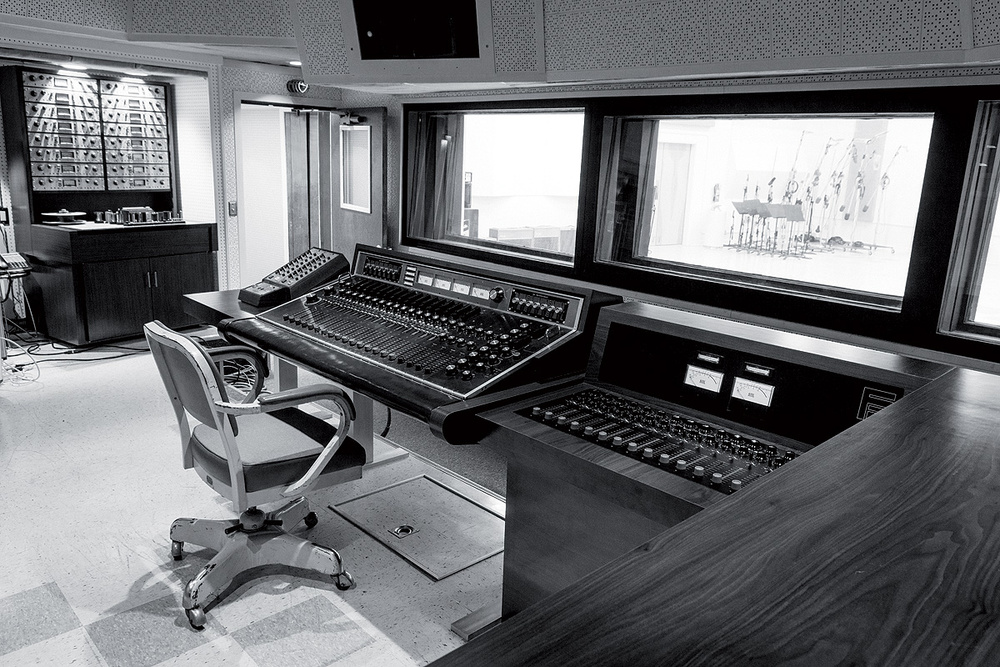 Fairfax Recording's control room is dominated by two pieces of gear which weren't used on the Lumineers album: the Scully 16-track (far left, with remote at the left of the console) and Altec mixer (centre). The actual mix was done on Kevin Augunas' custom-built monitoring console, visible at the front right.
"I don't think I am a vintage gear snob, who only uses gear built before the 1970s, or something like that,” asserts Augunas. "I use tape machines, but also computers. I use all kinds of stuff. The thing is that I'm not a great technician. I don't know many technical things in the engineering and mixing process. Instead I just follow my ears. That's all I'm doing. So I like to surround myself with what I call 'idiot boxes', meaning pieces of gear that are so simple that you can turn the knobs any way you want and you'll get a beautiful colour out of them — it's just a matter of choosing the colour you want. For instance, if you put things through a Pultec or a Fairchild, you can't get a bad sound out of them, you just get different sounds. Whereas if you were to put me in front of an SSL, that's like asking me to fly a 747: I'm probably going to crash it into the ground. There are too many things to mess up, too many dead ends to go down. Put it into the hands of someone really technically savvy and he or she can do beautiful things with it. But it's not what I'm able to do. I prefer things that have very simple options and choices and yes, I do prefer for things to sound a little darker and woolier than is common today, so tend to work with tube gear and older boxes with certain kinds of transformers in them.”
Growing up in Fairfax, California, near San Francisco, Augunas played bass in high school, and then went to Berklee College of Music in Boston on a scholarship to study Music Production & Engineering. Aiming to be a session bassist, he moved to New York in the mid-'90s, where he played in bands and also toured with different artists, but also became more and more involved in recording bands and jingles. He moved back to California in 1998, and built a studio in his house in LA, which gradually grew until it eventually held one of the finest unique and vintage gear collections in the world, the prize piece being an EMI TG12345 Mark IV recording console from 1970, which was built for Abbey Road Studios and used to record many famous records and film scores, including the music for the Pink Floyd film The Wall.
In early 2011, however, Augunas took over the legendary Sound City premises in Los Angeles, renamed it Fairfax Recording, and in the process of moving in, got rid of most of his gear. Partly as a result, the control room now looks like a '50s sci-fi movie TV set. There's a Scully 16-track with a very fancy-looking remote, a 16-track Altec 9200 console from the mid-1960s, two mounted Altec 944 speakers, a custom-built monitoring console, one rack of outboard, and that's about it. The mixing of the Lumineers album was the first project he did in his new studio. Since then, he has also used it to record, mix and produce most of the acts that are signed to his Fairfax record label. (The one exception is Gotye, who Augunas auspiciously signed just as 'Somebody That I Used To Know' was released in Australia. Talk about hitting the jackpot…)
Panning Panned
When he moved into Sound City, Augunas sold the studio's Neve desk to Dave Grohl, and to replace this and the EMI TG, he acquired the Altec 9200 and had a monitoring board designed to his specifications by Mark Neill and constructed by Ken Hirsch. The Altec once belonged to legendary C&W producer Owen Bradley and graced his Bradley's Barn studio in Nashville. Augunas found it "in a shed” a couple of years ago, and renovating it took a year.
"The Altec is an amazing-sounding desk,” elaborates Augunas, "and I use it for recording, because it has mic pres and EQs and it goes straight into the Scully, though the returns of the tape machine come up on the monitoring board. The Altec has a very open, clean but also quite aggressive sound, so I tend to use it to mix rock records on which I want the claws to come out of a little bit. The Altec therefore wasn't involved in mixing the Lumineers. When I want a record to sound more lush and pretty, like with the Lumineers, I'll mix it on the monitoring board, because it is totally passive. The monitoring section has 16 inputs and just a stereo pair of outputs. If you are looking from top to bottom at a channel there is a pre-[fade] send, a post-[fade] send, a big switch that is just left-centre-right, so there is no panning — I don't like panning — and then there is the fader, and that is it. There is no mute switch and no solo switch. There really is not much in there.”
 Another view of the Fairfax control room, showing the Scully remote (front) and the minimal outboard rack (right). Augunas's exhortation that he "doesn't like panning” demands some explanation. "I think panning is like having too many tracks. You don't need it. Just having centre, left or right is much better. I love the hard commitment! If you want something to fly across the stereo image in a mix, you just put it on two faders and you work the volume of the faders. Most the time when people talk about analogue and digital, the debate focuses on the sonics. This is a valid comparison, because they do sound different, though neither is necessarily better or worse. I've heard amazing and shitty-sounding recordings recorded on both digital and analogue. They are both valid recording media. The real rub for me with digital is that there are simply too many options. I'll use the 747 analogy again. You put a kid in front of a DAW, whichever one it is, and there are too many things you need to know, too many things you can do, and too many options that allow you to mess things up. I mean, you have virtually unlimited tracks. With all these options, instead of choosing your colours and painting a picture, the tendency is to use all colours and eventually everything will turn brown.
"When a band comes to record here, I point at the Scully and say, 'Look, you have 16 tracks to make your statement.' They'll usually protest and say, 'But that's not enough!' I'll then ask them what their favourite records are, and they'll often name records from the '60s and early '70s, by the Beatles, Led Zeppelin, Stevie Wonder, and so on, and I'll point out that most of these records were done on eight tracks. My point is that people need to learn to arrange music, and that this will make music better. Using your ears and working with limitations will create better music. Neither the thousands of options offered by a DAW, nor looking at a screen, is going to make your music better. Looking at a screen takes you away from using your ears.
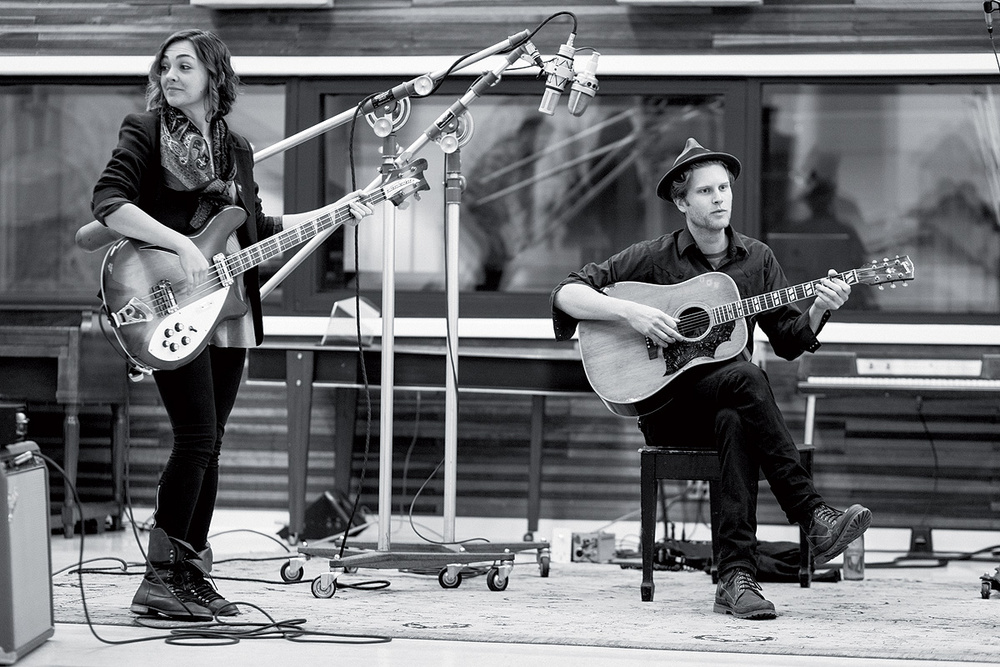 Once Kevin Augunas had eliminated what he saw as spurious parts from the original recordings, he had the Lumineers record additional overdubs to fill any perceived gaps. This photo shows Neyla Pekarek (left) and Wesley Schultz during the recording of an extra song which was eventually left off the track listing."When I was a kid I had a four-track Tascam cassette recorder and that forced me to learn to arrange. I'm with Ken Scott, who I saw speaking not so long ago, and who said, 'Every young person who wants to get into recording should start off working on a four-track cassette recorder.' It's also probably the cheapest thing you can find: go to eBay and you can pick one up for $200 or less. That's less than most DAWs. You can get four-track Android apps for next to nothing? Great! Make a bunch of recordings on a four-track recorder, and that will teach you everything you need to know, and it will sound better too. People will stack endless guitars in a DAW, and this makes things sound smaller and smaller. But when I recorded two guitars playing simple power chords on my Tascam and panned them left and right, it sounded massive!”
Fairfax Recordings does, however, have a Pro Tools system. "I like to record to tape, and then use Pro Tools to do any editing that is needed,” says Augunas. "Lately, however, I've been using the [Endless Analog] CLASP system a lot. I love the CLASP, it's amazing, it's a great invention. It turns Pro Tools into what I think it should be, which is a very powerful editing tool that's also great for archiving. To my mind, Pro Tools should not be used as a multitrack recorder. The Lumineers' project came in as a 24-bit/48kHz Pro Tools session, and I used it mainly as a playback medium.”
Left Alone To Explore
Before delving deeper into his unconventional mixing approach, Augunas first elaborates on how he ended up mixing the Lumineers' album. "Before the band were signed, I'd heard them play a show, and I thought they were great. I contacted their management [Onto Entertainment in Seattle] with a view to signing them to Fairfax Recordings. I'd also heard the demos they were giving out, which they were calling their record, and which had been recorded and produced by Ryan Hadlock at his Bear Creek Studio near Seattle. The songs and the performances and the recordings and energy were great, but to me it sonically sounded more like demos than a finished record. When we had a meeting about me signing them, I brought this up right away, and actually suggested re-recording the album. They weren't into that, because they loved the way it was, but they did agree to me mixing the album. In the end they signed with a label in Nashville called Dualtone, and in the fall of 2011 they came to Fairfax for the mix.
"We worked very quickly, mixing two or three songs per day. Doing the whole album took five days! My mix process was very simple. I loaded the Pro Tools session for a song, listened to the session as it was via the LR outputs, so just in stereo, and made decisions as to what tracks I wanted to cut.
"I rarely mix somebody else's work. I usually do the whole process, ie. recording, mixing, and producing. So me mixing somebody else's recording is an anomaly, and when I do that, a large part of mixing is subtractive. I try to uncover what the most important part of the statement is. So the first thing I did with many songs was to delete a bunch of tracks and take off the plug-ins, because I wasn't hearing the songs in that way. To me these extra tracks and these plug-ins were examples of people overdoing things in DAWs because they could, whereas you need to focus on arranging. There were multiple plug-ins and multiple mikings of everything, like the acoustic guitar had three mics, there were room mics on the vocals, there were digital reverbs, and I pulled all this out.
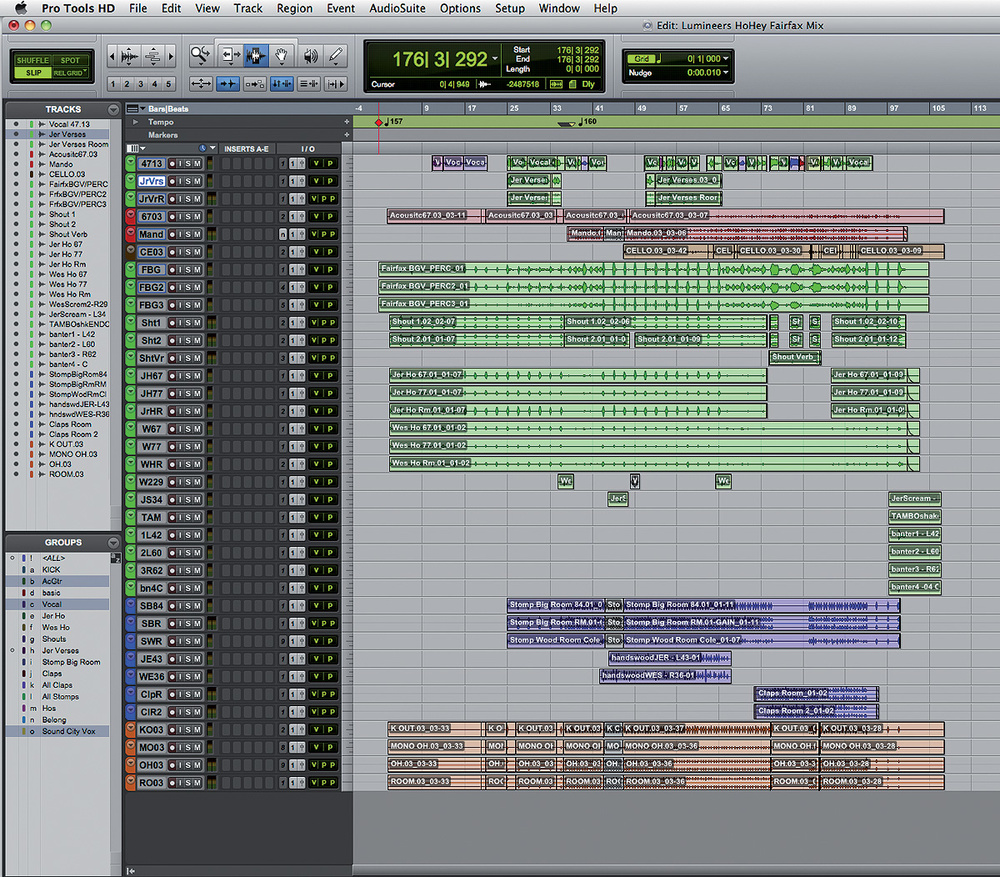 The Pro Tools Edit window for the final version of 'Ho Hey'. Visible near the top are the three 'Fairfax_BGV_PERC' tracks overdubbed at Fairfax."After this I laid the song out over my monitoring desk, and did a very rough mix of what I was left with, getting everything to a general level and then I listened to it, and it was like: 'OK, we cut away all the fat from the song, meaning the extra tracks. What are we missing, or are we complete?' If we felt that there were things missing, the band would record them in the live room, and they would add tracks. After that the final mixes were a matter of setting levels, reverbs and delays, panning things left, right and centre, and that usually was it. That is all mixing should be. It's not like I did good work: they did good work, and that allowed me to do only that. I didn't have to do any major surgery to the songs. If they had needed major surgery, I would have been the wrong guy to mix it. Those really professional mixers do open-heart surgery on songs every day, but I don't know how to do that.
"The band were amazing to work with. They were very trusting, and allowed me to explore what I wanted to explore. Honestly, they simply got out of the way, though they did speak up if I did something they definitely didn't like. But they were sweet: they were the musicians, and they let me do what I felt needed to be done. Also, it wasn't a high-pressure situation. They were not a big-name band yet. They were just another band making a record on a very, very small budget. We therefore did this as quickly as we could. Nobody was expecting anything, so there wasn't anyone breathing down our necks or telling us it had to be this or that way. That's when the best art happens, when you are left alone to explore. And we were.”
Adding Weight
"'Ho Hey' was in fact the first song I mixed for the project, and I deleted about 12 tracks from the recording session, which left me with a lead vocal, two tracks of backing vocals, an acoustic guitar, a mandolin, a cello, four drum tracks, and seven stomp, percussion and claps tracks [in blue, PT]. After this, I re-comped a new lead vocal for the first verse, because I wanted Wesley to sound an octave lower. When I received the song, the first verse vocal was an octave higher, meaning that he sang really aggressively right from the start. I felt that it sounded too too intense and not intimate enough. So I went into the Playlist and comped together a lead vocal that was an octave lower, knowing that if it didn't work, I could ask Wesley to go into the live room to re-sing the first verse.
"After changing the verse vocal, I felt that the song needed some more weight. To my ears it sounded a little thin and bright, so I asked the band to go out into the Fairfax live room, where I put up a Neumann M49, and they did the parts of the song where they go 'ho hey', and all the stomps and percussion and claps and banter. I asked them to talk amongst themselves as if they were at a cocktail party, and I triple-tracked that, so there's LCR of shouts, ad libs, and background vocals and all kinds of stuff. I have an Altec A7 speaker in the live room for playback, and instead of having them put headphones on, I would do the playbacks via the A7 in the room, and I asked them to freely walk around while they clapped and sang. This meant that I was re-amping the track in my live room while they were doing these background parts, and the bleed of the actual song is going into the vocal mic with them. This made the track sound bigger and fatter. These new background tracks are green in the session.
"I spent more time prepping the mix in this way than doing the actual mixing, which took just two hours. There was not much to do in the mix. The band is great, the song is great, the basic material sounded good, they gave me great stuff to mix. Regarding the effects, I had my quarter-inch Studer B67 two-track connected to the pre-[fade] send on the board for a slapback tape delay, and my studio has a real echo chamber, which was connected to the post-[fade] send. All the echo on the album comes from that echo chamber. The only outboard I used on this song was a Fairchild 660 and a Pultec EQP-1A3 on the lead vocal. I did want the lead vocal to punch out a little bit, I wanted it to sound a bit bigger and brighter. That was the whole mix.
"Again, it was just a matter of balancing levels and getting things to sit right. You get it all to a relative sound, with things being equally bright or dark, and you can then EQ the stereo bus at the end if you want to brighten it up. I mixed back into Pro Tools, because I had used the tape recorder for the delay on this project, and there was no budget for buying tape or using another tape machine. I EQ'ed the stereo mix with some old Universal Audio EQs, just adding a little of 10kHz and perhaps also a bit of low end around 100Hz. I didn't compress. The way I look at it, if you get the balance right, you don't need to compress a mix. You just don't. It's going to get compressed in mastering anyway, so why does it need to get double-compressed? That's where things start sounding too harsh and bright. I wanted there to be space in the music and for the listener to feel the energy of the song. If you compress things too much and make it too bright, you lose that.
"Bob Ludwig mastered the album. He was perfect for this. He is very sensitive to this kind of music, and I knew he would not over-compress it. I'm like everyone else, I love it when the records I work on reach a lot of people, but I don't chase the dragon, so to speak. I don't chase modern radio and I don't try to be louder than everybody else. I love music too much, and I couldn't live with myself if I was doing that. All I'm trying to do when I work on a project is make the best I can. For a band like this, in particular, it really was not appropriate to make it as loud or as compressed as possible, or any of that kind of stuff. It is what it is, and the single resonated with many people because they are an amazing band and wrote an amazing song.”
No To Nearfields
Virtually all studios, whether commercial or private, have a choice of monitors, invariably including one or more pairs of nearfields. Unsurprisingly, Augunas holds contrary opinions on this front. "I don't really like nearfields, and the only monitors at Fairfield are a pair of mounted old Altec 944s from the '60s that I brought in. I use them to track as well. The only other speakers I check my mixes on are those in my car, and I also have some custom in-ear headphones made for me by Ultimate Ears, who make in-ear monitors for live use. Every morning after I drop my kids off at school, I go on a five-mile hike up into the Santa Monica mountains and I usually put my earphones on and I check mixes from the day before. It is a good time of the day for me to do it, because I have a clear head.”
Downsizing
As mentioned in the main text, until recently Kevin Augunas owned one of the most impressive collections of vintage equipment in the world, but sold nearly all of it when he moved to the former Sound City premises. Why? "There were two reasons why I got rid of a bunch of stuff. First of all, I didn't want to have so much gear any more, because I did not need all of it. I had been addicted to gear for many years, and I had accumulated way too much. The second reason was that much of my gear had a pedigree of some sort, and this sometimes caused problems during the recording. For example, the TG console from Abbey Road is an amazing board, it sounds great, it's very reliable, it's incredible. But bands would come to my studio because of that board and whoever had worked on it, whether Pink Floyd or one of the ex-Beatles working on a solo album. This meant that their expectations often were really skewed and weird. They expected their record to sound as good as whatever records had been made on the board, putting that burden on me and the console. I felt like saying, 'Look, a lot of famous records have been made on this board, but what made those records great was not the board but the artists and their abilities.'
"People freak out when they see a real Fairchild, and yes, it's an amazing compressor, but it's not going to make your vocal. It's not going to turn you into an amazing singer. It simply magnifies what you do, and if you are a horrible singer, it will magnify how bad you are. So to remove those kind of preconceptions from my studio, I liquidated a bunch of stuff and kept what I actually used to make records. As for the gear that's in there now, the studio is predominantly a vehicle for me doing my thing, so I don't need to have a gear list up. But bands are so gear-hungry these days, they want to know what compressor you're using and what mic pre, and what microphone, and while I appreciate the interest, because I was the same when I was a kid, when I am making a record with them I want them to be the musicians. I don't want them worrying about the gear, because it's not relevant to their performances. I just want musicians to tell me what they want to hear, as in more or less of something or darker or brighter. I prefer for bands to speak in those terms. Putting up a gear list, or even having close-up photos taken of my gear, perpetuates this gear pornography thing, as in 'Oh, let's go and work there because he has an U47,' or, 'They have a Fairchild.' Who cares?”