

Finally the HR824 has a little brother and, like most little brothers, this one has both attitude and confidence!
Mackie's HR824 active monitor was their first foray into studio monitoring, but it soon became a highly respected member of the monitoring community, not least because of its good price/performance ratio. Now it has been followed up by the HR624, an essentially similar two-way active design aimed at users wanting a smaller and slightly less powerful speaker, but with the same family sound. While the HR824 was based around an 8.75-inch woofer with a die-cast magnesium frame and mineral-filled polypropylene cone, the HR624 uses a magnetically shielded 6.7-inch version of the speaker powered by a 1.25-inch voice coil. This is balanced by a one-inch aluminium-dome tweeter mounted in a shallow wave guide to control high-frequency dispersion — also magnetically shielded. The modified Linkwitz-Riley 24dB/octave crossover filter operates at 3kHz, as opposed to the 2kHz of the HR824, and the overall response of the system is 49Hz to 22kHz (-3dB), with controls on the rear panel to help compensate for room characteristics.
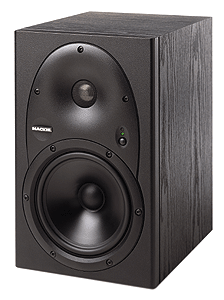 The MDF cabinet (330 x 210 x 264mm and weighing 11.4kg) is attractively veneered in black oak and is made from MDF with internal 'H' bracing and an extra-thick front baffle. An open-cell foam material fills the cabinet to attenuate internal reflections, and all the electronics are mounted in a well-ventilated metal case fixed to the rear of the cabinet. The low-end response may seem ambitious for such a compact speaker, and it certainly sounds quite impressive, but it does have some help in the form of a passive radiator, similar to that used in the HR824, mounted on the rear panel beneath the power amplifier pack. The amp delivers 100 Watts to the bass/mid-range unit and 40 Watts to the tweeter.
Passive radiators are physically similar to a regular bass driver, but with no coil and no magnetic assembly. Their purpose is to tune the low-frequency response of the cabinet, and you'll notice that, at bass frequencies, the bass/mid-range driver moves a relatively small distance and that a lot of the bass energy comes from the back of the cabinet. Overall, the maximum SPL at one metre is 106dB per pair (short-term peak) maximum, which compares well with the HR824's 111dB.
Power switches and status LEDs (for power and the electronic driver protection system) are located on the front panel, while around the back is a gain trim and four slide switches. There's a choice of balanced jack and XLR inputs, as well as an unbalanced RCA phono, and power comes in via an IEC mains cable.
 The HR624 rear panel includes controls to help compensate for room characteristics and speaker location.
The rightmost slide switch is a three-way power switch to select on, off or auto, the latter mode being activated by the presence of an audio signal. In auto mode, the speakers go back into standby mode after five minutes of continuous silence. Next comes high-frequency adjustment, providing the option of 2dB cut or boost as well as a flat position. The third switch sets the bass cutoff frequency to either 47Hz or 80Hz, while the switch labelled Acoustic Space is designed to compensate for positioning relative to room boundaries. Because very low frequencies radiate in all directions, the low-frequency energy is effectively spread out over a full 360 degrees, so having reflective boundaries close to the speakers affects their performance. If there are no nearby boundaries, the speakers are said to be working in full-space mode, whereas if you placed them directly in front of a wall, they would be working in half-space mode and half the low-frequency energy would be reflected back in the direction of the listener, effectively doubling the bass output. To compensate for half-space placement, the bass end needs to be dropped by 2-3dB in practice, so a 2dB cut position is provided. Quarter-space conditions occur when a monitor is placed in a corner, which isn't usually ideal. Here the bass level doubles yet again, so a 4dB cut position is also available. Both filters roll off at 50Hz.
Studio Performance
Like the HR824s I use in my own studio, the mid-range and high end come over as crisp and detailed, and the bass is full yet tightly controlled. Vocals sound clear and natural while full mixes are revealing of detail, solid and unmuddled at the low end, and exhibit excellent stereo imaging that seems even better than my HR824s. Ultimately the HR624s have the same classy sound as their bigger brothers, perhaps without the extravagant bass extension, but they still sound loud, solid and smooth.
Mackie HRS120 Matched Subwoofer
Both the HR624 and the HR824 can be used in conjunction with Mackie's own optional HRS120 subwoofer to make up a full-range stereo or surround system — for a stereo system, left and right speaker feeds can be looped through the subwoofer.
Although the HRS120 was not supplied for review, the manufacturer's literature reveals that it is a THX-approved, 12-inch active speaker which offers bass extension down to 19Hz (-3dB point). Measuring 533 x 457 x 541mm (hwd) and weighing 42.6kg, the well-damped design boasts very low distortion and has been carefully phase-aligned for use with the HR-series monitors. User controls include a switchable 18dB/octave subsonic filter operating at 15Hz, variable 24dB/octave crossover filter (ranging between 55Hz and 110Hz), and polarity inversion.
Pros
- Clear, detailed sound with enough bass extension for most project studio rooms.
- Good stereo imaging.
- Adjustable to suit various room types and listener preferences.
- Magnetically shielded.
Cons
- None at the price.
Summary
The HR624s are compact, accurate enough for serious monitoring and sensibly priced in the UK given the quality of their performance.
information
Mackie UK +44 (0)1268 571212.