

Kurzweil bring flexible multi-channel effects hardware within the reach of many more home studio owners.
Most of us probably associate the Kurzweil name with high-end digital keyboards and rackmount sound modules, as well as some superb digital pianos. However, the company also designs interesting and powerful effects processors as integral elements of some of those keyboards, and it has recently repackaged these effects engines into a stand-alone multi-channel signal processor, the KSP8, which was launched late last year.
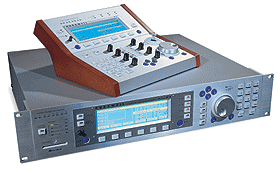 Photo: Mark Ewing
This new machine is an eight-channel multi-effects processor with up to fourteen physical inputs and outputs and an optional remote control panel providing real-time control of effects parameters. It is, in effect, the Kurzweil answer to TC Electronic's System 6000 platform and, while it doesn't quite match that unit's high-resolution capabilities, it comes surprisingly close in terms of raw signal processing at standard sampling rates, and is relatively affordable.
The signal processing engines used in the KSP8 are derived directly from the hardware and KDFX algorithms developed originally for the K2500 and K2600 keyboards. However, this new machine boasts over twice the processing power of the K2600, and it has a range of programs designed specifically for 5.1 surround processing.
|

KSP8 Hardware
The KSP8 is a 2U rackmounting box, extending 384mm behind the rack ears and weighing a tad over 6kg. The front panel carries all the necessary controls and displays to enable efficient operation, although an optional remote control unit is available — see 'The RSP8 Remote Control' box for details. Both control surfaces feature a large monochrome 240 x 64-pixel backlit LCD screen, with six soft keys along its bottom edge to access various menu pages and functions. The menus can be navigated using the cursor keys, and selected parameter values can be adjusted using either a data wheel, a pair of increment/decrement keys, or a numerical keypad. In addition, there are quite a lot of other buttons with dedicated functions to provide instant access to the most often used functions and screens. When the system is running, getting to a specific parameter of a Preset in a particular channel is never more than a few clicks away, and is often immediately available on one of the rotary encoders when the remote controller is being used.
The right-hand side of the rear panel sports an IEC mains inlet to the fan-cooled power supply, a trio of MIDI sockets, and a six-pin mini-DIN socket for the remote controller. The fan, while quiet, can still be clearly heard, so the KSP8 would be best placed in a separate machine room if the remote controller is used. The audio I/O is taken care of by a row of eight TRS sockets, providing four balanced analogue inputs and four balanced analogue outputs, with input sensitivity and output level independently adjustable for each channel. A pair of XLR sockets provide stereo digital I/O which can be configured for either AES or S/PDIF formats, supporting 24-bit input signals and 16, 20, or 24-bit outputs with a selection of dithering algorithms.
|
To access all eight processing channels at the same time, an optional audio interface module can be added to bring the system I/O up to a possible maximum of fourteen audio interfaces — although the effects processor can only handle eight channels internally. The first option is the KANA4 card, providing four balanced analogue inputs and outputs to extend the standard facilities to eight analogue I/O channels, and this was fitted to the review machine.
There are also digital interface cards which provide eight channels of I/O, plus a word-clock input on a BNC socket. The KAES8 is an AES-EBU interface, and the KADT8 provides both the Alesis ADAT lightpipe format and a TDIF interface. This latter card is particularly useful in that all sixteen physical outputs are available simultaneously, so a signal routed to the first ADAT output also appears on the first TDIF output, for example. Although only eight inputs can be used at a time, each effects channel can be selected from either the ADAT or TDIF port.
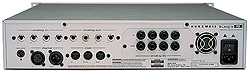 Photo: Mark EwingNormally, once an effects processor has been correctly integrated with a mixing console, the audio levels in and out can pretty much be taken for granted. The KSP8 certainly makes this assumption, as it has dispensed with the usual bar-graph input metering that you might expect. Instead, there are just eight tricolour LEDs, one for each channel. With normal signal levels these light green, turning orange when the signal exceeds -6dBFS. When an overload occurs the LED turns red.
So, although not as detailed as a conventional bar-graph meter, a quick glance at a row of green and occasionally orange LEDs is sufficient to reassure that all is well. Furthermore, the inputs to these metering LEDs are switchable between four key points in the notional signal path: at the input, after the EQ (before the effects), after the effects, and after the output level controls. There are also four clip LEDS which illuminate to warn of an overload on any channel at each of these four stages. Finally, the LCD panel can be switched (with a dedicated button) to show peak levels in dBFS values, and also to display eight conventional bar-graph meters, making initial level calibration very simple.
Internal Architecture
The processing architecture can handle up to eight channels of audio simultaneously, in any desired combination of mono, stereo, and surround channels. There are, as might be expected, a variety of processor channel modes, such as mono in, stereo out; stereo in, stereo out; mono in, 5.1 out; stereo in, 5.1 out; and 5.1, in 5.1 out. As with most digital signal processors, the KSP8's physical I/Os can be patched as required to the eight internal audio effects-processing channels. Each input can be routed to any number of processing channels, while different processed outputs can be mixed together before routing to a single output channel. Thus it is possible to combine the outputs of several effects processors to form a combined stereo effects return, for example. Each processing channel also incorporates its own multi-band equaliser and a stereo or multi-channel panner, before the signal is routed onward to the actual effects processor block.
The signal processing power is provided by a total of 16 DSP 'units' which can be allocated among the eight audio effects channels to provide the required effects processing. Naturally, different Algorithms use different amounts of processing power, so there are some limitations as to how many processes of particular kinds can be run simultaneously. Having said that, I didn't experience any problem combinations during my time with the review machine, using it in normal recording and mixdown applications.
The operating structure of the KSP8 is based on several functional layers. The foundations are built from the raw Algorithms, designed specifically for mono, stereo or 5.1 applications. These are the basic reverb, phase, pitch, EQ, dynamics, distortion and delay Algorithms, and, as you would expect, each is equipped with a comprehensive range of parameters to allow its characteristics to be changed as desired. The various parameters can be adjusted manually and also dynamically via MIDI automation or through a collection of internal modulation sources which include 36 LFOs and 36 envelope generators!
Suitably tweaked Algorithms are stored as Presets — such as Wooden Room Reverb or Slapback Flange. Although a channel can be processed by a single Preset, it is also possible to link different Presets together to form more complex combinations of effects (such as a phased reverb or compressed distortion with delayed reverb) which are called Chains. The top level of this layered cake is the Studio, and this is effectively a snapshot memory of the entire machine — all eight channels worth of Chains and Presets, plus the associated I/O routing and levels, channel equaliser settings, MIDI assignments, and so forth.
The RSP8 Remote Control
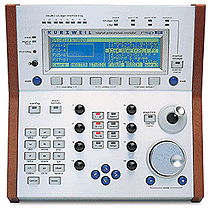 Photo: Mark EwingThe RSP8 is an optional remote control panel dedicated to the KSP8 multi-effects processor. It duplicates all the front-panel controls, displays and data-entry facilities of the rackmount processor, but also adds eight rotary encoder knobs to allow real-time parameter adjustment, and a joystick for stereo and 5.1 panning. The unit features an angled display screen and wooden cheeks, and has a solid, reliable feel to it.
It is quite large to sit on a console, but has the facility to be mounted on a suitable mic stand, if required, allowing it to be placed alongside the mixing position, rather than cluttering the desk. The controller is powered via the six-pin mini-DIN interface cable which provides the link with the main processor.
Algorithms & Presets
I counted 636 factory effect Presets built from the 249 internal algorithms, and there is onboard memory capacity to store up to 999 user-defined Presets. There are also 138 factory effects Chains, with a further memory capacity for 999 user-created Chains. Finally, there are 14 different factory Studio settings and, you've guessed it, another 999 user Studio memories. That lot all adds up to a heck of a lot of starting points for just about any kind of effect you can imagine — there are 24 pages listing the various Presets and Chains in the very detailed and well-written handbook. In addition to the onboard memories, Studio, Chain and Preset data can be stored to a Smart Media card (up to 64MB capacity) or can be exported and imported via MIDI SysEx dumps.
The reverb Presets include a wide variety of good-sounding spaces, covering all possible sizes, surfaces and applications. I was impressed with the ambience and 'booth' programs, as well as the small rooms, which are always amongst the hardest algorithms to get right. While I didn't think these quiet managed to equal the best of the Lexicon or TC Electronic small room reverbs, they were certainly believable and very usable. The usual array of chambers, halls and stages were also good, with nicely defined early reflections and controllable decays.
The collection of factory reverb Presets (149 stereo, 20 mono, and 40 5.1 Presets in all) continues with various plates, reverse reverbs, gated and compressed versions, nonlinear types, and Kurzweil's own Laserverb algorithms which have a very distinctive, surreal character all their own. On the whole, the Preset names are usefully descriptive, so finding a good starting point is fairly easy, and there is a simple alphanumeric search engine which can help locate all programs with, for example, 'room' in the title.
 Photo: Mark EwingFor each Preset, up to eight parameters are displayed at a time, the others being accessed in pages using the soft keys. The particular selection of parameters displayed on each page can also be configured by the user and stored as part of the Preset. The navigation buttons can be used to select the required parameter, which can then be changed using the wheel, the increment buttons, or by typing a new numerical value. If the remote controller is being used, then the eight displayed parameters are instantly accessible for editing via the remote control's rotary encoders.
In the case of the reverb programs, there are parameters here for the absorption and damping, early reflection level, decay level, pre-delay, wet/dry balance, source algorithm, room size, diffusion, and so on. Most Presets are arranged so that the most frequently used parameters are on the first page, with subsequent pages allowing access to the real nitty-gritty parameters — although most users will probably never need to delve beyond that first page.
Reverberation is only one component of a machine like this, and all the usual toys expected of a multi-effects processor can be found here: there are 50 delay modes, 25 chorus Presets and a similar number of flange and phaser treatments; about 25 tremolo and rotary speaker simulations; a handful of panners and stereo width enhancers; a comprehensive range of around 50 equalisers including various resonant, notch, and triggered filters, graphic and parametric EQs; several enhancers and cabinet simulators; 20 compressors, limiters, expanders, and gates; some excellent valve simulators and a sophisticated range of distortions, including valve emulation and some very lo-fi 'bad digital'; plus a very controllable ring modulator. Any effects which involve a temporal element in their range of parameters — such as the delays, filter sweeps, panners, and the like — can have the relevant speed set using either internal or external MIDI clocks, or by a 'tap tempo' key provided on a soft button.
Using The KSP8
I liked the KSP8 a lot, although I found it much easier and faster to control through the RSP8 remote panel. This is a very versatile and powerful machine, with an excellent and usable range of effects, almost all of which are very respectable. I wasn't that impressed with the pitch-shifting, but I would be happy to use everything else, and the reverbs not only work well in mixes generally, but are very controllable and easy to tailor to meet any requirement.
If you scale the UK price of this machine against the equivalent of four stereo multi-effects processors, you quickly realise what a bargain it is. But factor in the ability to handle 5.1 processing as well, and the facilities to route and mix inputs and outputs, plus the sheer breadth of effects algorithms built in, and it's easy to see why this machine is stirring up a lot of interest. Anyone thinking of moving into 5.1 mixing would be advised to look closely at this unit, as would anyone wanting to update their multi-effects processors with something more flexible.
Some may view the KSP8 as a poor man's System 6000, but while the functionality is similar to some extent, this is no slouch in the audio quality stakes. If you are considering the purchase of a multi-effects processor, this is definitely worth an audition — but allow plenty of time because there's a lot to hear!
| |
|
 KSP8 £2499.99; RSP8 £499.99; KANA4 analogue interface £299.99; KAES8 AES-EBU digital interface £tbc; KADT8 ADAT/TDIF digital interface £399.99. Prices including VAT.