

 Photo: Danny O'Conner
As a musician, engineer, producer and multimedia artist, Todd Rundgren has been a pioneering figure in rock music since the late 1960s. His first album of new material for 10 years was, like many of its predecessors, almost entirely played, produced and recorded by Rundgren alone.
 Todd Rundgren in more familiar guitar-hero pose.Photo: Danny O'ConnerMore than three decades ago a lanky youth with eccentric, gaunt features and large eyes sprang onto the international music stage with a remarkable double album called Something/Anything? The young man had written and produced all the songs, and on three of the four vinyl sides, had played all the instruments and sung all the vocals. The 1972 double album contained such a richness of top-drawer songs, nifty arrangements, and virtuoso playing and singing that it's still regarded as a timeless classic. The youth's next album, released in 1973, was called A Wizard, A True Star, and contained a brilliant sonic collage full of studio trickery, which was not only produced but also engineered by the man himself. His name was, of course, Todd Rundgren.
Utopian Legend
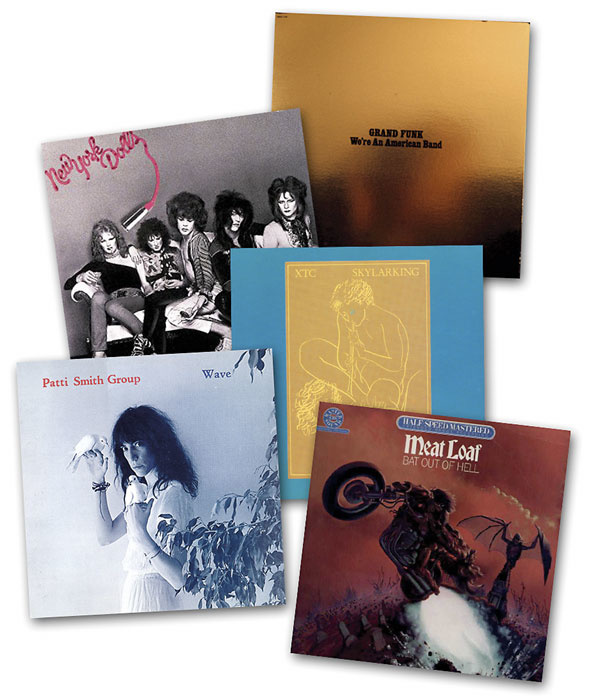
It took 10 more years for Rundgren to acquire a status close to that of living legend. In addition to his thriving solo career, he formed, in 1974, a band called Utopia, which recorded an array of albums during the 1970s and 1980s while moving stylistically from lengthy synth-driven instrumentals, via progressive metal rock, to power pop. In addition, Rundgren applied his knowledge of the recording process as a wildly successful producer for others. Often also functioning as engineer and player he oversaw the creation of classic albums like Grand Funk Railroad's We're An American Band (1973), the New York Dolls' self-titled 1973 debut, the Tubes' Remote Control (1976), Meatloaf's Bat Out Of Hell (1977), Patti Smith's Wave (1979), and XTC's Skylarking (1986).
...in 1980 he created the first colour graphics tablet, which was licensed to Apple as the Utopia Graphics Tablet...
However, the Philadelphia-born American refused to be a 'true star' in the traditional sense. Instead, he frequently took bizarre leftfield musical directions, dressed in weird camp clothing and make-up, and wrote lyrics that addressed much deeper issues than boy-meets-girl. He also became a pioneer of multimedia and computer technology. For instance, Rundgren organised the world's first interactive television concert in 1978, during which home audiences could chose what songs would be played; in 1980 he created the first colour graphics tablet, which was licensed to Apple as the Utopia Graphics Tablet; and in 1982 he made the first music videos to be commercially released, one of which was nominated for a Grammy. He founded Secret Sound Studios in 1972 and opened Utopia Video Studios in 1978, exemplifying a keen interest in audio-visual art.
 Todd Rundgren created the world's first colour graphics tablet in 1980, and is still exploring the possibilities today, thanks to the Tablet PC. Photo: Danny O'ConnerHis 1992 solo album No World Order was not only issued as a standard audio CD, but also on CD-I as the world's first interactive album, with the songs chopped up in four-bar segments, allowing the listener to construct his or her own song structures. In 1994, The Individualist was the world's first full-length enhanced CD, and by the late 1990s most of Rundgren's creative energies were focused on pioneering the use of the Internet as a vehicle for music delivery. Among other things, Rundgren founded two web sites, www.tr-i.com, and www.patronet.com [long before Patreon existed], through which listeners can act as patrons of the arts by paying the artist upfront to have music delivered directly to them. Since 1998 Rundgren issued his music song by song via Patronet, and some of this material, including some reworkings of older songs, was compiled on One Long Year, released as a traditional CD in 2000.
In several recent interviews, Rundgren has argued that CDs and record companies are outmoded routes for getting music from artist to audience. In his view, younger music lovers especially prefer to search the Internet, download what they like, and make their own MP3, MD or CD compilations. Rundgren's solution is to treat music delivery as the equivalent of cable television, with users paying a monthly fee of, say, $20, to gain access to all the music they want. Presumably, the proceeds are then divided between all those who supply music, according to some unspecified formula that may prove to be the tricky part to work out.
Todd Rundgren: The Record Producer
During the 1970s and 1980s Todd Rundgren was a big-name producer. He's produced artists like Janis Joplin, the New York Dolls, Hall & Oates, Alice Cooper, Steve Hillage, Tom Robinson, The Tubes, Patti Smith and Grand Funk, not to mention Meatloaf's multi-million-selling blockbuster Bat Out Of Hell.
"The most difficult thing of all in the studio, as a producer," explains Rundgren, "is not technical. It's to get the performer in the proper frame of mind to perform as if he or she's in front of 1000 adoring fans. That's the hardest thing. For a lot of people the studio is a foreign place, because you're isolating everyone, and they don't think of themselves in the moment any more. They're all thinking, 'Oh my God, I'm making a record, I'm making a record.'
Todd Rindgren: "The most difficult thing of all in the studio, as a producer, is not technical. It's to get the performer in the proper frame of mind to perform as if he or she's in front of 1000 adoring fans. That's the hardest thing."
"I've been involved in great records that have been artistic successes and that have been incredible commercial successes. It's hard to imagine something more commercially successful than Meatloaf, and at the same time that's musically so signature that it's also a classic. It was fun making that album. Meatloaf and Steinberg [the songwriter] are both fairly colourful personalities. It was also a tortuous record to make, because during recording Meatloaf wanted to be released by his label, and they let him off, and nobody else signed him. So I was underwriting the whole record, and it was a big gamble and not something I'd ever done before. I wasn't sure it was going to happen... even Bearsville [Rundgren's label at the time] turned him down!
"The work I did with Grand Funk Railroad [on We're An American Band] was fun, because they were a completely underestimated band. They had a big audience, but their records sounded like crap, because they had been produced by their manager, who knew nothing about making records. They were actually remarkably good players and singers, which their producer had managed to disguise from everyone! The gift in doing that record was instantaneous. Success happened like the speed of light, as opposed to Meatloaf, which took two years to break.
"[XTC's] Skylarking album is legendary in many respects... because of what happened between me and Andy [Partridge]. It was a little bit of a surprise for him to save all his vitriol until he was well away from me, and do it in the press, which I thought was shooting himself in the foot. It was a great album, and my attempts at making it accessible infuriated Andy. He thought it was another Andy Partridge solo album, with the help of the two other guys in the band. The problems probably started when I insisted that Colin [Moulding]'s material was as important as his...
"I've done a few productions in recent years, but nothing that has jived with the commercial market. Popular music is going through an abysmal phase right now."
Shapes And Sounds
Much of what Rundgren has done since the late 1980s has pushed the boundaries of the artist-audience relationship, in the search for greater interactivity. It therefore comes as a bit of a surprise to find that this April a traditional CD by him was released, called Liars, without interactive components, and put in traditional record shops by a traditional record company (Sanctuary). What's more, the synth-dominated work is hyped as a major event, because it's Rundgren's first CD release of all-new material for 10 years.
"Many people think of a record as a certain collection of songs put onto a disc-shaped object," begins Rundgren. "But in the past few years we've begun to realise that it isn't the shape of the object that matters. Instead sound can be virtualised in any number of forms. It may at one point be a link on your computer screen, and then it's a thing that appears in the window of your MP3 player, and it never takes physical form. At that point the experience of the music is more and more defined by the listener."
No problem here, one would say, but according to Rundgren, this does make it harder for musicians to realise their intentions. "You used to make a record and would say, 'OK, this record is 12 songs in this specific order and in this package with this cover and with these lyrics, blah, blah, blah. But now, at a certain point it gets completely redefined. Someone takes one song off this record and one song off that record, and burns themselves a CD, and this may be like nothing you imagined. That makes it very hard to say whether you're satisfying the original goals you set yourself. You have to be aware that you may have a concept about your songs appearing in a specific order, and that you may have to do something tricky to enforce that. Like on Liars, I had the songs overlap. I'm thinking here in terms of 'OK, I made a distribution deal with the record label, how do they hold on to the value of that format as long as possible?' You do that by trying to make the format unique in some sense. That's why all the songs flow together. No-one is going to download an entire album as one giant MP3 file. If you want the real experience of Liars, you're more or less forced to buy the CD.
"In addition to this, I'm delivering unlocked MP3s, with fade-outs in them, to my on-line subscribers, for them to do with what they want. What I know, and what I believe the record company knows, is that those listeners are going to buy both the CD and the MP3 files. They're going to buy everything there is. That's the whole idea of patronage, to get the most dedicated listeners, the ones who make a point of supporting you, and they will get a certain amount of attention and levity and special things that other people find difficult to get. And in that sense they give you the kind of support you used to get from the record label, like underwriting making records and financing your tours."
 Todd Rundgren's Utopia, 1980: Todd Rundgren, Willie Wilcox, Kasim Sulton and Roger Powell.Photo: Danny O'Conner
A Certain Sound
Todd Rundgren has something of a reputation as a guitar hero, but he has always explored other instruments, and on Liars, synths and other keyboard sounds take the spotlight. Once again, Rundgren plays all the instruments (barring a couple of solo spots by others). "I was going for a certain sound, " he explains. "I gravitated toward a B3 and Fender Rhodes for the central element. To me it's old-fashioned, and I wanted it to resemble all my influences... some Mose Allison, Beatle-esque things. And there's always a bit of Marvin Gaye in there somewhere."
Much of Liars therefore has a retro feel to it, dominated by influences of 1970s soul, and, rather surprisingly, four-to-the-floor 1980s house. According to Rundgren, this musical approach was shaped by the subject matter of the album. "It's a challenge to do an album called Liars, and not put yourself in a compromised position," explained Rundgren, quite understandably, and apparently not referring to the cover image of himself as a crazed Easter Bunny. "The album isn't about finger-pointing. It's about the phenomenon of dishonesty and non-reality and the many flavours there are, from the most innocent to the most venal. Not one of us is truly honest, and therefore the album is left open to accusations of fakery, which is why I'm, like always, reluctant to do any kind of breakdown of exactly how the album was constructed."
This kind of reluctance usually spells trouble for interviews of a technical nature, but luckily it was possible to persuade Rundgren to elaborate on the nuts and bolts of Liars. "Part of the reason there are so many keyboards on this album is compositional," he reveals. "I can do a lot more on a keyboard than on a guitar. There are just some things you can convey with keyboards that can't be done with guitars. The other reason is that certain keyboard sounds take me to a certain time. Like the Wurlitzer piano, which nobody plays any more because they're too much of a maintenance problem. They were a giant pain in the ass, but they had a characteristic sound. When you hear the Wurlitzer on 'Get Back', it takes you immediately back to the late 1960s. The same goes for the sound of the Fender Rhodes, and the B3, and some of the old, mono, analogue synths."
Todd Rundgren The Engineer
 Throughout his long career, Todd Rundgren has engineered and produced many of his solo albums, as well as often playing all the instruments. Among them are Something/Anything? (where he left the engineering to others), Hermit Of Mink Hollow (1978), A Capella (1985), No World Order (1993), and now Liars.
"There's certainly been a whole evolution in working," recalls Rundgren. "After Something/Anything? I got into engineering as well. I built a studio [Secret Sound] for the recording of a Wizard, A True Star, because my approach to music was so unrestricted that it was impractical to pay a studio by the hour. I engineered almost everything that happened there. In most cases this involved pushing a button and running out into the studio to participate in the performance. I also was punching in and out for myself when recording vocals. Initiation (1975) was also done that way.
"Recording Hermit Of Mink Hollow was a real hardship, because the control room was upstairs and the drums downstairs, so when trying to record drums, if I made a mistake, I had to run up and down the stairs just to rewind the machine. I didn't have a remote with a lead than ran long enough! For a long time I had a degree of aversion towards using synthetic or sequenced elements for basics like drums and bass, but eventually decided that the ends are always worth the means. My resistance came to an end on No World Order, because the music was delivered in such a radically different way, all chopped up in four-bar segments and later resequenced, that I couldn't consider another way of recording it. It's really difficult to get musicians to play with that degree of precision, so you can splice it every four bars. So it was a technical necessity to perform it substantially electronically.
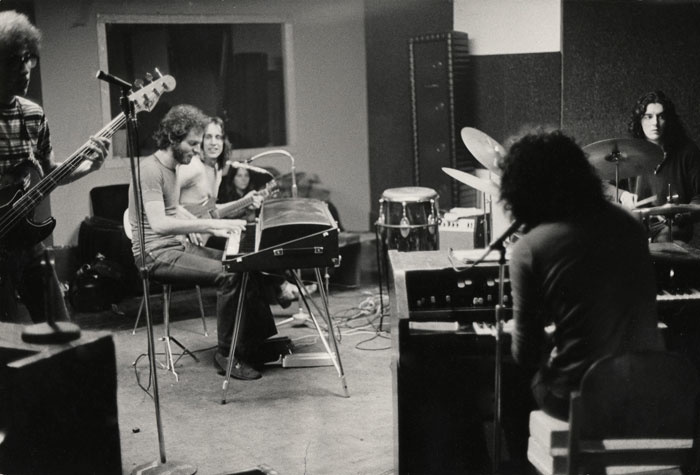 John Seigler (bass), Ralph Schuckett (electric piano), Todd Rundgren (guitar), Moogy Klingman (organ) and John Siomos (drums) rehearse at Secret Sound Studios for Todd's album A Wizard, A True Star in 1972.Photo: Bob Gruen / Star File