


In the past, tie-in video games have had to use samples to recreate real orchestral soundtracks from the original TV series or film. With 24: The Game, however, it was the other way around.
The TV series 24 has been an incredible success, so it was probably inevitable that it would lead to a spin-off video game, in this case produced by Sony for their Playstation 2 console. In order for the game to have the look and feel of the TV series, it was essential to retain the recognisable theme music, which was written and produced by LA-based composer Sean Callery. In a reversal of the normal order of things, though, Sony decided that the sample-based orchestral parts used in the TV music were not glossy enough for the game, and turned to Nimrod Studios, based in Oxfordshire in the UK, to ask them to 'take the recording to the next level'.

Although the brief was fairly open, the next level could mean only one thing, according to Nimrod's Production Director Richard Aitken. "Sean had done a good job of the composition, so deciding what to do was a no-brainer: the next level meant replacing the sampled parts with real instruments. Sony might have initially expected real horns and a few live 'cellos on a bed of sampled strings, but we've found that sort of doubling up rarely works and it's a tricky thing to do."
Providing orchestral arrangements for games is certainly not new territory for the Nimrod team. In fact, they have made it their speciality, and already had a long track record working with Sony on music for The Getaway, Black Monday, Gran Turismo 4 and Driver versions 2 and 3. "When Marc [Canham] and I started the company," says Richard, "we were looking for a new niche, having decided it wasn't worth running a studio or releasing records, so we set out to do game music to the professional standards expected from the rest of the music world. We were one of the first teams taking it to those extremes — before that it was people sequencing Proteus modules, or programming the GM MIDI synths that were inside products like the Playstation 1. One of our early jobs was on Driver 2, and luckily that it was a massive hit so we made our name with that.
"We don't use sampling unless it's really necessary, but some jobs call for it. For children's music, for example, sampled strings and guitars are appropriate because they're more toy-town, so it's more accessible for kids. It seems strange, but clients often want a professional/amateur score, which sounds like it was done on the cheap but wasn't! For that you deliberately use things like GM pianos. The music for [toddlers' TV show] the Tweenies, for example, is a very hi-fi mix, but it's clearly been done on MIDI modules, so it's cheaply recorded but expensively mixed, if you see what I mean!"
Dissecting MIDI
Nimrod's brief in this case was clearly to record and mix expensively, but before they could do that they needed to acquire the raw MIDI data and audio samples for the TV theme from Sean Callery. However, the composition was almost six years old, and Sean was unable to locate all his samples, or decipher what sounds were supposed to be triggered by the MIDI messages. "There were 116 tracks of MIDI," explains Richard, "and that was condensed from other tracks, so we ended up flying out to LA to discuss it with him. Quite often the MIDI would be meaningless, having originally triggered some kind of loop, so all you'd get is a 'C' sharp played for 10 seconds! We brought it all back so our in-house orchestrator, Johnny Williams, and Marc could study the MIDI and begin notating the score in Sibelius. That process of analysis helped us really understand the score musically, in terms of what emotion Sean was trying to create."
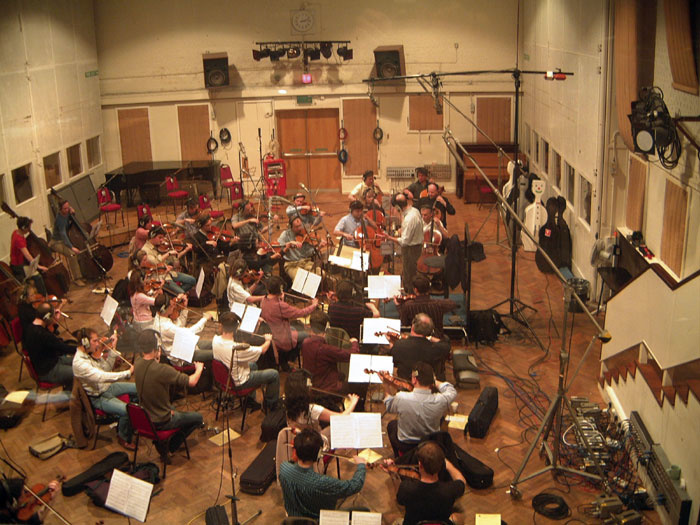 The main theme for 24: The Game was recorded in Abbey Road Studio 2, which, with its 'big but dead' acoustic, suited the fast string lines and dark atmosphere of the music.Notating the MIDI also involved changing some of the instrument assignment so that it better suited the subtle tonal eccentricities of a real ensemble. Richard explains. "Orchestras usually have two trombones plus a bass trombone, but sample libraries often have three, so if a composer uses two harmonic trombone patches panned left and right, you end up with six trombones playing together! As samples they still sound OK, but try doing that for real and they'll chorus terribly. In one instance there were meant to be four horns playing the high 24 melody, but to avoid chorusing and pitching issues we transposed two of them down an octave and recorded those parts separately. Mixed together, they sounded more in tune and actually reinforced each other. We also had to make sure that the chord clusters were playable by the number of musicians and instruments we had available, so there was a bit of re-voicing to do."
Sean's 24 score also contained numerous electronic sound effects and some sample-based material which was not suitable for orchestration. The team's plan for these parts was to locate the relevant samples and use them where possible, recreate anything that was missing. Callery provided Nimrod with an incomplete list of named samples, some of which were located and reused, but the audio tracks he'd recorded in Pro Tools were only used as a guide and weren't actually included in the final game score.
The Nimrod Studio Orchestra (NSO)
Nimrod Productions was started in 1999 by Richard Aitken, who now tackles most of the mixing work and production, and fellow director Marc Canham, who acts as the company's composer and main project manager. The pair are joined by in-house orchestrator and conductor Jonny Williams, engineer and studio manager Edwin Scroggie, and project manager and composer Andy Gannon. The orchestra itself is a variable number of session musicians, the core members being a valued bunch of regular Nimrod contributors. Richard explains the NSO philosophy. "We don't just rent an orchestra, we use the same musicians; people like bassist Stacey Watton and engineer Andrew Dudman at Abbey Road Studios. I have a longstanding relationship with a core of 10 to 12 musicians who we use all the time, so we have really open communication paths. The vibe is special because there is that friendship, which is important when you are spending days together in the studio. Building a good reliable team also minimises your risk, and when you're dealing with a project like 24, an hour or two of fuck-ups can cause considerable financial damage. We are our own fixers and I think we're fairly unique in that way. If we have a 60-piece orchestra, only a third of them will be strangers to us.
"Abbey Road engineer Andrew Dudman operates the console but I run the Pro Tools rig or tape machine system because I know all the edit and re-dub points. I like to talk directly to our conductor and musicians rather than relaying things through the engineer, and our regulars are usually spread out amongst the orchestra so we can communicate easily and rely on them to sort out any problems.
"I try to order the music so there is an easy piece to break everyone in, and by the end we're getting guys in the orchestra to be a bit creative, especially when we're looking for special effects. We'll be saying 'What do you want to do?' Instead of 'This is the bit we're doing, get on with it.' We must be doing it the right way because we finish upwards of 20 minutes a day and it's rare for an orchestral session to record more than about 12."
Playing In The Road
Having separated the noises and effects so they could be dealt with later, the Nimrod team began preparing to record the orchestral parts, as these were to form the basis both of the main theme that runs throughout the game, and the cut-scene themes, which Richard describes as being the parts that link scenes and missions together. "The cut-scene music was written specifically for the game," adds Richard, "so Sean delivered the parts in a more concise and organised format. They were more orchestral, and were more like a movie score."
 Cut scenes in the game featured specially written music which was tracked in Abbey Road Studio 1, for a more expansive feel. Visible above the conductor is the Decca Tree array of three microphones, with the very high stands containing ambience mics which were eventually used to feed reverb units.Two days were booked at Abbey Road studios with the intention of using one to produce the in-game music derived from the TV series, and the other for the more cinematic cut-scene material. "We've tried all the well-known London studios over the years but we particularly like Abbey Road for orchestral stuff," Richard insists. "For Black Monday we used Angel Studios because it has a harder and brighter sound, even though it looks quite woody. Abbey Road may look a bit like a school gymnasium but when you walk up to the walls you see it's treated. Studio 1 is much more suitable for big pompous ambient affairs or truly orchestral music, so we booked it for the cut-scene sessions. Studio 2 is surprisingly dry and dark-sounding, very dark in fact, which made it ideal for the main theme which had lots of very fast string parts that need to be heard succinctly and clearly. Essentially it doesn't have reverb; a snare in there doesn't go boomphhhaaa, it just goes boom.
"I knew I'd need to use the same reverb when blending the electronic parts, so I didn't want room sound. In the end I used our old EMT 140 stereo plate reverb that was in the Palladium in the 1960s. It has a deep, dirty, organic sound that many simulations seem to lack. I had the reverb set on a really short setting of about a second and a half, and that proved ideal for blending the two.
"Using classic gear like the EMT is an eye-opener because you soon begin to realise that the sound you've wondered about for years is often just preset number three, or that the classic kick, snare and bass sounds you hear on certain records are created simply by running to tape through an old Dolby unit. And if you've ever wondered how they engineered that dry drum sound on old Beatles records, it's just the way a kit sounds in Studio 2 if you dampen it off with tea towels. Obviously the engineers have a lot of skill but so much of it is having the right room and the right gear.
"I used a TC 4000 to provide some quieter symphonic reverb, just so that on the tail of some of the strings you get a sense of space. The algorithm was an altered version of the VSS4 Concertgebouw, which is very smooth. I changed it to 2.8 seconds which felt right and darkened it somewhat, and it was blended with the EMT plate reverb and supported by two room algorithms from the TC 6000. During the loud sections the mix is surprisingly dry; I was actually pulling those reverbs down because the electronica was providing all the sustain it needed."
Setting The Scene
As one might expect, quite a lot of preparation needed to be done to ensure the large orchestral session ran smoothly. Sample-based backing tracks of all the parts were arranged on separate channels in Pro Tools for referencing individual score elements during the sessions, and a custom click track was prepared to ensuring the playing would be tight enough to suit the demands of the game. "For an orchestra you have to get the right click track," insists Richard. "The one we use is a shaker processed through Abbey Road's own Urei click-track shaper. We shaped it so it wouldn't bleed from the orchestra's headphones and sampled the result for future use. For games it's all very strictly cut to time so the click is important, but the guys we use are used to the rock & roll language and can come in on a beat."
 Much of the unusual percussion in the TV series soundtrack was replaced by live overdubs, often using unconventional sound sources, as Ed Scroggie demonstrates.Before the sessions, Richard liaised with the Abbey Road engineers to agree on a recording strategy and seating arrangement for the musicians. "I set up the orchestra a little differently from the standard and always put my basses in the centre as opposed to the right. The main reason is that if you have a lot of bass coming from the right side it makes your speakers work in opposition." To capture the orchestra as a whole Richard used three Neumann M150s in the famous Decca Tree arrangement, placed 10 feet above the D-shaped space left between the conductor and orchestra. "As far as I'm aware it's pretty standard fare for strings and picks up a representation of a mid-range recording. It also gives you absolute mono compatibility from the forward-facing mic.
"I also used mono spot mics on the orchestra, although I know a lot of engineers set up stereo points at the front of each section. I find mono is a lot easier to handle in the mix when you want to focus in on an instrument, or something like a string tremolo. When I'm panning I like to get most things working from the 10 to two o'clock position, because it's much more impressive when you do introduce something that's really wide. I have the Decca Tree mics panned centre, nine or 10 o'clock and two or three o'clock.
"I also had Coles STC 4038 ribbon mics up in the room during the string sessions but didn't use them in the main mix. There are two moments when the violins go high and thin and that can be a bit harsh, so a ribbon mic is an ideal choice for adding warmth and depth. In the end I didn't need them, but I covered all eventualities. I also had some mics set right at the back of the room, but I didn't use those at all."
Although making a surround mix was not part of the brief, Richard took the precaution of placing two Schoeps outriggers about 35 feet apart at the front of the orchestra, and fairly high in the room, to pick up the ambience in case someone changed their mind at a later date. As it happens they were put to use for non-surround purposes. "They were really high to up the furthest room sounds, which would have been ideal for surround, but I actually ended up feeding them to the TC 4000 reverb without putting them in the mix. Surprisingly little genuine surround recording is commissioned, and even some of the big film productions just put mixes through the TC Electronic System 6000's Unfold tools.
"We fed most of the strings through Abbey Road's [Neve] AIR Montserrat preamps, which were really clear at the top end and gave a sheen to the violins. The rest went straight into the [Neve] 88R console."
Playing The Game
What qualities do you need for a career in games music? "Having talent and ability and being able to play, write and record is a prerequisite, and you need to have good ears, a good studio and be interested," says Richard Aitken — but that's not all. "It's no good saying 'I'm talented so I deserve it,' because those are the tools of the trade, the rest of it is how you run your business. We got into it by being businessmen, not by being the best writers.
You can't get by being the dope-smoking guitarist, you have to be professional and give the customers what they want, and not what you think they want, and know when to do what you're told. We made mistakes in the early days, but we've come to realise that it's the client's project and they usually have a good idea of what they're after. It's also about trying to be honest, fair and open with people. Don't get involved with arguing about the nitty-gritty — it's best to concentrate on getting a good job done, and figuring out when you're wrong. I don't think sending out a showreel is the best approach. You have to make your own luck by getting into a position where it can happen, so it's about hard work and networking.
"There are no royalties in video games, although there are sometimes stepped payments, so you get so much if it sells two million, and then another sum if it sells another million."
Back To Base
 In-house orchestrator and conductor Jonny Williams overdubs a piano part. Back at the Nimrod studio, Richard began compiling the various takes to form a single coherent performance. Each one was aligned within Pro Tools and all were synchronised to the click track so they were fairly easy to edit together. Richard used quick crossover points to avoid level glitches or chorusing and made the cuts under percussion hits so they'd be hard to detect.
Then began the process of adding the assorted sampled sounds, either by taking them from libraries or by fabricating a suitable substitute in the studio. "We managed to track down one very specific guitar sample from a CD," says Richard, "but other guitar lines were played, and in one case we miked up a cab to copy a part with feedback. That was played on a Burns plugged into a Line 6 Pod using a Rat distortion model, and the output was fed into a Fender Twin Reverb cab. That was captured using a Shure SM57 close up and a U87 in the room. In the end I just used the SM57, sent pretty much 90 percent wet into the mix via a plug-in reverb.
"Some of the lower thudding sound effects were created by hitting objects like our plate reverb and pitching them down. We also struck and re-pitched the pedal on our baby grand and the vibrating piano strings themselves.
 The main mixing desk at Nimrod is this Neve 51."In some instances the samples didn't sit too well with the orchestra so we ended up playing a lot of the percussive stuff using hi-hats, wood blocks and cow bells. We even created one of the theme's distinctive 'clickety' parts by striking an old cooling-fan grille with forks. We searched the studio for something that would make a high, resonant ring, and also sound organic at the same time. To give it a brittle sheen I used one of my favorite tricks and ran it through a Roland RE101 Space Echo with no echo, and the whole lot was driven hard through a TL Audio 5001 preamp. The sound was also mixed with some Zildjian hi-hats.
"There's a dig-a-dig-a-dig-a noise running all the way through 24 and that had to be worked out and reprogrammed from scratch because the original part Sean had sampled and looped on his Synclavier wasn't cutting it. In our live room we recorded a synth — possibly a Prophet — fed it through a guitar amp to add a bit more bottom end and sent it to our Abbey Road reverb simulation.
"We also did some double-bass overdubs to provide some more depth and we added timpani using a library we've created ourselves. You really need 20 variations of every hit so that it doesn't sound repetitive and even the Vienna String Library hasn't really got that, so some years ago we went to the Oxford University music faculty and recorded our own in different keys."
24: The Advert
The Nimrod team were commissioned to record a version of the 24: The Game music for the cinema and TV advertisements and, having been given a brief to make it quite punchy, they booked the bright-sounding CTS Studios in Watford. "We recorded brass and strings together, but the brass was extremely loud so we shifted the Decca Tree down towards the strings and moved the brass players back about 15 feet to get the separation," says Richard Aitken. "Even though we had four bass players, six cellos, eight violas and 20 violins I think we should have booked more — maybe 25 violins and six bass players — to balance out the brass. I did lot of scooping using the Manley Massive EQ to quell the brass."
Mix Tricks
To make the final mix easier, and to ensure all the electronic elements would marry up with the orchestral parts, Richard sub-mixed and pre-mastered various tracks into a few manageable stems. "I processed the spot mics for each section so, for example, I had a couple of faders for my brass and a couple for strings. I used a Manley Massive Passive valve EQ on the brass to tackle the harshest frequencies arising from hard-blown trombones. The Manley really suits orchestral timbres and has a very broad Q which is useful for tackling that abrasiveness from 900Hz to 1.5kHz. The brightness from 2.5 to 3 kHz also needed a bit of attenuation, especially from the Studio 1 sessions.
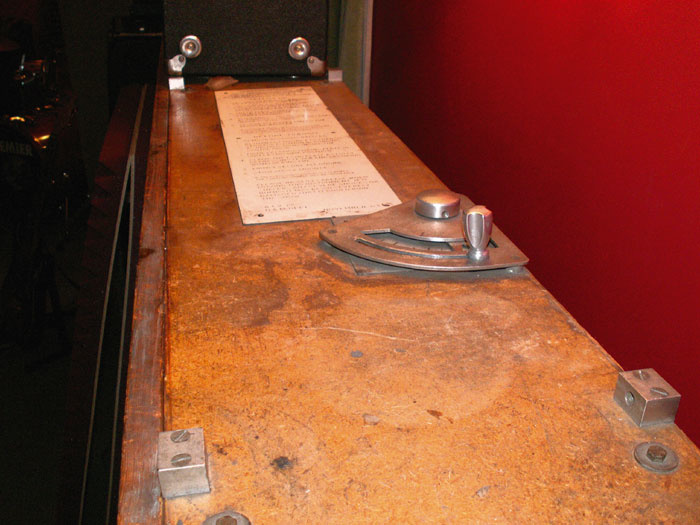 The reverb treatments for both orchestral and synthetic sounds relied heavily on Nimrod's vintage EMT 140 plate."Orchestral recording are not usually compressed, and I didn't do it on the cut-scene stuff, but for the main theme I used the Cranesong STC8 compressor to bring up the orchestra's level, and reduced its dynamic range to match the electronic material. I used the classic trick of setting a 1.2:1 ratio with the threshold right down so it's slightly compressing everything. The original MIDI does sound dynamic but it's nowhere near as dynamic as live instrumentation so I was trying to bring my orchestral recordings into line, otherwise it probably wouldn't have been as punchy as Fox and Sony would have liked."
For the percussion mix, which included everything from rock toms to snares, sampled and electronic drums, plus the fan percussion and tapped plates, Richard used parallel compression. "Basically I mixed a massively squashed version of the percussion with the uncompressed signal so it would reinforce the quieter parts. I used the STC8 again, via our Neve 51-series console, and set it up to emulate an optical compressor with a long attack and short release.
"I often run the mix through our Neve desk and use its EQ before tracking parts into Pro Tools. It has the first version of their spectral formant EQ which works very much in the same way as the Massive Passive, in that if you boost two bands at the same frequency by 6dB you don't get 12dB of boost, you still get six, so you can place two crossover filters close together without creating a third hump, and that allows you to do some quite surgical equalisation as you would with a digital parametric. The bottom end is fantastic too — you can boost away and it doesn't distort. I do use plug-ins during the mix, though, because having recall is essential when customers are constantly asking us to change something or other."
 More conventional percussion was overdubbed at Nimrod from their large array of instruments.When it came to panning the various mix effects, Richard went for a less extreme configuration than the one originally adopted by Callery, so that they would sit comfortably with the orchestral panorama. The positioning of each part was retained, however and the original effect fades were largely replicated.
Before sending the final mix for dubbing, Nimrod carried out a little of their own post-production work, premixing the music slightly so that it wouldn't get ducked severely by the dubbing engineer while adding the game's dialogue. Richard explains the technique he used. "When there's lots of dialogue you have to mix so the music comes from behind the orator. Close-miked instruments are right there in the speakers, so I employ a trick to push them using two stems of the mix. One is the normal version but on the other I use the Pro Tools Lexicon plug-in set to 100 percent early reflections, and that pushes the music behind the scene so that it sounds 35 feet further back while retaining its volume. Whenever there's some talking I'll mix the early-reflection version in with the dry mix. There's a good example of this during a car chase in the film Ronin when the music seems to go behind, and left and right, when Robert De Niro starts speaking, and I'm pretty sure that's using a similar trick."
The Future Now
Given the popularity of the TV series, and the current market for new and exciting games, 24: The Game is almost guaranteed to be a huge success. It may also set a precedent for lavishing a bigger budgets on the music for a video game than for the parent film or TV programme, a standard made all the more worthy by the high-resolution sound output of the latest consoles, and the likelihood that players will subject themselves to it for a longer period of time than the program viewers. The main theme also forms the basis of the soundtrack for an album release by Fox, further confirming just how far games music has come.
Nimrod Studios Gear List
Recording
- Digidesign Pro Tools TDM with RME converters.
- Steinberg Nuendo v3 (x2) with RME converters.
- Fostex D108 hard disk recorder.
- Tascam 80 eight-track recorder.
Desks
- Mackie 1604 VLZ.
- Neve 51-series.
- Soundcraft 6000.
Monitoring
- Adam P11a.
- Alesis Point Sevens.
- Dynaudio BM6.
- Earthworks Sigma 6.2 (with Hafler amp).
- Presonus Central Station monitor controller.
Outboard
- Alesis Wedge reverb.
- Cranesong STC8 compressor.
- Dbx 266XL compressor/gate, 376 voice channel.
- Empirical Labs Distressor compressor (x2).
- EMT 140 stereo plate reverb.
- Manley Massive Passive EQ.
- Neve 1073 preamps.
- Roland RE101 Space Echo.
- TC Electronic Reverb 4000.
- TL Audio Ivory Quad 5001 preamp, 5050 preamp/compressor.
- Waves L2 hardware limiter
- Yamaha late '70s reverb
Microphones
- Neumann U87s.
- Studio Electronics Z5600As.
- Models by Audio-Technica, Rode, AKG, Shure.
Instruments & Samplers
- Akai MPC2000, S2000 and S5000 samplers.
- Beckhardt baby grand piano.
- Crumar vintage electric piano.
- Double bass, cello, banjo.
- FAT Freebass synth and THC00 Resinator.
- Jen SX1000 synth.
- Moog Rogue synth.
- Roland Juno 6, Juno 60 and JP8000 synths.
- Sequential Circuits Prophet 5 synth.
- Various Premier drum kits, Zildjian, Paiste and Istanbul cymbals.
- Various electric and acoustic guitars, basses and amps.
- Yamaha P60 weighted digital piano.