

With its 150+ tracks encompassing everything from a marching band to a children's choir, it took a special talent to craft a hard-hitting, radio-friendly mix from My Chemical Romance's 'Welcome To The Black Parade'. Enter Chris Lord-Alge...
Chris Lord-Alge has an uncanny knack for making rock tracks both hard-hitting and hit-parade-friendly. The triple Grammy-winning mixer has become a genuine legend of the studio industry, to the extent that Allmusic.com needs eight pages to list his 750-plus credits. The first are from his early days as an assistant engineer at H&L Studios in New Jersey. This was followed by a stint as staff engineer at Unique Recording in New York. Lord-Alge moved to Los Angeles in 1988, and in subsequent years he added names such as Prince, Tina Turner, Stevie Nicks, Joe Cocker and Peter Frampton to his résumé.
In Lord-Alge's early days his activities also included engineering, keyboards, programming and producing. But since the late 1990s he's focused exclusively on mixing. The list of those who have benefited from the Chris Lord-Alge mix treatment is inordinately long, but to name just a few: U2, Snow Patrol, Sheryl Crow, Dave Matthews Band, Savage Garden, Green Day, Placebo, Alanis Morissette, Bon Jovi, Faith Hill, Melissa Etheridge, the Futureheads, Fleetwood Mac, Pink, Foo Fighters, Black Eyed Peas, Courtney Love, Heather Nova and Santana.
Vintage & Modern
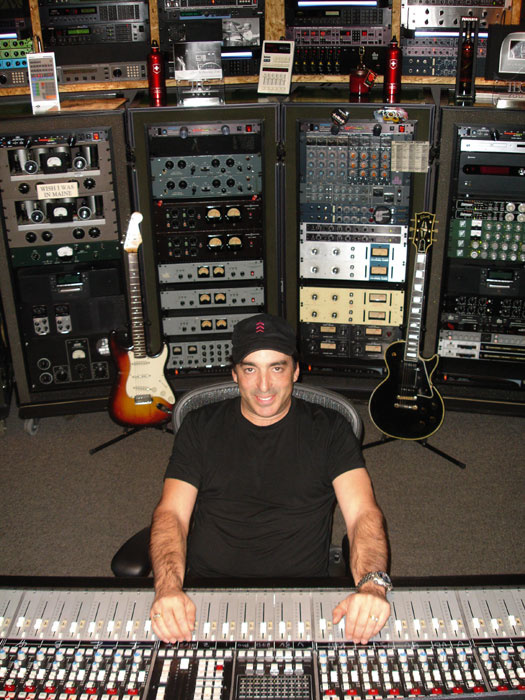
Chris Lord-Alge, whose younger brother Tom is a very successful mixer in his own right, works from Resonate Studios in Burbank, Los Angeles. In addition to the fact that his mix room is unusually airy and spacious for a recording studio, there are three other things that immediately attract attention: his 60-input 4056 E-series SSL, the incredible amount of mostly vintage outboard gear present, and his Sony 3348. Much of Lord-Alge's gear appears to date from 15 years ago or more, and it's a sign of how fast technology is moving that one feels compelled to explain that the 3348 is a 48-track digital two-inch tape machine that was first introduced in 1989, and Lord-Alge has the original 16-bit/48kHz version.
Lord-Alge elaborates on these ageing tools of his trade and why mixing 'in the box' is still irrelevant for him. "I have camped in front of an E-series SSL since it came out in 1985, and I don't think SSL have since improved on the concept of that console. The recall, the compressor and gate, the way the channel strip is laid out, the ease of automation with a very simple computer that just does faders and mutes... I have not found anything better. It is comfortable to use and it sounds musical. Sure, the G-series had a bigger keyboard, but for automation you don't really need to be able to type letters to anybody! I prefer it simple with a small keyboard and a computer that you probably couldn't even run a modern video game on. But what the computer does, it does well, and in the mixes I have done over the years, I've never needed more than fader and mute automation.
"I look at the E-series as SSL's [Neve] 8078: it's the classic SSL with the classic SSL sound. That's where they really hit the mark. I'm not saying that the 'J' and the 'K' and the Duality are bad, but I appreciate the character of the E-series. It's like plugging a nice Les Paul into a Marshall stack or a great tube amp. I've had my desk modified, with line amps and buss amps brought up to G+ spec, but it still sounds like an E-series. If I ever wanted to change, I would like them to make me a new one from scratch, with the same technology."
Chris Lord-Alge Plugs In
Last year Chris Lord-Alge, hitherto not perceived as the world's most enthusiastic Pro Tools and plug-in user, surprised many by endorsing Waves's new SSL 4000 bundle, even offering the company his SSL settings for a variety of instruments, so they could use them as plug-in presets.
"I normally don't really endorse anything," comments Lord-Alge, "but when the Waves bundle came out, I knew that SSL had given them the green light to officially copy the E-series EQ. It sounded really good, it looked good, and it was very similar to what I was used to, as I've been sitting in front of the E-series for years. So I looked at a whole bunch of settings I had used over the years and copied them right off the console.
"Today, believe it or not, the plug-in I use the most is the Waves SSL bundle. I use it in conjunction with the console. If I can't get the guitars bright enough on the console, I can add 6dB at 8k on all guitar tracks on the way in. Or I can use some of the SSL limiting in Pro Tools. Also, the difference between the console and the plug-in is that every one of those plug-in EQ and compression settings sound exactly the same. But on the console each channel is a little different. It's the nature of a beast that's 20 years old. So I now use my own presets on the Waves SSL plug-in as a starting point, and I tweak from there."
You Can't Beat Outboard
The vast array of outboard gear in Lord-Alge's Resonate room is explained by his assertion that hardware effects still sound significantly better than plug-ins, plus the fact that he has most of his boxes permanently set to one setting and hard-wired to specific channels of his SSL. If he finds himself regularly using an additional setting, he tends to buy another copy of the same box for that purpose.
The mixer extraordinaire explains: "We have a little bit of a Noah's Ark mentality here: two of every effect ever made. It's like when you go to an ice-cream parlour, you want to make sure that they have all the flavours you need to make your sundae. Plug-ins don't give me the character thing that outboard has. Outboard compression is tough to beat. When I hear a song, after the first minute I know what effect I want and yes, most of these units are set to one sound. The Lexicon 480 has millions of presets, but its algorithm has a certain texture, and the best effect remains the delayed plate. It's a sound that's been around for a while, and it works really well.

 This composite screenshot (above) shows the Edit window from the original Pro Tools Session. The 159 tracks were comped down to 44 on Chris Lord-Alge's Sony 3348 digital multitrack recorder, as shown on the track sheet (above)."I use the Sony DRE2000 on drums and percussion, and they have never improved on that sound. The AMS still has that non-linear setting and the classic long reverb that you can't change and that nothing else can duplicate. The Lexicon 300 has a really nice, distinct and clean long reverb. Lexicon reverbs tend to sound bright, while the Quantec reverb has a dark quality. The delays of the Roland SDE3000 have real character, and I also use the Line 6 Echo Pro — with delays it's all about tempo. The Marshall Tape Eliminator gives me tape slap echo, and I also still use the Eventide H3000, even though we're not doing that much chorusing these days. All these effects are tough to beat."
So what about the 3348? All the other mixers so far featured in this series have been Pro Tools converts, because of features like high resolution, enormous track counts, instant access and ease of editing. Why does Lord-Alge prefer to work with something non-standard that has none of these qualities?
"They can say using the 3348 is oddball," he responds, "but right now there is no other format to which you can compile all the Pro Tools stuff and that works well and is reliable. When you are mixing with tape, you are doing rewind and fast-forward and locate and play and you get a feel for a song in a way that a computer doesn't give you. Plus, when I compare the sound of Pro Tools and Apogee and all that, the 3348 still sounds better to me. It's punchier and more in your face, like vintage analogue tape. My brother uses the 24-bit HD 3348, but I'm used to the way my 3348 sounds, and as long as you hit the level well, you're OK. The essential thing about bits is really the resolution of level. The 3348 has a sweet spot where it sounds really good, somewhere in the top 10-15 percent of the level.
"I still prefer the open-reel format, sonically, in terms of vibe, in terms of having something stable, and it gives me a definite number of tracks to end up with. These days many songs come in as Pro Tools files consisting of well over 100 tracks, and you can have issues when loading such a file because of tracks that are spread far and wide. With 48-track digital tape there's nothing hidden and you know everything is there. And there are no real compromises in comping down to 48-track, or, as is more often the case, 44. You actually end up being more creative because you're making a lot of your magic happen in your comps. If you look back at Sgt Pepper's, everything was comped, four tracks on four tracks. In most early records it was all about submixing, and about mixing from the word go."
With these last few sentences Lord-Alge touches on the heart of his mixing approach, and what appears to be his core reason for using the 3348. The whole process of comping down to and mixing from 44 tracks appears to offer him an elegant way of organising his material and sharpening his creative focus. It's a streamlined and long-standing working method that has served him well, and he sees no need to change something that continues to help him deliver mixes that sound relevant today, are head and shoulders above the competition, and regularly occupy the upper regions of many international hit parades.
 Chris Lord-Alge leaves most of his hardware gear fixed on a single favourite setting. If he needs to use another setting, he buys another 1176...The best way to examine the ins and outs of Lord-Alge's mix approach in detail is to take apart his mix of one particularly successful song. Inside Track chose the slow-building, wall-of-sound rock track 'Welcome To The Black Parade' by My Chemical Romance, which features a massive, Roy Thomas Baker-style kitchen sink production.
'Welcome To The Black Parade'
Writer: Gerard Way • Producer: Rob Cavallo
"This song came in on a Pro Tools file with 159 tracks. After we get the file in, I review the possible comp scenarios with my two assistant engineers. They then prep the file, getting rid of all the crud, hums and noises and so on, and they also comp with the balance they think I'm after. When you clean up the audio files you have to make sure that you cut and tail things off in a musical way. There's no global leakage clean-up plug-in; you have to manually go through things, and that can take time, although most of the time the engineers of the producers of the tracks that I mix are really good and they will have prepped the file well.
"All the comps are done inside of Pro Tools, because if necessary I want to be able to reprint the comp onto a fresh piece of tape. The comp of 'Black Parade' was 44 tracks — the remaining four were for the rough mix, for reference, and I printed my final mix back to the 3348 [see track sheet, previous page]. There were 26 Pro Tools tracks of huge marching snares and rooms and ambience, which we called the March. It's comped down to a stereo pair on tracks 45-46. Then there was what we called the Ensemble, which is woodwinds, brass, strings, which was 10 tracks, comped to a stereo pair. We comped the big orchestral drums — bass drums and timpani and so on — separately to 13 and 14. There were also six tracks of Ensemble rooms, reduced to a stereo pair, plus four tracks of cymbal overdubs that we comped to tracks 15 and 16. We made a duplicate of the Ensemble, 16 tracks to a stereo pair (1-2) and the Ensemble rooms (5-6), because we needed to do an edit for the single version of the song.
"The drums were fairly straightforward: the comp had two snares, stereo toms, hi-hat, stereo overheads and stereo room. I replaced their kick with a clean and punchier kick sample and also added two snare samples — all samples were taken from the track. The bass was a DI and an amp. The main pair of guitars, on tracks 25-26, was originally four tracks, and the second stereo pair was 10 tracks. The third pair of guitars is a stereo comp of three sets of hand-offs [non-overlapping parts], and each hand-off was five tracks. Tracks 31-32 are the piano, which hands off twice to the cascading guitar solo, which was originally 10 tracks. If you listen to the comp, it's like 'Omigod, that sounds just like the Sgt Pepper's the way that's comped.' The lead vocals [track 17] are doubled [18], the first set of backing vocals [20-21] is six tracks to a pair, and the second set [22-23] is 10 to a pair, so you have 16 tracks of BVs going to four tracks. The BVs included what they called an 'orphanage', which means kids' backing vocals. Plus there are eight tracks of organs reduced to a pair."
Lord-Alge explains that he adds plug-in effects during the comping stage, mainly to tidy up his comps, and because he's still working within Pro Tools. "There are some songs in which I'll be a bit more heavy-handed with plug-ins. If I need 15dB high end on some track and it still sounds dark, why not EQ it on the way in? [ie. on the way to the 3348] Plug-ins that I often use are the Waves SSL plug-in, the one that I endorse, and Waves L1 and L2 compression plug-ins, Bomb Factory's 1176 for help with compression, and the Massenburg EQ plug-in, which is really good. While I'm still in Pro Tools, the plug-ins are not going to have a problem with a bad patch cord or some crud that builds up from internal processing, so I'd rather use plug-ins and apply the external stuff later on.
"The 'Black Parade' file was recorded so well that it did not require a bunch of plug-ins. It was all about balancing, which is a big deal. All I used for the song were the SSL EQ on the piano, to boost high end around 5000Hz, because pianos, for some reason, often sound dull right away in a mix, and the L1 on the lead vocals. The L1 adds some spit and attitude to the vocal. It makes it bark a little harder than if I'd copied it straight into the 3348. It's put in to add a little level, a little tone. It works almost like an EQ, rather than a compressor, which is funny."
Quiet Is The New Loud
Famously, Chris Lord-Alge mixes tend to sound particularly hard-hitting and in-your-face. When asked what his main ingredient is in achieving this apparent power and loudness, his answer might surprise some. "Well, it's to do with using old compressors and the SSL EQ and the way that the desk is a really hard-hitting desk. It makes it a lot easier to get that sound. But most of all," he reveals with a smile, "I listen really quietly. When you've been doing this job for a while, you tend to listen at such a low volume that in order for it to hit you in the face, you have to really push it. I listen on [Yamaha] NS10s, the original ones with the covers, plus an old Infinity 12-inch subwoofer that cost me $300, so I can hear the ultra-low end. Listening at low volumes prevents fatigue and you can hear better what's going on. When you turn things up, after a while all your moves become a smear. So when you're doing really critical moves, do them at a low level.
Of course, Lord-Alge wouldn't be in the world of rock & roll if he didn't occasionally like cranking up the volume, and he also needs to be able to do so to create a vibe for the band. To this end his room at Resonate Studios is kitted out with two Miller & Kreisel MPS 2510P speakers for left and right. Surrounds and centre are MPS 1611Ps (serial numbers 1, 2 and 3), Sub 1 is an MPS 5420, Sub 2 an MPS 5410, and bass management is courtesy of the same company's LFE4. "They sound really clean," says Lord-Alge. "I like them."
The Real Mix Begins
"Once all the material is on the 3348, my real mix begins. I review every comp and every track, and if I come across comp balances that need to be fine-tuned, we do that. Sometimes that's done with the band in here, because they may want something specific to stick out. Some of the comps were 'set and forget', but a bunch of them required automation within Pro Tools.
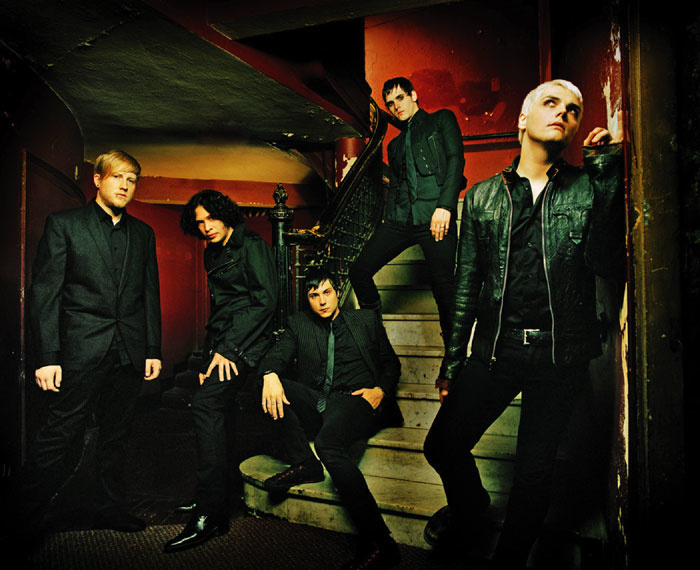 My Chemical Romance."I try to always have the same instruments and effects coming up on the same tracks on the 3348 and the corresponding channels on the console. On the console, 1-4 are delay effect returns, 5-6 percussion, 9-16 keyboards and/or percussion, 17-24 vocals, 25-32 guitars, 33-48 drums, 49-52 stereo reverb channels. If everything is parked in the same place, all you have to worry about is the song. When you're mixing you want to eliminate all the things that make you think outside of the song. It's an ergonomic issue more than anything. When you know where your outboard is, you can begin with your favourite compressor. You have a good starting point, and then you can start to change things if you want.
"The first thing I do after I've sorted out the comps is push all the faders up, and get a balance right away. I EQ everything at the same time, because everything reacts off everything else. It's not like I'll tinker with EQs individually at this stage. I'll only do some fine-tuning on solo'd instruments once I have a vibe for the song. When everything is in place and I have the delays set where I want them, I start automating. I automate in a very dangerous way, where one false move can wipe out what I did just before. So I'm just forging ahead, sculpting things 15 or 30 seconds at a time. I get a feel for the song and am getting more bold, treating mixing like a live performance."
Chris Lord-Alge agrees that in the case of 'Welcome To The Black Parade', which builds and goes through different sections, some of which are of a massive wall-of-sound nature, EQ is important, but says that level automation is even more important. "The mix was a challenge because there were a few sections in the song, especially during the solo, where there were a lot of mouths to be fed. But fader moves are even more important than EQ. No matter what song you have, you have to help it to build. You have to make each move more dramatic, and dynamics are judged by ear, not so much by level. You also keep your dynamics so they won't fold under the radio compression. What will anger me is when someone tries to make my final mix 9dB louder by L1-ing it to the wall, and flattens out my impact, just to make the CD louder. I will already have done all the compression and limiting that I think necessary.
"Panning is something I'm not subtle with. It's either left, right, or centre. Absolutely. Unless you're panning an orchestra and you're trying to make it sound like real life, as we did on 'Black Parade'. But I try to make my panning extreme, so it jumps out at the sides.
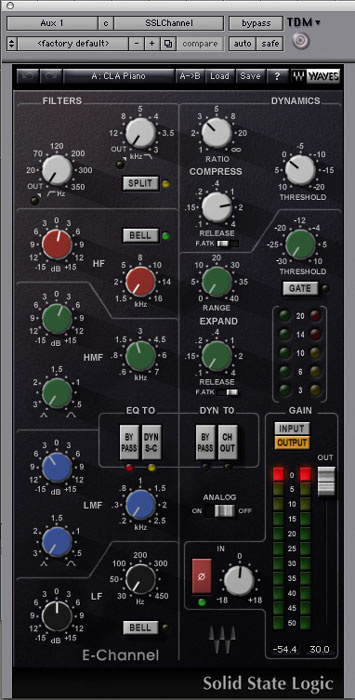 Chris Lord-Alge is an endorsee and fan of Waves' SSL plug-ins, and used the EQ to brighten the piano on its way to the 3348.Drums: Urei 1178, Neve 33264, Sony DRE2000
"As far as outboard effects are concerned, the drums were mostly treated with a [Urei] 1178 at 4:1 and a Neve 33264 at 2:1, all slow attack and quick release stuff with 4-5dB movement. The reverb was the Sony DRE2000, set to one second in length, just a short room. In terms of EQ, I tend to suck out the mid from kick drums, add top to snares, and make sure that the cymbals are not coming from everywhere. The whole thing with drums is once you have your overall mix in good shape, ride the faders to make they sit well in the track. You have to do one automation pass just for that. It's a lot easier to ride faders than to EQ. A lot of people over-compress and over-EQ drums, which lessens their impact. So get your hands on there and ride them to make sure the drums are balanced in each section and that each section works."
Bass: Urei 1176
"The bass has a black [Urei] 1176, 4:1, 7dB gain reduction. You begin with checking that the bass is in phase, and I also add plenty of top end, so it fits in the track. You may think that the bass sounds bright when you solo it, but once you put the heavy guitars on, it always seems dull all of a sudden."
Electric guitars: SSL EQ, Teletronix LA3
"The guitars were multi-miked pairs, usually three microphones per amp, so during comping it was a matter of balancing the different microphones on each amp onto one track. It's a bit like finding the sweet spot with the drawbars on a B3. It's like adding salt and pepper or salad dressing, you flavour to taste. On the console I'm pretty sure that my main compressor on the guitars was the [Teletronix] LA3, moving 2-3dB, maybe 5dB, and I added some console EQ, 6-8dB around 8K. I'm not scooping mids out, because these guys have worked hard to get the mid-tone that they want. It's more a matter of making sure that the guitars are bright enough in the track. I don't think there were reverbs on the guitars, they were just dry."
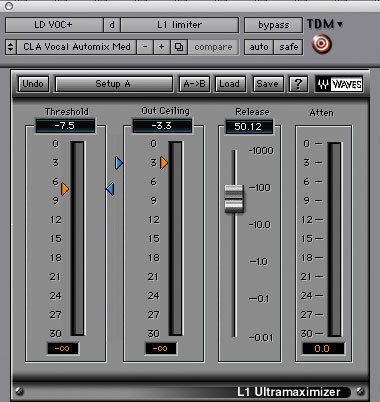 The lead vocal on 'Welcome To The Black Parade' was limited using Waves' L1 during the transfer to 3348.Vocals: Waves L1, Urei 1176, Inward Connection TSL3, Dbx 263x, Roland SDE3000, Line 6 Echo Pro, Marshall Tape Emulator
"The lead vocals all got blue 1176 compression, 4:1, quick release — this in addition to the L1 compression during comping. The backing vocals were compressed with the Inward Connection TSL3. I also did some de-essing with the Dbx 263x. There were several delayed reverbs. The amount varied from section to section. I used some of the long Ensemble reverb [see below] on the lead vocals in the beginning. There are also a few long delay spills that I automated. I would have done those with the SDE3000 or Echo Pro, both of which I like for longer delays. The delays would have been tempo-set to quarter or eighth notes, perhaps the bridge section had dotted eighths on them. I also used the Marshall Tape Emulator for slap echo, which was kicked in just for the vibe, probably at 15ips with varispeed. With the vocals you try to get the overall tone for the whole record with the compressors, and then you're chasing the faders to get them really in your face. It's all about automation."
Orchestral reverb: Lexicon 300
"They did a good orchestral recording, so the orchestra was just automation and panning to get the blend. I think I also put all the reverbs I had on the orchestra, just to give it a 3D effect. The organs were dry, but the piano had Inward Connections TSL3 compression on it and the same long Ensemble reverb the vocal had in the beginning. The Ensemble reverb was a giant Lexicon 300 hall with a seven-second decay time. That really gave the orchestral stuff length and character. Some of the background vocals may also have had that long reverb and even some of the big drum fills in the beginning. That was the more anthemic reverb, but once the song turns into a rock song, all the long reverbs get shut off, and it's back to the tight band sound.
"You have these moments in the track where it's open and soaring and where the big reverbs open all the floodgates, and then in other sections it was the one-second room. It's an artistic choice how things change from section to section, and you have your line of effects for each. The song was a challenge to mix, but it was a hell of a thrill and great fun to do. It was also a great accomplishment for the band."
And, one could add, for Chris Lord-Alge.