

The world is simply teeming with audio interfaces these days, so what does M‑Audio's latest offering, the Fast Track Ultra, have that the others don't?
There is no denying that home and project studio owners have never had a better range of audio and MIDI interfaces to choose from, whatever their budget or feature requirements. The latest addition to your dilemma is M-Audio's Fast Track Ultra, which provides six-in/six-out analogue audio interfacing with 24-bit audio at sample rates up to 96kHz, alongside stereo S/PDIF digital I/O and MIDI I/O. This is all housed in a compact desktop unit with USB 2.0 connectivity to the host computer. However, the feature that perhaps immediately causes the Fast Track Ultra to stand out is its onboard DSP processing. So if you are in the market for a compact, multi-channel audio interface with a few bells and whistles thrown in, is the Fast Track Ultra worth a serious look?
Warm-up Lap
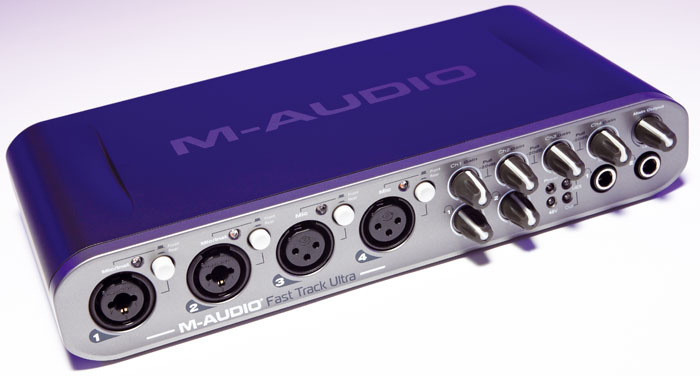
With a footprint not much bigger than a Harry Potter novel, the Fast Track Ultra packs a lot of features into a pretty small space. The front panel is dominated by the four microphone inputs. Two of these (channels 1 and 2) feature combi XLR/TRS connectors suitable for balanced or unbalanced mic and instrument signals, while the other two (channels 3 and 4) use standard XLR sockets. A push-button located to the top right of each input allows the user to switch between the front-panel input and the corresponding quarter-inch jack inputs on the rear panel. Each input also features a single LED for use when setting levels, which flashes green for a healthy signal level and red when the signal is getting a little hot — basic in terms of metering, but not dissimilar to that found on many compact audio interfaces. The preamps are based on M-Audio's Octane technology, as found in the more upmarket Profire 2626.
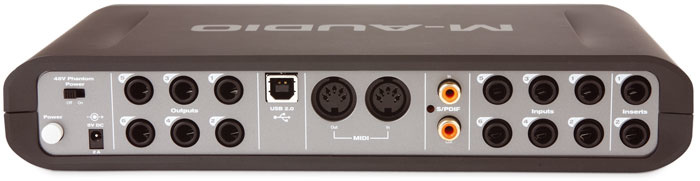 The Fast Track Ultra's rear panel accommodates most of the unit's I/O connections.The right side of the front panel hosts four gain controls for the mic preamps (offering about 60dB of gain). A 20dB pad is included, which can be useful for recording particularly loud signals and is engaged by pulling the respective gain knob out — it clicks firmly into either position. The other knobs control the main output level and the output levels of the two independent headphone outs. While fingers of the short and stubby kind are perhaps not best suited to the closely packed knobs, overall, M-Audio have done a good job of getting a lot of functionality into what is a small-footprint interface.
Moving from left to right, the rear panel features a power button, an input for the included power supply and a switch for the phantom power. The latter is global: on or off for all four channels. Next in line are the six TRS jack outputs, followed by the USB 2.0 port and a pair of standard MIDI I/O sockets. S/PDIF I/O is provided on coaxial sockets and these channels can be used simultaneously with the analogue ins and outs, giving an eight-in, eight-out configuration. In addition to the six TRS jack line inputs, the rear panel is completed by two insert jacks (also TRS) that can be used to patch in a hardware processor (such as an analogue compressor) between the preamp and the A-D conversion. It's great to see such inserts included, as they can add considerable flexibility. However, they are hardly given a mention in the supplied documentation and, given that the unit is priced at a point that will appeal to the recording novice, this is a pity.
The Fast Track Ultra can be powered either via the USB bus or the supplied AC power adaptor. Via the USB bus, there is only enough power to drive the first analogue I/O pair and the S/PDIF I/O. This is, perhaps, understandable, but it does mean another power adaptor to pack if you want to use the device as part of a mobile recording setup and need more than two analogue channels. While on the subject of power, I was a little surprised that the power socket on the rear of the unit doesn't feature some sort of cable lock, as the jack from the power adaptor seems to have a little play in it when connected and, in the chaos that often ensues in a mobile recording environment, I could easily imagine it becoming dislodged. This is a bit of a shame, but in all other respects the Fast Track Ultra seems to be solidly built.
Hardware aside, also included in the box are a printed Quick Start manual, a USB cable, the external power adaptor, and a CD containing the drivers and Control Panel software, further documentation in PDF format and a version of Ableton Live Lite 6 (see the 'Live In The Fast Track Ultra' box). The manual pointed me to the M-Audio web site to check for updated software and, with this downloaded, installation proceeded without a hitch on my system. The drivers work with OS 10.3.9 or higher for Mac and Windows XP SP2 and Vista 32-bit for PCs.
Live In The Fast Track Ultra
Ableton Live Lite 6 is bundled with the Fast Track Ultra, and while it offers a limited track count compared to the full version of Live (four audio tracks and four MIDI tracks), it nevertheless has a good deal of the functionality of the full version. Its inclusion also allows those new to computer-based recording to get started 'straight out of the box'. An upgrade path to the full version of Live 7 (reviewed in the February 2008 issue of SOS) is also available.
Ins, Outs & Audio Quality
With the occasional exception at the very budget end of the market, most modern audio devices aimed at recording musicians have very respectable audio specifications, and the data for the Fast Track Ultra suggests it's capable of good things. Playing back my test tracks (covering rock, folk, country, dance and classical) through the main outputs gave excellent results and, subjectively, the unit produced an even frequency response and good stereo imaging.
 The Monitor windows allow multiple monitor mixes to be created and the Ultra's DSP effects to be applied.When monitoring both the mic and line inputs at zero gain, in terms of average noise levels, I was able to get very close to the stated SNR data of approximately -103dB, and recording both vocals and acoustic guitar produced perfectly acceptable results. The mic preamps offer a reasonable amount of gain and the phantom power operated as advertised, although it's a shame it's global — even being switchable in two pairs would offer further flexibility for those with a limited mic collection. What is perhaps a little surprising is that the four input-gain knobs only function with the front-panel inputs. As far as I could see, if you're using any of the rear-panel line-level inputs the signal level has to be controlled at source, as the Fast Track Ultra doesn't provide any means of control either in hardware or software.
Having two independent headphone outputs is a big plus, allowing both engineer and performer to monitor if they are recording in a single room and don't have the luxury of a separate control room and live room. Equally, the front-panel controls for the headphone outputs and main output level are welcome and much preferable to software-only controls. My only other minor gripe here is that the headphone outputs seem a tad underpowered — a drummer might struggle to hear what was going on in their headphones over the sound of the kit without some further amplification.
This said, in the average home studio the Fast Track Ultra is unlikely to be the weak link in the audio signal chain. In terms of audio quality, I'd have no problems in using this device in a commercial context for most recording tasks.
Ultra Control
The majority of the Fast Track Ultra's features are accessed via the eight tabbed windows within the Control Panel software. The first four of these allow the user to set up alternative monitor mixes to be fed to any of the four output pairs (the final pair being the S/PDIF I/O). The mixes set up via the Monitor 1/2 and Monitor 3/4 windows go to both the similarly numbered line-output pairs and to the two headphone outputs respectively. The user has control over the levels from all eight inputs, as well as up to eight channels of audio being returned to the Fast Track Ultra from the host sequencer. It is also worth noting that the software faders for the input channels control only the monitoring level. Adjusting these has no influence on the level being sent to the host sequencer for recording — this is controlled independently via the front-panel gain controls (although only, as noted earlier, for channels 1-4). The Monitor 1/2 and Monitor 3/4 windows include Send knobs (at the bottom of each channel strip) that allow the DSP reverb or delay to be added to the monitor mix as required.
 The tidy front panel is small but packed with functionality.The onboard DSP processing powers a small selection of reverb and delay algorithms. The effects can be applied to either one of the input channels or to signals being passed from the computer back to the Fast Track Ultra for monitoring. The DSP can only be applied to signals being monitored through the main outputs (channels 1 and 2) or channels 3 and 4, and are for monitoring purposes only — the 'wet' signal cannot be routed back to the host computer for recording. The most obvious application of the DSP would be to add a little reverb or delay into the monitor mix for a singer — a touch of reverb applied to their own voice in their headphone mix can make things sound more natural. With most compact audio interfaces, adding monitoring reverb for this purpose is either difficult or requires you to monitor via your host sequencer (which, in turn, requires low-latency settings), so the DSP makes this very common practice a whole lot easier.
The Settings window provides access to the usual sample rate and latency settings and this is also where the DSP effects can be configured. Any one of the eight different algorithms can be selected — six reverb types (three rooms, two halls and a plate) plus a delay and echo. The Duration control sets the decay time of the reverb or the time between repeats for the delay and echo. The Feedback control is only operative on the delay and echo algorithms and controls the number of repeats.
Testing On The Track
In use, the Fast Track Ultra proved to be very user friendly. The Control Panel application, if not the most pretty of user interfaces, is straightforward in operation, and brief testing with a number of different audio applications (Sound Forge, Wavelab and Acid Pro) didn't turn up any problems. I did my more detailed testing with Cubase and was able to work with pretty complex projects at a respectable 256-sample ASIO buffer size, without my CPU getting too stressed. My overall impression was of very robust drivers. Given the six analogue outputs, the Fast Track Ultra is also suitable for 5.1 surround projects and, once the various output pairs had been configured, this worked a treat within Cubase.
Using the DSP to apply a little gentle reverb or delay to the monitor mix also proved easy, and as this is such a common requirement when recording vocals or acoustic instruments, this feature is a real plus for the Fast Track Ultra. The quality of the reverb is perhaps not the greatest — I don't think I'd really want to use it to mix with, even if the audio routing allowed that — but it's absolutely fine for monitoring purposes, and is a much more elegant solution than monitoring with a reverb added via your host sequencer.
One further thing worth noting is that both powering up and powering down the unit does create a noticeable 'clunk'. After I had scared myself silly the first time it happened (and checked that my speaker cones were still in working order!), I made sure that my monitoring system was powered down before switching the Fast Track Ultra on or off.
Last Lap
M-Audio's Fast Track Ultra packs a lot of I/O into a neat package. It's small enough for the mobile studio but has enough features and channels to deal with the majority of tasks in a home or small project studio. The audio quality is very good indeed, the drivers seem solid and the Control Panel software, while not particularly appealing to the eye, gets the job done with a minimum of fuss. The included DSP effects are also a bonus and will make the recording process that much more pleasant for vocalists who like to have some reverb in their headphones when they're singing. This feature alone would make the Fast Track Ultra worth auditioning alongside the extensive competition in the compact USB/Firewire interface market.
Alternatives
There are any number of alternative compact audio and MIDI interfaces that potential purchasers can choose from. The detailed specifications of all these units vary, offering different combinations of multi-channel I/O, but products from the likes of Edirol, ESI, Alesis and Focusrite would be obvious examples. However, given the DSP effects included with the Fast Track Ultra, perhaps the most suitable comparison is with the slightly more expensive TC Electronic Konnekt 24D. This Firewire interface offers a four-in/four-out analogue configuration but also features onboard DSP. In terms of the quality and flexibility of the effects, the Konnekt is superior (see the review in our May 2007 issue), but it is obviously more expensive and has fewer I/O channels.
Pros
- Plenty of I/O in a very compact box.
- Audio quality is very good
- Easy to use.
- Included DSP effects are great for adding a touch of reverb or delay to a monitor mix.
Cons
- Power supply connector could be more secure?
- Watch out for the power on/off 'clunk'!
- No input-gain control over the rear-panel line inputs.
Summary
The Fast Track Ultra offers a lot of I/O in a small package and performs very well. The included DSP effects are very useful when tracking, and certainly give this interface an edge when compared to the majority of the competition in this price bracket.