

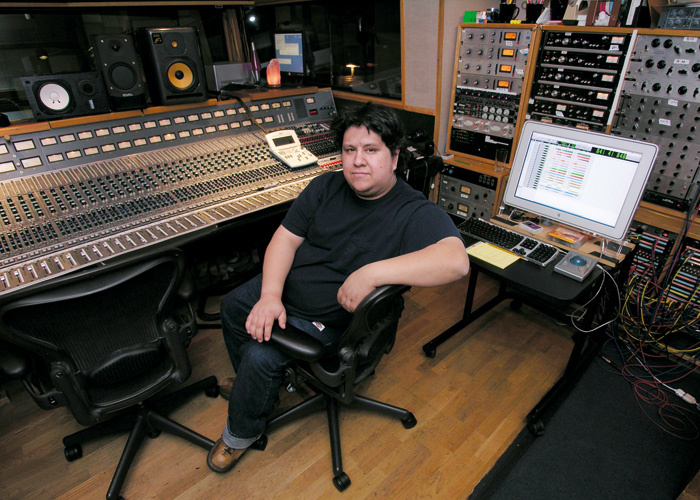
 Mix Engineer Robert Carranza
Jack Johnson is living proof that you don't need Auto–Tune, Beat Detective or a million overdubs to record a hit album. In fact, as engineer Robert Carranza explains, he didn't even need mains electricity...
Jack Johnson's album Sleep Through The Static has been phenomenally successful, reaching number 1 in every Anglo–Saxon country in the world, including the US and the UK. Not bad for music that was created entirely on analogue, almost without effects, and with a philosophy that deliberately championed feel, spontaneity and simplicity. There are, arguably, lessons here for prospective hitmakers.
From his home in Los Angeles, Robert Carranza, the album's mixer and engineer, elaborates. "The whole focus of making this record was to simplify things. Even the process of using outboard gear was enormously simplified: there was hardly any. We trusted our instincts, and we had the good sense of not being bound by how people are making records right now. We did our own thing. We focused on feel, and so if something felt right, we went with it. Even when it came to mastering, we told Bernie Grundman that this record didn't need to be loud and that the acoustic songs should feel like acoustic songs and be less loud than the other songs. And it's interesting for people to see that a hit record can be made in such a very simple way!"
Not Static
Robert Carranza has worked with Jack Johnson since 2003, when he engineered and mixed the singer's second release, On And On. He performed the same duties on In Between Dreams (2005), and graduated to co–producer (with the singer) for 2007's Curious George. The making of Sleep Through The Static was rather different from those predecessors: it features more electric guitars and keyboards, and was the first time Johnson had recorded in Los Angeles and to analogue tape. It was also the first time producer JP Plunier (Ben Harper, John Lee Hooker) was involved.
"The previous records I did with Jack were recorded to Pro Tools at his studio in Hawaii," recalls Carranza. "Jack had never made a record to tape, and he asked me one day: 'What's the difference?' I replied 'I don't know whether you'll hear the difference, but I can show you what the difference is.' So he decided to do it on tape, and we soon realised that this was a good decision. Most of all it forced us to pay attention. With Pro Tools you spend a lot of time looking at the screen and you start listening with your eyes. Working with tape forced us to sit back and really listen to takes and to what was good or not in terms of feel, and be a little bit more forgiving of little mistakes that happen. That was really liberating.
 Jack Johnson's emphasis on live playing and performance is refreshingly different today."Jack had gotten tired of listening with his eyes, and he loved to sit back and close his eyes and just use his ears. He also enjoyed the fact that we only had a limited amount of tracks, and for most songs we didn't even fill all of them up. We went with the attitude: 'Let's not be precious about it, if it works let's leave it as it is. The feeling of the song is more important than the technical side.' The other thing that helped was that we had moments of pause in between takes and songs. With Pro Tools the files come up instantly, but it takes a while for the tape machine to roll back, and it takes another minute to change reels. These are little moments of quiet in the recording process, and they made us pay more attention. The pauses forced me to refocus and get my thoughts together, and pay attention to what was happening next.
"Personally I don't mind whether I record to analogue or Pro Tools, but I will say that my views have changed after doing Jack's last record. Pro Tools is a great thing, but working with a 24–track analogue multitrack forced us to make quality decisions, sometimes even irrational decisions! You can't just fly things around at will, and that really helped us form this record. The point of our approach was not that it was old school, but that we had a clear philosophy that was liberating for us. It helped us psychologically, and also sonically. But we did not overthink it. It was more a matter of 'Let's just do it.' "In the end, the gear aspect is superfluous. If the song is not there, it doesn't matter how you approach the recording. As for JP, when you bring someone else in, it keeps you on your feet. JP brought a lot of objectivity, which at times could be very challenging!"
Let It Bleed
 The live area at Solar Powered Plastic Plant Studios, where most of Sleep Through The Static was recorded.Sleep Through The Static was recorded at Jack Johnson's Solar Powered Plastic Plant Studios (see box overleaf) with his regular band, consisting of drummer Adam Topol, bassist Merlo Podlewski and keyboardist Zach Gill. "The basic piano, guitar, bass and drums tracks you hear on the album were all recorded live, which I'm really proud of," says Carranza. "It's guys playing together, and the camaraderie that involves. Jack's approach was: 'I just want to come in and make it happen,' and 'Let the bleed be the bleed.' The piano had a little bit of drum bleed, which reminded me of the old Motown stuff. Initially we didn't even have screens, so I called a rental company to hire some screens, which we placed around the drums to screen them from the piano and guitar. The whole process was definitely a trial by fire. I had bought this Aviom headphone system, so they could all hear each other and make their own mixes, but at some point someone said 'Let's not wear headphones!' and so they tracked without after that. I had put up some nice microphones, and we did a couple of takes of each song, and picked the best one. In the case of one song I edited two takes together. Jack always did a scratch vocal that we used in a couple of cases. We just went for a really simple way of making a record."
The "nice microphones" Carranza refers to involved "nothing spectacular on the drums", specifically a Sennheiser MD421 on the kick, two Shure SM57s on the snare (bottom and top), more 421s on the toms, Audio–Technica AT4050 overheads, and a Royer SF24 stereo ribbon mic in front of the drums, a foot away. The bass was recorded using both a DI and a 421 on the Ampeg B15 amp. The upright piano was captured with two Neumann U87s placed in front of the sound board. "Zach was initially playing towards the drummer, but to get more separation I moved him 45 degrees, so he faced the wall, and I covered things up with a couple of packing blankets.
"Electric guitars were also pretty straightforward, with an SM57 on the amp. The acoustic guitar was usually a Gibson J45, sometimes a Cole Clark, recorded with an AKG C451. I'd screened off the acoustic guitar so it didn't bleed as much. Some songs started off acoustically, and Jack would say 'There's too much bleed on the mic, let's try an electric,' and all of a sudden the vibe of the song changed. We simply went with it. 'If I Had Eyes' was one of those songs.
"We started the project using a vocal microphone I don't really want to name. It was OK, but a friend of mine was telling me about the reissue of the U47 that Telefunken were making. So Telefunken sent me a demo copy, and the minute Jack sang into it, it sounded great. I called the company and asked them what the deal was, and they offered to send me a new one, but I was like 'No, no, no, I want this mic. It sounds amazing, you're not getting it back!' I still have it to this day. We went back and retracked some of Jack's vocals with this mic. It made a huge difference — it had the sound I had been looking for for years."
Trusting To Instinct
Overdubs, says Carranza, were recorded with headphones — "it's hard not to" — and included guitars, backing vocals (through a Neumann U47), Clavinet (SM57), banjo, melodica, pump organ (all using a Telefunken 251 reissue), synthesizers, tambourine (AKG C451), and handclaps (U47). "The mic we used was usually based on what was nearest and easiest to use. When you work like that, it creates a nice flow. When someone had an idea, he could instantly try it out, and even if the sound wasn't right, at least the idea was there."
Regarding the signal chains, simplicity again ruled. "For vocals it was the U47 going into an API 512, into an LA2A with a dB compression at the most, straight to tape. I've learned in the past that you want to use no or very little EQ during recording, because if you later want to drop in a fix, you'll never match it. The drums were all cut through an API preamp. For bass we went through a Universal Audio 610, and guitar and piano went through the Neve 1073. That was pretty much the signal chain on everything.
"There was no compression, not on the bass or the guitar. I only compressed the kick drum a little bit, and I mean just a dB, to smooth it out a little. That was it. Everything else was pretty flat. Because of their great musicianship, they balanced themselves amazingly. It was almost unnatural. I think the fact that they didn't use headphones when laying down the basic tracks helped them to really listen to each other. And finally, we didn't use a click track, apart from for the song 'Hope'. We struggled a bit with the tempo on that one, and when we finally agreed on a tempo, we started the song with a click track and then faded it out. Again, we trusted our instincts, and did our own thing. If it felt right, we went with it."
 Robert Carranza's outboard gear includes, from top: Drawmer MX50 de–esser, Neve 1073 channel strips (x4), API 512 preamps (x8), API L200 preamps (x12), Universal Audio 2–610 channel strips (x2).Recordings took place off and on over a period of three months in the late spring and summer of 2007. This included a 10–day spell at Johnson's Hawaiian studio, and Carranza ended up buying another Studer A827 plus a Malcolm Toft console especially for the project. "I took the microphones with me to Hawaii, and we had a duplicate of my outboard and preamp rack, so the signal chain was exactly the same. There was no great pressure in working. We really went with what we felt like." The only moment of concern came when the 18 RMG900 two–inch reels (recorded without Dolby, at +6/185) they had filled had to be sent back to Los Angeles for mixdown. Naturally, Carranza made Pro Tools copies before shipping.
Tape Liberation
Robert Carranza mixed the album at Solar Powered Plastic Plant Studios, happily using the Studer A827 and the SSL AWS900. Was he not tempted to load everything into Pro Tools and mix from there? "I did not want to change the mood or atmosphere of what we had been doing at all," replied the mixer. "I could have mixed in Pro Tools, but aesthetically I wanted to keep the project in the flow of not looking at a screen. Even when mixing you tend to look at the screen, and you often go 'What's going on right there?' and zoom in to see it. I wanted to stay away from that. I wanted to focus on sound, faders, and my perception of what was coming out of the speakers. I wanted to mix off tape, and Jack was OK with that. It was a liberating thing. So I mixed the album at our studio. I had my outboard gear there anyway.
"The only digitisation in the whole project occurred during mixdown, which was via Benchmark A–D converters to Tascam DVR1000HD, both 96/24 and DSD. And we only did this because we couldn't get a hold of half–inch tape! The supplier had run out and nobody was making it at the time. There briefly was some concern, but when we played the mixes back, nobody was worried about it any more. I'm not an audiophile to the 10th degree, but I went from the SSL to the Benchmark A–D converters, then straight into the Tascam. No patchbay. And it sounded great."
'Sleep Through The Static' & 'If I Had Eyes'
Written by Jack Johnson • Produced by Jack Johnson & JP Plunier
 'Sleep Through The Static' track sheet.Robert Carranza: "Trying to create a fresh mix from a song that you've also engineered is very hard. You may think that you know what the song is about and that you understand how to build it, but you could be completely wrong. 'Static' was one of these songs with an ebb and flow what was hard to grasp. I began the mixing process with this song, but I put it away again. There was something about the balance that I wasn't getting quite right, so I jumped to the acoustic songs, because they were straightforward, got them out of the way, and then returned to 'Static'. My concern was that I was getting lost in it. Here was this very sparse track, and I felt that I had to make it sound as if something was happening. I was adding compression to the snare drum and to other things, and I suddenly realised that I jumped in too quickly and need to pull the reins back.
"One of the best lessons I ever learned was when mixing Los Lobos' Live At Fillmore [DVD 2004, CD 2005]. I was in the studio and the band were on the road, and I was uploading mixes for them to listen to. One day I got a call from the band, and they were all in a conference room, and they said 'Hey, have you listened to the rough mixes?' And I was like 'No, why?' And they replied 'Have a listen and then call us back.' These mixes were really quick, rough live mixes that I had done in the truck. So I listened to them, and they sounded incredible. As a result I told my engineer to pull back all the faders and effects and I started again from scratch. It's one of those lessons that you learn not from engineers, but from musicians. And it is what happened to me with 'Static'. I started overdoing it, and I suddenly realised that I was back with what I did with Los Lobos.
"So when I came back to the song, I simply put the faders back up, and then started with the lead vocal [21, below] and the live guitar [14]. I then added the vocal double, followed by the other instruments around it, and finally the rhythm section. The whole song took maybe four hours to mix! With this album, mixing was a matter of lining up the faders and listening constantly. I'd listen to a song four or five times, take a break, and listen again. I was aware that the tape was degrading with each playback, so the pressure was on. 'Static' was very easy to mix. Technically there's very little happening in it. My main concern was that the feeling came across. That's what I spent the most time on.
"The lead vocal was treated very minimally. Because Jack had been very close up to the vocal mic, I needed to do some de–essing, and I used the Drawmer MX50 for that. I really like that effect. Many people like the DBX 902 or the SPL Transient Designer, but the MX50 was in the room, and it's what I used. I also ran the vocal through a Tube–Tech TCL2 limiter, with 2:1 ratio and maybe 1dB compression. It gave the vocal a little bit more body and pushed it up a little. And that was it. I did experiment with some TC6000 reverb, because I wanted to give a bit more of the feel of a room. But in the end it was like 'You know what? This is a waste of time!' What remained was very slight. I give you a thousand bucks if you can hear it.
"I used no compression at all on the electric guitar, the bass, or the piano. The only thing I did on the bass was manually ride a couple of notes that didn't come out clearly. Most of the stuff was done without automation. The piano had a little bit of SSL EQ to bring out the high mids. I wanted it to speak a little more. The drums were also really straightforward, with all the faders straight up. I'm a big fan of the Empirical Labs EL7 Fatso Jr, and I added a little bit of compression on the drum bus with that. It made a difference, but not a huge difference. It just gave it a bit more size. The ambience on the drums came from the overheads and the room mic.
"Track 13 and 19 were the guitar lines in the verse that sound like a guitar solo. They were definitely treated differently than track 14. I recorded the guitar lines with a close mic on the amp and I also had a Beta 58 talkback mic, which was close to Jack's face. I accidentally left the talkback mic on, and it sounded great as an ambient mic. It gave the guitar a much warmer sound. So I ended up just using that. The intro features a pump organ on track 17, played by Jack, and Zach overdubbed a melodica on top. There's also some outro noise on track 17 and 24. Jack wanted some kind of static–like sound, but didn't want to use sample CDs or something. So Zach pulled up this white noise sound from a Moog Voyager, sweeping it in and out. It gives you the sound of a radio station that has gone off air. There were no effects on the intro and outro sounds.
"It was a very simple mix, but complex to do at the same time. My first pass was very close. Jack had some little comments, for example about the banjo, that really jumped out at you. He wanted it really tucked down, and I was like 'But it's just two seconds, and like this nobody is going to hear it, and we spent so much time recording it with a great mic.' That was me the engineer. When I tucked it down it sounded great. It is well understated, on purpose, because the whole song is supposed to feel understated."
'If I Had Eyes'
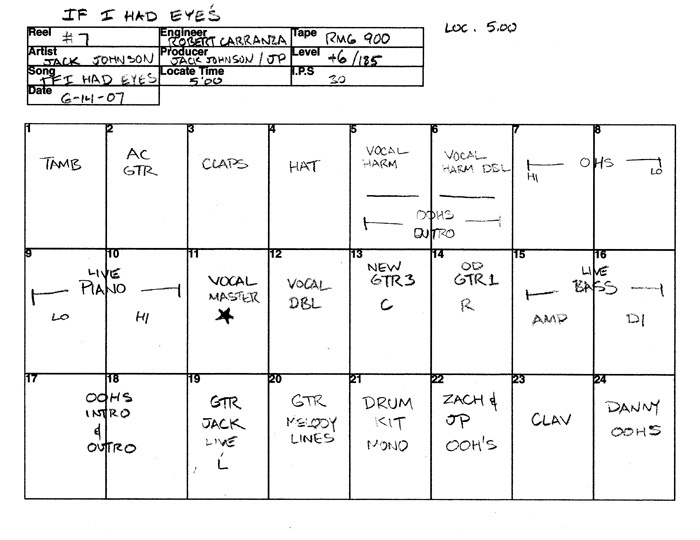 'If I Had Eyes' track sheet."The funny thing about this track is that you'll notice three electric guitar tracks, 13, 14 and 19, the last one being the live track that Jack initially played. There are also guitars on tracks 2 and 20. This was the most amount of guitar overdubs we've ever done! We went AC/DC on this one! What happened was that we initially had two guitars, 19 and 14, left and right, and Jack felt that something didn't feel right. So he went back in with a different guitar and a very different sound. He asked whether I wanted to match the sound, but I replied 'Don't bother.' He did the overdub and I wondered what the track would sound like with three guitars, so I panned them left, right and centre. It's not a big deal, everyone does it all the time, but for us it was different. Jack was like 'Wow, this feels great'.
"The other striking thing about this track is that it has a mono drum kit. I first recorded the song with a full drum kit, like in 'Static'. You can see the hi–hat on track 4 and the overheads on track 7–8 remaining. I had also added one Coles 4038 mono mic to record the drums, kind of to get the old Motown sound, and when I was listening to the sound of that one mic, it sounded really great. When Jack later asked me for more tracks, I erased the snare, kick and toms, and we went just with the mono mic, the overheads, and the hi–hat mic. Of course, the guitars helped fill the space that was opened up by having the drums mainly in mono.
 More Carranza outboard. From top: API & Speck EQs, Furman power conditioner, Altamoda Unicomp compressor, Thermionic Culture Vulture compressor, Chandler TG1 Abbey Road Edition limiter, Summit DCL200 compressor, Empirical Labs EL7 Fatso Jr tape simulator, Ridge Farm Boiler compressor, Tube–Tech CL2A compressor, Summit TLA100 compressor, Teletronix LA2A compressor."Because of the mono drums, I had to start the mix with them. They were the centre point of everything and they needed to sound really good. So I put track 21 up first, and ran the drum signal chain through the same stereo bus as for 'Static', with the Fatso compressor to give the drums a little bit more size and weight. Next I added the L–C–R guitars, which were kept pretty dry. If there was any reverb from the electric guitars it came from the amps. Then I added in the acoustic, adding nothing, piano, just boosting the upper mids, and the bass, again only riding a couple of notes. Merlo is such a good player that I didn't need to use compression. I again used the MX50 de–esser on the lead vocal, and I added a little bit of top end, around 12k, to give it some air.
"The claps and the tambourine were dry. I think I backed off the mic for the tambourine a little to get some ambience from the room. I added nothing to the backgrounds. The 'oohs' were all sung around a Royer SP24 stereo mic, and at one point Jack had another idea for a background part, which we recorded on track 22. One of the greatest things of all was that we got Danny Riley to sing backing vocals. He was Jack's cousin and he has since passed. It was really touching to have him in the studio. [Riley was a singer/songwriter, and by all accounts, a remarkable human being — see www.dannyriley.com]
"'If I Had Eyes' was the easiest song to mix on the album, even though it has the most tracks. Like everywhere else on the album, there was no pitch–shifting, no Auto–Tune, no ping–pong delays. We really went for natural recordings, but with a modern feel. I wish I could take credit for shaping the guys' sound a little bit, but they truly shaped their own sound. "A song is the ultimate story to be told, and the music industry appears to be losing focus on that. I would not buy a book that had blurred words in it, but with the loudness wars and so on, that appears to be where we're going. But if you open up a book with a good story that's easy to read, ultimately you're going to feel good about it. So we do these records, and the fact that so many people resonate with it is just amazing."
There's Always The Sun
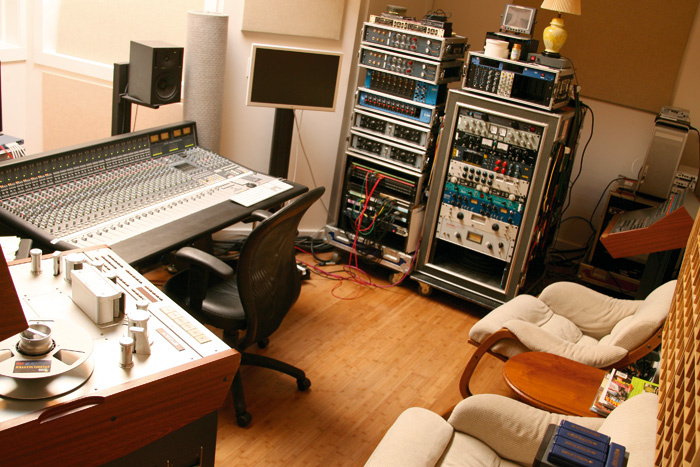 Sleep Through The Static was recorded on a 24–track Studer reel–to–reel machine. The unique solar–powered studio is equipped with an SSL AWS900 mixer; Robert Carranza's own outboard gear is visible in the racks to the side of it.Around the time Johnson planned to record the Sleep Through The Static album, he and his manager, Emmett Malloy, were looking for a place to house their label, Brushfire Records. They found a 100–year old building in Los Angeles, which had a huge room at the back, previously used by a photographer. The duo immediately hit on the idea of turning it into a studio, and asked Carranza to organise this. Following the decision to record on analogue tape, the engineer/mixer/producer suddenly found himself having to take a rather unusual angle on fitting out what was to be named Solar Powered Plastic Plant Studios, courtesy of the solar panels that were fitted to the roof to make the building 100 percent self–sufficient.
"Choosing the studio equipment was up to me," explained Carranza. "Nobody had any foresight as to what to get. I already owned all the outboard gear that we needed and I also have a complete Pro Tools system, so the main challenge was to get a tape machine, a desk, and a monitoring system that would work in the relatively untreated acoustic space. We ended up buying a Studer A827 24–track from Harry Maslin, an old engineer and producer who has done a lot of great records. As for the desk, Jack wanted something economical and low–maintenance. I've grown up with API, and they're great, but I know how problematic they can be. The same goes for Neve. So I settled for the SSL AWS900. I realised that I could get any sound I wanted on this console, as opposed to a Neve, which will only give you the Neve sound. As I have a rack full of preamps, four Neve 1073s, eight API 512s, 12 API L200s, I only intended the SSL AWS900 to be used for monitoring and mixing.
"A friend of mine, Rich Costey [see SOS, March 2008] recommended the ATC50 monitors, which definitely complemented the music. But they were too big for the control room, causing a big bump in the bottom end, so I had them in an office room to the side. Sometimes I'd play back through them while sitting in the control room, with the office doors open, just to get a mono perspective. I'm a bit of a snob when it comes to monitors, and I tried the PMC AML1 monitors, but I was thrown off because for some reason there was a big void in a couple of frequencies. Then I tried some M&K monitors, but they didn't work, even though they are great speakers. So in the end I settled on my tried-and-tested Genelec 1030s. All of a sudden it sounded perfect in the room. I also always reference things on a cheap boombox from Circuit City. It all gives a different perspective."