

If sound is leaking from your studio or external noise is ruining your recordings, there are practical steps you can take to improve matters.
 Recording musicians can face a variety of problems with unwanted noise. Sound from monitor speakers and instruments can leak into neighbours' properties and cause a nuisance, but equally, noise entering your studio from the outside world can make it impossible to record properly. In both cases, the best answer is to improve the sound isolation of your studio, because sound isolation treatment works the same both ways: what stops sound getting in to a room affects sound getting out to the same degree. However, there's no lightweight 'magic bullet' to solve the problem, and the foam materials you use to improve the acoustics of your room will have little benefit in terms of sound isolation. Likewise, despite long-standing urban myths to the contrary, egg boxes stuck to the walls have virtually no effect on sound leakage!
In the context of a small studio, the term 'soundproofing' is actually rather misleading, because the best you can really hope for is to improve the situation. Eliminating all sound leakage is virtually impossible in the types of buildings used for housing and typical domestic or project studios. So what you actually need to determine is whether the measures you're able to take (both practically and economically) can reduce sound leakage to a level that you find acceptable. I've tried to write this article with this in mind, and most of the steps described here should be within the scope of a DIY enthusiast. The necessary materials should be available from your local builders' merchant or by mail order from a studio materials supplier (such as, for example, www.assiderise.com in the UK).
Sound Science
If you were paying attention in your elementary physics lessons, you'll know that sound is acoustic energy and that, as with any other form of energy, it cannot be destroyed: it can only converted to another form of energy. Sounds die away naturally because their vibrational energy is converted to (a very small amount of) heat, either due to friction in the air itself or in moving (vibrating) the objects it encounters. Sound also reduces in level the further it travels from the source, as its energy becomes spread over a larger area — something that we know as the inverse square law, due to the fact that the sound intensity of an omnidirectional source reduces relative to the square of the distance from the source.
More precisely, sound is vibrational energy in the audio frequency range that passes through the air, and can also be conducted via solids or liquids. Though airborne sound can't escape directly from an airtight environment, its vibrational energy causes the walls of that environment to move and they in turn launch new soundwaves which can be heard outside. This gives us our first clue as to how to contain sound: we need to reduce the amount by which the walls can move.
Materials of infinite stiffness may be available in Star Trek, but in the real world they simply don't exist, so the simplest thing we can do is to add mass to the walls, because the heavier an object is, the less distance it will move for a given amount of applied energy. From this, it follows that if we double the mass of a wall (for instance, by doubling its thickness) then a given amount of sound energy will only be able to move it half as far, which in turn means that the amount of sound leakage will be halved (reduced by 6dB). We can also choose 'lossy' materials that aren't very efficient in transmitting vibrations. As an example, a given thickness of glass may transmit more sound energy than the same thickness and mass of sand, because the sand particles tend to lose more energy through friction between the individual particles.
The bad news about sound isolation is that the isolation provided by a structure reduces with frequency. This is quite logical because it clearly takes more energy to make a wall vibrate back and forth a thousand times in one second than it does to make it vibrate back and forth say 20 times. It's a simple matter of inertia. The bottom line here is that for every octave drop in pitch the amount of sound isolation is halved, so while high frequencies are easy to keep in or out, low frequencies are far more difficult to contain. This is why when you walk outside a night club you can still hear the bass and kick drum but little else.
Because sound attenuation is frequency-dependent, the attenuation of a particular material is generally measured in decibels (dB) at a number of specific frequencies between around 100Hz and 3kHz. This figure is called the 'Sound Reduction Index', and while most materials also come with an average specified SRI value this isn't actually that useful: what you really need to know is how much attenuation you can expect at the lowest bass frequencies you're trying to isolate.
Charts are available from the manufacturers of many materials, giving their SRI at all the specified frequencies, but if you need a more general guide this formula enables you to work out the approximate SRI of a solid wall or partition for a given frequency (if you know the mass per square metre of the material being used):
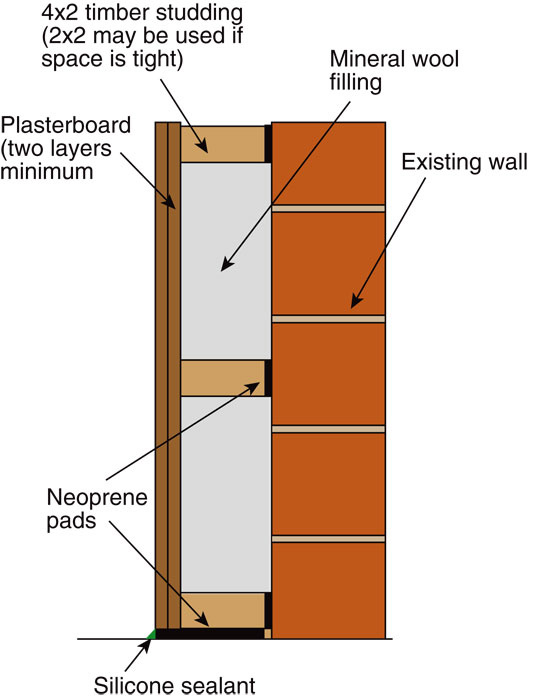 This diagram shows a good way to make walls better at attenuating sound: the double plasterboard layer adds significant mass to the wall; the neoprene rubber separates the new and existing structure; and the gap between the two walls improves sound isolation even further. R=20 log(fm) -47dB
In this formula, 'f' is the frequency of the incident sound; 'm' is the mass (in kilograms) per square metre of the wall material; and 'R' is the Sound Reduction Index (dB).
The answer given by the mass-law equation can only be approximate because the formula takes into account neither how lossy the material may be, nor how resonant the partition structure is, and the stiffness of the material also plays a part. If the partition exhibits strong resonances, some frequencies related to multiples of the resonant frequency will be attenuated less. There's also an effect that happens at higher frequencies that's associated with bending waves within the solid material. For every frequency above a certain, critical value, there'll be an angle of incidence for which the wavelength of the bending wave within the material is equal to the wavelength of the sound incident upon the material, and when this occurs the attenuation drops significantly. This is why using lossy materials or layers of materials with different acoustic properties can help to smooth out the attenuation characteristics of a wall or partition.
To give you some idea of what to expect in terms of sound reduction from real-life materials, a domestic door in a well-fitted frame has an average of SRI of something like 15dB (although this figure is of course lower for lower frequencies), whereas a double-thickness brick wall of the type used in modern house construction may have an average SRI of better than 50dB.
So... if a single wall can reduce the sound leakage by say 50dB, then if we add another wall outside, that will give us another 50dB of isolation resulting in 100dB in total, right? Unfortunately, things are a little more complex than this. Unless the walls are separated by a considerable distance, the cushion of air between the walls couples energy from one wall to the other, reducing the isolation to well below this figure — but an air gap is still a good thing, and the wider the air gap, the better the isolation (most noticeable at low frequencies again). A double structure will invariably perform significantly better than a single-layer barrier of similar mass, even if the air gap is only a few inches wide. You can see this principle put to work in large commercial studios, where corridors are often used as part of the isolation structure, so that the width of the corridor is essentially the air gap between the two walls. On a smaller scale, the same theory also applies to double-glazed windows — although with such a small gap, the low-frequency efficiency isn't that great.
While you can, as we've seen, add additional structures to a wall to improve its performance, the weak areas of most project studios tend to be the doors and windows, and uprating the walls by adding another layer with an air gap may bring about no significant benefit unless one of the walls adjoins a property where the sound isolation needs to be improved for the benefit of neighbours or other family members. How significant any remaining sound leakage is depends on the ambient noise level, so while low-level noise may be completely masked by daytime noise, it will seem much more noticeable at night, when the ambient sound level drops. Often the pragmatic solution to sound leaking out of your studio is to combine a practical level of soundproofing treatment with a reduction in the amount of noise that you make in the studio!
As we've just discovered, double-glazed windows offer only a limited amount of sound isolation compared with a solid wall, although they're still far more efficient than single-glazed units and also tend to have better airtight seals. Some practical DIY improvements you can make include fitting a double-glazed window flush with the outside of the wall, then adding extra internal heavy glass or perspex glazing with a large air gap flush with the inside of the wall. Small windows — or those comprising multiple separate panels — work best, because large windows tend to be quite resonant. The other option, of course (if you don't need the daylight) is to fill the window space with sandbags or high-density Rockwool and simply board it up with a couple of layers of thick plasterboard or chipboard. If the window you're boarding up isn't airtight and you don't want to replace it, you can use some frame sealant applied from a mastic gun to seal around the edges first. Heavy curtains help a little, but as with so many things, they won't do much for you at low frequencies.
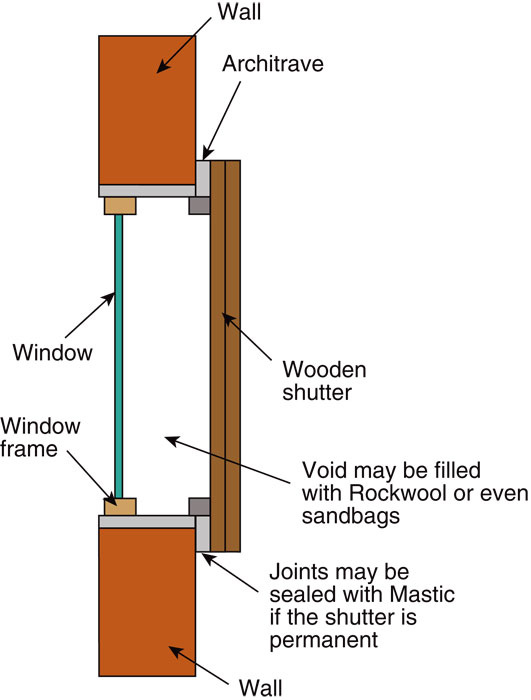 Windows are one of the main problem areas for sound leakage in and out of the home studio. If you're prepared to sacrifice daylight, you can quite easily make a temporary shutter to remedy the problem.Adding more than two layers is not a good plan because this tends to be counterproductive at low frequencies, where the air gap needs to be as large as possible. Using a double-glazed window in conjunction with a separate piece of glass spaced a few inches away won't reduce the air gap by very much so that's OK, but attempting to make a triple partition with two equal air gaps will result in less low-frequency isolation than having the same mass separated by one large air gap.
While you can seal up windows, you can't do the same with doors. Domestic doors tend to present a major weakness, because they're lightweight and they don't seal well around the edges. And if a door is not airtight on all four sides, it isn't going to provide much sound isolation no matter how thick or heavy it is.
Providing you can get airtight seals all around the door, significant improvements can be made by increasing the mass of the door, either by replacing it with a heavy fire door or purpose-built studio door, or by adding material, such as thick plywood or plasterboard, to one or both sides. However, a far better solution where possible is to use double doors, with an air gap in between. Even a gap the thickness of the wall will make a big difference, although you should still try to get the doors as airtight as possible around all four edges by using a neoprene sealing strip (get this from a commercial studio materials supplier, as consumer draught-proofing isn't very effective here). If you're building the studio from scratch and can afford the space to separate the doors by more distance by incorporating a small hallway or vestibule, then so much the better. Note that to get the best seal, you ideally need to fit the doors with compression latches that squeeze the door up against the seals when closed (again, these can be bought from studio suppliers).
Commercial studio doors often incorporate a sealing strip on their lower edge that's automatically raised and lowered as the door is opened and closed. This avoids having to have a raised threshold strip on the floor, which is the only practical solution if using standard doors. A useful tip when fitting neoprene sealing strip is to first glue this to the wooden strips against which the door closes before pinning them to the inside of the door frame. That way you can position the strips so that the neoprene seal is just tight enough against the face of the door to hold a sheet of paper. This will provide enough pressure to give a decent seal but not so much that it will be difficult to close the door. Make sure you mitre the corners neatly so there are no gaps in the seal.
What A Nuisance!
It's no coincidence that the word 'noise' comes from the Latin word for nausea, and government statistics show loud music to be the most complained-about form of noise pollution (followed closely by barking dogs, so I feel for the Baha Men's neighbours...). The statistics may have more to do with antisocial types blasting their stereos at full volume, but we musicians are also a significant cause of complaint. It cuts both ways, of course: perhaps you've been on the other side of the fence, ceiling, partition wall... and had a neighbour keep their TV on full volume 24/7, or whose clomping feet always end up on your precious recordings.
Either way around, it isn't pleasant, and you need to do something about it. Obviously it pays to take reasonable steps to reduce the noise — as described in the main body of this article. If you can't do enough to reduce the noise leaking out, then it's a good idea to talk to your neighbour, discuss what's proving to be the biggest problem and how you can work around things. You might be surprised to find out what does or doesn't cause them headaches, and a little good will may well go a long way.
If you can't stop noise leaking out, there's plenty you can do to reduce the amount of noise you make: you could restrict noise-making to certain times of day, or do more work at lower volumes or on headphones (perfectly possible these days for mixing and practising electric guitar). Your neighbour may also agree (with reasonable notice) to keep things quiet during recording sessions. What works will be different in each case but most people find they can reach agreement, and if you reach an impasse, you could always try mediation where a third party helps you reach agreement (try Mediation UK on 0117 904 6661).
In the UK, there are specific noise laws governing business and commerce (including music venues and professional studios) but they don't usually apply to domestic residences, where most complaints are dealt with under nuisance law, and things aren't always clear cut: for example, what's considered a nuisance in a sparsely populated village may not be in an urban area (or vice versa).
Anyone can complain to their local authority (LA), and can do so anonymously, and the LA is obliged under the Environmental Protection Act 1990 to deal with any noise they consider to be a statutory nuisance. If you're unable to resolve the issue informally, they'll serve an abatement notice. You have a right of appeal within 21 days of the notice being served, but if you fail to comply you may be fined £5000, with the amount increasing by £500 for each day the offence continues — and they're also able to seize 'noise-making equipment'! They may even seek an antisocial behaviour order ('ASBO' to you and me). If you're considerate, it is unlikely to get to that stage, but if you want to know more, you can download the Government's leaflet Bothered By Noise from: www.defra.gov.uk/environment/noise/suffer/pdf/botheredbynoise06.pdf. Matt Houghton
Floors & Ceilings
 The main problem with all doors is the leakage around the frame and underneath the door, and domestic doors are particularly poor at stopping sound. You can make significant improvements by adding mass, such as plywood panels, and making the door close tightly to neoprene seals.Concrete floors already offer a reasonable amount of sound isolation, although as with wooden floors, they can be further improved — this time by building a so-called 'floating floor' on top. There are many ways to do this but a simple and effective solution for those on a tight budget is to lay 30mm or 60mm high-density Rockwool or glass-fibre slab (the rigid type used for cavity wall insulation) directly onto the floor and then to create a floor on top of that using two layers of chipboard (three-quarter inch or 16mm) glued and screwed together, making sure the joints in the bottom layer are bridged by solid sheets in the top layer. If you don't plan to carpet the floor, then plywood may make a more attractive and more durable upper surface. Alternatively you could fit a standard laminate floor on top of the chipboard. Use felt or rubber around the walls to stop the new floor touching them and if you fit a skirting board, leave a gap below it so it doesn't touch the floor. We're trying to avoid vibrations from the floor getting into the surrounding structure.
If you're working on a wooden floor and sound transmission to the room below is a problem, you may get a worthwhile improvement by laying 20kg per metre squared barrier matt on the floor before putting down the Rockwool. Barrier matt is a flexible vinyl material that's loaded with clay particles. It adds mass and seals gaps, and its 'lossy' structure absorbs a useful amount of energy. Again, most studio materials suppliers have various types in their catalogues.
Even if you take all these precautions, it's extremely unlikely that you'll be able to use an acoustic drum kit in a wooden-floored room without it being audible to some extent in the room below but the improvement should still be quite dramatic. Even if you use an electronic kit out of consideration for your neighbours, don't forget that the pedal thump still tends to come through wooden floors, so a floating floor or a smaller floating drum plinth using the construction just described will still be a worthwhile addition.
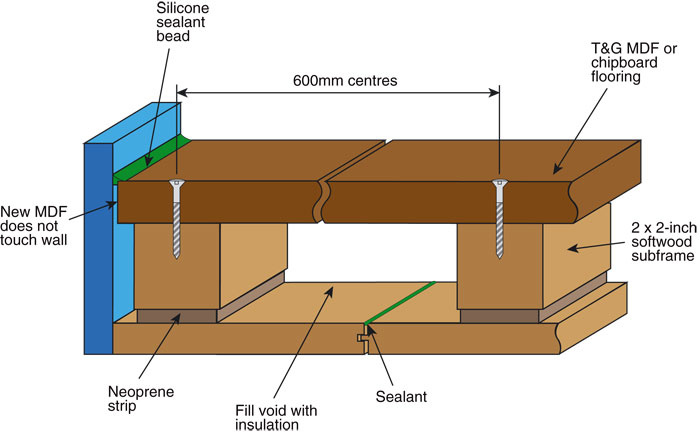 If you're able to do so, installing a floating floor will improve sound isolation no end, as it reduces mechanically transmitted noise, which can be a major problem in flats and non-detatched housing.Ceilings are more difficult to treat because to bring about any serious improvement, you need to build a solid, suspended ceiling below the original ceiling — and to leave as big an air gap as possible. Few DIY enthusiasts will want to tackle this job, so this is one area where you should think about calling in the professionals. However, if the room above is part of your own building, putting a layer of barrier matt on the floor above, below the normal floor covering, will help. You can also find specialist noise-absorbing underlay materials for fitting beneath carpets (see www.noisestopsystems.co.uk for examples). There are also commercial systems for improving walls and ceilings that rely on sound-deadening panels fixed to flexible metal channels, which are in turn suspended on wooden battens. The idea is that the metal channels flex to absorb some of the sound energy. In fact, you can find a lot of commercial solutions by doing a simple web search for 'soundproofing', but several companies, such as Sound Service (www.soundservice.co.uk), offer neat systems that you can either fit yourself or have fitted for you.
Keeping Your Cool!
Because a soundproof room needs to be an airtight room, you also need to think about how to get fresh air into your studio. Ducted air systems that provide adequate sound isolation are too expensive and too bulky to even consider at home, but maybe opening the doors between takes will be enough? However, as computers and outboard gear generate a lot of heat, you may also find that you need some form of air conditioning, especially in the summer. My split system (which comprises one box on the wall and one outside the building) cost me about £1000 and it is far from silent so it is only run when needed to cool the room for a few minutes — but it makes the studio usable. Free-standing air conditioners, or those that work by evaporating water, are not really suitable, although the free-standing types that pass the warm air out through a flexible hose may do the job at a pinch if you can make the hose a permanent fixture through the wall. Some sound will leak out via the vent pipe, but if you site it carefully it may be acceptable.
Good Vibrations

 A less intrusive alternative to constructing a full floating floor is to create something like this drum riser. Of course, playing acoustic drums at home may not be a good idea if noise is a problem, but the same principle can reduce mechanical noise transmission through wooden floors from other instruments, including guitar amps.Professional studio designs often involve building a completely separate inner room inside the existing space, isolated from the original floor by blocks of neoprene rubber or even mounted on metal springs. However, when talking to pro designers, they tell me that it is rarely necessary to go to these lengths other than for high-end commercial studios. I've seen a number of impressive studios built in colleges and these often comprise additional studding and plasterboard walls, but the floors and ceilings are fitted to the existing structure, often via neoprene isolation blocks to prevent vibration being transmitted through the structure. I mentioned earlier that sound isn't only transmitted through the air — it travels through solids too — so in the unlikely case that your monitor speakers are mounted directly on a steel joist that runs through several rooms, the sound is likely to be audible in any space that the joist passes through. If you can isolate your speakers from the walls or the floor, by using foam mounting pads for example, you're less likely to have sound passing from room to room via mechanical vibration within the structure. It's for the same reason that I recommended putting drum kits on a floating floor or plinth. Guitar amps — and particularly bass amps — also tend to inject energy into the floor, so some DIY floating plinths made up for these will also help. Of course, you can buy commercial isolation platforms from companies such as Auralex, so you don't need to be a DIY expert!
Where you need to create a new partition but you don't want to use brick or concrete block, you'll find that a plasterboard-on-studding construction is often adequate, with the proviso that both sides are built onto separate frames that are not in contact with each other and that multiple layers of plasterboard are used on each side to maximise the mass of the partition. As ever, the bigger the air gap, the better the performance, and filling the air gap with Rockwool may also help to reduce resonances. Isolating the partition from the floor and adjoining walls using neoprene blocks can also improve performance but all air gaps around the edges must be filled with a resilient material such as silicone rubber or expanding foam. If noise coming from above is a problem, a suspended ceiling can be a surprisingly unobtrusive and effective solution. The 'Z' suspension channel shown here (and alternative commercial solutions using springs) serves to absorb the vibrations that cause sound in the room below.
Practical First Steps
The laws of physics show no respect of budget or situation and, in practice, you may not be able to get as much sound isolation as you'd ideally like. Budgets too can impose a limitation on what you can achieve, but while there are some very good commercial products and services around, thankfully most of the sound isolation methods discussed in this article lend themselves to a low-cost, DIY approach. If you tackle the weak spots first (usually doors and windows) you'll still be able to bring about a big improvement. I'd suggest starting with air-tight seals around doors and windows, then re-evaluating the situation to see where the remaining weak spots are, and tackle them first.