

A producer from the US who's doing very nicely in the UK, Tony Hoffer has been responsible for some of the most successful indie-rock albums of recent years.
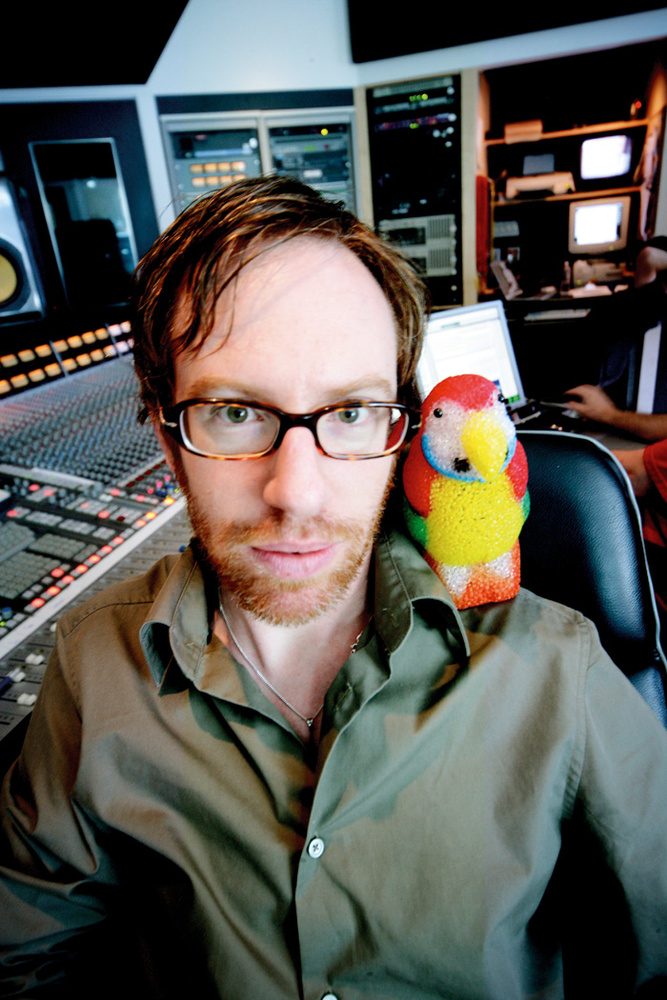 Operating out of Los Angeles, Tony Hoffer is unusual for a US producer, in that he's built a reputation for working mostly with British bands. His extensive CV lists many of the key UK guitar groups of the past 10 years, including Supergrass, Belle & Sebastian, the Fratellis and the Kooks.
Ironically, then, Hoffer's initial break came not through a Britpop connection but through Beck, figurehead of the US alternative music scene in the '90s, who would regularly open for the future producer's college rock band This Great Religion in his early days. Some years after Beck had poached the group's bassist, Justin Meldel Johnsen, for his touring band, the connection was re-established, resulting in Hoffer becoming live guitarist for the Odelay tour.
"Justin told Beck 'Tony's coming down to LA a lot, he's got some skills, maybe you should hook up with him and see what happens,'" Hoffer recalls. "So I came down to do some recording with him but I ended up also getting the gig playing guitar. I loved touring but I definitely enjoy the studio a lot more."
Hoffer cut his teeth as an engineer in the early '90s at a studio in San Francisco called Earwax, a pioneering digital facility where he first got his hands on Sound Tools, the two-track editing precursor to Pro Tools. "Digital stereo editing was a really big deal," he remembers. "You could rearrange songs and it was like 'Wow.' At the time there were other analogue studios around in San Francisco, but Earwax were trying to be a little more cutting-edge. Eventually they ended up with the [Digidesign] 442 four-track stuff, which was even more pioneering, and things kind of moved over to that."
Coming up in the period where analogue gave way to affordable digital, Hoffer schooled himself in both. "I would compose various things using guitars, samplers, keyboards, outboard processing like really cool delays," he says. "But I think I was probably a bit more into programming and when I started there was a lot of that available, work-wise."
Beck & Call
Tony Hoffer is equally flexible in terms of the projects he takes on, a characteristic he credits to his studio work with Beck. "He's a solo artist, so you'll either be working with him or there might be some musicians. You might be tracking a full band live or you might be working with him building something up based on samples. It can be anything and everything. That's the great thing about working with him — you never know what to expect, and that definitely brings the best out in me."
His first Beck album was 1999's soul–funk set Midnite Vultures, primarily a sample collage album. "It was a lot of programming and sampling and then manipulating the samples. Little tiny bits. Extracting one little bass note of one sample and that'll be the first note of a two-bar thing and then you go find another note from another sample. And so on. And you get this crazy collage of, y'know, really cool textural aural delight. That's what Midnite Vultures was all about — crazy sonics and parts. The songs that I did with him on Guero [in 2005], he played all the instruments himself and that was a bit more organic."
So can Beck be something of a perfectionist?
"He's a perfectionist with very unusual things," reckons Hoffer. "The things that most people probably wouldn't consider important are very important to him, and in the end it's the things that make the track really special. It can be some minute detail, some rhythm that almost has a drunken feel to it, and he'll really make sure that it has the proper amount of drunkenness, whereas someone else might overlook it and just say 'Oh, we want to do a messy sloppy little thing here,' and it doesn't have a vibe to it. He'll hone in on the details. When you listen to all of his music, you can kind of hear that in there."
Recommended to Air at the turn of the decade by their drummer Brian Reitzell, Hoffer travelled to Paris to work with the French duo on their second album 10,000Hz Legend, contributing additional production and then mixing the results. Possibly the key feature of his input was his fat, warm '70s drum sound, something of a Hoffer speciality. "I suppose it is," he says. "As I grew up I loved that kind of drum sound — very tight-focused and dead. Just like the Eagles, Fleetwood Mac, so many '70s bands. That is heaven for me, that sound."
Any tips on getting that sound? "Mmm," he offers, slowly, laughing. "Very carefully. No, it's not that hard to do, to be honest. The best way to get that drum sound is to have a really good drummer and good drum kit. Everyone's using the same microphones — everyone puts a 57 on the snare, or whatever. So it's how you treat the drums. Tuning is 90 percent of it. Obviously, you're not gonna get that sound in a very lively room. You have to be in a dead room or cut the reflections down somehow."
The British Connection
Hoffer's reputation for recording British guitar bands was founded on his work on the third Supergrass album, Life On Other Planets, in 2002. Travelling to England to work at Chris Difford's Helioscentric Studios near Rye, the producer was initially daunted to find himself faced with the facility's namesake vintage Helios desk.
"Rolling in there more used to the API and Neve consoles, it took a minute to get things sorted," he recalls. "But once we figured it all out, it was great. The console there had been in the basement of Island Records, so it had been used on some of those great Bob Marley records. Helioscentric is basically a converted barn that they turned into a studio. Not anything particularly amazing, mic-wise, but it just goes to show you maybe that's a good thing. Sometimes you can get real cool broken sounds with lots of character. You don't necessarily need the most expensive mics.
 One of Tony Hoffer's favourite studios is The Sound Factory in LA. Here, the crowded live area in Studio B reflects his preference for recording bands (in this case, Elviin and his band) live and 'in the room'."Supergrass brought out the best in me. They pushed me and I pushed them to get the best we possibly get and we did a really cool poppy, edgy, punky record. That's definitely what we wanted to do and that's definitely what I think their fans were wanting them to do as well."
In 2006, Hoffer played a significant role in the formerly gossamer Belle & Sebastian's transformation into a far sturdier outfit, with their seventh album The Life Pursuit. Recorded at The Sound Factory in LA, it pushed to its limits Hoffer's desire to capture performances live.
"There's seven people in the band. That's a lot of microphones, a lot of headphones. But we really had to figure it out and make it work somehow. They're a band where, if it's a piano song, the guitar player might not play guitar and might just play a shaker on the last chorus. So if that was the case, I wanted him to sit there with the shaker until the last chorus and then record it, just to try to get as much of it live as possible. The majority of the record is everybody playing together. We'd go back and we'd overdub some things or patch up some bits of stuff. But the feel — which was maybe a bit different than some of their other records — is them all playing together. Rather than doing the drums, then doing the bass, then doing the guitars.
"I've never had much luck at that, only because you're doing drums and maybe you record some scratch instruments, but you never really know what you have until you get to the end. I need to know 'What is this thing?' Like, I think the best way to shape a drum sound is to have your guitar sound and you're sort of shaping all the sounds together. You're going for the guitar sound that's going to be probably the final sound, you're going for the bass sound that's going to be final sound. And that way I'm able to do records in three or four weeks."
For The Life Pursuit, Hoffer also used Logic, though almost as a synth rack. "I'll have musicians play something from Logic in my laptop into the main Pro Tools rig in the studio and then I can process it. A lot of those sort of odd synth sounds on the Belle & Sebastian record were different Logic plug-ins. I have normal outboard synths too, like the Korg MS20 and Roland JX3P, which is kind of like the SM57 for me — very cheap and not many people know about them."
The Frat Pack
 Given the choice, Hoffer prefers to record on API desks.The live feel that Hoffer tries to achieve was no more evident than on Glasgow band the Fratellis' 2006 album Costello Music, recorded in Studio 3 at Sunset Sound in an impressively swift 23 days, following a week of rehearsals in LA.
"The main overdubs were mapped out in pre-production," he says. "I wanted to make sure things didn't sound too cluttered, but at the same time not too bare. I'm not a big fan of tracks where people keep adding overdub upon overdub with no real concept or purpose. I feel like each track you put on a song has to count. I definitely didn't want to end up with tons of unnecessary guitar overdubs crowding the space, when actually one or two guitar tracks could be made to work far more effectively. They have a custom console in Studio 3 that's based on an old API. I mixed it on the monitor section because it sounded better to me coming from there rather than on the main section of the console."
The producer's other recent successes have included Brighton's the Kooks. Hoffer was responsible for their triple-platinum debut Inside In/Inside Out and now its successor Konk, recorded — like its predecessor — at the Kinks' North London studio that lends the album its name.
"On the first record it was my choice to go there, because I really felt that if it were possible to record them on an older Neve console, it wouldn't hurt. I talked to some friends that had worked there. They said it was a cool, quirky studio with a great console and great mics, and the room sounds really interesting. So we went there and it was great on the first record."
Though there was initially talk of relocating to New York or Los Angeles for the follow-up, in the band's minds, at least, there was no question of where the Kooks wanted to work. "I could see in their eyes that they were so excited at the possibility of going back to Konk," Hoffer says. "[Singer] Luke [Pritchard] said that it's almost like their Abbey Road or something."
Tracking through the studio's Neve directly onto tape, Hoffer and the band developed a daily routine where they'd run down a bunch of takes, choose the best one and then overdub and — in some instances — nail the vocal before the end of play. "I'd rather work fast, make quick decisions and not waste time going back and forth. Because you can get a lot more done in a shorter period of time. Quite often I'll redo the first song because I know you get into a good flow maybe by the second song when you're tracking. And it's almost like, 'Cool, why don't we just come back to it?'. I'd almost rather do that than spend a lot of time on one thing."
Konking Out
The mixing duties for Konk were handed over to Chris Lord-Alge. Often this can be a touchy point for producers, though Hoffer insists that — in this instance, at least — he had confidence in handing over the album. "If it's someone that does a good job with it then I'm really, really happy. If it's someone who's just flat-out not doing a very good job with it and not playing off the strengths of the band and the songs, then it's kinda like 'Man, y'know, I'd rather just do it myself.' Naming absolutely no names.
 Pre-production and planning are central to Tony Hoffer's success as a producer."But Chris did such an amazing job of it. I went there wearing my producer's hat and that's kind of nice for me. I normally mix the records I produce and it's sometimes hard to wear the mixer hat and the producer hat at the same time. Basically, you do a mix and the band will come in and have a listen and you're sort of presenting it to them like you're the mixer of this, as well as being the producer and you're maybe saying 'This guitar should be almost too loud so that it sounds crazy.'
"Don't get me wrong, I love mixing. It's a far more technical thing and it's fun to get into that, especially when you've been producing several records in a row. It's nice to get into more of a technical sonic thing where you're listening to details in sound very carefully, rather than thinking 'Is the guitar in tune?'"
Indeed, Hoffer is often employed purely for his mixing skills, most recently to add polish to Goldfrapp's dreamlike folk-pop album Seventh Tree, with its blend of treated acoustic instruments, orchestration and discrete electronics. He took the project into Studio One at Sunset Sound.
"There was a handful of songs that still needed some additional stuff — drums, bass, keyboards. Every artist I work with is a learning experience and Goldfrapp is very, very different, as you can imagine, from the Kooks, or even Beck for that matter. With Goldfrapp I learned different ways of treating keyboards — making analogue sounds sound very digital or digital sounds sound organic. I did a bit of that on the Air record and they liked that. The cool thing is that each song is its own world with its own little eco-system. With Goldfrapp, that's how they see their music."
Artist Development
In terms of his overall role as producer, Hoffer sees himself as being there to aid the artist to fulfil their potential in the studio. "I'm there to help the band make the best record they can make," he says. "To help them artistically and also commercially, so they'll have a career and they'll be making more records years down the line. It's about doing anything possible to help the artist with their career.
"But in addition to producing and mixing I'm getting into artist development — I guess A&Ring in the sense of how it was in the '50s and '60s, helping them with their songs. If they've got 15 songs, they feel they're ready to go, but they're all maybe a bit too similar and there isn't a lighter type of song on the record. It's being very specific with direction and guiding them to come up with some other things to round out the record."
To help a project go smoothly, Hoffer says, he'll put time in on the pre-production before he or an artist even enters the studio. "I've got a whole spreadsheet of what needs to happen on what song when and where, so it's all organised. I can go in and get the band in a good place where they're able to throw down amazing performances and all the mechanics — whether it be the studio or their performance mechanics, like, their hands or this or that — none of that's getting in the way and all we focus on is creative stuff. That atmosphere that will be heard on the record."
Tony Hoffer's enthusiasm for music seems boundless, perhaps one of the reasons that he's responsible for so many high-profile projects. Putting his old–school A&R hat back on, he's currently in pre–production, working through songs with London soul artist Elviin. Ultimately, he says his plan is to continue down the same road that brought him here. In other words, in order to make a great record, he's prepared to try anything.
"That's what's cool about recording, you can just try stuff and see what works for you," he decides. "And the crazy thing is what works with this one artist probably won't work for another artist. You have to constantly be finding new things. The bag of tricks keeps expanding and expanding."
Maintenance Is Everything
Although he works all over the world, Tony Hoffer favours three LA facilities: Sunset Sound, Sound Factory and Ocean Way. "It's just very easy to get things done in those studios," he reasons. "I like to work fast and get good momentum and it can be a bit frustrating if you're constantly coming up against technical worries and mechanical issues. I tend to work on older consoles from the '70s, Neve or API, and they need to be handled. You need to have someone around to maintain them every day. I've worked in studios where they've got an amazing Neve console, but it doesn't mean anything. I learned early on that you've got to find the studios that have good maintenance. Same with the mics — you can have an amazing console but if the mics aren't in order, it's pointless."
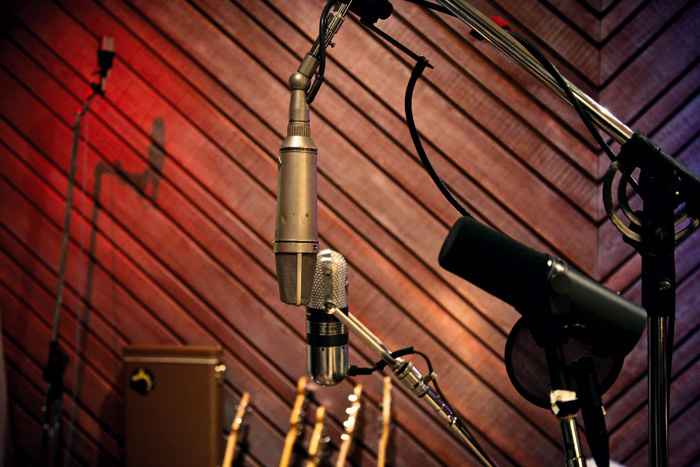 Though he's a fan of the unsung Shure SM57, Hoffer also makes use of more desirable vintage mics such as the Neumann U67 and RCA B77DX on display here.If forced to choose between Neve and API, Hoffer prefers the latter. "It gives me what I like to hear. I like the EQs a lot. The frequencies that API have chosen just make sense. They're very musical. I like broad EQs and they're perfect — not too broad if you need to get in and tweak a little something, but not too narrow like some other consoles."
Mic-wise, Hoffer's preferences are fairly standard. "I use [Shure] SM57s on everything. That's probably the most under-rated microphone. Until you've actually tried them on a bunch of things, you can't really assume anything. I guess I'm a big Neumann fan — U87s, I love them, U47 FETs. Then I'm familiar with those mics because the studios that I work in have them, so I know what they can do. But quite often I'll go to a studio where they don't have those mics and you get on with it and you make it work.
"I'm a little fussy for certain instruments. For drums I like to have good mics, only in that it's not easy to redo drums at a later date. If the kick mic is a little this or that, or the snare isn't quite picking up the depth that you hear out in the room, it's hard to sort that kind of stuff out. With guitars, there are many more options and a lot more flexibility."
Wherever he works, Hoffer takes his Pro Tools HD rig with two 192 I/O and one 96 I/O interface, running on an Apple Mac Pro with two 2.66GHz dual-core processors. He doesn't use many plug-ins apart from Digidesign's stock EQ III. "The API console that I work on doesn't really have any decent high-pass or low-pass filters," he states.
In terms of outboard compressors, beyond the tried and tested Universal Audio LA3As and 1176s, the producer also has some more unusual devices. "I've got something called a Boiler made by Ridge Farm. It's really cool. It'll hold something and not let it go beyond a certain point. If a sound is kind of pokey, lots of transients, it'll basically sort it out. It holds it but it adds a little bit of excitement. There's probably a bit of upper-frequency distortion happening in there, so it'll make something pop out a little more. I've got a Thermionic Culture Phoenix, which is cool. I use those for creating character sounds."
Where's The Tape?
Typically, Tony Hoffer chooses to track drums and bass to two-inch tape before dumping the results into Pro Tools. Recently, however, he's been finding it harder to get his hands on decent tape. "It's almost at that point where it could be over," he laments. "You'll record something on it and you play it back and it's really strange. From one reel to the next reel it's different — 'OK, this reel is a little brighter... OK, this reel has hardly any low end on it.'
"I always print mixes to half-inch but for the past year or so, most of the records I've mixed have been mastered to digital. When you put the tape up next to the digital, the tape just doesn't sound that great. You line it at plus six, plus five, plus three, plus two, plus one and at zero — which I'd never even used before — and it's OK, but not great. I don't know what it is. It's the whole chemistry process and I don't know if it's a quality-control problem. I wish I knew."