

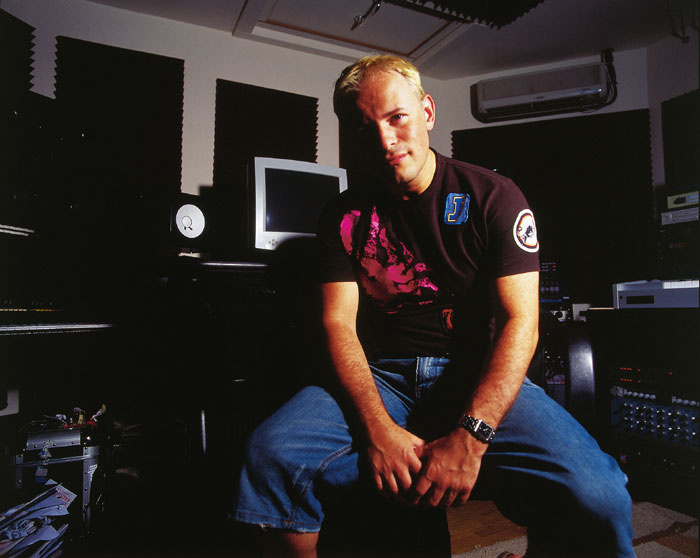
 Photo: Richard Ecclestone
Darren Tate is one of Britain's leading house and trance producers with nine top-40 hits under aliases including Jurgen Vries, Angelic and Citizen Caned, his latest success being the DT8 Project's summer anthem 'The Sun Is Shining (Down On Me)'. He reveals the personal production tricks which make his records stand out.
Dance music is based on repetition — and if you are repeating something, you've got to make sure it's something that's not just likeable. You want to have something that gives you goosebumps, that raises the hairs on the back of your neck. The most important and significant parts, for me, are the chord structure and the melodic elements. It's got to be something that people get straight away, something that has that right feeling from the word go. Sometimes you get an element of that, but the melody can be overly complicated. If you're doing dance music, it's got to be quite straightforward. So take your mix and play it to people. They're not necessarily the best judges, but a good uplifting piece of music will generally get a good reaction from a lot of people on first listen.
Arrangement is all about anticipation. You can listen to a record you've never heard before, and still instinctively feel when certain things are going to happen, because the music gives you clues. So getting that right is the key. In the club context you're doing it in terms of a seven or eight-minute 12-inch mix, and from a radio mentality point of view it's within a three-and-a-half-minute framework. I usually start by thinking about the 12-inch arrangement: if it doesn't work as a 12-inch, it just doesn't work.
 The most recent of Darren's nine top-40 hits is the DT8 Project's 'The Sun Is Shining (Down On Me)'.It's about the different elements you can put in. You start off slow with simple elements, and you build up. If you want more emphasis going from one section into another, you might drop just the bass in a fill, or the kick and the bass, and when it kicks back in again, there's a little bit more emphasis. Snare rolls are famous for obvious build-ups, as is taking a piece of white noise and filtering it to create a 'whoosh', or using sound effects. You can create your own or use libraries. You can filter sounds. For example, I've got a big, warm Moog pad here, and I'll open the filter to suggest there's something coming up, or when there's a verse playing and I just want it more thumping it might be filtered down. And then there's obviously the natural rhythmic things that a drummer would play, like a crash on the first beat of the bar.
When you've got those things in the right order, it's just a case of how long you extend the track out for before it feels right to bring in a breakdown, or how long it feels right to have a breakdown for, or how long a build-up is right for. That is purely based on listening to the record and thinking what feels right. It's very hard to have a rule of thumb.
In trance records you usually get one breakdown or two. The classic 'hands in the air' moment in trance is usually the breakdown, and then it builds and builds and builds. House music is more consistent, it's about playing with the constituent parts and bringing them in and out. It still drops basses and kicks, but it's not so much about big anthemic drops and huge builds, it's more subtle. It's very much about chopping up certain elements. So not only might you have a four-bar phrase, but you'd take the first two bars and repeat that, and screw with the mix of that, and then create a build by using filters and using additional drums and then kicking in again.
Fresh stuff and fresh sounds help you write melodies and create ideas. Go down to a music shop, play around on all the keyboards and listen to all the new stuff, and you'll find yourself inspired to do something.
 Photo: Richard Ecclestone
 In addition to favourites like the Access Virus and Roland JP8080, Darren also finds the Novation Nova a useful trance sound source.Photo: Richard Ecclestone
 Photo: Richard EcclestoneThe most important thing is to have a degree of originality. I get inundated with records that are basically the same thing. We need to be making the most of technology to get the most effective results, and the great thing about it is that you can experiment with it and create sounds and noises and effects that set your record apart, that give it something fresh and new. On top of having your melodies right and your arrangement and production, you've got to come up with something fresh too.
I'll start playing around with different sounds, but in the context of an idea I have in my head. The normal rule is, I've got the melody or I've got the chords, I've got an idea. I would either have found the sound first, in line with those chords, or I'll have the chords and I'll think to myself 'Right, I need an angle here.' For example, my current record is 'The Sun Is Shining Down On Me'. I had the idea of doing a trance record with a soulful male vocal. The regular thing is white female vocals, but I don't like doing the regular thing, I like to do something a bit different. And I later reinvented the record by bringing in instrumentalists, live bass and everything else, and turned it into a house record. But I had the idea to do that in the first place, and it worked.
If I'm doing a trance record or a house track, I'll have a template set up in Logic. I'll have a set of basic MIDI drum patterns which gets me into the flow of things. They're the basic building blocks. It'll be your standard 909-ish kick, your standard closed hats, the same kind of kit that everyone is using. If it's house, I've got a slightly different set of samples that I like — different snares, more realistic samples, more heavily compressed sounds to give it a bit more bite and edge. That's when I'll start doing the chords and things and get into the flow of it with the idea in mind.
Then I start building up the arrangement. What I tend to do is work on a four- or eight-bar section originally, rather than just go 'Oh, I like that,' and lay it out for eight minutes. I'll just layer down the chords and the sounds, and then start finding the right sounds and putting together elements of track that I like. I keep building the track up and tweaking the different elements. I get a little section up and running and sounding good, and then I'll probably start putting the arrangement together at that stage.
The point about being a cutting-edge dance producer is not just producing something, it's producing it really, really well. It's making everything sound fantastic. I can mix down a dance track and make it sound like a pop track and it will sound crap in a club. It will sound very nice and pleasant, but it won't sound thumping and banging, and the sounds won't jump out at me, and it won't be doing enough — but with that kind of record, you need it to do that. Whereas if I produce a pop-house track, it's much more of a toned-down sound, there's not such an emphasis on blasting certain frequencies and creating noise at certain levels. It's about creating an effective radio record, which is not so extreme musically.
Another key thing is knowing when it doesn't work. I start umpteen tracks where people go 'That's really good, I really like that' — and I'll still scrap them. For me, they're still not good enough, because all those elements aren't quite right.
What you must do is listen to your gut instinct. In the old days I never used to be able to mix properly, because I had no acoustic treatment, and it was like monitoring in a cave. I used to do the arrangements at home and then hire other studios to mix. And what I found was that I was hiring these studios and listening to the engineers, and they were going 'Right, you want that, and you shouldn't be doing that...' and I'd take my track away and think 'How come this sounds even worse than when I was doing it in my stinking setup at home?' I started realising that when I was in these studios, my gut instinct wasn't necessarily agreeing with what the engineer was saying, and I started saying 'No, this is how this track has got to sound.' And that made all the difference. As you listen to it in a correct acoustically treated environment, you start to develop that ear that lets you recognise when something sounds great or doesn't. When I started hearing things in a proper environment was when I realised I could do this myself.
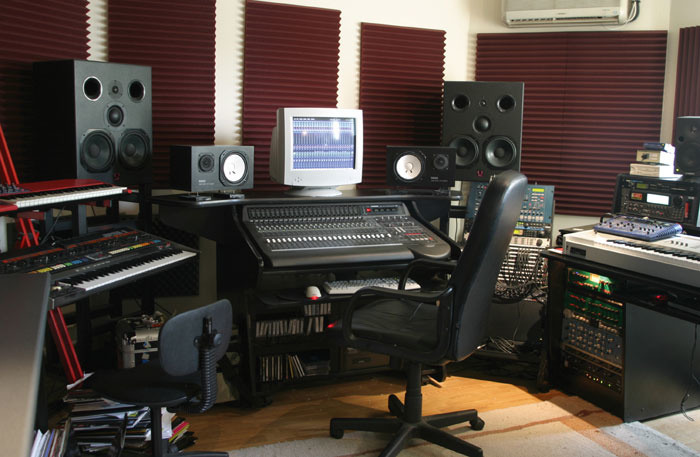 Although much mixing can be done on small nearfields such as the Yamaha NS10s, larger monitors are required to make critical judgements about the low bass regions of the mix — Darren uses the Quested 3208s for this purpose.Photo: Richard Ecclestone
I don't want to hear any rubbish going on in the room, I just want to hear what's coming out of the speakers. I did all the treatment in here myself, and originally there weren't enough panels on the wall, and I kept putting more and more on. I like the sound quite dead. But because it's slightly coffin-shaped it's quite good, because you get the sub-bass sitting at the back like in a normal studio, and you can get quite a realistic impression of the bass response. If I really want to hear the lowest frequencies I've got my Quested 3208s. I don't need the sub, they're so heavy as they are. You can sit at the back and listen and it'll sound fine on the NS10s, because they only register so low, but you listen to the 3208s and suddenly you'll hear this huge frequency that you wouldn't have heard. You won't have realised how boomy it is until you hear it on a monitor that has that bandwidth.
What you have to do is get your sounds right in the first place, and then take it from there. I remember going to Turnkey years ago and saying 'I can't get my mixes to sound like this,' and they said 'Oh, what you want is a Finalizer.' That's quite possibly the worst piece of advice I could have been given. I know a lot of engineers who'll go 'I've got to record with this kind of mic,' or 'I've got to get that,' but it's not much bloody good doing that if you then set it 2dB too quiet in your mix, or you use the wrong effect. I've heard recordings made on really good microphones and they do sound lovely, and there is probably a slight tonality difference, but there's bugger all you can hear in a dance record. There's too much stuff going on. There's more important things to get right. Say, for example, I have a pad, I'm thinking about how heavy the bass that I've chosen is, how the EQ of that works with my pad, and how that fits into the whole scheme with the drums in there as well.
If you want a challenge as an engineer, nothing's harder to mix than a trance record. There are certain synths that are infamous for trance sounds — the Roland JP8000 and JP8080, obviously the Access Virus, and I like the Novation Nova. Some of these sounds have been used to death, and combined with certain effects, they make what is now considered a standard in trance production. But you can still do something with them. If you combine the Roland with something that's heavy and wet, and then put that against a nice plug-in soft synth that's very dry, maybe with a delay, each sound still has a lot of separation, even if they are in the same frequency range.
 Hardware sound modules at Darren's disposal include the Roland S760 and Emu E4XT Ultra samplers and Roland's JV1080 and XV3080 sample-based synths.Photo: Richard Ecclestone
 Photo: Richard Ecclestone
Sometimes I'll do something totally bizarre and use orchestral instruments in a dance track, like a 'cello or a French horn. If I blatantly put it in, people will think 'What the hell are you doing?', but quietly in the  One of the well-stocked processing racks in Darren's studio (from top): Joemeek TwinQ and two VC6Q voice channels, Smart Research C2 compressor, Oram Hi-Def 35 equaliser, Behringer Ultrafex II enhancer, SPL Transient Designer dynamics processor, and Digidesign ADAT Bridge audio interface.Photo: Richard Ecclestonetrack it works a treat. As long as their dynamic and their frequency range works in combination with the other sounds that are present, and they don't clutter the mix up too much, it's great.
You can do a lot of work on a kick drum. Sometimes I've taken a kick drum off a record, but what I then do is put it in an audio editor and find another element of a kick drum that I like, like the attack, and line it up, and on the audio channel I'll crossfade between them to create my definitive-sounding kick. And then if it needs more sub-bass, I'll add the lowest frequency from a heavier kick. On top of that I might layer a really thin snare to give it a bit more bite. And then on top of that, I might have the Pultec EQ emulator running. I'll listen to a kick drum and think, bearing in mind where club speakers have their pronounced point — generally around 60Hz to 100Hz — I know that for this particular mix that I'm working on, I really want it thumping at around 100Hz, that's the really chunky part of the sound, whereas the really low part just creates an unwanted 'mmmph' that isn't necessary, so I may roll off the really low sub frequencies. On top of that I might then compress it to make it a little bit tougher.
What a lot of people do in trance to create snare sounds is to get white noise and compress it really heavily, even using the Logic compressor, so it cuts in with a heavy attack and then cuts out. It makes a blisteringly sharp clap noise, and that works really well. You can put that in stereo and put a nice reverb on that.
With hi-hats it's about making them sound tight, with a sharp attack. I've got an SPL Transient Designer which I don't use much any more, but in the past I remember using it to bring in the attack, it just trims start points so you can make things sound really clipped. I think with this kind of stuff, drums should sound very tight and really stick out in the mix. I tend to use short reverbs on hi-hats, generally, but I tend to use quite a long reverb on crashes and things, I like it lingering. If it's in a breakdown and I just want the crash floating off into the distance I'll use automation to switch on the delay or turn up the send level.
All club systems are mono, pretty much, so just make sure you don't do anything stupid and put your mix out of phase. I sometimes like my drums to sound very mono if I've got a lot of other stereo stuff going on, but sometimes it's nice when they sound really wide when you've got less going on. Some people I know use two hi-hats and pan them left and right, some put it centre in the mix. Both work, it depends what effect you want.
Compression is an integral part of sounds, and an integral part of components of sounds. Often I'll compress the reverbs on the drums on every beat, so that you feel it pumping. You'll hear the reverb come in and out, and that's a really nice effect. It makes the kick itself sound more defined — rather than the reverb washing over the kick that comes on every beat of the bar, the kick comes through and then you get a kind of 'oomph'. I don't use the kick drum itself as the side-chain trigger — I create a MIDI pattern so that I can control how that compressor fires against the drums. That way I can make it compress on every kick beat, but I can also make the track compress without the kick drum running. Often I'll use it on other instruments too, and it creates that great bouncy, pumping feel.
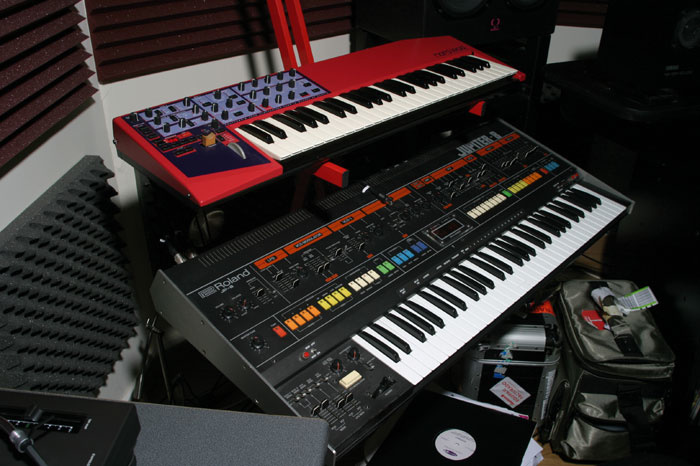 Photo: Richard Ecclestone
Engineers are taught to use EQ to cut, but the most natural thing is to boost. I mix as I go along, and I'll leave lots of headroom on the desk, I'll keep my levels low in Logic so I've got room to play in terms of automation, and I'll tend to boost things when I need to boost them. I tend to boost more high frequencies — 1kHz upwards tends to be my boost territory. If I have unwanted sibilance or nasty noise at the top, I'll roll off some of the highest frequencies. Usually all my drum sounds have been treated individually with filters or EQs.
They say that in America mastering engineers master to the bass, whereas if I do a dance mastering session here it's all about bringing the kick out. The bass is a good thing to duck sometimes, if you've got a running line — it gives you a little bit more impact when the kick fires — but then again, sometimes it's really nice just under it. It depends on what you're working on. I've done some R&B as well, and the emphasis is different. The kick's there, but the bass is really important.
Basses are a bit annoying if they cover a lot of notes, because you'll often get certain notes that just physically sound louder than others. What I do if I have a real overload on a certain note, a real 'bludge' of sub-bass just at that certain frequency, is automate the level or automate an EQ, and just on those notes I'll lose that. A compressor won't always pick it up, it's something you usually need to do with an EQ.
Vocals are a world unto themselves in terms of production. Bringing up and balancing vocal levels is really important in dance music, where you need the vocals sitting up there in the mix. You don't want to just lose things. If you're working with the vocals from the beginning, sometimes you end up doing an instrumental track and you have to fit a vocal on. That can be quite hard, but obviously there's lots of methods of doing it. It depends on the style of the vocal, and whether it's a lower male voice or a slightly higher female one. Higher can be easier to place, but it completely depends on how much is going on in the track. If you've got very little going on, for a house record, it's quite straightforward, especially for empty-ish funky house records because there's tons of space. I'll tend to compress vocals quite heavily for dance records, I'll tend to EQ them quite brutally, I'll effect them as required and do all sorts of crazy stuff to them.
The final discipline is knowing when to cut something to make a track work better. I think that's one of the hardest things people have to learn — sometimes, less is more.
I'll always find things wrong with a mix if I take it away thinking it's perfect. I tend to mix vocals last, and then once that's done I still end up going over my mix again. I have this little method that I work by, where if I've finished a complete MIDI arrangement but haven't done the final mix, I'll come in and really get that mix sounding as tight as humanly possible, exactly where I want it to be, and then I'll take it away and listen to it. I can guarantee I'll still think 'That needs sorting out, and that needs sorting out...'
What I do sometimes in house music is that I won't just bounce down the whole mix when I'm done, I'll bounce down the drum part and then I'll bounce down say the strings and the bass, and do maybe three or four bounces, and then I'll start pissing around with the stems themselves, adding effects and stuff to each bit, be it filtering or flanging or whatever. In one instance, when I did Angelic's 'It's My Turn', I put the whole record through my DJM600 mixer, which has got a wicked flanger in it, and I just used it before the record kicked in after the breakdown.
To me, if it sounds great in my studio, and I'm happy with it there, it sounds great in a club. I was writing club music and dance music before I went clubbing.