

 Mark Nevers, playing the ukelele.Photo: Steve Gullick
Fed up with being treated badly by spoilt divas, engineer Mark Nevers abandoned the country music establishment to start his own studio, and has made a name for himself on the 'other side' of Nashville.
Mark Nevers is fast becoming the producer of choice for key alt-country artists the world over, including Lambchop, Bonnie 'Prince' Billy, Calexico and the Silver Jews, but the Nashville-based studio owner and engineer admits that he often wonders how he managed to find himself in his current position. "I really don't know," he shrugs. "I mean, I love the Ramones! So I don't know how I got into the hushed-down world. But actually, y'know, I find it's harder to record than the loud stuff. The quiet stuff drives you nuts because all it takes is the singer having a dry throat and everything's ruined."
His punk roots notwithstanding, Nevers' studio grounding was very much in the world of traditional Nashville country music. The son of a Vietnam fighter pilot, he first became interested in tape machines as a kid, recording messages to send out to his father ("I was infatuated by my voice sounding different when I heard it back"). In his early '20s, having studied engineering in Florida, he graduated with SSL experience — invaluable in the mid-'80s — and landed a job at Castle Recording in Nashville, chiefly thanks to the ineptitude of the previous engineer, who'd managed to snap a master in the middle of a session.
"This was back in the day when you couldn't really fix stuff when you'd ruined it," he recalls. "It was on the first digital 3M machine and it looked like film the way it went around the heads. And he snapped it in half somehow right in the middle of the bridge and they couldn't fix it. So they were real suspicious of me when I came in there — they wouldn't let me touch nothing."
Over the next 10 years, Nevers put in countless hours recording what he describes as "the first renaissance of reborn traditionalists" like Randy Travis and Hank Williams Jr, as well as country legends like Johnny Cash and George Jones. Although this was obviously a fascinating and important period in his life, the producer looks back on those days with mixed feelings, particularly due to the incredibly off-hand, old-fashioned treatment of engineers by some artists. "A lot of people are dickheads and they don't remember your name. You can have years of working with somebody and they still don't remember your name. It's like 'I've been up all night in the studio making you rich, please remember my name.'"
Perhaps inevitably, given his plain-speaking attitude, something was bound to give eventually, and in 1995, Nevers walked out of a session and never went back. "This chick was singing and screaming at me and it was terrible," he remembers, with a grimace. "It was like 'This is not what I went to Nashville to do.' And I just thought 'I can't do this any more.' It had got to the point where I couldn't face it for another second."
The Studio Floor
For the next few years, Nevers returned to his second profession as a chef, though he continued to build his home studio, the Beech House, seeing it through from its modest beginnings with a Portastudio through his purchase of a Tascam T38 half-inch eight-track machine and onto its current status as a facility offering the best of both the analogue and digital domains, with its combination of MCI JH16 two-inch 16-track and Pro Tools.
 Deeply sceptical about the value of professional studio designers, Mark Nevers chose to build a studio in his own house.Photo: Steve Gullick
It was through his development of the Beech House that Nevers first met Lambchop frontman Kurt Wagner, at the time working as a hardwood flooring specialist. The singer offered to lay a floor for the producer in return for some studio time. But while the recordings took place, funnily enough, the work on the floor never happened. "He scammed me!" jokes Nevers. "But I'm gonna put in a new floor soon and he's gonna at least polish it. I'm gonna bring him back to his roots..."
Lambchop's latest and most ambitious effort, the two-albums-released-as-one package of Aw C'Mon/No You C'Mon, was the first to be recorded entirely at the Beech House using Nevers' most recent purchase, a Sphere Eclipse 28-channel desk originally built for Doppler Studios in Atlanta, Georgia in 1978. "They only made about 50 of them," he explains. "Its design was kinda ripped off by API for their parametric EQs and stuff. It's a very quiet desk and it has these giant transformers on the outputs. There was a scam on transformers on tape machines and stuff when they ruled the world, people said they were noisy. So they brought the chip in and it was like 'Hey, we got rid of the noise.' But, no, what they did was they got rid of the 100-dollar transformer and replaced it with a 10-cent chip which is quieter but sounds like shit.
"Anyway, my partner John Kelton picked it up from Doppler and it wasn't working that well, so I brought it over to the house and spent a couple of days with some techs and got it working. All it was was capacitors. Everybody always says 'The old shit's all fucked up,' but it's usually things like the knobs on APIs or Neves click and they break. The shit that doesn't click doesn't have a problem and the Sphere doesn't have a click.
"Because it was from Atlanta in the late '70s, I'm sure a lot of disco and R&B was recorded with it. But then I read this thing about the Sphere that said that a lot of heavy metal like Krokus and Lynyrd Skynyrd was recorded using it. It's weird 'cause sometimes if they play a song on the radio, I can hear its sound. It's got the top, it's got the bottom — a Neve to me is mushy on the bottom and an API doesn't have any bottom, but a Sphere is like both of them combined, with a hard bottom and a good top."
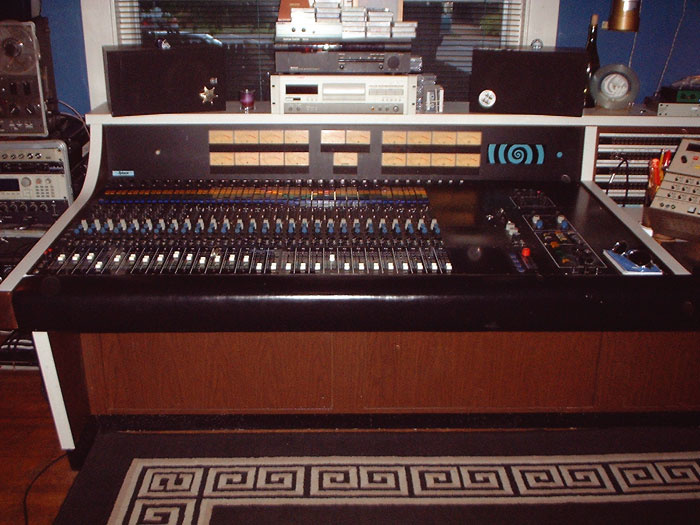 The Beech House studio is based around a '70s Sphere desk.Photo: Steve Gullick
Nevers explains that as a studio, the Beech House has completely taken over his home, to the point where he lives "upstairs or on the couch". Throughout the development of the facility, though, he's remained defiantly resistant to any kind of professional acoustic tweaking. "I didn't have to have anything done to it because it's a bungalow — which in America means it's got wooden floors and a basement under it and plaster walls — and so it just sounds great naturally. I always had problems with studio designers. There's this guy called Tom Hidley and he was the dude that would never let a window be put in a studio. So us engineers always hated him 'cause we were the ones that had to sit there in that studio without a window. It's not natural not to see time progress with sunlight. It's like being in a submarine. So I don't give a shit about sound reflection at all, just give me a window so that I know whether it's day or night. It's like, get NS10s, put a window in and screw all that shit."
In terms of layout, the studio is situated on the ground floor of the property and centred around what Nevers calls the 'den room' where the main recording takes place, with five ante-rooms which are used as iso booths for amp placement.
"I've got the console facing the wrong way — it doesn't face the band, so I have to turn around, but that's fine. I try to keep everybody that's playing at the same time in the same room so they can get the feel. In Nashville they have this thing where everybody gets separated — drummer's in one room, piano player in the other room, and it's just discombobulating. I like to be able to hear the guitar player strumming on the drum overheads.
"The only thing you really have to separate is the piano because that'll cause you hell. If it's being played delicately, if it's close to the other sounds, it'll pick it up and it'll make everything real distant and muddy. So you've got to get the piano the hell out of there. The same with the acoustic guitar, that's gotta be separated. But as far as all the rocking dudes go, they should be right in there and their amps somewhere else. I don't mind bleed at all, as long as it's not too far away to the point where you can no longer make it tight."
Perhaps unsurprisingly, given the largely hushed nature of Lambchop's music in particular, the monitoring levels at the Beech House are always on the quiet side. "If you listen too loud, it wrecks your ears and it also fools you about pitch," Nevers points out. "If it's loud, you're forgiving about stuff being out of pitch, especially vocals. If you listen lower, you're like 'Oh that's crap, we've gotta fix that.'"
Another Man's Spillage
Nevers' first project with Lambchop was engineering 1998's What Another Man Spills, though it was only with their 2000 breakthrough album Nixon that he first picked up a production credit. He remembers that even in the preliminary stages, he and Wagner were determined to make that particular record very special. "Before we did Nixon, me and Kurt decided that we were gonna spend the time to make a record that competed with people that had a lot of money. We wanted the record to sound as good as the records that cost hundreds of thousands of dollars. Because of the situation I was in with John Kelton who had this great studio, Wedgetone, with an SSL and all the gear, we could do that. If we were paying real rates, we couldn't have. We knew we had to fix certain things with the band, but the sonic thing was the main driving force. To take it out of the crappy console world." The current line-up of Lambchop, lined up.
Having succeeded in elevating Lambchop out of the world of makeshift indie recording, Nevers and Wagner repeated the trick with 2002's stripped-down set Is A Woman. Approaching Aw C'Mon/No You C'Mon proved more of a headache, however, mostly due to the sheer volume of material (Wagner had set himself the task of writing a song a day in the period before recording) and the fact that the Lambchop frontman was still using working titles for the songs that were often just the date when they'd been written.
"That was hell, 'cause he had 35 songs and they were all called 'January 14th' or 'January 15th'. So we're trying to work on them and there's nothing to grab onto. The band was just as confused as hell. But Kurt always does that. He's always like 'We're gonna do a new record,' and it's three records."
Sessions began in April 2003 and normally the band — whose membership can at various points swell from a trio to a 14-piece — would turn up on day one. Ask Nevers whether the band rehearse the songs beforehand and his response is typically blunt. "I wish they would! For the last record, Kurt actually did demos on his little Pro Tools unit and he gave them to the band members. The demos are just guitar and vocal and a bad drum machine which drove the drummer crazy because he had to mimic it and he couldn't."
In terms of the basic live recording process, the producer says he likes to nail as much as possible live. "Basically, the bass, the drums, the guitars and with Kurt, his vocal, he always does it live. That's why it kind of feels like it's him playing with a band behind him, instead of him singing on top of something. He's always in the hallway looking at the band through the window, playing his Gibson. That causes problems too because I have to put a spy mic in it, just in case he wants to redo a word or something, so you don't miss the strumming. So I put a spy mic inside the guitar itself to get the 'click'.
 The main recording area at the Beech House.Photo: Steve Gullick
"When we're tracking, there'll be five or six of the band there. On Is A Woman the whole band was there and that was a nightmare because we had to go back and fix everything. This time we controlled it more. With Is A Woman, I guess because I didn't use enough compression, there's actually a whole lot of shit going on.
"On this one, the recordings actually went too quickly — we booked the band for a month and we did it in, like, two weeks. So we've still got to pay them for two weeks! Thirty-five songs in two weeks. The working hours are very short because everybody has their families and stuff, so it'd be only from like 11 to five in the afternoon. That was as far as the tracking went."
The Master Keyboard
Aside from Kurt Wagner's vocal, the primary feature of Lambchop's sound on recent albums is Tony Crow's ornate piano playing, which is recorded using a Yamaha C3 conservatory piano that, unusually, has been wired for MIDI. "John Kelton gave it to me because it was in the other studio and it wasn't being used," says Mark Nevers. "I was like 'What if we restrung it and repegged it?' And he's like 'Well if you do that, cool, but I'm gonna put MIDI in it.' I don't know how they do it, but they do! So now I can run it into the computer and Tony can be playing his beautiful Liberace shit and then I can use Reason and put space sounds under it following the notes. So he doesn't have to track the parts."
Awesome Cats
Kurt Wagner's distinctive baritone vocal is usually recorded using what Nevers calls the 'dark' Neumann U87. "People always say 'How do you get that vocal sound?' It's funny because I learned this trick from my country music days, which is just using the Dbx 160, the cheapest compressor in the world. But it has the Over Easy function on it where you can squash the shit out of it, but you don't hear it. So with Kurt, I've got it going through the Sphere and we're adding high-end and the 160 is squashing it, but you can't hear it."
If the basic track-laying was relatively painless, then it was followed by what Nevers describes as "aeons of hell overdubbing". This included all of the elaborate string parts that adorn the songs, which were arranged by Lloyd Barry ("a great old soul guy") and played by the Nashville String Machine. Nevers has nothing but utter respect for these musicians, particularly since the band were still tweaking the arrangements even as the parts were actually going down.
"These Nashville cats are so awesome," he enthuses, "and they don't have a problem, they can just play it. We used a 10-piece — six violins, two violas, two cellos — and then we doubled it. I tend to use Neumanns, it's back to 87s and then 47s for the cellos. I record strings two different ways. The dude that did all the great Motown shit, he just put two mics up, but he had a great room. If you don't have a great room, you have to close-mic it, then create it. What I do is I close-mic them and then I put them far away, so when I do the different passes, I can do far away or close."
The Joy Of Analogue
One recurrent feature of Nevers' recordings is their warm, spacious sound, a factor he puts down to the combination of the Beech House's Sphere desk and JH16 reel-to-reel multitrack. He recalls the moment he finally matched the two together as being a defining moment in the history of the studio. "I already had the tape machine but when I put it together with the desk, it was like they'd been lost forever. It was like 'Oh my God, this is the way they're supposed to be.' You can just put a 57 in front of anything, and the shittiest mic through that preamp to that tape machine sounds a lot better than a 47 through Pro Tools. Because back then they cared about sound instead of convenience."
As you may gather, Nevers is a firm analogue fan, even if he uses Pro Tools for editing and mixing. "Pro Tools is such a great editing machine, but when digital first came out, its big thing was that there was no tape hiss. But if that was the reason to get rid of analogue, then analogue — if you do it right, like, on 16-track with proper tape — is as quiet as digital, so that excuse is no longer there. And you have the 3D and you'll never have 3D with digital.
"I feel kinda like a fish out of water, 'cause the way I make records is very hard. It's carrying tape around and lining up machines and using old shit. I still use Pro Tools, but it's after the fact. They've got it to the point where it's not as piercing, but it's never gonna have the imagery, it's never gonna have the depth. You put on a Todd Rundgren record or an Elton John record from the '70s and you can hear right into it. Then you listen to the modern shit and it's just right in your face, there's nothing behind it."
On the digital side, Nevers runs Pro Tools on an Apple G4 using OS 9.2, though he prefers to use the Apogee converters from his two Mitsubishi 850 32-track digital machines ("They're crunchy, more rock & roll, they actually have a life to them"). Everything, eventually, ends up on the Pro Tools rig.
"At one time I was locking two 16-tracks up," he explains, "but it's such a pain and it's gonna end up on a CD anyway. So what I started doing is I record everything originally to 16-track. I take that and I dump it into Pro Tools and then I dump the stuff I need back onto 16-track for slaves and then overdub on that."
In terms of mics, Nevers says that everything is very much geared around what sounds good with the Sphere. "Because of the impedance, there's different mics that sound like crap on modern-day consoles, but on the Sphere they sound amazing. Like the dark 87 from the mid-'80s, it's just amazing. The trick that my partner John Kelton taught me about the Sphere is that you turn up the 12kHz all the way, so it's too bright, but you're recording analogue, so later on when you're mixing, you turn it back the other way and it gets rid of the hiss.
"I use a lot of 87s and then on guitars I still use 57s 'cause they're great and they've got the punch. I'm very primitive on that, I don't have a lot of fancy mics and the newest and the best. Basically it's the tape machine and the preamps. Last thing I'd want to do is spend $10,000 on a new Neumann. I mean, John got the Sphere for $3000 and I spent another couple of thousand dollars getting it working, so the thought of buying one microphone or one GML preamp for the cost of that whole console is just mind-boggling."
A Mixing Challenge
Mixing for Aw C'Mon/No You C'Mon was done in the Beech House's sister studio, John Kelton's SSL room Wedgetone, and lasted a month, which isn't bad going since the finished product features 24 songs. Nevers says his biggest problem was balancing the orchestral arrangements with Wagner's vocals. "That's when it became hard because he was singing real quiet and also there's this huge orchestra. It's like 'How do you get him above the orchestra?' But like John Kelton says, 'If he's a star, turn his vocal up, don't worry about it.' It does come down to, if you've got someone who can sing, that's all you're listening to really. I wish I could've spent more time mixing, but usually it's a day a song. The ones that have the percussion and the giant strings and stuff, with him barely singing, even just a little variance of his volume is too much."
 The Yamaha C3 piano in the Beech House has been modified to output MIDI.Photo: Steve Gullick
So how does Nevers manage to control that in a mix? "Not very well," he sighs. "I used to be so afraid of compression because it brings out all of the bad tendencies in the vocal. But now I just overcompress it and go back in and get rid of the voice clicks in Pro Tools. I use the LA1A and it's pretty awesome. The Vocal Stresser is great too 'cause you can really slam it and you can hear what it does. With a lot of compressors, like the ART and stuff, you can slam it but you can't hear it. You don't know what it's doing."
Even if mixing Lambchop's records involves some delicate balancing, in comparison, Nevers finds the mastering process far easier, for one simple reason: he doesn't get involved in it. "I do various mixes — vocal up, vocal down, strings up and whatever — but actually we leave it up to the mastering guy. If he goes 'Woah, God, the vocal's too low on that song,' we'll go back. We mastered this one in Nashville with a friend of mine, Jim DeMain, who used to work in country music like I did. Back in the day, mastering used to cost two or three thousand dollars and now they can do it for a thousand and be better. The technology's gotten cheaper and also he's got his experience now.
"My deal is that I try to take it as far as I can, but if I give it to somebody, then I want it to be different. I don't want to hear the same thing. And sometimes it'll piss me off, if it's over-compressed or whatever and I tell him to back off. But at least I know he's doing something. I don't like getting a record back the same way it sounded, unless I was really happy with it. Which is never."
Chances are that the producer's refusal to attend mastering sessions comes from having his wrists slapped by mastering engineers in the past. "When I first started getting into putting out records, I was really into phase. And mastering engineers would always be going 'Oh, you're making us sick.' But I don't sit down and listen to records, I walk around, I smoke cigarettes, I cook dinner and the phase makes it come out from everywhere. But when I need something for radio, I need to mix it for radio. Like I just had to go back and remix 'Something's Going On' for Lambchop and I had to get rid of all the wide stuff."
Girl Power
It's clear that Mark Nevers is proud of his idiosyncratic, homespun working methods, and rightly so, when the results are so impressive. "That's my life," he laughs. "I spend all of my time trying to keep old crap working!"
Additionally, anyone considering using the Beech House for a future project should be aware of one important fact. At some point in the afternoon, Nevers' daughters arrive back home from school, and if they don't like what you're doing, they'll let you know. In this respect, it seems, they certainly take after their father... "Lily and Iris, my daughters, are very straightforward," he grins, with barely disguised pride. "Kurt can take it, a lot of artists can't. They'll be like 'Quit playing that stupid song over and over again.' So if you've got an ego and you can't have a kid tell you that your song is boring, then don't come over to the Beech House!"