

 When Jimi Hendrix decided to build his own Electric Lady studio in New York, Eddie Kramer designed it and became the first head of engineering there. Photo: Kramer Archives
With his searing version of 'All Along The Watchtower', Jimi Hendrix set a standard for Dylan covers that has rarely been equalled. Eddie Kramer was behind the glass as the sessions moved from London to New York.
By 1968, Eddie Kramer had already earned his stripes as an engineer. A native of South Africa who had studied classical piano, cello and violin before developing twin interests in jazz and engineering, he'd relocated to England at age 19 and worked at Pye, his own KPS Studios, Regent Sound and Olympic through the mid-'60s, where he'd accumulated recording credits that included the Kinks, the Beatles, the Rolling Stones, the Small Faces, Traffic and, most notably, Jimi Hendrix. Kramer was, after all, the main man behind the board for most of the guitar virtuoso's brief time in the spotlight.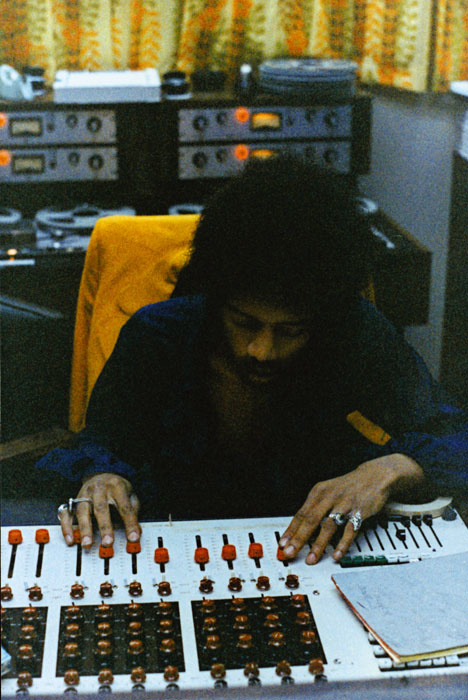 Jimi Hendrix at the Datamix console at the Record Plant, New York, during the recording of the Electric Ladyland album.Photo: Kramer Archives
It was at Olympic that Kramer had previously sat alongside producer Chas Chandler and engineered Jimi's stunning 1967 debut, Are You Experienced?, which spawned the British hit singles 'Hey Joe', 'Purple Haze' and 'The Wind Cries Mary', as well as its follow-up, Axis: Bold As Love. And it was also at Olympic that, in early 1968, sessions commenced for Hendrix's third and arguably best effort, Electric Ladyland. Although not as consistent as its predecessors in terms of material and musical arrangements, this hallucinogen-soaked double album nevertheless featured the 25-year-old guitarist/vocalist/composer at the top of his game, showing off his breathtaking skills on classic cuts such as 'Voodoo Chile', 'Crosstown Traffic' and '1983... (A Merman I Should Turn To Be)', while Eddie Kramer helped realise Jimi's sonic vision by pushing the technological envelope to its absolute limits.
"The fact that Jimi really had a great idea of what he wanted to hear enabled us to create sounds for him and enhance what he was giving us," Kramer says. "That really helped make Electric Ladyland unique."
Along with the aforementioned 'Crosstown Traffic', the tracks recorded at Olympic included one with which Hendrix would forever be associated even though he didn't write it: an exceptional interpretation of Bob Dylan's 'All Along The Watchtower'. The song's poetic, allegorical lyrics about social change had intrigued Hendrix when he first listened to Dylan's John Wesley Harding album, and in his version they would be infused with four blistering and distinctive guitar solos, aligning the song far more with its dramatic context than Dylan's much sparer rendering had. Other artists would cover the song, including the Grateful Dead, Eric Clapton, Neil Young, U2 and the Dave Matthews Band, but Hendrix's intensely evocative version remains the most famous, and his arrangement was the one that Dylan himself subsequently adhered to.
Ahead In England
At Olympic the setup comprised a Dick Swettenham-designed Helios desk and Ampex four-track tape machine housed within what Eddie Kramer describes as "a wonderful, spectacular-sounding room. The modular console, with its great EQ, great reverb and great compression, was absolutely marvellous — we were ahead in terms of console design in England. In fact, that desk was so advanced, the American engineers would come over and say 'Wow, what an incredible board,' to which we'd say 'Yeah, but you've got eight-track.' We were so jealous of what was going on in America when we were stuck with this bloody four-track format where we had to go four to four to four all the time, even though in essence this really trained us to make decisions then and there about the stereo bounce — we had to be very accurate with our mixes, and that was a different kind of training because it forced you to be creative as the sound was being printed. That held me in good stead later on." Eddie Kramer in New York, 1968.Photo: Kramer Archives
While Hendrix's amp was screened off in the studio and miked with Neumann U67s, Mitch Mitchell's kit was positioned on a riser within a roofed, open-sided booth to give it depth and miked with a combination of U67s and AKG C12s.
"Initially there was no bass," says Kramer. "Jimi just played a six-string acoustic guitar while Traffic's Dave Mason played 12-string and Mitch was on drums. That's how Jimi wanted to cut it, and as a result the track had a marvellous, light feel thanks to the acoustic guitars that were driving it. Jimi not only loved the lyrics but also the chord sequences of 'All Along The Watchtower', and he just gave them a terrific bed to do a nice solo. He also showed Mitch how to turn the beat around on the intro, but Dave Mason couldn't get it together and he was up to about take 20 when [Rolling Stone] Brian Jones walked in. Actually, let me correct that: he staggered in. He was completely out of his brain. Poor Brian, he was a good mate of Jimi's and we all loved him. Jimi could never say no to his mates, and Brian was so sweet. He came in and said 'Oh, let me play,' and he got on the piano, it was take 21, and we could just hear 'clang, clang, clang, clang, clang...' It was all bloody horrible and out of time, and Jimi said 'Uh, I don't think so.' Brian was gone after two takes. He practically fell on the floor in the control room... Dear Brian.
"It actually took about 27 takes to get the track going because Dave Mason couldn't get it together, but eventually he did and that was all that mattered. Jimi was driving the train. He always drove the train, whatever he was doing, and he had a magical ability, bar none, to take other people's material and make it his own. In fact, he also played bass on this track. When he said that's what he wanted to do, Noel [Redding] pissed off to the pub. He didn't want to know.
"Recording was always a learning process for Jimi, so each take would be different, and for 'All Along The Watchtower' there was no real rehearsal. Jimi just wanted to record the song. He loved Bob Dylan and he always carried his songbook with him. In this case, he was fascinated by the colour of the lyrics and the tone of the lyrics, and of course the chord sequences were wonderful, too. It was a very special song." Photo: Kramer Archives
When asked about the techniques used to record Hendrix's guitar, Eddie Kramer's response is concise and to the point. "I'd stick a bloody mic in front of it and hope for the best," he jokes. "Nah, generally speaking it was either a 67 or [a Beyer] M160 or a combination of both, which I still use today. It might be slightly different, of course, but the basic principle's the same — a ribbon and a condenser, along with compression and EQ and reverb. All that stuff was always added during recording."
Ready For A Change
After the acoustic guitars, drums, bass and lead guitar for 'All Along The Watchtower' had been tracked, the Electric Ladyland sessions switched location to the US. Hendrix wanted to move back there, and when Record Plant owner Gary Kellgren invited Eddie Kramer to come work at his newly opened studio in New York City, the engineer jumped at the opportunity. He was, after all, ready for a change. Experience drummer Mitch Mitchell behind his kit at the Record Plant.Photo: Kramer Archives
"In England, if you were successful, people would do their utmost to cut you down," he says. "Nobody appreciated you — 'Oh, you flash bastard. How dare you make £95 a week when I'm making £50.' I couldn't stand that attitude and to this day it makes me very angry. I didn't feel at all appreciated."
Consequently, April 17, 1968, was the date of Eddie Kramer's arrival on American soil, and amid all the upheaval the Electric Ladyland project provided him with a strong sense of continuity despite the sudden change of environment and transition from four-track to 12-track. What's more, it also included the Record Plant's very first sessions, interspersed with Hendrix's frequent assignments on the road.
"We would get a week in the studio and then he'd be off, and then we'd get another week or 10 days and again he'd be off," Kramer recalls. "There I was, an emigré, establishing myself, getting into sessions, figuring out what America was all about. It was quite a challenge, and in the beginning it wasn't easy, but once I got used to the vibe I was flying. I loved it. The culture was so completely different — 'If you do a good job, you're gonna get paid, brother,' — and so was the technology for me, going from four to 12-track and bypassing eight-track completely. Hello. What a wake-up call.
"Instead of the Helios I was now sitting down at a Datamix board that was completely foreign to me, in a room that didn't sound the way that I was used to hearing things, and using a 12-track, one-inch Scully machine that was a horrible piece of crap. Good God, it was so noisy, it was horrendous. We scrapped it after the first couple of months and went straight from 12 to 16-track. When the songs we'd recorded at Olympic had been transferred from four-track half-inch to 12-track one-inch, Jimi had said 'Wow, man, now I've got eight more tracks to fuck around with. Cool!' and of course they all got filled up. But then we scrapped the bloody machine after transferring all of the 12-track tapes to 16-track.
"So, for instance, 'All Along The Watchtower', which had started four-track in England, was transferred onto the Scully and then the first Ampex 16-track, which was actually not a bad machine. In fact, listen to any of the tracks on that album and the lack of hiss is so apparent. That's down to the way we hit the tape — we hit it very hard and got all the necessary compression that came with it. Also, what with all the intensity that was going on, there was a fair amount of signal on the tape, and that really helped. It was quite a journey.
"Eventually, I got used to the Record Plant room, which was just a fairly live rectangular box with a couple of panels on the wall, made of pegboard with a little bit of fibreglass behind them. The control-room window was so thin, and the wall itself was so thin — we had these four huge 15-inch Tannoys mounted above the window, and when Jimi would blast we could hear him through the wall. There was virtually no soundproofing. The room was constructed out of breeze block, there were two thin curtains, and that was it. Very primitive. This was the antithesis of what I'd been used to in England, but nevertheless what we got out of it was magic. The board was fairly flexible: not a great-sounding console, but we made it work."
You Keep Me Hanging On
Chas Chandler, the former Animals bass player who had discovered Jimi in 1966 and since guided his career, was initially at the helm in New York as manager and co-producer to continue the work that had commenced in London. However, as has been well documented, he grew quickly tired of all the hangers-on attending the sessions, and decided that he wanted to opt out.
"Once Jimi got to the States I think his whole attitude changed towards what he was looking for musically," Eddie Kramer remarks. "I don't know whether this was aimed at having Chas leave — one could never tell — but there was definitely tension between them. Chas liked to run his sessions in a very strict, formal manner, without wasting time. He'd say 'We're here to work. The hangers-on must leave,' and it was left to me or Chas to tell the hangers-on to take a hike. Well, I guess that caused some friction and eventually Chas couldn't really take it any more. He hated wasting time, and if Jimi wanted to do 30 takes it would drive him nuts.
"Chas was the boss. Not musically, per se, but the boss in terms of not allowing any wasted time, and I think the restrictions he placed on Jimi for the first two albums were really good. I don't necessarily agree with what happened on the Electric Ladyland sessions, but without Chas there would have been no huge superstar. To start with, Chas recognised Jimi's talent, and then he was able to corral that raw talent and develop it and encourage it. He would sit with Jimi every night, helping him to write lyrics and helping him with the song structures, encouraging him to write. However, during that third album the sessions took their own course, and Jimi, with his strong vision, just allowed things to happen in a very casual way.
"Now, having said that, I also feel very strongly that he had a master plan, and as chaotic as it may have seemed to an outside observer it was actually quite well thought out. The classic example of this was 'Voodoo Chile', which was really created as a jam but a very, very calculated jam. I mean, after Chas left [the project], Jimi had wonderful aid and assistance from a quite unlikely source: the Scene club which was, fortunately for him, around the corner from the Record Plant. Having booked the session for seven o'clock, we'd be sitting there, tapping our fingers on the desk and twiddling our thumbs, wondering when he was going to show up. After he'd done this a few times we all knew this was Jimi's way of working. He'd be over at the Scene at 10 and show up at the studio at 12 or one, dragging behind him an entourage that included musicians whom he had sussed out as being the key players to try out that evening.
"You see, he had a specific plan in mind. There was a certain sound he was looking for, and he'd eyeball the musicians very carefully to make sure that they were going to be compatible with what he wanted to do. Generally speaking, he got the cream of the crop, because at that time, 1968, there were some phenomenal musicians around, and 'Voodoo Chile' was a classic example of Jimi figuring 'OK, I'm gonna get these guys in to play this particular song'. He'd bring them in at midnight or whenever, and everything would be ready: the amps, the mics, the headphones — I'd tested everything. Then he'd show them the song, and there'd be one run-through and one take, maybe two. Bam! It was done. So, to the outside observer there were the hangers-on and the whole rigmarole with onlookers, and sometimes that made it a bit challenging to work, but it never detracted from Jimi's goal. Chas may have commented 'Oh, he's playing to the gallery,' but it didn't seem to bother Jimi. In fact, it probably encouraged him to play more to the gallery, because maybe that was the vibe he was looking for.
"Chas was absolutely essential to Jimi's development as a writer and as a performer, as well as in terms of putting the band together, producing the records and giving Jimi the necessary discipline to come up with the goods. But with the Electric Ladyland album his role diminished as soon as the sessions moved to the States. You could tell there was a sea change in Jimi's behaviour, in his attitude and so on. I think the album as a whole has a journeyish feeling to it — and I'm not referring to the band, for Chrissakes. It rambles a bit, but it rambles with a purpose. And I love how there are so many different moods. Of all of Jimi's albums, it's the one that has the most moodiness — to some people it represents the most fun that you could have on a record. I mean, it was very daring to make a double album with all that experimentation. That was making a statement in 1968. And although it was looser than his previous records, it had a purpose, it had a focus. The purpose was 'Let's be loose!'
"I think this was Jimi expressing himself for the first time, completely unfettered. He could basically do anything he wanted — it was his album, from soup to nuts, and while it bears the stamp of Chas on some of the songs it very much shows Jimi's freedom in the creative process; the freedom to do a 14-minute opus like '1983...' Taking a chance to do something like that was very '60s."
Shy Guy
Hendrix recorded all of his vocals for the album at the Record Plant, and as usual a Beyer M160 was the mic of choice while a three-sided screen provided him with the desired privacy. "He'd always face the other way," says Kramer. "He hated to be looked at. He was very shy about his vocals. The truth was, he had a great style and I loved his vocals, but he hated them. He was so embarrassed by them. 'Oh man, was that OK?' 'Yeah man, it's cool.' 'No, I've got to do another one.' 'OK.' Jimi was not a great vocalist in the classic sense, but his vocal style suited what he did to the nth degree. I mean, it was very emotional and very personal, and I can't think of anybody else doing what he did. He was eminently capable, and the singing was an integral part of what he was doing, because he would often take a guitar solo and sing the melody line in unison with that solo — which is an old jazz trick — and it was wonderful." Noel Redding at the Record Plant during the Electric Ladyland sessions; the bass on 'All Along The Watchtower' was played by Hendrix himself. Photo: Kramer Archives
So, for that matter, was the constantly evolving 'All Along The Watchtower', recorded in consecutive layers: acoustic guitars, drums, bass and electric lead taped at Olympic, before the vocal and percussion overdubs took place in New York. "What's amazing to me is how the original four-track punches through so much at the end," Kramer remarks. "Jimi's loping bass line doesn't have any top end to it at all — it's just round and lovely — and you can hear him moving around on the bass as if it were a guitar. You see, he could play pretty much anything — the piano, a bit of drums. It was feel over technique in that department, whereas with stringed instruments like bass and guitar he was magnificent.
"When it came to the mix it was a case of Jimi and I doing it together and just making it sound as commercial as we possibly could. At least, that's what I was going for with the judicious use of compression and EQ and reverb. That's what we had at our disposal and I think it worked — that reverb on the offbeat is just one example."
He can say that again. It was Eddie Kramer who, with the few effects then at everyone's disposal, made highly innovative use of flanging, chorusing, looping and backwards tapes to realise the sonic vision inside Jimi Hendrix's head. As a result, the studio itself became yet another of the artist's instruments, plied like his guitars to mould sounds in his unique, groundbreaking style. Yet, while 16-track really opened up the doors in this regard, there is something to be said for limited resources inspiring creative thinking.
"When you recorded four-track you really had to have your act together," Kramer asserts, "and during the mix you knew you just couldn't screw it up, because this was the final one. In the transfer from the first four down to the two tracks of the next four-track machine, that first pass had to be absolutely spot-on. Of course, you could go back and remix it, but you wanted to avoid that if all possible. So, you just had to have it all there, and thank God we were taught correctly by great mentors: people like Bob Auger at Pye and Keith Grant at Olympic. They were really great teachers. You just rehearsed a song and got it right, got the EQ, got the compression, got all the bloody bits and pieces in there. And you knew in the final analysis that when you added the extra two tracks and bounced back to the first four tracks and then maybe went back one more time, all of those stages along the road had to be absolutely spot-on.
"When I listen to those tapes now I'm still amazed that we actually got what we got. In the moment we didn't give a damn about convention or anything, we just did it, and tape was running most of the time. Occasionally we'd edit together takes, but not so much with Jimi. Mixes we would splice together, and there'd be lots of panning and loads of cups of tea, but his performances were pretty damned complete." Eddie Kramer in 2002.Photo: Kramer Archives
So, does Eddie Kramer consider Electric Ladyland to be an artistic high point for Jimi Hendrix? "His whole career was an artistic high point," comes the reply. "I think he really loved the record, although he was pissed at the fact that we were not allowed to go to the mastering. We gave it to the crew over at Columbia and they completely screwed it up, because they didn't know what to do with the phase content and all of that. It was subsequently remastered at Warners."
And once again in 1997, by Kramer himself, for the reissue on MCA. "I've completely screwed it up now," quips Kramer, who relocated to LA last year and recently worked on the restoration of the original Woodstock movie, to be released in 5.1. "No, seriously, I'm very proud of it. It sounds really good, the best it's ever sounded. When I listen to the original tapes I love hearing the conversations between myself and Jimi. They're always a lot of fun. He was a funny bloke in the studio, he was hilarious. He was always cracking jokes."
Following its release as a single in September 1968, 'All Along The Watchtower' climbed to number 20 on the Billboard Hot 100, providing Jimi Hendrix with his only American Top 40 hit. The song went all the way to number five in the UK.
"Hendrix is the Robert Johnson of the '60s, and really the first cat to ever totally play electric guitar," wrote Tony Glover in his Rolling Stone review of Electric Ladyland. "Hendrix, psychedelic superspade??? Or just a damn good musician/producer? Depends on whether you want to believe the image or your ears. (And if you wanna flow, dig this on earphones, and watch the guitar swoop back and forth through your head.) Hendrix is amazing, and I hope he gets to the moon first. If he keeps up the way he's going here, he will."