

 Gareth Parton at Fortress Studios, where Thunder, Lightning, Strike was mixed.Photo: Richard Ecclestone
The Go! Team's debut album, a glorious pile-up of mangled samples and lo-fi home recordings, is now attracting widespread acclaim — but its path to Mercury nomination and commercial success has been anything but smooth.
Recorded in a garage in Swansea, mixed almost entirely in mono and offering a headspinning brew of Northern soul, electro, cheerleader chants, Charlie Brown-styled piano and abrasive, Sonic Youth-inspired loops, the Go! Team's debut album Thunder, Lightning, Strike is one of the most unusual and innovative records of recent times. Essentially the work of Brighton-based Ian Parton, formerly a maker of documentaries for the Discovery Channel, the Mercury Prize-nominated album began as a series of sample-collage experiments fitted in between overseas filming trips.
The record's co-producer, Ian's elder brother Gareth Parton, has been engineering at various studios including Strongroom, Livingston and the Church since the early '90s and was brought in to help with the project's pre-production, long before the operation moved to Fortress Studios in North London for mixing. "It's Ian's original concept and on the record it's pretty much him playing everything apart from the samples," Gareth explains. "He's been mucking around with it for years and years. The original demos he did were with an Atari 1040 running Cubase and an S1000 sampler in about 2000. But ever since I've been working in studios he's been popping in doing stuff similar to the Go! Team."
Very much a one-man operation in the initial stages, the preliminary Go! Team sessions found Ian Parton bravely attempting to engineer and record everything himself at the Partons' parents home in Wales. "We'd set up the desk in their garage and have tie lines going up to the kitchen where he'd record the drums," says Gareth. "He'd be pressing Record and then running up and down the stairs. Frustrating way to do it, working on his own, but he had to do that for a while to get the original demos done. I would go down and help him set up — mic the kit up and then leave him to it because I'd be working on something else and he'd be down there for a week."
 Most of the basic tracks for Thunder, Lightning, Strike were recorded at the Partons' Swansea family home, using a Soundtracs desk and an eight-track Otari reel-to-reel. Photo: Richard Ecclestone
In keeping with the retro-futuristic, lo-fi concept of Thunder, Lightning, Strike, the original tracking equipment was devoutly old-school. "Ian had an Otari half-inch eight-track and an old Soundtracs desk. He'd stripe timecode and have the samples running — bits he'd nicked from charity-shop records or whatever. The drums would go down live and then be bounced to one track and he'd use the other seven tracks to fill with whatever he could."
Were the demos fairly loose-sounding then? "Yes! Too right. But that's part of it. It's supposed to sound spontaneous and fun, like a band jamming in a room. It's not supposed to necessarily sound like these are samples and these are live instruments and it's all glued together. It's an absolute mish-mash."
Gareth admits that there is a specific philosophy behind the sound of the Go! Team album — a concept album in all but name. "It's not just lo-fi and cobbled together, it's deliberately sounding like that. The vocal samples are quite often taken from VHS, the rappy cheerleader stuff is from straight-to-video films. And 'cause they sound fucked, you'd kind of have to make everything else sound a bit fucked around it. The mono thing is intentional as well. If you've got a bunch of samples and you start panning them around, it starts sounding quite fake. The Northern soul samples in there, there's not a huge amount of bass on those records, so that was the kind of angle we were going for."
Straight To Video
Most of the work in preparing the 'clean' version of Thunder, Lightning, Strike involved recreating samples as closely as possible, but there were two tracks where new vocal lines were recorded. For the catchy proto-rap rhymes of 'Bottle Rocket', the Go! Team's live MC Ninja was brought in to perform the track. "She changed the words and it's got the same kind of feel, but it's mixed slightly more as a single. The original vocal was extremely quiet on there, you couldn't make out the lyrics at all. But that was deliberate as well."
Then, as luck would have it, one of Memphis Industries' co-founders was visiting the Stoke Newington Festival when he chanced upon a troupe of teenage girls from South London performing Go! Team-like Double Dutch chants. Within weeks, they'd been spirited away to Fortress Studios to record the new vocals for 'Huddle Formation'. "We got them down the studio and they were ace," Gareth enthuses. "The new 'cheerleader' vocals had to sound like they were taken off VHS, so I did just that. Recorded them onto a VCR at high level and I even added a very high-pitched 16KHz whistle at low level to make them sound like they'd been taped off the telly in 1984."
Going Further
When the Go! Team demos attracted the attention of North London-based boutique indie label Memphis Industries, Ian Parton suddenly found himself with a budget — albeit a limited one — to finish the album. Gareth admits that it took some time for his brother (who he reckons would "happily master everything to cassette if he could") to accept his advice and take the leap into the digital domain.
"Now he's got Pro Tools with a Digi 001 and a G4 Mac running OS 9. He didn't want to go Digi straight away because of the sound of it, basically. But I convinced him that as long as you get the analogue process in there to start with — slam it to tape, get it through the desk and crank it up — then transfer it to Pro Tools, you can do all your editing. Which was a Godsend really, 'cause he's a good drummer, but when you're playing on top of loops, it's getting a balance between being totally tight-ass, 'cause that's not what this is about, and being... acceptable. It wouldn't necessarily be going into Beat Detective or anything like that and completely going 100 percent tight-ass on it. It would be getting a bunch of takes, getting the greatest hits and thinking 'That's the best fill there,' or 'That's a fantastic feel for the verse,' or whatever."
Gareth sees his role in the project as being something of a sweeper-upper. "He comes to me with what he's done and I try to make it sound a little bit posher." Was Ian happy with Pro Tools in the end then? "Oh yeah. And I don't think he's used his S1000 since. Now he just tends to use [Serato's] Pitch 'n Time to stretch stuff. You can kind of do it in real time a bit better with an S1000, but it's trial and error sitting there with a guitar tuned to the note you want it to go to. He's got a lot of patience to do what he does on that side of things."
Once the proper album sessions had begun, in general, the original methods stuck, including the Partons' stripped-down kit-miking technique. "We tend to mainly use an ambient mic for the drums, a Rode valve — budget stuff because it was on a budget — a 58 for the close snare mic that didn't really get used that much in the mix and then a D112 on the kick. What I like to do, which we used on quite a lot of the stuff, was place a PZM on the floor underneath the snare, so you're getting the under-snare sound and the splat off the front of the kick, but you're not getting much of the top kit, so if you want to distort the fuck out of that, you can. You're getting the crunch of the kick and the snare without the room ambience, which we tended to distort anyway. It was just a cheap Pearl kit, nothing very posh at all. Almost stubbornly, deliberately not posh."
 The live room at Fortress.Photo: Richard Ecclestone
While the range of instrumentation on Thunder, Lightning, Strike is fairly eclectic — including banjo, recorder and pub piano (as recorded, quite literally on 'Hold Yr Terror Close', in a Brighton bar) — it's perhaps Ian Parton's idiosyncratic selection of samples that really defines the sound of the album. Gareth is cagey when it comes to revealing their sources, mainly because some are still in the process of being cleared.
"Most of them are stuff you'd never ever pick up on. It's snippets of charity-shop records that were deleted. People come up to me and go 'Oh yeah, that's the sample from Bob Dylan,' or something. But it's not. There's a few higher-profile things, but they tend to be cover versions of higher profile acts, like the strings from a cover version of... something or other."
Cleaning Up The Act
In fact, there are actually two versions of Thunder, Lightning, Strike: the original illegal, sample-strewn version and the recently released, legally 'clean' version, featuring cleared samples or approximate recreations of them.
"On the original version, all the vocals were samples," Gareth reveals, carefully. "But because it went out on a small indie and we thought it wouldn't do anything, none of the samples were cleared. It's not a good thing to do because in the end it's a big pain in the arse. The label didn't really have any choice, they weren't in a position to do what the Avalanches did, to take a year to clear all the samples. It was a case of 'Let's just put the bloody thing out and see what happens.'
"The next thing, it started getting a bit of attention and we hadn't made any contingency plans for having to recreate it without any of the samples. If I'd have realised at the time, I'd have stuck down mixes without the samples on."
Considering that samples can cost an average of £6000 to clear and each of the tracks on the Go! Team album features multiple samples, the potential sums involved might have easily bankrupted Ian Parton and Memphis Industries or seen the record being pulled from the shops. Luckily, the album's early success attracted the attention of Sony/BMG in the UK and Columbia in the US who agreed to buy into the record by way of sample clearance funds. "That's kind of saved the record's ass really," Gareth admits. If the original album cost less than 10 grand to make, the producer reckons, then the cost of the remake was easily 10 times that amount.
"Some of the samples have been cleared and we've had to rewrite the ones we couldn't get publishing on. Some of them we're paying publishing on and we're recreating the samples. Which is a real shame, y'know, when you've lived with a record and it's your baby. We had a musicologist come down to the studio and we sat here going through all the samples and he would go 'Nah... nah... can't do that... gotta change that.' By the end of the day, Ian was pale and feeling rather ill. At that stage we'd started recreating the record and the guy was going 'No, that's too close.' But I think what we've come up with in the end is really good — I don't think we've taken away from the spirit of it or the sound of it."
In actual fact, the most unpredictable part of the remaking process came from the Partons employing sample-recreation companies to copy certain key lifts. The results, as Gareth recalls with a smile, varied wildly.
"There's a few different companies out there who profess to be sample-recreation companies, so we farmed some of the ones out that we thought we couldn't do ourselves. And I'm not gonna name names, but we had a bunch come back and they were shocking. We'd sit here, almost in tears, laughing at what they'd done. These dodgy pub singer versions of [the hook from 'Ladyflash'] 'We came here to rock the microphone'! We thought 'Shit, who are these guys?' And it turned out that most of the stuff they do is ringtones.
"We panicked at that stage 'cause we had to make the whole bloody record. But then we found these guys who'd done stuff for Lemon Jelly and Fatboy Slim and they were a lot better. Still, some of them we had to touch up with our own horns and stuff. I don't know what it is with people trying to record horn sections these days, but it always ends up sounding like keyboards. If you're recording in a small room close-miked, multitracking the same trumpet, then it starts sounding really thin and keyboardy, so we had to get some extra horn players in to beef it up.
"I also ended up getting string players in and doing some of the strings in here, just a viola and a violin, and multitracked it, real top-line stuff. In 'Everyone's A VIP' there's a really high-pitched string line that's time-stretched to buggery and distorted. So I had to varispeed the track in Pro Tools and pitch it right down, 'cause they could never get those really piercing high notes in reality."
Outboard Magic
 From top: Amek dual compressor/limiters (x2), Antares AVP1 vocal processor, Drawmer 1960 voice channel, Valley People Dynamite compressor, Dbx 902 de-essers (x2) and 160X compressors (x2). Photo: Richard Ecclestone
Despite being a fan of Pro Tools, Gareth admits that, for the Go! Team sessions at least, he tended to avoid its plug-ins. "Maybe Auto-Tune on a few things. But because Fortress has got a decent bunch of outboard compressors, I tend to go for those. Usually the [Urei] 1176s or the old Dbx 160s and then there's the Alan Smart SSL copy which we tend to use across the mix buss."
Outboard compression aside, the producer is also a huge fan of tape compression. "There's quite a lot of tape processing going on throughout everything. If we're recording new instruments, we tend to record onto the Otari MTR90 in sync with the Pro Tools and then transfer it over.
"On this stuff I tend to run the tape really hot — lining the machine up to +9 or whatever we can get out of it and making sure the output level isn't too high, so when it comes back into Pro Tools it's not taking the roof off it. We're purely using it just for the effect of it.
"When we put the final mixes down, we also go through the Massenburg GML EQ, just for picking things out and making it sound even nastier, believe it or not! All along the way, especially when I was doing the recreation mixes and sending them off to Ian, I thought I'd already given it enough distortion and he'd go 'Can we distort it a bit more?' And he'd spot if I was trying to make anything slightly stereo and say 'Can you bring that in a bit?' I'd try to sneak it in every now and then. I go along with his philosophy, but it's not the way I tend to mix everything because that would be a bit limiting. But on this particular stuff, I think it works really well."
 Fortress's outboard was heavily used in preference to plug-in effects and processing. From top: ADR stereo compressor, GML EQ, Al Smart stereo compressor, Thermionic Culture Culture Vulture distortion unit, Trident Audio compressor/limiter, Dbx 120XP bass enhancer, Drawmer DS201 gates (x2).
Remote Mixing
If the process of recreating the legally cleaned-up version of Thunder, Lightning, Strike was a convoluted affair, then the mix stage of the album's second incarnation provided further complications: Ian Parton was off on tour with the live line-up of the Go! Team promoting the original version of the album, at the same time as the new one was being mixed. "He was in Japan or Australia or America, so I'd spend most of my time on the computer in the office here — from the sample recreation guys emailing their recreations over to me, me slotting them into the rebuilt mix without the illegal samples, dirtying everything up, then having to do an MP3 and email it over to Ian in Japan at, y'know, two o'clock in the morning. He'd be sitting there listening bleary-eyed, going 'Yeah, it's good, but turn the piano up a little bit,' or something, basically directing me from the other side of the world. So then I'd make the changes, MP3 him another one overnight and then he'd have a listen to it in the morning. So it was kind of remote mixing.
"At the beginning of the session, I thought 'Wow, this is fantastic, we can do this,' and then you think 'Oh shit, this is really annoying,' 'cause you'd have to work out what time it was on the other side of the world and there's a delay in uploading it and downloading it, so I'd be sitting around for ages just waiting for responses. Quite frustrating."
 The control room at Fortress Studios is based around a Neve desk with Flying Faders automation.Photo: Richard Ecclestone
Since all of the original mixes had been done at Fortress, Gareth decided that it was best to work in the same room on the same Neve V1 for the new versions. "I'm used to working in this room, I've worked down here for years and I'm really comfortable with the Genelec [1030A] monitors. I've got a pair at home as well and a lot of people think they make everything sound a bit too nice, but I think alongside NS10s, they're kind of workable. If you're listening to loud, distorted music all day, I can't do it on NS10s. Familiarity is the thing about NS10s — you've grown up with them and you're supposed to know how much bottom end you can get away with on them. Well, roughly anyway. It's a bit of a dark art down the bottom on those things.
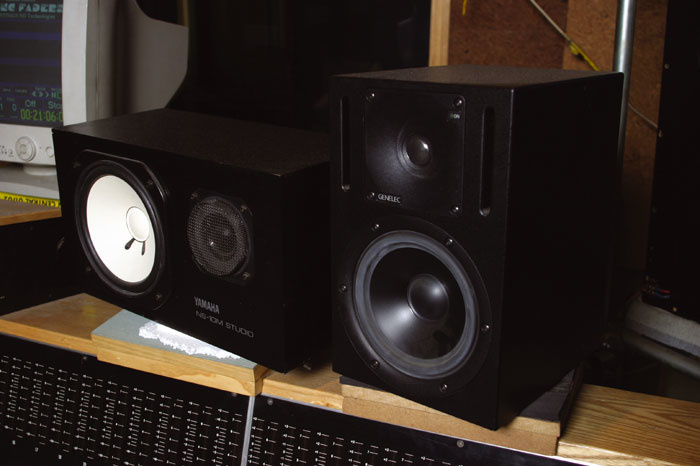 Fortress's Yamaha NS10 and Genelec 1030A monitors: Gareth Parton says he prefers the latter for most mixing tasks. Photo: Richard Ecclestone
"With the Neve, I love Flying Faders. It beats anything. You have to be a computer programmer in order to automate on an SSL. Flying Faders is just grab it, it does it. Because of the way that I work, I don't tend to do a lot of automation within Pro Tools because if you're doing fader rides before you hit the compressors on the desk, then that kind of defeats the object of it. So it makes sense to use Flying Faders automation and it's great anyway. But the desk is pre-VR, so there's no recall on it. We couldn't just press a button and get the recall back, we had to sit there A-Bing the original mixes. That became, like, urgh. You sort of start mixing it from scratch and then you have to A-B all the time to make sure we're going along the same route."
To achieve the same distorted crunch of the original mixes, Gareth again used Thermionic Culture's Culture Vulture and hired in the same Neve mic preamps as he had for the first sessions. "Can't remember what model they are, but they're the greeny bluey ones with the chunky knobs," he laughs. "I'd patch the auxiliary into the mic pre and crank it right up and patch it back up a fader. It distorts a different way from a distortion box and it can give it that bit of edge, a slight fuzziness to it and it's sort of smoother." Most of the recordings made at Fortress were tracked to an Otari reel-to-reel recorder before being transferred to Pro Tools.Photo: Richard Ecclestone
If at the end of all of this, the mixing of the second version sounds like it was a bit of an engineering nightmare, then Gareth concedes with a grin that it was. "The problem across the board with Ian's stuff is it's layers and layers of samples. So there can be four bass guitars going off at the same time or four drum kits going off at the same time. To control that is the biggest nightmare. You end up filtering the bass off on just about every sample, which thins it out, but that's part of the reason it sounds the way it does. So that was one of the big problems — sorting out the layers of stuff and making sure we had all the right things coming through. We tend to use filters on the desk quite a lot rather than go straight for the EQs.
"The other problem was that some of the stuff actually survived from the very first demo sessions that we did, so the drums for instance on 'Junior Kickstart' survived from the very first time he put it down. There's one track of drums that we've got bounced together with an out-of-time tambourine and there's fuck-all we can do about it, because there's something about that drum take, some really nice fills in there with a great sound, and we tried to redo it and it didn't sound as good.
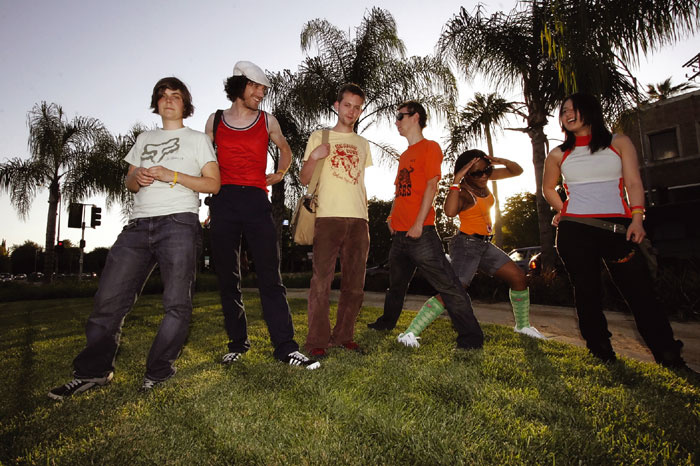 The Go! Team's six-strong live line-up."Also, when that was transferred over, the Otari eight-track has a tendency to drift with the tempo, so the tuning across the whole thing was a bit strange. The samples tended to be taken off vinyl, as well, and sometimes they're between pitching, they're not concert, so everything else has to be tuned around it. So there's a little bit of Auto-Tuning going on, say on the new live trumpets where the player wasn't quite getting the right inbetweeniness and we had to do a bit of tinkering. And on the bass some of the time as well — the intonation on the guitar was a bit wonky. Cheap instruments! Hopefully you can't hear it."
The mixes were put to an Otari MTR12 half-inch machine and sent straight from the repro head to Pro Tools, although in line with the lo-fi audio aesthetic (and particularly with the low budget constraints of the original sessions), the Partons kept on repeatedly re-using the same reels of tape. Gareth smiles and says "I'm sure it sounds better when it's thinner anyway."
It's Supposed To Be Like That!
Live, the Go! Team are a 12-legged groove machine featuring Ian Parton on guitar, his two friends Sam and Jamie on guitar and bass, plus two girl drummers, Silke (from Germany) and Chi (from Japan), alongside rapper Ninja. While professing that he was "too old and fat" to get involved in the live side of things, Gareth laid down backing track mixes alongside the album versions. "I think Ian's tinkered around with them a little bit and had to pitch them, because of course the versions that we had weren't in concert pitch, and obviously you can't be retuning guitars all the time."
For all its retro values, Thunder, Lightning, Strike is clearly an album that could only have been made in recent times. "You couldn't make it any other time than now, no," Gareth nods. "Not without splicing up a lot of tape and spending about 12 years doing it."
Nevertheless, he admits that some people miss the point of its intentionally degraded sonics. The producer admits he's had a few strange emails in the wake of the album's release... "They say 'You can't hear the vocals, it's distorted, it's mono.' But it's supposed to be like that! I get people writing going 'You need to get a better pair of monitors 'cause it sounds shite.' I feel like writing back saying 'Uh... I've actually got Genelecs, mate..."