

The democratisation of the ribbon mic continues with the release of an attractive model from SE. We find out whether it sounds as good as it looks.
Not so many years ago, capacitor mics were the most expensive of the commonly available microphone types — which is why the home-recording revolution was launched almost exclusively on the back of dynamic models. However, once the size of the potential home-recording market was realised, capacitor microphones started to be built in quantity, allowing their prices to be reduced to project-studio levels.
 Photo: Mark Ewing
The influx of cheaper Russian and Chinese microphones pushed prices down even further, to the point where you can now buy a respectable capacitor mic for less than you might pay for a decent dynamic model. Until recently, ribbon microphones seemed to have slipped under the project-studio radar — but there are signs that that's about to change too. First, though, what is a ribbon microphone and why should you consider buying one?
The Ribbon Difference
Just from looking at a spec sheet, you can see that a typical ribbon mic's frequency response falls away above 15kHz, in much the same way as a conventional dynamic model —and they're not particularly sensitive either, which means that you need to run them through a sensibly quiet mic preamp with lots of gain. In fact, it looks on the face of it as though you're paying a lot more money for a specialist type of dynamic microphone that is actually more fragile than its moving-diaphragm dynamic counterparts and offers a similar response curve. However, the reality is somewhat different, because while a ribbon mic is indeed a type of dynamic model, its lightweight ribbon has far less mass than a typical diaphragm and voice coil, so it has quite a different dynamic response. Certainly the rolled-off high end produces a warm, rich sound, but a good ribbon mic doesn't sound in any way dull — just different.
You can use a ribbon mic to record both vocals and instruments, with the proviso that you don't put them into excessively high SPL situations, as you could damage the ribbon. Having said that, the SE model under review here is happy up to 135dB, which is pretty loud and should cover most applications. Because the top end of a good ribbon mic might best be described as 'sweet', ribbons are popular for recording instruments that tend to sound harsh when miked at close quarters, such as bowed strings or flutes, although in many cases you'll also find that they out-perform (from a subjective viewpoint) both dynamic and capacitor models when recording guitar amplifiers. In this application they tend to be placed a few inches from the speaker grille, rather than right up against it, as they exhibit a noticeable degree of proximity effect.
Ribbon mics are also well suited to recording drum overheads, brass, horns and woodwind. Because of their physical structure, ribbon mics all have a figure-of-eight pickup pattern, which is actually a more useful pattern than some studio musicians seem to think, not least because a figure-of-eight microphone is almost perfectly immune to sounds arriving from 90 degrees off-axis. They also have a more open sound than cardioids because no complex rear ports are needed to shape the polar response.
Second Opinion
Given my background with the dear old BBC, it will come as no surprise to read that I am something of a fan of ribbon mics in general and the venerable Coles 4038 in particular. The latter was — and in many cases still is — the staple BBC 'studio talks' mic, but also serves remarkably well on all manner of other sources, particular those with complex harmonic structures.
The inherent design attributes of a ribbon mic mean that the diaphragm resonances are at relatively low frequencies. This is in complete contrast to most capacitor-mic diaphragms, which are generally tensioned in such a way that their resonances are towards the top end of the audio spectrum. It is this fundamental aspect of the design that I think plays a big part in the 'ribbon sound' — a very natural, fatigue-free sound with a smooth but always detailed top end. This characteristic makes the ribbon mic a very reliable choice for sources such as brass and string sections, as well as for 'difficult' voices.
The R1 is certainly a nice-sounding ribbon, and I thought it seemed to have a decent output level compared to many older ribbon mics, and especially the very quiet 4038! The polar response has nice, deep, well-defined side nulls, making it easy to position the mic to reject unwanted spill, while the proximity effect is strong but progressive and predictable — which makes it usable as a creative tool. Using figure-of-eight mics in the studio might require a different approach to normal, but with a little more thought and planning it's surprising what can be achieved.
Initially, I was concerned about the design of the shockmount because it appeared that the mic was intended to simply sit in a felt-lined cup with a relatively loose fit. However, closer inspection revealed that a grey threaded collar at the base of the mic unscrews, allowing the mic's 'stem' to be passed through a hole in the bottom of the shockmount cup. The threaded collar can then be screwed back on to the mic, to provide a much more stable and secure fitting, with a reasonable level of mechanical isolation. The only downside of the arrangement is that the mic has to be removed from the shockmount before it can be put back in the case — and you really do want to put the mic back in the case after use. Ribbons are easily damaged, and although the warranty generously provides for three replacement ribbons it would be better not to use them all in the first year of ownership! Hugh Robjohns
The R1 In Detail
SE produce a whole range of mics, from the very affordable to the very esoteric and this model falls closer to the esoteric end of their output. They clearly felt that a ribbon mic was an obvious addition to their portfolio, but as you can see from the price, this isn't part of their budget range. SE claim that their approach to ribbon design is more expensive than that used by many of their competitors but that it delivers a better high end than most and is also a little more sensitive. Even so, the SE R1 is still less expensive than many of the other ribbon mics on the market. Included in the package is a purpose-designed shockmount and a tough aluminium storage case, but there's also a five-year guarantee that covers up to three ribbon replacements under warranty. After this you can still have the microphone serviced at the going rate. This peace of mind is worth a lot and goes some way to offsetting the seemingly high initial cost.
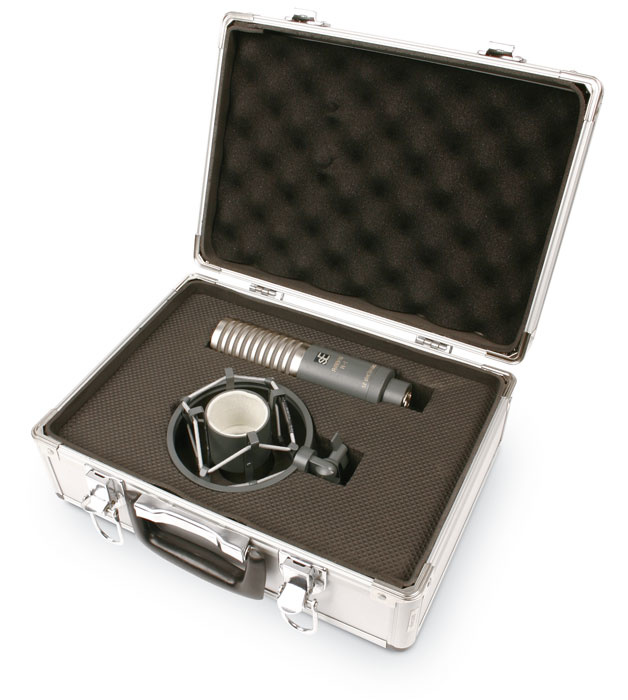 Photo: Mark EwingPhysically, the microphone takes the form of a substantially engineered cylinder whose upper half is occupied by the vertically mounted ribbon capsule. Slots are machined into the cylinder to form apertures that allow sound through the capsule housing, while at the same time providing plenty of protection for the ribbon. A layer of fine mesh is positioned inside the grille, to further protect the ribbon and to provide electrical screening. The ribbon itself is made from aluminium, is a hint under two microns thick, and, as with all ribbon mics, is suspended within a powerful magnetic assembly (neodymium, in this case). When sound moves the ribbon, an electric current is set up in the material of the ribbon itself, rather than a voice coil, as is the case with a conventional dynamic microphone.
As with all figure-of-eight microphones, this mic is 'side entry', as sound needs to be able to reach both sides of the ribbon. Either side can be used, although one side is identified by the SE logo to help with orientation. There are no switches on the microphone, and because of the passive ribbon circuitry there's also no need to use phantom power. Indeed, as with other dynamic microphones, it is best not to apply phantom power at all. However, if a global switching arrangement on your console forces you to do so, the R1 will tolerate it, providing you use a properly balanced cable.
The supplied shockmount is made from metal, with a felt-lined inner section that supports the microphone. A swivel stand bracket comes as part of the shockmount, and a thread adaptor is included for both US and European stands. A simple thumbscrew tightens the swivel, but it seems very secure and doesn't require lots of force to tighten.
Studio Testing
As a vocal mic, the R1 sounds smooth and very classy, with a rich low end, but you'll need to crank your mic-amp gain close to full to get a decent amount of level out of it. I tried this and didn't hear any excessive noise, so no technical problems there. The tonality is warm, with a very smooth high end that's reminiscent of some tube mics, and although the response doesn't go any further up than a regular dynamic mic, the top end doesn't feel restricted in any obvious way and you don't get that slightly congested sound that cardioid dynamic mics tend to suffer from. The mic has much less tendency to pop than most cardioid models, but a pop screen is still a good idea.
As with cardioid-pattern mics, figure-of-eight models all exhibit a proximity effect, so when I came to mic up my guitar combo it was no surprise that the low end seemed a little hot at 150-200Hz. However, it was nothing that a little compression and EQ couldn't remedy. I seemed to get a usable sound no matter where I put the mic, with plenty of punch and definition but none of the scratchy hardness that often shows up when you're close-miking amps using moderate amounts of distortion. With some mics you never seem to be able to get close to the way the amp sounds in the room, but with this ribbon model it's really not difficult to capture the right sound.
Although it's tonally well-suited, I feel that the output of the R1 is really too low to use for most acoustic guitars, unless they're strummed fairly assertively, but I did try my American Indian wooden flute and found that I could capture a solid, woody tone with plenty of articulation but, again, none of the harshness that you might expect from other microphones. I needed to set high mic-amp gain to get the right recording level, but there was no obvious noise on the resulting recording.
Conclusion
This isn't a cheap microphone, but it turns in a very respectable performance for its price and seemingly has the ability to make almost anything sound smooth, silky and expensive, with plenty of low-end weight. The downside of ribbon mics in general is that you have to use a lot of mic gain to get enough level from quieter sources, and in practice this means that you need a good mic preamp with at least 60dB of available gain, which most stand-alone mixers and mic amps provide. Where you may encounter problems is with some all-in-one multitrackers, as a number of these offer only 50dB or so of mic gain.
I particularly like how the SE R1 works with electric guitar speakers and for voice recording, and I look forward to getting the chance to record some violin parts using it. It also adds weight and polish to wind instruments, so it's by no means a one-trick pony.
I've had relatively little experience with ribbon mics in this price range (although other mid-priced models are now on the market or due to show up soon), so it's hard for me to say at the moment how the SE R1 stands up to similarly priced competition, much of which is only just now becoming available. Nevertheless, judged by the results it can produce and the solid way in which it's built, I have to say that this microphone would make a useful addition to any serious engineer's mic locker, as it can translate tonalities that other mic types struggle with. There's also that robust guarantee in its favour.
Pros
- Good build quality.
- Very worthwhile three-ribbon guarantee.
- Smooth, solid sound.
Cons
- The low sensitivity of passive ribbon mics in general means that you require a quiet mic amp, as you may need to turn the gain right up for some quieter sources.
Summary
Ribbon mics offer some genuinely useful alternative sound flavours, and you may find this one stealing work away from your favourite capacitor mic for many applications where low signal level isn't a problem.
information
£699 including VAT.
Sonic Distribution +44 (0)1582 470260.
+44 (0)1582 470269.