

For his second solo album, Steely Dan's Walter Becker made the unexpected decision to apply his band's high production values and jazzy sophistication to the world of reggae...
The relaxed, sensual rhythms and simple harmonic structures of reggae are, in many ways, the antithesis of the cerebral jazz-rock universe inhabited by Steely Dan's Walter Becker and Donald Fagen. Yet Becker's album Circus Money is the result of a conscious effort to integrate reggae and dub into this universe.
 Circus Money saw Walter Becker take the bass player's role for the first time in many years.
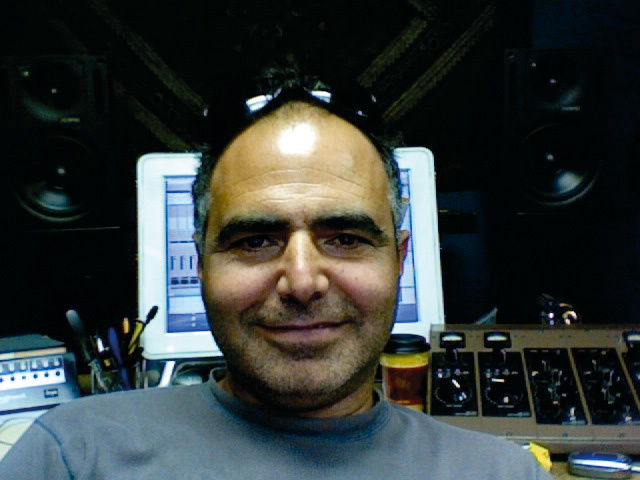
  The album was co-written and produced by Larry Klein, seen here in his Market Street studio."I've been listening almost exclusively to Jamaican music for many years," he says. "As a bass player, the emphasis on the rhythm section in this music, often with effects, is fascinating to me. I became something of an expert in various sub-genres, such as songs about motorcycles and/or featuring motorcycle effects, songs about barbers versus dreads, and songs about various judicial procedures. At one point my idea was to get actual Jamaican rhythm tracks and write songs over them, but I abandoned this when I discovered that most Jamaican music only exists in two-track form. You can't pull out the rhythm section, and this means that you're stuck with the limited harmonies of the Jamaican stuff."
No, You Play The Bass...
The album was co-written and produced by bassist Larry Klein, who had to fight to get Becker to pick up the bass again himself. "When Walter suggested that we work together on recording an album three years ago, neither of us had any idea how this would work. We had never tried writing together. When he asked me to play bass, I convinced him that since this was his solo album, he should do it. He's a great bass player and it was a great muscle for him to flex, while it also freed me up to listen to the songs in my capacity as a producer. Walter certainly managed to infect me with this great reggae music from the '60s and '70s, and we began the process of working on the album by compiling a group of Jamaican songs he really loved as starting points.
 "We were talking about licensing our selection of reggae and dub tracks from Blood and Fire or any of these companies that puts out this music, but when it turned out that using them wasn't practical, we ended up crudely mocking up some of these grooves in a sequencer as a point of departure. Essentially we would take the nuts and bolts of certain grooves and just start mucking about over them. This turned out to be a very natural way of writing songs. Most of the time we would experiment with musical ideas and tackle the lyrical end of things afterwards."
"Larry and I wrote all the songs from scratch over a period of about a year," adds Becker. "Only two songs, 'Upside Looking Down' and 'Paging Audrey', were based on ideas that I've had lying around for years. And both Larry and I wrote choruses and verses, lyrics and music. I often get asked the who-did-what question with Donald as well, but basically songwriting is a matter of two guys sitting in a room, starting with nothing and ending up with something, and you don't really know who did what. Imagine two people that built a house being asked who laid what brick."
Klein: "In terms of writing lyrics together, we'd often start with a title or something Walter had been thinking about. There was a grey line between conversation and writing lyrics, because we'd sit around laughing and goofing around, as we often do, and one of us would say: 'Wait a moment, what you just said is a good line,' and we'd write that down. Walter is incredibly quick-minded as a writer, so it was a battle for me to keep up with him, but I managed to some extent."
Becker: "Writing lyrics is like doing the Sunday crossword puzzle. If you get it done in two hours you have a feeling of achievement that lasts all day long. And if you write a couple of good lines on a day, you have the same feeling. Lyrics are not hard for me, and especially with Larry's help we had a pretty good flow of ideas."
A Consistent Vision
A few years ago, Walter Becker sold his Hyperbolic Sound studio in Hawaii and moved back to his native New York. Circus Money was written and recorded there, as well as at Klein's place in Los Angeles. Amidst all the change, however, Becker remains faithful to the long-discontinued Vision sequencer from Opcode.
"I'd create a crude drum track and feed the other parts into the sequencer with a keyboard. I like writing with keyboards, because I can get chord voicings that I can't duplicate on the guitar. Since I don't play very well I have to immediately save them. We also worked at Larry's place in New York on some modern version of Vision, and we created demos with drums, bass, keyboards, and usually a fourth part representing a guitar part and a melody."
"We used Propellerhead's Reason at my place," states Klein, "because it is so simple to set up, and it has software-based sounds on board. We'd mock up the drum patterns, and sometimes we even used the bass lines from the reggae tracks. We'd generally just have that looping endlessly, and then we developed our own harmonic schemes for the verse and chorus. Once the harmonic scheme had coalesced we'd develop other bass lines. We put vocal melodies down using just a vibe synth sound and we didn't use microphones or other inputs at all. We always had a guitar and a bass in the room — we both play both — but they were just for us to jam with. Bass and guitar parts were recorded using a keyboard. By the time things were done, the initial groove might have changed."
Becker echoes Klein's declaration that many songs ended up straying very far from their point of departure. "The songs that have ended up with the strongest reggae influences are 'Bob Is Not Your Uncle Anymore', 'God's Eye View', and 'Do You Remember The Name'. The last has an almost pre-reggae, rocksteady kind of feel to it. 'Bob Is Not Your Uncle Anymore' actually reflects the original idea we had the most, in that it has this ostinato reggae bass line that remains on one chord throughout, and the keyboards revolve through a number of chord changes. The reggae elements in the rest of the songs are well integrated. Lots of people think that when you play reggae you need to use every possible cliche of Jamaican music and sing about Jah or Babylon The Beast, and so on. I did not want to do that, but I did want to incorporate the feel and the type of interplay between the bass and the drums."
Market Economics
These initial demos were transcribed by Andrew Rathburn and guitarist Jon Herrington, after which Becker rehearsed the band. Becker: "Keith [Carlock, drummer] and I first worked together on the grooves and determining the basic drums and bass approach. I wanted Keith to get into the idea of finding a way of playing these reggae beats without literally imitating what the Jamaican drummers had done. I also rehearsed with Ted Baker and Herrington at my house, for instance working out who did the fixed chord and the changing chords in 'Bob Is Not Your Uncle Anymore'."
The basic tracks were recorded live, without a click track, at Avatar Studios in New York, Becker's patience for studio detail having been eroded since Steely Dan's heyday. "The overdubs are just for what they call sweetening. That was really important to me. To tell you the truth, I hate doing overdubs, it bores me to tears. My attention span is not there any more to bang away at things endlessly."
Instead, Klein took care of the time–consuming minutiae, which included overseeing the vocals, guitars and other overdubs at his Market Street studios in Los Angeles, with Klein's regular engineer Helik Hadar at the controls (see box overleaf).
Becker: "For my first album Donald helped me with production part of the time, but most of the time I was working on my own in Hawaii. I did vocals and vocal comps myself and this became very laborious. In the case of the new album I sang the vocals and could then essentially go out and sit on the porch for a bit while Larry was comping. He spared me from my own worst, self-critical instincts about what was good enough to use. Left to their own devices, musicians are often so inside their own playing and writing that they completely lose perspective on what to use and what not to use. Larry also helped me with my vocals, suggesting that I sing more softly. There's only so much you can do with my vocals [laughs], but I'm more comfortable with my voice now, and it helped to be able to hook into the rhythmic feel of the musicians. That was very relaxing to me."
 The setup used to record Becker's bass at Avatar Studios, with an Orange head through an Aguilar cab.Klein: "Walter's natural inclination is to belt things, and I persuaded him to sing softer sometimes and find different sounds in his voice. I think this worked beautifully. I love his singing on this record. He has a really conversational way of delivering the lyrics that really suits them. As for the production side of things, I think Walter and I had compatible agendas in that we really wanted to get away from some of the extensive micro-balancing that he may have done with Donald. I like there to be some rough edges and for the music to have some asymmetries and a boulder quality inasfar as proportions go. Along with not having the patience to spend too much time on things, you can also start to go backwards by dissecting things too much. With Pro Tools you can disappear down a rabbit hole, moving things a 10th of a dB, and I hear quite a few records on which people have clearly been caught up in the pursuit of perfection and forgotten what made them feel something in a record.
"Walter insisted on recording to analogue, and we used 24-track tape, Dolby SR. It's hard to say how much difference that made, but, especially for the bass and drums, recording to tape to get the compression aspect is a good thing. The rooms at Avatar are also great to record in, and the subtle aspects of how much of the room sounds and the tape compression were used were important to how the album sounds. Walter and I were very involved in all aspects of the recording, being very attentive to signal chains and sonic details on the mixing process. At the same time part of his agenda with this record was to feel more blood and sweat and not get fixated on details. All the rhythm stuff was recorded through Neve mic pres, I think the 1073, and compressor-wise we had fantastic old Fairchilds and Ureis. I also love the Eclair Engineering Evil Twin DI boxes for bass.
"After the Avatar sessions we transferred stuff to Pro Tools at 96/24, for editing and so we could continue working at my studio in Los Angeles. I got rid of my multitracks two years ago, because I never used them, they had become part of the furniture. I have two relatively small rooms at my studio, one room with piano and keyboards and amplifiers and one which is the 'control room'. We often work with headphones in the control room area. I don't have a console, but we do have a bunch of great analogue equipment to send signals through, and we used these for the overdubs on Walter's album, like vocals, soloists, keyboards and a lot of guitar."
Silky Plushness
Steely Dan's pursuit of sonic perfection continues to be the stuff of legend, and one imagines that the subject will fire Becker up — but again, his priorities seem to have changed somewhat over the years. "I figure that my records, yeah, they should sound a certain way. It's also why we're selling FLACs [Free Lossless Audio Codec] as well as MP3 for downloads, so people can hear it in whatever medium they want to have it. But it's probably not the most important thing about recording music. There are many records that I like that don't sound great. But yes, a silky plushness in the sound is indeed important to me. You want to feel like you're in the front row when listening to music."
Circus Money is released on Sonic360.
Helik Hadar: Engineering & Mixing
 Helik Hadar.Helik Hadar started his career at Sigma Studios in Tel Aviv, and moved to LA in 1991, where he studied at the Trebas Institute for Audio Engineering, then cut his teeth at Studio 55 and Paramount, recording hip-hop and rap artists such as Snoop Dogg and Coolio. He's worked with Larry Klein since the late '90s.
Hadar explains how Klein and he built a finished record on the initial recordings made at Avatar. "The sound of the original analogue Dolby SR recordings that were done by Elliot [Scheiner] and Jay [Messina] was absolutely fantastic. It was warm, cohesive, and the tape compression had a great effect. That gave me a superb starting point. Also, the arrangements on Circus Money are not dense, and this helped achieve a great degree of clarity. The songs usually consisted of 12 tracks of drums, bass, two or three tracks of electric guitar, two pairs of keyboards, LCR room mics, plus the overdub tracks consisting of horns, lead vocals, sometimes a double lead vocal track, and a stack of two to four backing vocals, depending on the song. For the overdubs at Market Street we made intense use of my eight-bay Inward Connections rack, consisting of four compressors, two EQs and a pair of mic pres.
"The Inward Connections stuff is beautiful, very soft-sounding. We used it on Walter's lead vocals and other overdubs, along with an Alan Smart stereo compressor. I think that we also ended up using the Inward Connections as our stereo compressor for the final mixes, applying just a tiny touch of compression.
"The signal path for recording Walter's vocals was a great-sounding Neumann U67 going into a IC MP820 mic pre, and then through an IC 820 compressor. The U67 seemed to help keep Walter's voice warm and real. The IC mic pre is open and solid-sounding, with rich harmonics, while the IC compressor is a great 'invisible' tube compressor. On electric guitar overdubs we used a Shure SM57 for bite and presence and an RCA 44DX for the size and weight. The organ was recorded with a pair of AKG 451 mics on top of the cabinet and an RCA 44DX at the bottom. As small-diaphragm mics, the 451s seemed to place the instrument in the mix, with the 44DX again supplying body."
Market Street doesn't have a mixing desk, meaning that Hadar mixed 'in the box'. "I think there are sonic limitations to mixing in the box, but these can be made irrelevant if the recording is very good, as was the case with Circus Money. So no, I didn't miss large faders in my hands. I find that I'm much faster working with a mouse and keyboard. The workflow is much more efficient. For tonal purposes I would go out of Pro Tools, though, because I prefer analogue outboard. The only expections are dynamic effects that need fast transients, for which plug-ins are better. Delay plug-ins are also very good, and I find myself being much more open to plug-ins now, as there's such a great variety."