

 The 'Air That I Breathe' incarnation of the Hollies appears on Top Of The Pops. From left: Tony Hicks (electric guitar), Terry Sylvester (acoustic guitar), Allan Clarke (vocals), Bobby Elliot (drums) and Bernie Calvert (bass).Photo: Ron Howard / Redferns
The Hollies were the third artist in as many years to cut Albert Hammond and Mike Hazelwood's pop ballad, yet it was their version that became a worldwide top 10 hit. Alan Parsons was behind the controls at Abbey Road for the recording.
A pop/rock band they might have been, but the Hollies had far more going for them than most of the British Invasion outfits that prospered in the wake of the Beatles. The band was notable among other reasons for the three-part Everly Brothers-inspired harmonies of lead singer Allan Clarke, guitarist Graham Nash and lead guitarist Tony Hicks, all of whom penned some of the group's material, not to mention Hick's ringing, often innovative licks, the superb drumming of Bobby Elliott, and the hit song contributions of outside composers such as Graham Gouldman.
Between 1963 and 1968, the Mancunian band that took its name from Buddy Holly scored time and again with the likes of 'Here I Go Again', 'I'm Alive', 'Look Through Any Window', 'Bus Stop' (the group's American breakthrough), 'Stop! Stop! Stop!', 'Carrie-Ann' and 'Jennifer Eccles'. When Graham Nash, feeling constrained by the Hollies' commerciality, departed to form Crosby, Stills & Nash, guitarist/vocalist Terry Sylvester filled his shoes and the band had further hits courtesy of 'Sorry Suzanne', 'He Ain't Heavy, He's My Brother' and 'Long Cool Woman (In A Black Dress)'.
By 1973, however, the Hollies' best days were firmly behind them... save for one remarkable exception. 'The Air That I Breathe', written by the team of Albert Hammond and Mike Hazelwood, was one of pop's all-time finest ballads. Hammond, who before Hazelwood's death in 2001, co-wrote with him for artists like Johnny Cash and Olivia Newton-John, recorded 'The Air That I Breathe' for his 1972 album It Never Rains In Southern California, and the following year Phil Everly covered it for his Star Spangled Banner long-player. It was the Everly version that producer Ron Richards, the man who'd signed the Hollies to EMI back in 1963, then brought into EMI Studios at Abbey Road for the band to work from.
"Ron heard Phil Everly's version and he said 'That is a huge hit,'" says Alan Parsons, who engineered the Hollies' recording. "That was his special skill, and I remember him doing the same with 'He Ain't Heavy, He's My Brother'. He said it there and then: 'That's going to be one of the biggest hits you've ever had.' He just knew.
"Phil Everly's version was quite different. It was very sombre, and without harmonies on the chorus it was very introverted and kind of a very personal statement. Ron loved it, but when it came to adapting it for the Hollies he didn't arrange the song — he never did. He just said 'I want to do this, I want to get this result.' He wasn't particularly good at describing exactly what he wanted so much as describing the mood he wanted. And the Hollies were so experienced in terms of working together vocally that they could just go and pick the parts themselves. They knew exactly what they were doing. They knew that Tony would hit the lower part, that Terry would hit the upper part and that Allan would have the melody. They could work out a harmony in two minutes flat. It wasn't a problem for them." Alan Parsons in the studio in the early '70s.Photo: Ron Howard / Redferns
Track Laying
Alan Parsons had been on staff at EMI for several years, and assisted and engineered on projects such as the Beatles' Let It Be and Abbey Road, Paul McCartney's earliest albums with Wings and, most famously, Pink Floyd's legendary Dark Side Of The Moon, not to mention a number of previous Hollies albums dating back to 1969's curious Hollies Sing Dylan venture, which had convinced Graham Nash to quit rather than get involved. 'The Air That I Breathe' was the sole standout on 1974's Hollies, among tracks like 'Rubber Lucy', 'Transatlantic West Bound Jet' and 'The Day That Curly Billy Shot Down Crazy Sam McGee', but the album was important to Parsons, at least, as the first to be engineered solely by him.
"I was perfectly content with the rate of my progress through the ranks," says Parsons, who graduated to production in 1975 on records by Al Stewart, John Miles and Cockney Rebel, before founding the Alan Parsons Project with songwriter Eric Woolfson and utilising vocalists such as Steve Harley, Colin Blunstone, Arthur Brown and, yes, Allan Clarke. "I was actually one of the quicker ones."
While the Hollies album was recorded in all three of EMI Studios' facilities — "At that time, nobody seemed to mind chopping and changing," Parsons remarks — the bulk of 'The Air That I Breathe' was tracked in Studio Three, whose control room at that time housed a 24-channel Neve console, Studer A80 tape machine and JBL 4320 monitors. The band was set up in the live area.
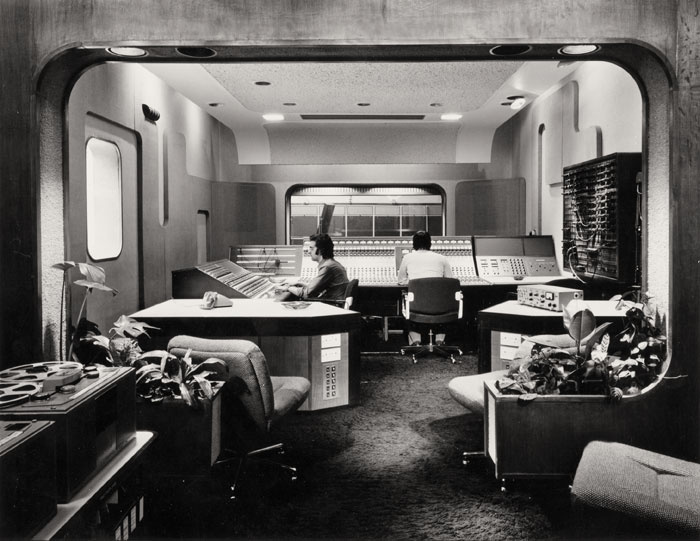 The control room at Abbey Road Studio Three in its '70s guise.Photo: Ron Howard / Redferns
"I'd already established a fairly standard approach to drum miking back then," says Parsons. "There was an AKG D20 on the kick drum, a Neumann KM84 on the snare, two [STC] 4038 ribbons overhead, and if I miked the toms at all I'd probably use dynamics like AKG D19s, or maybe 414s. As it happens, in this case Bobby said 'I think I'd like to dub on some tom fills,' so I just got this huge delayed plate echo going on and it seemed to pretty much take over the track. I mean, it really brought the whole to life when we put those fills on, and I remember the guys teasing me, saying 'You mixed those toms a bit loud! You obviously like them.' They were a bit loud, but to my mind they were also an integral part of the atnmosphere of that record.
"Basically, I had a lot of luck with my drum setup and saw no good reason to change it unless I was looking for something quite different. And it also meant that I could get a drum sound in five minutes flat, which was kind of important. The Hollies were quick workers and didn't want to be bothered with hours of getting individual sounds. They just wanted to play and get it done. And they were not particularly experimental in terms of getting different sounds. You know, an acoustic guitar was an acoustic guitar, and the electric sound was what Tony produced, while the bass was usually pretty solid-sounding.
"One thing that I think the Hollies perhaps did better than anybody was incorporate acoustic rhythm with electric. They favoured acoustic guitar rhythms quite heavily on most of their stuff, and I think that rubbed off on me because I always did the same thing with the [Alan Parsons] Project later on. Both Tony and Terry would play acoustics — as I recall, Terry never touched an electric, although I could be mistaken. Generally speaking, Terry would play an acoustic and Tony would play an electric. My favourite acoustic mic was the 84 again, with a little bit of top end, and for the electric I generally used an 86 on the amps.
"They would always routine a song with acoustic guitars to start with. The group generally didn't have keyboards on their basic rhythm tracks... unless Elton John happened to be around." (It was as a session pianist that, at a time when he could be anonymously heard on supermarket muzak, Elton played on 'He Ain't Heavy, He's My Brother'. By 1974, he was no longer on call.)
Meanwhile, a DI was used for the bass of Bernie Calvert, who'd replaced original bassist Eric Haydock eight years earlier, in 1966. "I would only use the bass cabinet if requested to do so," Parsons comments. "Generally speaking, on everything I've done since the '70s, I've never had any luck miking a cabinet. I've always done better with a DI."
Well Balanced
"The Hollies worked very quickly," Alan Parsons continues. "We normally felt disappointed if we didn't start and finish a track the same day. There was a standard routine: arrive, decide what song they were going to do, routine it, get the rhythm track sorted out, record the rhythm track, rehearse the vocals and get the harmony vocals sorted out, and then record the vocals. We wouldn't mix the track the same day, but we would go the pub thinking 'Well, that's the job done.' Alan Parsons today.
"The wonderful thing about the Hollies is that they were a great team and a joy to work with. They were very amenable, always friendly, always generous — if they went out for dinner somewhere, there was never a question that we would all go. And they were all terrific musicians. Allan Clarke had a very powerful voice — even if, God bless him, he did have a tendency to sing flat — Bobby Elliott was a first-class drummer and some people regarded Tony Hicks as one of the great guitar players. In fact, Eric Clapton once said that the first note of 'The Air That I Breathe' had more soul than anything he'd ever heard.
"Allan would usually record a guide vocal when the rhythm section was being laid down, and when it came to the proper vocal he would occasionally say 'I would like to do mine on my own first,' but usually he, Tony and Terry would do them in the studio together, standing side by side as if on stage, maybe slightly angled inwards so that they could look at one another, and each in front of an 87. Ron did do the balancing of that — he would have the three faders in front of him and balance the harmonies, although we would always record them to a single track and then double them. You see, the decision was made there and then, there was no doubt about the right balance, and that left room for more stuff to be recorded to the other tracks. Otherwise, we'd have used six tracks alone for the vocals."
The mix took place in Studio Three, and again this was a formal process. "We'd sit down and go 'Right, we're going to mix this song today,'" says Parsons. "However, we probably wouldn't spend more than three hours on it. I remember in the case of 'The Air That I Breathe', the master machine that we mixed to had some kind of speed fluctuation problem. It might have been slipping on the capstan or something, but I actually took the master to a second generation and did a bit of pitch correction on it, which was quite daring, I suppose."
Released in early 1974, 'The Air That I Breathe' was a worldwide smash, peaking at number two in Britain and number six in the States. It would be the Hollies' last major hit single.
Close To The Orchestra
The orchestral arrangement for 'The Air That I Breathe', comprising brass and strings, was done by Chris Gunning, perhaps best known for the Martini commercial — "Try a taste of Martini..." Like the rest of the track, this was recorded in Abbey Road Studio Three, the 40-piece setup creating quite a squeeze.
"Two was a good studio for that size of orchestra, but that was probably booked," Alan Parsons surmises, "and pop engineers didn't favour Studio One particularly for overdubbing orchestras because of the reverb. If you wanted a dry sound, it was hard to get. I mean, in later years I adored it, but at that time everything really needed to be very tight and separate.
"Right from my earliest days with orchestra, I used close-miking. I miked to each pair of instruments, using [Neumann] 86s for the violins, 84s for the violas, 87s for the cellos, and 87s as well on the basses, if any, although I would mic them individually, and that was just because there's not much of them. They don't make as much noise as the rest of the instruments, so they benefit from having their own mic, for separation reasons more than anything else.
"In terms of miking orchestras, I'd had the best training in the world, working with people like Geoff Emerick and Peter Bown. In fact, Peter Bown had been the Hollies' main engineer, and I'd got to know them through working with him as his assistant. Abbey Road was an ideal place to grow up in the business, amd I wouldn't have changed that for anything. I learned all styles of music and all styles of production, as well."