

Last month we discussed how to prepare mixes so that they are ready for the mastering engineer. This month we look inside the mastering room during the processing of an album, to see what kind of equipment is used, and the sort of things that are done to finish the tracks to the required standard.
As you may recall from my 'Preparing Your Music For Mastering' article last month, we're following the mastering of an album recorded in a fairly typical home studio. The song files were saved onto a CD-ROM in 24-bit WAV format, and sent to mastering engineer Ray Staff at Alchemy Soho in advance of the session to ensure there were no formatting problems. However, on the day of the session I took a fresh CD-ROM containing replacement mixes of six of the songs. By this time I had already been assigned ISRCs from Phonographic Performance Ltd (PPL) so we could code each of the tracks. I also took along some notes on each of the songs for reference during the session. These included a brief description of each track, a note on what I thought the song required, and some further information on specific areas of concern.
Ray's first task was to exchange the old mixes with the new ones, and to arrange the tracks into the correct order according to my revised track listing, compiling the songs into a playlist in Steinberg's Wavelab running on a PC. From there, the tracks were played out into the various analogue and digital processors, before being recorded to SADiE DAW.
Ray Staff: "I use Wavelab because it supports a reasonable range of sample rates and file formats, and it allows me to import and organise songs quickly. I record to SADiE because it is a good editor and outputs the formats that we need for CD mastering. A lot of cheaper editors are not complete, and require you to buy an add-on if you want to do DDP. I don't use the program for processing, I just need a good editor that sounds clean and is fast to use."
Between Wavelab and the SADiE system is a signal path into which any number of digital and analogue processors can be patched as required. For this project, Ray decided to use mainly analogue compressors and EQs, although TC Electronic System 6000 mastering tools were also applied in places too. Used most were the Crane Song Ibis equaliser, sporting Class-A circuitry and five bands of EQ per channel, and the Crane Song STC8 stereo compressor/limiter, also with Class-A circuitry, and the whole lot was patched and monitored via the Maselec control console.
Initial Discussions & CD Referencing
Choosing the right track to begin the mastering session turned out to be quite important. Ray explained that the rest of the session would hinge around the first master, and therefore it was necessary to pick a song with the right kinds of elements, whatever they might be.
"Often a track intended for release as a single is the most important thing on the album, so that is a good starting point," says Ray, "but I've done albums before where I've thought I'd picked a representative track, and had built everything to fit around it, only to find out halfway through the session that a different track would have been a better choice. On those rare occasions I've had to go back and rework everything in relation to the new track."
I had decided to start the album with a song called Trial (Of An Argument), which seemed to sum up the music as a whole. It contained lots of upfront vocals, keyboards, guitars, and piano parts, and while I didn't consider it to be a potential single, it was a bit of a showcase number. Ray thought that, from a mastering point of view, the song was a good place to start, because, being one of the more full-on numbers, it was quite representative of the musical style. He also thought that the mix possessed a good bottom end which could be used as a template for the following tracks. Ray: "Musically, it seemed as though it could be manipulated into something interesting that the others could sit alongside."
 The mastering was carried out by Ray Staff at Alchemy Soho over the course of one day. Tom attended the session and consulted with Ray throughout the process.
Before going any further, Ray wanted to discuss how I wanted the tracks to sound. I had compiled a short list of albums which I thought had vaguely the same palate of instruments, or at least a similar arrangement density as my own tracks. From my short list, Ray ruled out several albums straight away because their tonal balance and recorded sound was too different, although he highlighted a few he thought might marry up with my material. Two of those were albums I'd brought with me on CD, so we were able to cue them up and compare them against our reference song. In retrospect, I wish I'd taken a few more albums with me, as it only took a few moments to pop a CD into the player and make an A/B comparison.
Although the albums were different to mine in many ways, there were certain musical elements that had similarities, and it was these that formed the basis of the comparison. Ray looked at the characters of the bass and vocals primarily, and made a few exploratory EQ adjustments to see if my material would match up.
Ray commented that he could see a kinship between the reference CDs and the song Trial, which helped him work out how to get some more 'snap' into the music. Using the first CD as a measure, Ray explained that the bass needed to come forward in the mix. This was despite the fact that the bass on my song was created using a synthesizer/sound module mix, whereas the CD track had been recorded in the late '60s using real instruments and a proper studio. In this instance, the origin of the sound was immaterial; it simply provided a level to which the bass on the new track could be made to match. Ray used the other album I'd brought with me to get an idea of what sort of feel we wanted from our vocals and keyboards, although he didn't worry too much about matching like for like, as the material had a very different tone to it due to the way it had been recorded. Ray also warned that, although the basic qualities of the material were comparable, I had brought in an old CD which was lower in level than most modern masters, and had a sound that was a little bit brittle.
Setting The Stage
Finding the right processing for the first track certainly took longer than it did for any of the rest, partly because it provided a starting point for the other tracks, but also because it was necessary to do some experimentation to establish the limits of the material. "Sometimes you get an album that is so consistent that one setting more or less does it all, but that's not very often," admits Ray. "You can't hold that as a rule, though, because you may get to a song that is totally different and requires a different treatment.
"As far as this track was concerned, everything was well balanced, and the mix had a lot of space, but for me, it didn't come together as a whole. The vocals were a bit aggressive, so I used the Ibis EQ to cut about a decibel around the voice. Any more than that and we would have been losing too much snap out of the snare and guitars, because those sounds are in a similar area. It was a trade-off.
"I decided to gently apply an analogue compressor, rather than a digital one, because I thought it would be smother. The STC8 is very pliable, and has two modes named Hara and K1. The Hara mode is quite transparent and more like an ordinary compressor, but K1 is more like an opto-compressor in that it helps everything gel together."
Ray also added a little digital processing courtesy of the TC Electronic System 6000 compressor. "The STC8 provided a musical texture, but the track still needed a bit of a level boost. I tried a brick-wall limiter first, but it was taking away too much of the track's energy, so instead I applied a bit of multi-band compression, which gave 3-4dB of lift. The compressor can do different things depending on how you set it up. If you are using it gently and mildly it can lift the level a few decibels without meddling with the overall sound. In this instance I used a minimal amount of compression."
"The mastering has helped everything to gel together rhythmically, although I haven't done a lot to it. Whereas the original mix elements sounded a little bit disparate, they now fit as a package, the bottom end has a lot of kick and the track has a lot of energy as a whole." Once everything was set up, Ray played the track through the processing rig, recording it to the SADiE DAW. The processors were then available for readjustment to suit the next track.
Law Of Averages
Ray Staff: "When you're mastering you've got to aim for the average, not the extremes. Even if the end result is going to be played mainly in a car with loads of sub-bass, primarily it has to work on a normal pair of speakers, and then hopefully it will transfer to every other area. We do bear in mind the environment the music is intended for, whether it is a club or whatever, and we monitor what it sounds like when played at the relevant volume. But the test for me is that it should sound reasonable when played at home on an ordinary pair of speakers, and it should translate to radio if it's to be a single."
Processing The Remaining Tracks
The second song, a softer number, sounded a little muffled compared to the first, so Ray applied a touch of EQ and used a System 6000 expander to bring out the vocal so that it matched the level and tone of the voice from the previous song. Matching things up was done by having the reference track playing in the background, courtesy of SADiE, and then using the desk monitoring to flick from one source to the other. "I used a new DXP expander from TC to bring up a lot of the low-level detail," says Ray. "The opening track has a lot of middle and snap to it, and the vocal is quite hard, but the second is much smoother. Because of that, the vocal sounded a bit sweet in comparison, so bringing out the middle helped take it in the same direction."
The first difficulty we encountered, as far as levels were concerned, was during a song called Goodtime Girl, which had more going on at the end of the track than at the beginning, which meant that when the end was levelled to match the other tracks, the start seemed a little weak in relation to the end of the previous track. Ray concluded that the discrepancy was no more than a decibel or so, and could possibly be remedied by making an edit just before the louder part, and then boosting just the level of the first section of the song. "If I placed the edit just on the beginning of the bar it's unlikely you'd notice the cut, but we won't be able to tell until we try," commented Ray. "The song doesn't need any more compression, so that's an alternative method of giving a tiny level lift without compressing."
Ray was reluctant to crush the dynamics any further for fear of harming the track's energy. However, when we tried pushing the compressor just a little more, the level did raise without detriment to the track. "If you look at the SADiE waveform," said Ray, "the start and end levels are pretty close, and it is not squared off at all, so I've kept the dynamics." There was, however, a short piano riff acting as an introduction right at the front of the track, before any drums, bass, guitar, or vocals began, which Ray boosted by 2dB using the edit method so that it carried on from the previous track without appearing to lose energy.
During the mastering of another track called Dreaming By Gaslight, Ray commented that there was some bass flying around which needed to be dealt with in some way. He describes the phenomenon. "I assume the bass drum was panned centrally, but for whatever reason there was a bit of cross-channel spill causing it to move about across the stereo spread. I used the Maselec control console's elliptical equaliser to tighten the bottom end slightly at 100Hz — this EQ basically reduces the stereo width of the bass end by gently taking away out-of-phase bass, and that has the effect of solidifying the bass in the centre. You can get the same result by using the sum and difference principle to cancel stuff out.
"As a very course guide, reducing the spread of frequencies below 100Hz won't adversely affect the song's spatial characteristics or the directionality of an instrument, because the human head can't detect stereo below 100Hz anyway. Above that it becomes a trade-off between the stereo spread and quality of the bottom end. The elliptical equaliser of this desk steps up from 20Hz to about 270Hz in increments of 10Hz, so it's possible to hone in quite accurately."
The Mastering Setup
One of the most interesting things about the mastering session was the fluid way in which Ray used the monitoring section of the studio desk to make A/B comparisons between songs, processors, and levels. Unsurprisingly, the Maselec control console seemed to be extremely flexible and well designed for this purpose. The desk itself was divided into three racked parts, one of which was not used in the session as it was specifically designed for vinyl mastering. The first of the other two parts was the control section, which determined what path the signal would take through the studio's various processors. The other console part provided a set of monitoring buttons which were assigned to individual sound sources such as the CD player, so that any processor or audio source could be cued up for listening instantly.
 The clever signal routing and switching in Ray's Maselec mastering control console allowed processors to be switched in and out of the signal path easily and without audio glitches.
"The monitoring unit allows me to listen to anything and everything," says Ray. "The system works in such a way that a signal feed is sent to every processor all the time, so, for example, if you are not using a compressor but want to quickly switch it in to monitor its potential affect on the signal, you don't get any bumps as the compressor catches up. That way, you are always hearing the true result of the processing. You can insert any equaliser you want into the system, change its level, and set high- and low-pass filters, and you also have the elliptical equaliser and the output gain fader.
"As regards the rest of the setup here, I don't use the GML 9500 EQ very often, because I find the Crane Song much cleaner and more open. Similarly, the Prism MLA2 is a good optical compressor, but the STC8 keeps more of the original sound. I don't apply the SPL Vitalizer very much, but I find it very handy for analysing a bit of the mix. The Crane Song EQ controls are stepped, and are not as immediate as rotary controls, but I can quickly turn up the Mid Tune control of the Vitalizer and hear how it affects a certain instrument or part of the mix. Other times I do use the Vitalizer, or a combination of processors. I mix and match as I need to, but I tend to use the least amount of equipment possible. Mostly I send signals through the analogue path first, and then through the System 6000 into SADiE, but if a digital source is giving me a problem, I might tidy it up with a digital processor before converting it to analogue. The system's completely flexible."
Second Thoughts
By the time we got to the ninth or tenth song, Ray began to rethink the settings he had made for the first song, and started to feel that the song wasn't gelling as well as some of the subsequent tracks. The main problem was still the bass, which didn't seem to have enough punch. Ironically, rolling off the frequencies below 20Hz had the result of making it sound stronger, which was no doubt because the EQ curve created more space for the rest of the audible frequencies. "Once you've finished a number of songs you have a better overview of how it's shaping up," admits Ray. "I tend to review what I've done when I get a way in. Sometimes I find that one or two songs haven't quite worked, in which case I'll tweak the settings slightly and tidy up those small things.
"The first song here was a little bit thicker in the bass end than everything else, which was the nature of the mix. It's not wrong, it just isn't quite as neat as the other songs. As we were on a flow, I decided to master a few more songs before going back to that one. At one time, if you were cutting an album, you'd have had to work through from start to finish and have every setting written down in case you needed to do it all again. Because we can now compile the master on the computer, that isn't such a necessity. If you don't like how a song's turned out you can go back and change it, and sometimes it's better to start fresh anyway."
Gaps & Fades
When all the songs were recorded into SADiE, it was time to tidy up the starts and ends, and to establish the lengths of the gaps between each song. Ray began by roughly topping and tailing each song fairly closely so that there were no random noises interfering with our judgement, and by placing a nominal gap of a few seconds between each one. From there on, it was a matter of listening to the end of one song and the start of the following one to see if the space felt right. Although not many of the songs required the music to fade in or out, most ended on a guitar or synth sound decaying to noise, so some very short fades were needed, particularly where I'd cropped my file very close to the end of the decaying note. In some instances, I certainly wished I'd left a little more noise on the end to use for fading, and Ray concurred that leaving a little space at either end was a wise move. "Some people edit their files very tight, and I've worked on quite a few projects where the audio has been clipped. It is so useful to leave on a bit of silence at each end, even if it's just a few seconds of space."
The lengths of the gaps between songs depended greatly on the shape of the fades, and the relative natures of the adjacent songs. Once everything felt about right, the song file names were checked and the ISRCs added. Ray then burnt off a CD-R at 2x speed for me to take home, and advised me to try it on a few different systems and in a variety of environments before deciding if everything was OK. With no immediate singles planned, and no drastic last-minute changes to make, we didn't have any big edits to make, so this last part of the process was relatively quick. If there had been edits to make, they would undoubtedly have added to the session length, and would have increased the cost, so Ray's advice was that I should have any such changes well planned out in advance.
Mastering and coding pretty much finished by 6pm after a 10am start, including an hour for lunch and a couple of tea breaks — apparently this is good going for a 16-track album. Having no edits to make or any technical hitches certainly helped and, although some tracks were considerably different to others, the overall consistency of the production also made life easier.

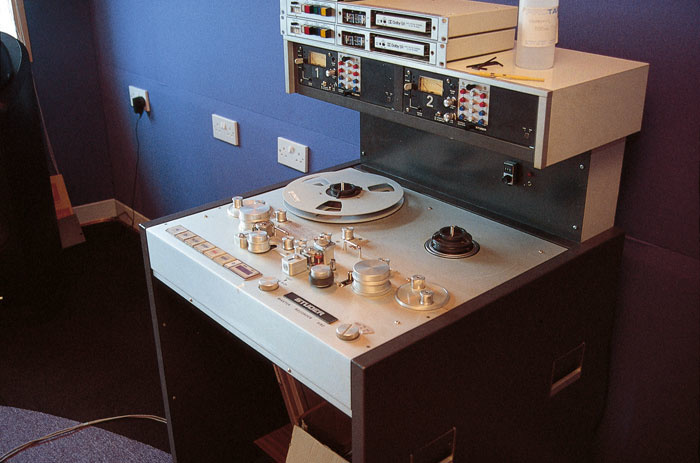 Although Ray's setup can cater for a variety of digital sources and output formats, there are also facilities for playing open-reel analogue master tapes and for cutting vinyl discs (above).
Lessons Learned
The most valuable thing I gained from attending the mastering session was an awareness of the limitations of the process. Although each song is dealt with individually, the mastering engineer works on an album as a whole, and because of that certain compromises have to be made so that some tracks fit with the rest. For example, one song may need a little more sparkle adding to its vocal before it matches the others, but EQ'ing the vocal will affect other sounds in that area. If the surrounding instruments are already quite bright, they could end up sounding rather harsh as a result of marrying the vocals. In this way, the mastering session reveals how it is important to get certain things balanced well with one another at the mixing stage.
Back at home, the bass end of the mastered tracks sounded more solid and dominant, and in some instances this has had a slight negative impact on the presence of the vocals and guitars. This was most problematic where I had been a little conservative with the vocal and guitar levels during mixing, and in retrospect I think I would have pushed the lead instruments louder in places. Interestingly, I found that wherever I'd been concerned that I'd overcooked a synth lead line, guitar break, or vocal yelp, it hadn't proved a problem in the end. The whole experience will undoubtedly affect the recording and mixing decisions I make on future projects.
After some deliberation I was able to get back to Ray with instructions to make a few adjustments. In particular there was a gap that needed changing, as well as a few minor changes to the fades, and there was also one song which both my musical collaborator and I thought sounded a little flat for our tastes. Ray was able to email me MP3s of the revised fades and gap changes, but posted a CD of the remastered problem track.
Manufacturing From Masters
Choosing a manufacturer is a little tricky, as there are so many companies offering the same services for about the same amount of money. For my research I asked several companies to send me an example of their work so that I could see if the artwork had been printed well, and to hear if the audio recording was free from problems. As Exabyte and DDP are fairly standard delivery formats for mastered recordings, I was a little wary of companies who only accepted CD Audio. It also seemed likely that most of the service providers used more than one factory to get the job done, so I paid particular attention to any information telling me what factories were used. Obviously, mastering engineers get as much experience of dealing with manufacturers as anyone, so I asked Ray for some tips or notes of caution.
"It's hard to find out which factories are doing a good job. If you talk to an engineer they might be able to recommend a company they've used, but I suspect some agencies use more than one plant if they want a quick turnaround. I've even experienced variations in quality from the same factory. For example, a plant technical manager in the US once told me of a record which sounded fine on its first pressing, but not so good five years later when another batch of CDs were made from the same master. The same factory had been used, but the manufacturer had changed all their equipment since the last time!
"There is no doubt that most CD plants working from a DDP file end up doing a decent job, but there are still differences in quality. To make a good musical CD you have got to have good glass mastering that doesn't increase jitter, and the CDs themselves need to be pressed properly."
Some Of Ray Staff's Mastering Gear
- Maselec analogue control console with MDC80 disc-control system.
- Studer A80 MkII tape machine with vinyl preview head and custom DAV electronics.
- Dolby A & SR noise-reduction processors.
- Crane Song Ibis & GML 9500 analogue equalisers.
- Crane Song STC8 & Prism Sound Maselec MLA2 analogue compressors.
- Maselec MPL2 limiter.
- SPL Vitalizer MkII processor.
- Sony PCM7030 DAT recorder.
- Digital Audio Denmark A-D/D-A converters.
- DCS A-D/D-A & sample-rate converters.
- Sintefex CX2000 digital compressor.
- TC Electronic System 6000 digital processor with GML high-resolution EQ algorithms.
- SADiE Artemis digital audio workstation.
- B&W 802 monitors and Chord amplification.
- Neumann VMS82/SAL74/SX74 cutting lathe, with modifications for lacquer mastering.