

Digidesign may be better known for Pro Tools, but the RM-series speakers are every bit as 'pro' as their heritage suggests.
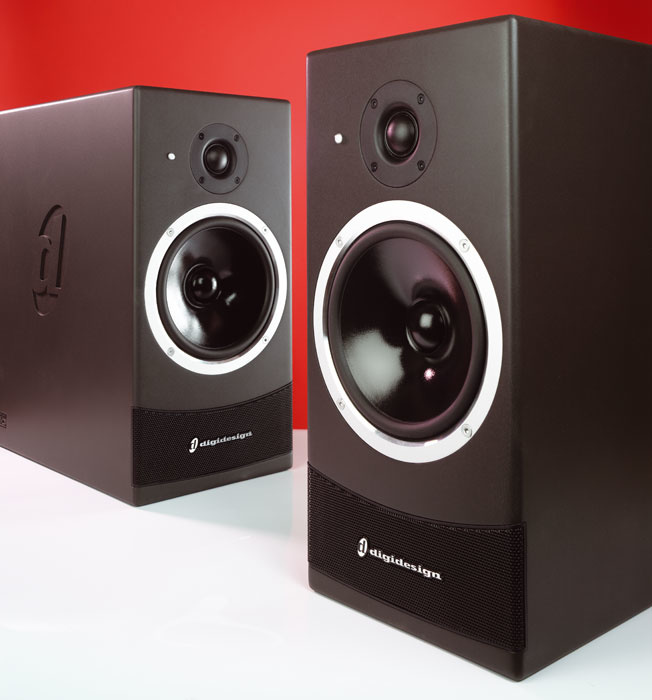 Digidesign are inextricably associated for most of us with the Pro Tools digital audio workstation system. Related logically enough to that DAW origin are a couple of variations on DSP hardware for the high-end systems, various audio interfaces for the professional and project studio markets, and some increasingly impressive and complex control surfaces. A bespoke range of very high-quality, ground-breaking professional monitor loudspeakers, on the other hand, is probably not something you would connect directly with Digidesign — but that is exactly what the company have just launched, in the form of the RM1 and RM2.
Digidesign don't have a background in sophisticated loudspeaker design, but they did know what they wanted, and worked in partnership with one of the world's leading professional monitor manufacturers, PMC, to design and develop the Reference Monitor (RMS) series. These small-format monitors are built in PMC's Luton factory and are being distributed through Digidesign's extensive dealer network.
Design & Construction
One of the more unusual aspects of these new monitors is the use of DSP-based crossovers. Some other manufacturers have been using DSP in this application for years, but it is a first for PMC. Likewise, these new monitors feature a digital input, which is also new ground for PMC.
Both of the new RMS models are two-way, active, bi-amplified speakers. They share the same one-inch, ferrofluid-cooled, soft-dome tweeter, but this is of a different type to that fitted to most of PMC's own-brand speakers. Most obviously, it has a smaller face-plate, which allows it to be mounted significantly closer to the bass driver — and I'll come back to the importance of that shortly.
The smaller RM1 uses a 5.5-inch mid/bass driver, while the larger RM2 uses a 6.75-inch model. Both are bespoke 4Ω units, designed and constructed specifically to work correctly with the unusual loading parameters presented by the unique Advanced Transmission Line (ATL) cabinet construction that all PMC monitors employ. For both bass drivers, the cast-alloy chassis supports conventional doped cones.
Thanks to the smaller tweeter face-plate, and the closer proximity of the two drivers on the baffle, the ATL port can be vented at the bottom of the front baffles of both these monitors, through a mesh grille. This is an interesting point because PMC's own, roughly-equivalent-sized speakers (the DB1 and TB2) both have rear ports. In contrast, all of the larger PMC monitors vent to the front, which is the more desirable location. Apart from anything else, frontal ports allow the monitors to be placed more easily in small rooms near to the rear wall, and even allow soffit-mounting.
The transmission-line structure employed in these RMS speakers is apparently an entirely new design, which takes full advantage of the incremental improvements and discoveries that PMC have made in this technology over the years.
In terms of the electronics, each driver is powered by its own Class-D amplifier, and these, too, are entirely new designs. The specifications claim 92 percent power-efficiency, but I don't know if that figure takes into account the extreme light pollution from the bright-blue LED adjacent to the tweeter that lets you know in no uncertain terms when the speakers are powered! Boasting a bandwidth of DC to 50kHz, these amps deliver 50W to the tweeters, while either 80 or 100W is provided for the woofer, depending on size. The THD+Noise figure is quoted as 0.05 percent and the signal-to-noise ratio is a very respectable 125dB.
Despite some dodgy marketing campaigns in the past, the 'D' in Class-D does not stand for 'digital.' In fact, it was simply the next letter that came after the earlier established amplifier classes: A, B, (AB) and C. In fact, Class-D amplifiers use analogue pulse-width modulation techniques that are entirely linear — not the nasty HF-switching employed by some true 'digital amplifier' designs. As the designer, Peter Thomas, told me, "there are absolutely no numbers in this amplifier, only voltages, currents and time; none of them quantised!" A single overall feedback path, taken from the associated drive unit back to the input, linearises the amplification and compensates for the drive unit's reactance.
Given PMC's adoption of the incredible Flying Mole amplifiers, used in the company's smaller 'activated' speakers, it may seem reasonable to assume a link between the Moles and the new RMS amps. However, it turns out that the RMS designs are completely bespoke and entirely unrelated designs — even down to the power supply arrangements. The Moles use an integrated switched-mode supply, whereas the RMS amplifiers are powered from a generously over-specified linear power supply.
The beating heart of these new RMS designs is the DSP-based crossover, which is implemented in a 48-bit, fixed-point processor. A simplistic description would be to say that the crossover design replicates 12dB-per-octave slopes to integrate the drive units, but the truth is that the filters are much more complex than that. The enormous advantage of performing this task in the digital domain is that each frequency band's response can be matched far more accurately to the corresponding driver's physical performance than is possible in any practical analogue design — not only in terms of the amplitude response, but also the phase response, which affects dispersion and imaging accuracy so critically.
However, although the crossover stage is performed in DSP, there is still a lot of 'analogue' in these monitors. Not only is there an analogue input, gain stage and associated A-D converter, but the output from the DSP section passes through a high-quality D-A converter to feed the amplifiers. Clearly, a lot of careful thought and design has had to go into optimising the gain structure through this complex signal path, but the result is an impressive overall signal-to-noise ratio in excess of 110dB.
Rear Panel
Unusually, the fused IEC mains inlet, voltage selector and power switch are mounted towards the top of the panel, with four threaded holes for a standard wall-mounting bracket in the centre. Below that are the input sockets and configuration controls.
Two female XLRs are provided: one for the balanced analogue line input, and the other for a (stereo) AES3 digital input (24-bit word length, at sample rates up to 96kHz). The analogue input sensitivity can be adjusted such that peak output levels are 113 and 111dB SPL at 1m, for the RM2 and the smaller RM1 respectively). This is achieved with a 16-position endless rotary switch, which accommodates line levels between +19 and +4dBu. At first sight, the switch looks like an ordinary trimmer. It is a little odd to discover that there are no end-stops, and that the signal level suddenly jumps 15dB, as the switch transits from the lowest to the highest sensitivity!
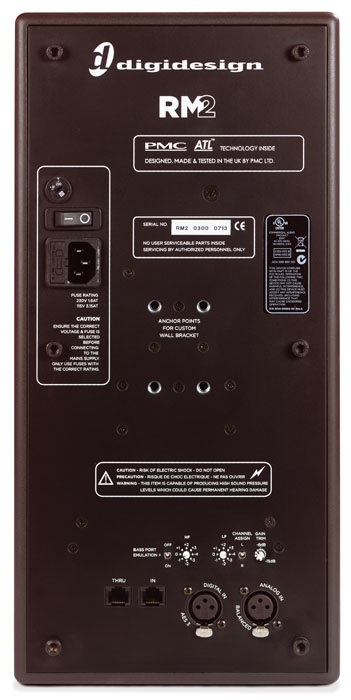 Inputs are on two female XLRs — one for the analogue input and one for digital. A pair of RJ45 sockets provides an alternative AES3 connection format and allows the data stream to be passed on to the other speaker in the pair.The analogue circuitry is designed such that, assuming the correct sensitivity setting is used, the full dynamic range of the A-D converter is employed, maximising the signal-to-noise ratio. A very low-noise, low-jitter internal clock drives the internal A-D converter, DSP and D-A circuitry (again, to maximise quality), and the entire digital chain operates with a 24-bit, 96kHz signal.
For the digital input, a small toggle switch above the socket selects which channel in the stereo pair the speaker is intended to reproduce. In addition to the standard AES3 input on the XLR, a pair of RJ45 sockets are labelled In and Thru. The input socket provides an alternative AES3 connection format, while the Thru socket enables the data stream to be passed on conveniently to the other speaker in the pair (which would, of course, be switched to reproduce the other channel).
Input source selection is completely automatic, with a valid digital input being given priority over the analogue input. Other 'digital speakers' already on the market also make use of the RJ45 connector to link multiple speakers and provide remote control options, so I wouldn't be surprised if additional functionality was introduced to these ports in the future....
A pair of recessed, rotary switches on the rear panel provide HF and LF equalisation for the purpose of room-matching. The treble side allows a gradual boost or cut above about 1kHz, with a range of -4 to +3dB in 0.5dB steps. The low-frequency equalisation operates over the same boost/cut range, with the nominal turnover point being 750Hz for the RM1 and 500Hz for the RM2.
In addition to these simple shelving equalisers, there is also a unique 'Bass Port Emulation' feature, controlled with a miniature toggle-switch. Those already familiar with PMC monitors will know that the ATL design provides a more extended and remarkably accurate bass performance, which remains consistent at all monitoring levels. The 'resonant hump' that is characteristic of most reflex (ported) cabinets is completely absent, and this can initially make the bass response sound rather thin and 'odd' to some listeners.
To help 'wean' users over to the more accurate ATL presentation, Digidesign have included the facility to put back some of that 'reflex port' colouration. Essentially, this switch introduces a peak in the frequency response just as the bass response starts to roll off, with the aim of mimicking (to a limited extent) the characteristic reflex port distortion and fullness. Obviously, these effects are largely mechanical in a real reflex speaker, and the DSP emulation can only go so far — but it does provide the opportunity to hear how a mix might sound on a typical ported speaker, should you feel the need.
Listening
To provide a known reference point with which to start assessing the RM2s, I rigged a pair of PMC TB2s, fitted with Bryston PP120 Powerpac amps. I've used this combination for many years now for all my location recording and some editing work, so they are very familiar to me. The TB2s are an old design now — although updated with soft-dome tweeters and crossovers — but still very good value for money. And the Powerpacs are serious 'overkill' amps that give nothing away in terms of resolution and control.
Like most PMC designs, the RM2s definitely need some 'running in' time — the bass sounds unnaturally dry and tight until the drive units are bedded in properly. However, after a few hours the performance started getting better, and better, and better... After running the RM2s for a day or so, I reached a point where the TB2s were sounding rather congested and veiled in comparison. The overall tonal character was very similar (bass and treble extension, smoothness through the mid band, and imaging) but the amount of detail and clarity, the articulation and presence of bass instruments from the RM2s, was quite astonishing. The image stability was also noticeably better, with bigger, deeper more believable sound stages on suitable material, and a wider sweet spot. Eventually, I had to take the TB2s down and move up to my much larger (and a lot more expensive) three-way PMC IB1s as a reference point instead, because the Digidesign speakers were revealing low-level details that simply weren't audible on the TB2s.
My two favourite benchmarks for this size of monitor are the stunningly impressive PMC AML1 active two-way, and the remarkable K+H O300 active three-way. While I'm not sure the RM2 quite matches the AML1's resolution, it's not far off at all, and it would certainly give the O300s a challenging time.
Clearly, DSP technology (and probably cabinet and driver design) has come on in leaps and bounds since the AMLs were launched. I was actually quite taken aback at what these Digidesign speakers are capable of delivering.
One of the biggest advantages of well-engineered, active designs is the unusually articulate bass performance. The RM2s were fast, responsive and tuneful, yet still managed to move serious amounts of air and create trouser-flapping pressure fronts when called upon to do so. The most subtle nuances of a bass player's performance were laid out clearly in the midst of the rest of the band's activities. Remixing a full band using the RM2s was a joy, and fine-tuning EQ was never easier — always a sign of a good monitor. I found that I was able to hear what was going on in the most complex of mixes without any effort, which is something I would normally associate with far larger and more expensive monitors than these!
I'm not wholly convinced of the benefits of the port emulation facility, but at least it can be switched off. The other on-board EQ facilities allow flexible room-matching and tonal shaping, with good resolution and sensible ranges. The provision of both analogue and digital inputs is very attractive, and clearly a lot of thought has gone into optimising gain structure and signal levels. The use of the RJ45 sockets is intriguing, and I look forward to seeing what related developments occur.
Lasting Impression
Overall, I was extremely impressed with the quality of these compact RM2 monitors, which are amongst the very few I've heard to approach the capabilities of PMC's fabulous AML1 design in a similar-sized cabinet. It seems DSP speakers have come of age in the professional environment, and I can't wait to see what comes next! The RM2s and the little RM1s are being distributed through all normal Digidesign suppliers, so finding a pair to listen to should be very easy. Go on, treat yourself at the earliest opportunity!
Alternatives
The RM2 is an expensive monitor compared with many alternatives, but the performance easily justifies the price. For the same kind of outlay, monitors such as the Adam S2.5a, the Dynaudio M1.5, Genelec 8250A, K+H O300 and the Earthworks Sigma 6.2 come into the frame, although the passive Sigma demands a quality amp to allow it to deliver the goods. Of those, I would say the RM2s would compare most favourably with the more realistic tonality of the Sigma and the O300, but can shift air with the same aplomb as the Genelec, if not quite matching the sheer SPL offerd by Adam and Dynaudio.
Pros
- Consistent bass performance, regardless of volume.
- Excellent detail and clarity.
- Analogue and digital inputs.
- Bass port emulation (for those who feel the need).
Cons
- None.
Summary
A new bespoke design of active two-way studio monitor, built for Digidesign by PMC. They incorporate the unique ATL cabinet design, but coupled to DSP-based crossovers and with digital inputs. Astonishing levels of resolution and clarity place these monitors in the serious league.
information
£2468 per pair including VAT.
Digidesign UK +44 (0)1753 655999.
+44 (0)1753 658501.