

This is a basic gear connection question. Should I connect instruments and mics to mixer inputs and connect mixer outputs to audio interface inputs, or alternatively connect instruments and mics to audio interface inputs, connect audio interface outputs to mixer inputs, and connect mixer outputs back to audio interface inputs? I think both work, but is one 'better' than the other, and if it is, why?
SOS Forum post
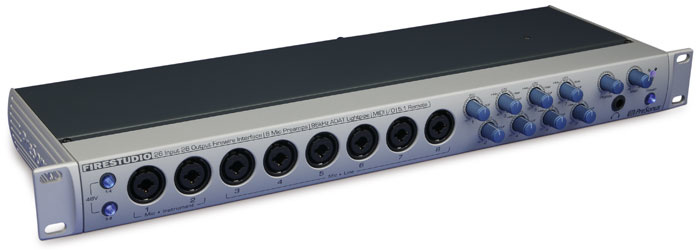 The best way to connect up your mixer and audio interface may depend on factors such as relative quality of mic preamps. If your interface is mid-priced and upwards, such as this Presonus Firestudio, you'll probably find its mic preamps are better than those on the average mixer, so you'll be better off plugging your mics directly into the interface preamps rather than the mixer preamps. SOS contributor Martin Walker replies: Both approaches do work, but which one you choose largely depends on the quality and features of both your audio interface and mixer and what other gear you have, as well as on how you prefer to work.
For recording mic signals, audio interfaces in the medium to higher price brackets (and by this I mean several hundred pounds upwards) often feature mic and instrument preamps that sound better than the ones you find on typical small mixing desks. So plugging your microphones directly into the interface mic inputs may well result in a higher-quality recording. Another attractive alternative for many musicians is to buy a few high-quality rackmount mic preamps for the particular sound they offer, and plug these direct into audio interface line-level inputs rather than patching them through a mixing desk.
Electric instruments with passive circuitry are best plugged into a high-impedance input to avoid high-frequency loss. You can either use one on a guitar amp and mic up the amp, use a suitable DI (Direct Injection) box to raise the input impedance and then plug its output into a mixer or interface mic input, or use a specialist guitar preamp, such as a Line 6 Pod or Behringer V-Amp, that you plug into any line-level input on a mixing desk or interface. While mixing desks very rarely have suitable high-impedance instrument inputs, many audio interfaces do provide dedicated 'instrument' inputs with a high impedance, often making them the cheapest and most convenient option for guitars.
Another big divide occurs in the effects department. Some musicians find it easier to get the best recordings by sending their signals through a mixing desk EQ and then adding analogue effects such as compression and reverb, which can be easily patched into the desk using its dedicated insert and send sockets. Alternatively, if your signals are sent direct to the audio interface, computer-based plug-in effects can be used, but these will normally only be heard after a slight delay (latency) of at least several milliseconds, which can sometimes be disconcerting (particularly for vocalists monitoring their performance). Many audio interfaces do provide 'zero latency' features to help monitor your sounds in real time during the recording phase, and a few audio interfaces (notably from Emu, Focusrite and TC Electronic) also feature built-in DSP effects that can help you during the recording process, even though the signal is still often recorded 'dry' into the computer so you can apply different effects afterwards.
Ultimately, your input choice depends on whether you like the 'sound' of your mixing desk and prefer the immediacy of having all its controls laid out in front of you for immediate tweaking during a recording. If you do, then that's the routing to adopt.
When it comes to output routing, there are, again, considerations to weigh up. Patching the outputs of your audio interface through the mixer lets you mix its sounds with other sources, and also gives you instant hands-on control over their relative levels, EQ and effects while mixing. Analogue mixers may also add that certain something to 'glue' the overall sound together, and you can then patch the output back into the audio interface inputs to record the final stereo mix. However, it's generally acknowledged that you need a high-quality (read expensive) analogue mixing desk to add 'fairy dust': cheaper models rarely cut the mustard in this department, so don't automatically expect an audible improvement simply from passing your recordings through an analogue mixer.
The opposite argument is that connecting the output of the audio interface directly to your monitoring system, with no recourse to an analogue mixing desk, results in a simpler signal path that can sound cleaner and more transparent, although you may lose some control over it, especially if the interface doesn't offer an analogue output level control to let you easily adjust the volume of the speakers (this is why so many musicians who abandon their analogue mixing desks require a monitor controller).
Your routing choices tend to determined by what gear you have available, which approach worked best for you in the past, and the audio quality of your gear. You could always try recording and mixing the same song using several approaches and see which proves most manageable, which you enjoy most, and which achieves the best overall sound quality.