

 Giorgio Moroder with his Moog modular system.
The pioneering electronica of 'I Feel Love' didn't just revolutionise disco, it changed dance music forever. This is the story of how it was made...
"This is it, look no further. This single is going to change the sound of club music for the next 15 years.” So said Brian Eno in 1977, and he wasn't at all far off the mark. Indeed, Eno was quick to recognise the ingenuity and potential of 'I Feel Love', with its clinical, pulsating bass line, hypnotically sensual lead vocal, and entirely synthesized rhythm that dispensed with the lush orchestral backing which, until then, had been an integral part of the disco sound. Performed by Donna Summer, who co‑wrote the song with producers Giorgio Moroder and Pete Bellotte, the slick, sequencer‑driven recording followed closely in the footsteps of Kraftwerk's Trans‑Europe Express as a pioneer of electronic music, while also paving the way for both house and techno.
Background Check
"It didn't feel at all revolutionary at the time,” admits Pete Bellotte, whose production and songwriting credits also include Elton John, Janet Jackson and Cliff Richard. "We just thought it was a decent track.”
 Donna Summer and Giorgio Moroder, 1977.Photo: Redferns
Having played guitar in a number of school bands, Bellotte joined an outfit named Linda Laine & The Sinners at age 18 in 1965, and acquired his first studio experience recording at the EMI facility on Abbey Road under the auspices of producer Norrie Paramor. This subsequently came into play at the end of the decade when, after having toured the UK and Germany with his fellow Sinners, Bellotte decided that "the guy behind the glass had the best job... If a particular act didn't work, he would have something else, whereas in a band, if you didn't work out, then that was it.”
Fluent in German, Bellotte initially visited both Hamburg and Munich to try to find some gigs as a producer, and it was in the latter city that he landed a job as assistant to one Giorgio Moroder.
"The first day I met Giorgio, he gave me his briefcase to carry, whereupon I told him I would perform all the other duties, but there was no way I could do that,” Bellotte recalls. "Fortunately, Giorgio accepted this, and I worked as his assistant for a year, year‑and‑a‑half, before Ariola Records offered me a job as a house producer.”
It was while at Ariola that, in 1972, Bellotte co‑wrote 'Son Of My Father' with Moroder. However, although also recorded by Moroder, the song became a chart‑topper in Britain as covered by Chicory Tip.
"I never really liked that song,” remarks Bellotte, who wrote the lyrics. "It was so lightweight.” Nevertheless, Giorgio Moroder's recording of the song was also his first to feature a synthesizer; the instrument whose sound he would later become irrevocably associated with.
"In 1970, an engineer I knew, called Robbie [Wedel], introduced me to a classical composer in Munich [Eberhard Schöner] who had this incredible new instrument,” Moroder recalled when I spoke with him in 1998. "It was a humongous machine with cords everywhere, and he played me this composition which just consisted of a bass tone that kept changing every half minute. That was his composition! He was using this huge machine to create what was known as 'musique concrete'. There were no rhythms, no effects, and it wasn't too interesting, but then, when he wasn't around, Robbie took me aside and said, 'Look, with this synthesizer you can create more than just a low note.' He showed me a few things and I thought, 'Wow, this is great!'
"I was immediately fascinated by the possibilities and the different kinds of sounds it could produce. It was two or three weeks later that 'Son Of My Father' became the first of my records to feature a synthesizer, but, although I had several small hits in Europe with other records that used it, I eventually began to lose interest. You see, it was quite a pain in the butt to use, because the Moog in question was the only one around and the classical composer who owned it wasn't too happy about people using it as a popular instrument. He guarded it jealously, so we kind of had to sneak in when he was away. That's how it was for a couple of years, before synthesizers became more widely available.”
In the meantime, following a year at Ariola, Bellotte again teamed up with Moroder. "Now I was his partner,” Bellotte explains. "We both produced equally together, each giving our own input, and back then, in terms of the songs, Giorgio principally wrote the music while I wrote the lyrics. In terms of the productions, we overlapped all the time — there was no defined area, and I think that's why we got on so well. Neither of us contributed more than the other, and we also never argued. I have to say, Giorgio and I were a strange team, because we never, ever smoked, drank or did drugs; we were just there for the music and working all the time. I don't recall us ever disagreeing vehemently over anything whatsoever — we always had similar visions of where we were heading.”
In 1974, this happened to be in the direction of Donna Summer, a trained gospel belter who had recently performed in various stage musicals, most notably the German and Austrian productions of Hair.
"There were all these refugees from Hair back then,” Bellotte confirms. "There was Marsha Hunt, Judy Cheeks, Roberta Kelly — all these black American girls who had appeared in different versions of Hair in various cities and countries. Judy, Roberta and Donna were all doing session work in Munich, performing backing vocals, and one day I needed to demo a song that I had written, 'Denver Dream', and the French record company wanted to release the demo of Donna. Well, that then became a hit in Holland, so she signed with us and we recorded 'The Hostage' and the Lady Of The Night album, both of which were also big hits in Holland [the only place where they were released], and we all thought we were doing fantastically well. They were just pop records, but then came the disco thing...”
Songs For Swingers
A core band of musicians had been used up until this time, including Keith Forsey on drums and Sylvester Levay on piano. It was while doing a sound‑check warm‑up with a Crusaders jazz‑fusion instrumental for a particular session that Forsey employed the then‑unique four‑on‑the‑floor bass drum pattern, coupled with the 'pea soup' hi‑hat rhythm that he had heard on the Hues Corporation's dance hit, 'Rock The Boat'.
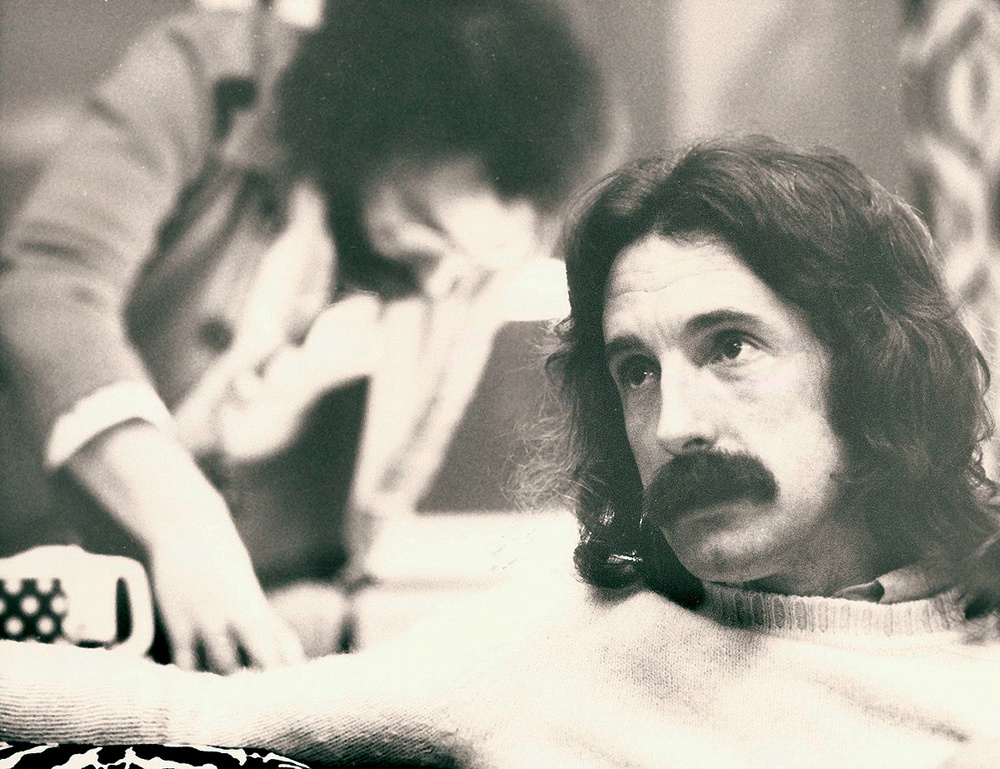 Pete Bellotte, late 1970s.
"That is how the first disco beat elements came about,” says Pete Bellotte. "They simply came out of that jam.”
And what resulted from those disco beat elements was 'Love To Love You Baby', the 1975 smash‑hit breakthrough for Summer, Moroder and Bellotte that, courtesy of the singer's graphic moans and groans — amounting to a record‑breaking 22 simulated orgasms, according to Time Magazine — stormed the charts on both sides of the Atlantic, while being banned by certain radio broadcasters, including the BBC.
Several days after 'Love To Love You Baby' was demo'd, it was placed with Dick Leahy's GTO record label during MIDEM in Cannes. Moroder persuaded Summer to re‑record the song. Released in the UK, it initially bombed, but it was a different story after the tape was sent to Casablanca Records president Neil Bogart in the US.
"Keith Forsey was away when we did that recording, so Martin Harrison filled in for him,” Bellotte recalls. "Martin was a very nice guy, but his timing wasn't great, so after the whole thing was finished and we listened to the breakdown in the middle, we could hear it noticeably slowing up. We therefore sat down trying to figure out what to do. I'd gone to a lot of clubs where these peculiar Italian bands played a schmaltzy kind of music and they used to have this little drum machine where, if you just pressed a button, it would play a samba, or if you pressed another button it would play a waltz. It was very basic and it had a horrible sound, but of course it played in time, so we sent out for one and we laid that down as a track. This then provided us with a four‑minute, metronomic beat that had a kind of groove going on, and that really was the origin of drum machines, and the thing that enabled us to stretch it to a 16‑minute version, kept in perfect time, when Neil Bogart requested it.”
According to Moroder, it was on a Friday that Bogart called him, at about three o'clock in the morning LA time, ecstatic over the number and insisting that it should be extended to cover the entire side of an album. Bellotte fills in the details...
"Bogart was having an orgy at his house, there was a lot of coke going on and, to use his own language, they were all 'f*cking to this track' and the crowd there had him replay the song over and over again. Suddenly, a 'Eureka' thought hit Bogart; he recalled 'In‑A‑Gadda‑Da‑Vida' by Iron Butterfly, which had taken up a whole side. In a flash he came up with the idea of doing the same with 'Love To Love You Baby' and he needed it within a week. So we just proceeded to get down to it on that weekend, and since things always went very fast back then, within the week he had what he wanted.”
Having been a hit in Europe at its original length, the remixed song became a dance‑club sensation in the States, where it peaked at Number two on the Billboard Hot 100, while the album of the same name — whose entire first side comprised the extended version of the title track — was quickly certified gold. Nevertheless, despite all the controversy surrounding Donna Summer's breathy performance, when I spoke with Moroder, he denied setting out to cause a stir with 'Love To Love You Baby', or even being aware of the reaction.
"I wasn't really in touch with what was going on in England and America,” he stated. "I got some feedback about how the record was selling through the music papers, but I was never one for going to the discotheques. I maybe visited [New York's] Studio 54 once or twice, but I didn't follow the scene and the trends too much.”
Capitalising on the success of 'Love To Love You Baby', Donna Summer returned to America and was followed there by Giorgio Moroder, who would eventually base himself full‑time on the West Coast. This, in turn, would lead to the end of his partnership with Pete Bellotte who, not enamoured with the US, would return to England in the mid‑'80s. But that was still a long way in the future when, after recording two more albums, 1976's Love Trilogy and Four Seasons Of Love, the trio created the following year's I Remember Yesterday, and Summer's second top 10 single, in the form of 'I Feel Love'.
Moog Manoeuvres
"With disco albums, we started using themes,” Bellotte explains. "I was always the ideas man, and so for Love Trilogy I came up with the idea of having three separate songs and then a fourth song consisting of those three songs linked together, all combined into one. Four Seasons Of Love was a double album, with each side featuring a season, and my next idea — having just read Anthony Powell's A Dance To The Music Of Time, which is 12 novels inspired by the painting of that name by Nicolas Poussin — was to record an album that chronicled popular music up until the present and on into the future. So, we started out with a '50s song, 'I Remember Yesterday' — I was rather peeved when the album was changed to that name, because I really wanted it to be called A Dance To The Music Of Time — and continued with a bit of rock, a Tamla Motown number and so on, and then brought it up to date with disco, before the final, futuristic song was 'I Feel Love'.
"That's when we got Robbie Wedel in. He came in with four cases containing the Moog and set it all up. Giorgio had the idea for how the bass should go, and we explained the concept to Robbie that the whole song had to be done with the Moog. He said this meant we would need to lock or sync the Moog to the Studer, and when we asked, 'What do you mean, sync?' Robbie replied, 'Well, whatever you play now will then play in perfect time with the first take.' We said, 'How's that possible?' and he said, 'It's something I've figured out that even Bob Moog didn't know his machine was capable of, and now I've told him how it's done... Here's how: first, we need to record a reference pulse on track 16 of the tape, and from that we can then lock in the Moog so that the rest of the tracks are perfectly synchronised.'
"Once this was done and Giorgio had laid the basic track down — we'd use other Moogs later on, including the Minimoog, but nothing ever had the strength of that particular bass, which is like a giant's hammer on a wall — every other synthesized sound locked in absolutely solidly with the original tempo. We had entered another world! This is how brilliantly clever Robbie Wedel was. No one had ever figured this out before — he was the true innovator, and he deserves so much credit.
"Robbie simulated a hi‑hat, snare and bass drum on there, as well as a swell pad — he was just a very ingenious programmer. It was recorded on a 16‑track Studer A80 in an Eastlake room at Musicland, where we had a 32/32 Harrison desk. In terms of effects on this track, there was only compression and reverb from one of the early Lexicons, while for vocals we just used Neumann U87s. The Moog was simply direct‑injected into the desk, and even now, on any system, that track sounds so massive, so future‑proof.
"Giorgio had the idea for the song, coming up with the tune while Donna and I wrote the lyrics, but in the studio we always built things as we went along, just as with 'I Feel Love'. For others we'd also come up with basic ideas, sometimes the musicians would chip in, and with hindsight it now seems a much, much more fluid way of recording than that which takes place today. I mean, nowadays it's possible to sit in our home studios with no hourly rate clocking up, and spend days working on a little detail that doesn't make too much difference in the end. Back then, I think there was more spontaneity, less navel‑gazing.”
Last-minute Edits
The last song on the album, recorded in two to three hours and designed to transport listeners into the future, 'I Feel Love' would quickly become a gay anthem, not least because of Neil Bogart's astute marketing, while topping the UK singles chart and climbing to number six on the Billboard Hot 100. However, it was considered to be nothing more than a filler when the record was finished.
"We never thought of it as a stand-out track, we just thought it part of a good album,” Bellotte comments. "However, when we sent the album off to LA, Neil Bogart called back straight away and said, 'The single is 'I Feel Love', it needs three edits and these are the edits.' Doing these immediately improved the fluidity of the track no end. He was that kind of a record man. And, of course, those edits no longer exist, because they would have been sliced from the quarter‑inch master and simply thrown on the floor. That's how it was then. If you ever did any editing, the floor was cluttered with all the stuff you didn't use. We never saved anything, it was just discarded. However, because of his uncanny feel for the music, Bogart knew exactly where the track should be edited and, of course, the improvement was fantastic.”
The Sound Of Summer
"We really just thought of 'Love To Love You Baby' as a bit of fun,” Giorgio Moroder told me. "Back then I had a studio in the basement of my Munich apartment building called Musicland, and it happened to be empty that afternoon, so I went straight down there and composed the song. Then, a day or two later, Donna came in and we did a very rough demo.
"Donna originally didn't want to do dance music at all. I mean, I knew her as a great singer with an incredible voice, so when we did the demo for 'Love To Love You Baby' it was very different for her to be singing in that soft, breathy way. She hadn't sung that way for me before, and she wasn't too interested in disco. Ballads and musical numbers were more her style.”
"Donna was compliant with anything we ever did,” Pete Bellotte counters. "She used to sing in all different kinds of voices and she never protested about anything throughout the time I worked with her. In fact, what was remarkable about her was that she would come into the studio to record a specific song at, say, four in the afternoon, she would then talk and talk and talk for a couple of hours, and all of a sudden she would look at her watch, say, 'I've got to hurry,' and go to the mic, sing the track and be gone.
"Donna was never involved in the production in any way whatsoever, and she'd never hear any of the songs until they were totally finished and mixed. Her trust in us was absolutely fantastic and we had the smoothest possible recording time with her that anyone could ever have with an artist. I only remember her struggling with a song once, and that was 'MacArthur Park'. It had such a vast range, she had to have a few goes at it, but otherwise she was truly a one‑take artist. She was the real thing; an absolutely phenomenal singer with a full‑throttle voice whenever she wanted, a fantastic tone and always in tune.”