

Shure SRH940

Studio Headphones


Reviews : Monitors
 
Shure are recent arrivals in the pro headphone market. Do their new flagship cans measure up against more established names in the field?
Sam Inglis
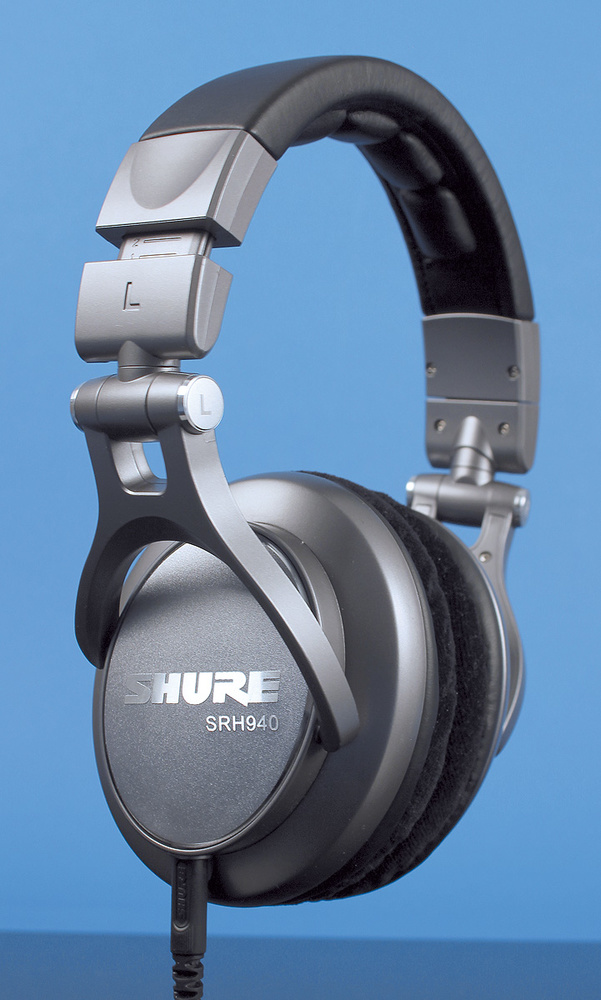
Shure are perhaps better known for their microphones than for transducers that work in the opposite direction, but their SRH series of professional headphones, launched two years ago, promises to change all that. The original flagship model in the range, the SRH840, is still available but, as the model number suggests, the new SRH940 sits above its forerunners in the product range. Designed for studio use and critical listening, they promise “accurate response across the entire audio spectrum, smooth high‑end extension, [and] tight bass”.
The SRH940s ship in a smart, padded case. Both cable and earpads are detachable, and the package includes spare earpads and a choice of straight or curly cables. These terminate in a 3.5mm mini‑jack with a screw thread allowing a quarter‑inch adaptor to be fitted, while the other end uses a smaller, 2.5mm mini‑jack with a plastic barrel that twists half a turn to lock into place. The phones themselves appear to be solidly built from a firm grey plastic, and the frame and earcup mountings incorporate plenty of flexibility, allowing the cups to be rotated in every conceivable direction, and probably some directions that are not readily conceived of.
The construction arrangement means that the cups exert slightly more pressure on and around the ear than some phones, but they are well padded and comfortable enough for long listening sessions, and this pressure ensures that isolation from external sounds is pretty good. For me, the only suggestion of discomfort came from the top band, which has a tendency to load the entire weight of the phones onto a small point on top of the head instead of spreading it out, but I suspect that has as much to do with the shape of my head as with the design of these phones. With an impedance rated at 42Ω and a sensitivity of 100dB SPL/mW, the SRH940s shouldn’t require any sort of esoteric headphone amp to drive them.
In Use
Various adjectives come to mind to describe the tonality of the SRH940s, among them ‘punchy’, ‘muscular’ and ‘forward’. They’re not rich and plummy like my usual Sony MDR7509s, nor do they share the crystalline high‑end brightness of the Ultrasone phones I’ve tried. Rather, they seem to have a broad lift in the mid‑range, from perhaps 1‑3 kHz, which brings out the snarl of an electric guitar or the ring of a snare drum without over-emphasising sibilants or making crash cymbals leap out of the mix. They’re perfect for rock music, or indeed anything else where the main focus is mid‑range impact and excitement. Transients are well represented, and the high frequencies seem balanced.
If there’s a down side, it’s that the bass is arguably a bit too tight. Whenever I turned to electronica, or indeed any mix that leaned on a heavy bottom end, I was struck with a gut feeling that something was lacking. It’s not that bass and low mids are absent or inaccurate; rather, they are slightly overshadowed by that prominent mid range, in a way that sometimes robs them of ‘oomph’. If you like bass to be an emotional experience, these are not the phones for you.
That said, we all know that reproducing sound to give maximum enjoyment is a very different business from reproducing it in a way that is useful to the mix engineer. And for most studio purposes, I think the frequency balance of these phones, with its ruthless absence of hype at the low end, is much more a blessing than a curse. Most mixes stand or fall on the mid-range, and you quickly appreciate the detail and clarity that these phones bring to that region. After a lot of listening, I even began to feel that my beloved Sonys were sounding muddy and veiled by comparison. I wouldn’t want to make dubstep on these, but for any sort of guitar‑based music, they’re hard to beat, and the good levels of comfort and isolation make them ideal for tracking as well as mixing.    0


Home | Search | News | Current Issue | Tablet Mag | Articles | Forum | Subscribe | Shop | Readers Ads

Advertise | Information | Digital Editions | Privacy Policy | Support

In this article:
Shure SRH940 £249$375
pros
Punchy mid-range brings excellent clarity and a dose of rock & roll excitement.
Replaceable earpads and cable.
Comfortable, with pretty good isolation from external noise.
cons
Tight low end won’t suit everyone.
summary
Shure’s new flagship headphones make excellent studio all‑rounders, especially if you work more with guitar music than bass‑heavy electronica.
information
£249 including VAT.
Shure UK +44 (0)1992 703058.
$375.
Shure +1 847 600 2000.

SOS Readers Ads
GRAB A BARGAIN

£846,184

of Second-User Gear for sale now — don't miss out!

AVI Neutron Five

2.1 Monitor System

Thumbnail for article: AVI Neutron Five

This interesting monitor system uses the natural roll-off of the satellite speakers to provide the crossover with the subwoofer.

Tannoy Reveal 601A

Studio Nearfield Reference Monitors

Thumbnail for article: Tannoy Reveal 601A

Building to a price inevitably entails compromises. The art is in choosing the right ones...

Quested V3110

Three-way Active Monitors

Thumbnail for article: Quested V3110

Sometimes, a dose of old-fashioned good engineering delivers something well worth listening to...

Adam A7X

Active Two-way Studio Monitors

Thumbnail for article: Adam A7X

Their A7 nearfield monitors received many plaudits, not least in the pages of SOS, but manufacturer Adam thought there was room for improvement.

PMC TB2S AII

Active Nearfield Monitors

Thumbnail for article: PMC TB2S AII

PMC broke new ground a decade ago with their TB2 monitors, but the competition have been catching up. Does PMC’s new ‘activated’ design nudge them back to the front of the pack?

Avantone Active MixCube

Secondary Reference Monitors

Thumbnail for article: Avantone Active MixCube

Avantone have added on-board amplification to their contemporary take on the classic ‘Horrortone’ secondary monitor, and the result is something quite special...

Sonodyne SM 50AK

Two-way Nearfield Active Monitors

Thumbnail for article: Sonodyne SM 50AK

India may be a growing force in most industries these days, but few Indian pro-audio companies have made it into Western markets. Can Sonodyne’s speakers change all that?

Unity Audio The Rock

Monitor Speakers

Thumbnail for article: Unity Audio The Rock

The time-domain response of monitors is often sacrificed for level, but this sealed-cabinet design tackles that issue head-on...

Infrasonic Blow 4D

Nearfield Monitor Speakers

Thumbnail for article: Infrasonic Blow 4D

With digital and analogue inputs, these small speakers from newcomers Infrasonic promise a lot for the money. Can they outperform their budget price tag?

Blue Sky Sat 8 & Sub 212

2.1 Monitoring System

Thumbnail for article: Blue Sky Sat 8 & Sub 212

If you demand brutal and revealing precision from your monitors, read on...

Barefoot Sound MicroMain 27

Active Three-way Monitors

Thumbnail for article: Barefoot Sound MicroMain 27

As well as a distinctive design, these huge nearfield monitors offer a frequency and time-domain performance that compares with the best.

Adam S3XV

Studio Reference Monitors

Adam make the leap to a three-way speaker design that seems to pay dividends in clarity and separation.

JBL LSR 2300

Monitor Speakers

Thumbnail for article: JBL LSR 2300

JBL have a reputation for clinically precise monitors, but this time they’ve come up with something a little smoother...

Equator Audio Q8

Active Monitors

Thumbnail for article: Equator Audio Q8

Coaxially-mounted speakers may seem a bit old-school, but there’s nothing wrong with the theory — and a touch of DSP can make them very modern indeed!

M-Audio Studiophile DSM1

DSP Reference Monitors

Thumbnail for article: M-Audio Studiophile DSM1

Built-in DSP extends the flexibility and usefulness of these capable speakers.

Event Opal

Studio Monitors

Thumbnail for article: Event Opal

Event’s new owners make some extravagant claims for these new high-end monitors, whose design is said to put quality first. Do they live up to the hype?

Samson Resolv A6 & 120A

Studio Monitors & Subwoofer

Thumbnail for article: Samson Resolv A6 & 120A

Samson’s new low-cost nearfields can produce a big sound, but do they measure up for serious mixing? We find out.

Prodipe Pro Ribbon 8

Active Monitors

Thumbnail for article: Prodipe Pro Ribbon 8

Ribbon tweeters can yield a smooth sound, while still capably reproducing transient detail — and the Pro Ribbon range promises to do so for an attractive price.

Focal CMS65

Active Nearfield Monitors

Thumbnail for article: Focal CMS65

Focal control everything from design to manufacture in their factory in France — and this approach appears to be paying off.

Klein+Hummel O410

Active Midfield Monitors

Thumbnail for article: Klein+Hummel O410

Getting the balance right between the benefits and disadvantages of ported and non-ported speaker designs is a tricky job, and K+H do it better than most with this ported model.

WIN Great Prizes in SOS Competitions!
 

Email: Contact SOS

Telephone: +44 (0)1954 789888

Fax: +44 (0)1954 789895

Registered Office: Media House, Trafalgar Way, Bar Hill, Cambridge, CB23 8SQ, United Kingdom.

Sound On Sound Ltd is registered in England and Wales.

Company number: 3015516 VAT number: GB 638 5307 26


All contents copyright © SOS Publications Group and/or its licensors, 1985-2013. All rights reserved.
The contents of this article are subject to worldwide copyright protection and reproduction in whole or part, whether mechanical or electronic, is expressly forbidden without the prior written consent of the Publishers. Great care has been taken to ensure accuracy in the preparation of this article but neither Sound On Sound Limited nor the publishers can be held responsible for its contents. The views expressed are those of the contributors and not necessarily those of the publishers.

Web site designed & maintained by PB Associates | SOS | Relative Media