

 Photo: Richard Ecclestone
There's a drum & bass revival going on, and London Elektricity are taking the genre in new directions — including live stages across Europe.
"The sound of drum & bass has really changed a lot," says Tony Colman. "When drum & bass started, around 1989-90, it was all about an Akai S900 and an Atari, so there was a lot less you could achieve, and the tunes were a lot rawer. If you bring it up to date now, producers generally have a massive knowledge of how to shape their tunes sonically, how to get everything really fat, and how to actually compose music. We're signing an artist at the moment called nu:tone who is a fully trained organ scholar, but he makes serious drum & bass, and it's not noodly. The thing about drum & bass is that there's an incredibly strong community, not only of producers but followers, and they integrate with producers."
Colman is certainly a pillar of this drum & bass community. He's the co-founder of specialist dance label Hospital Records, a respected DJ, and the writer and producer behind London Elektricity. Initially a studio project, the latter has now mutated into a live band, who at the time of writing are about to set off on a lengthy European tour. Colman's roots in the music industry reach beyond the birth of drum & bass, and it's no surprise to discover that he has previous form as a producer and musician in the '80s funk and acid jazz scene. As well as an unfashionable enthusiasm for playing live, this broader musical background is apparent in the construction of most of the tracks from London Elektricity's 2003 album Billion Dollar Gravy: the breakneck tempos, whipcrack snares and soulful double basses are all present and correct, but they're often welded to surprisingly traditional pop song structures.
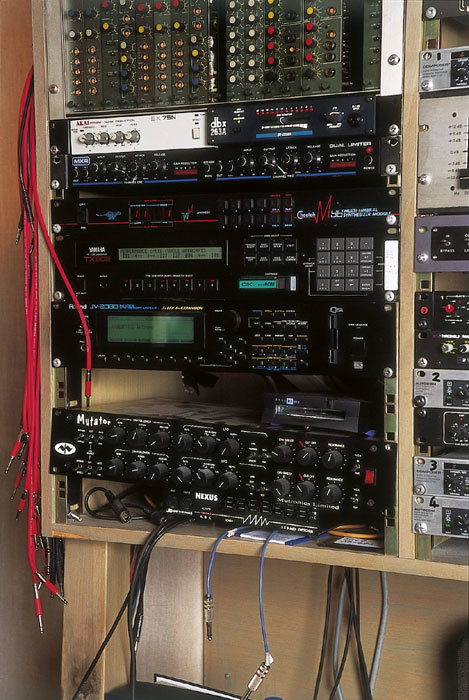 Some of the outboard in Tony Colman's studio (from top): Scamp multi-purpose outboard processing modules, Akai EX75N noise reducer, Dbx 263A de-esser, MXR dual limiter, Cheetah MS6 rackmount synth module, Yamaha TX802 FM synth, Roland JV2080 sound module and Mutronics Mutator filter bank. Photo: Richard Ecclestone"Having been a songwriter all my life, I find it hard to break out of that," admits Colman. "In some ways it's a strength, in some ways it's a weakness for the dancefloor. It's a constant battle when you're making dancefloor music but you've written a song for it. Does it work on the dance floor, is it going to work at home? That's hard work to get right.
"For instance, there's a track on there with [singer] Robert Owens called 'Different Drum'. I'd written a sketch and wrote the song for him, went round to his flat and taught it to him, and he came down and laid the vocals down over the sketch. There followed a tortuous three months trying to get the music to sound right. It's basically an 'Amen' tune — using the classic 'Amen' break, which is the old-school jungle break — and I wanted to use that break with a full song. It's almost like a full gospel tune, really. That was definitely a struggle.
"I normally start off with the germ idea of the tune, which is usually a sample. It could be a sample that I've created, or it could be a conglomerate of slices of chords from different albums, or whatever, and I build the tune up around that. I usually start with a kernel musical element, and I build the drums and the bass line around that. If it turns out to be a song, then once I've got a sketch, I'll write to it, and usually I'll be sitting at the keyboard to do that. Then the songwriting process takes over, and then I'll go back in on the original groove and start to mutate that to fit the song that I've written. That's when key changes will happen and I'll bring in different samples or whatever."
The Sound Of Sequencers
Ever since sequencer programs began to add audio recording to their lists of features, debate has raged about whether different pieces of digital audio software sound different. On the one hand, there are those who maintain that this is impossible, that two different programs playing back the same stream of numbers through the same D-A converter must always sound the same. On the other, there are those who swear they can hear a difference. Tony Colman is firmly in the latter camp. "Nuendo was a revelation to me," he explains. "I don't normally get carried away about software — I've been a Cubase man since the Atari days, and when I discovered Nuendo it was what I wanted because it sounded better than Pro Tools, but it's got the most amazing functionality. It's almost as easy to automate as Reason.
"When I got it, we had this theory that all programs made audio sound different, so we sat down and we put some Villa-Lobos in, and some Ry Cooder, really hi-fi music, in Cubase VST, the Reason sampler, Pro Tools, Nuendo, Logic, Recycle, just to see, and the differences were quite amazing. You need to sit down and do it in a controlled situation. They've all got different audio engines, so they all sound different. So far, Nuendo has come out tops. Pro Tools is hi-fi, but Nuendo does sound quite different from Pro Tools, even using the same hardware, same computer, everything.
"Cubase VST, not SX, is actually really good for drum & bass, because it adds a certain hardness to the sound. It's not 100 percent hi-fi, but it adds a certain something to it which really gives it added punch. On a couple of tunes on the album, I had done them in Nuendo, but they were sounding too 'bling' and not rough enough, and I put them into VST and they got a kind of roughness, even without using the EQ — just from playback. Reason is an amazing piece of software, but a complaint that some people had about it is that sounds disappear in it. There's a compromise in Reason because the file size is diminished — you put an audio file into it, and when you save it as a self-contained file which includes all the audio data, it's smaller. There is a sonic compromise which enables them to get so much power out of a modest processor, and you do lose stuff in there.
"While I was making this album it was getting stupid, because there's tunes that have been done completely within Reason, there's tunes done in Reason and output into the desk, there's tunes that have been done in Nuendo, and tunes that have been done in Reason Rewired into Nuendo, and Cubase. I took so many different routes to achieve the end goal on each tune. For me, this album was all about learning about this new software."
Real Drums & Bass
Unlike some dance producers, Tony Colman works out of a studio that's fully equipped for live recording, with separate live areas. This gave him the luxury of not having to rely solely on samples for the drums on Billion Dollar Gravy. The first problem was finding the right drummer. "I know lots of drummers who could play drum & bass, but they're not really angry enough. However, I was lucky enough to meet this guy called Chris the Jungle Drummer, who was introduced to me by Nicky Black Market, one of the don DJs in drum & bass, who runs Black Market Records. He said I had to check the Jungle Drummer out, and I'd never seen anything like it — if you imagine Billy Cobham had grown up listening to jungle and hip-hop, that's what he does.
 Tony Colman's studio. The live area is behind the DDA desk; equipment racks are to the right, while Roland Juno 106 and Access Virus kb synths are visible to the left.Photo: Richard Ecclestone"To get live drums to sound live and fat enough is very difficult, because it usually sounds like a funk drummer. Luckily, the Jungle Drummer plays so hard, it's like John Bonham. We did some of the drums in the live room with fairly basic miking — kick, snare, toms, two overheads and random mics in the room, which is what I like to do, feeding it through whatever I've got here, making it sound good on the day. I record onto ADAT and then mix down at leisure. To get a totally different sound I put the drums in the lobby — you get a really wicked, claustrophobic, boxy sound — and we've got a shower room through there which gives you a really nasty stone sound. He's got two snares, and you need that with drum & bass because you've got the main backbeat and all the ghost notes. Apart from that it's a fairly standard kit, it's not a huge kit.
"You have to turn it into loops, but what I like to do is, if there's one really good performance, to try to keep the quantise from the original performance, because that's what makes it unique. You choose all the best parts of it, check which ones roll the best, you might need to do a bit of Recycle-ing and shifting things around, but that's the best way. The way we work with Jungle is that we set him up and basically play other people's records to him, and he'll just play along to them, because that's what he's used to doing in a club situation. For some of the tunes on the album I already had one or two elements sketched down, which I'd play to him, but a click's a no-no. It's not exactly inspiring."
In The Racks
Tony Colman's studio has something of a history behind it: it achieved some fame under previous owner Steve Parr, when it was called Hear No Evil, and before that, as Rooster Two, had a reputation as one of the few affordable 24-track studios in London in the '70s. Tony still has the mid-'80s DDA desk from Hear No Evil days, and a collection of outboard. Now that most of his recording and sequencing is done in the Apple Mac, however, this equipment gets used more for its sonic peculiarities than out of necessity.
"I inherited the Scamp with the studio," he explains. "It's a really old budget outboard unit with compressors, ADTs, gates, chorus, EQ and stuff. It sounds crazy. A lot of them are broken, but the ADT still works, you get that real bucket-brigade analogue double-tracking which can sound really nice on bass tones. The MXR limiter sounds wicked on bass. It's really noisy, I don't know what it does, but I use it on bass lines a lot. My MIDI stuff isn't getting used so much any more apart from the Yamaha TX. It's all about FM bass lines, you can't get a better sine wave for garage bass lines, it's brilliant — particularly if you need to put in some sub-bass underneath to fill up the whole spectrum.
"The 'Trouper Series' limiter is my secret weapon. It's a limiter that was built for a PA, and on bass lines it's fantastic. It gives a real graininess to the bottom end. It's solid-state and really noisy, but it's part of my sound now. The Manley sounds wicked on drums and vocals, the Dbx is a brilliant compressor, I use that on almost everything. It's fantastic on individual parts and over a mix. The Lexicon PCM41 delay has a really nice sound. Very good for dub delays and stuff like that. You can do the old trick where you route it back on itself via the desk and filter the loop so you get that real Studio One-style delay, progressively cutting out all the bottom end and boosting the resonance. The Sherman Filterbank is no good on bass, but really good for those strange bleepy effects that come in and out of tunes, you can just sculpt sounds with it and it does things I haven't heard any other filter do. The Space Echo is indispensable.
"I still use my Casio FZ10M, mainly because I haven't transferred the library over into the computer. It was my first ever sampler, and I still really like some of the sounds. I paid £120 for the 1MB memory expansion! There's all sorts of loops in there from my early days on floppy disks. The Bosendorfer piano in there sounds amazing — really."
Lurking on the table is a less familiar piece of '80s technology: "This is a Fairlight Voice Tracker. I haven't figured out how to use it yet. I even tracked down the manual off the Internet, but I still can't make it work. I think they only built about 200 of them — it's a voice-to-MIDI unit, though I don't know why anyone would want to build a voice-to-MIDI unit. I've been plugging stuff into it to see if it does anything else to sound, but nothing yet!"
Going Live
 More outboard (from top): 'Trouper Series' PA limiter, Behringer Composer compressor, Klark Teknik graphic EQ, Manley mic channel, Dbx 166 stereo compressor, Valley People gates, Behringer Autocom compressor, Drawmer LX20 dynamics and more Behringer compressors. Photo: Richard EcclestoneFinding the Jungle Drummer, and a chance offer of a live session for BBC Radio One, gave Tony the idea of developing London Elektricity as a full live act. "I'm a live music fanatic," he says. "Most electronic acts that go live are slave to a click, and that kills it for me every time. I've never seen a show that I've enjoyed where the drummer's got headphones on, I'd rather either hear a completely live band or a DJ. So the challenge with London Elektricity live was to get a drum & bass act that smashed it but had no click. With the drums and the bass it's kind of easy, because the Jungle Drummer sounds like a mental 'Amen' break anyway, and we've got an amazing bass player called Andy Waterworth on upright bass. The difficult bit is the samples — what do you do to take it live? Basically, what we decided to do is Recycle everything. A lot of the tunes have got filtered loops — there might be an orchestral loop that's very rhythmic, and over time it gradually needs to filter up and then close. So how do you do that live? Well, we Recycled everything, and we've both got five octaves each, just covered in different REX files, and we're like human sequencers. It's like being in the Philip Glass ensemble or something, but it works, because it means that the band can speed up or slow down. You don't normally see that in dance music — we'll be in the middle of a drum & bass tune, and we'll suddenly cut into garage tempo or drop down to hip-hop, but still maintain the fatness that having all the samples gives you.
"As a producer, for it to be properly live, you've got to let go of all your control over the music. I think this is why a lot of projects that are born in the studio and then taken on the road just end up sounding like the record. It's because the producer, who's probably part of the band, doesn't want to let go of that control. But if you don't let go of the control, how can anything really exciting happen?"
Mastering Drum & Bass
As in most specialist dance genres, vinyl is a crucial medium for the drum & bass producer, and when Tony Colman finishes a London Elektricity tune he'll often produce different mixes for record and CD. "The process I've ended up doing, which quite a few people do now, is like this: when you finish a tune, you cut it onto a dub plate and play out, and then if you're sure about it you give it out to other DJs on plates, and it's normally over-mastered. You have to make it too fat, fatter than you would for a commercial release, because when people are cutting dub plates it's like 'Bung it in, cut it, walk out the door.' It's done really quickly, and you've got to make sure that what you're giving them is really loud. Otherwise it won't sound good off a plate. So you want to do exaggerated mastering for dub plate.
"You've got to go easy on the bass if you're making vinyl. You've got to remember that DJs do have control over the EQ, and most systems are enhanced on the bottom end anyway, so it's much more about clarity in the bottom end than weight. It's about getting the spaces right in the mix, so you do that dub-plate version, and then when it comes to the album, for example, I do different mixes for the vinyl and the CD. They may be structurally the same, but they'll be sonically different, because different things work on CD than on vinyl.
"I master all the CDs here using Nuendo, though I also put some tunes onto tape at the end. Some tunes I didn't put onto tape, because I didn't think they needed it. I generally like to go onto the Revox if the tune's still sounding a little bit mechanical or brittle. That may just be to make myself feel better, but I think it works, it adds a certain amount of low mid-range compression and distortion, and it definitely warms the track up. I've had the Revox for years and the heads are really mashed up, but it sounds good. I still take drum & bass tracks down to Metropolis, where we master, on quarter-inch sometimes, and they always get annoyed because they have to wheel it out. But if there's a tune that's been made just in a computer and it's sounding a little bit empty, you can totally transform it if you stick it on tape."
Getting On With It
 Tony Colman's aged Revox B77 stereo reel-to-reel recorder.Photo: Richard EcclestoneOnce the hottest thing on the planet, before fading from view behind the rise of UK garage, drum & bass is now undergoing a serious revival, and Tony Colman is in the vanguard. "It's become a mature genre of music, like hip-hop is," he says. "When any genre starts there's a flurry of activity and it's the latest thing and the music press jump on it — but in England, the music press will jump on something, big it up, and then try to kill it when they've got nothing else to write about. One year it was 'It's all about jungle,' the next year 'Drum & bass is dead,' but now they're all into it again. So you just have to get on with it really." With upwards of 30 tour dates in the books, Billion Dollar Gravy in the shops and a busy release schedule planned for the Autumn, that's exactly what Tony Colman is doing.