

 Jim Sutherland in his Edinburgh studio.Photo: Ruth Barrie
Recent years have seen a revival in back-to-basics recording techniques, but few engineers or producers have taken things as far as Jim Sutherland did with Edinburgh folk-pop band Aberfeldy...
The debut album from Scots indie popsters Aberfeldy, Young Forever, has all the ingredients of a classic Rough Trade release. It's full of charming, catchy melodies and deceptively simple songwriting with a laid-back pop sensibility, whilst the sensitive arrangements centre around acoustic guitar and loose-but-tight vocal performances, embellished with fiddle, organ, glockenspiel and a smattering of retro synth sounds. But for the average Sound On Sound reader, there's nothing really remarkable going on here: it's just a straightforward studio recording from a promising new band. Until, that is, you find out that it was recorded in mono, in one room and on one microphone.
The Life Of Riley
So when I spoke to Young Forever 's producer, Jim Sutherland, my first question (immediately before 'how?') was 'why?'. "I'm always working on several projects at once," says Jim, "so there are always lots of different people popping in and out of the studio. Riley [Briggs, Aberfeldy's lead singer and songwriter] was one of them, and I wanted to get the ball rolling on a project based around him and his songs. I got some other friends to come in, just to see what was going on.
"We started multitracking the songs, but it didn't really capture what was special about Riley. There's something special he has when he's sitting with his guitar and he sings. Maybe he kind of gets off on something to do with the resonance of the guitar, I don't know, but it certainly makes him sing better, and that was what I really wanted to capture. So I thought 'We'll just demo these songs for now,' and bunged up a mic. That was kind of the beginning of it all.
"Those first one-mic recordings were just for ourselves, really, but I felt there was something really worth pursuing in them. They had real atmosphere, and I thought it would really great to be able to create the standard of production that people are more used to hearing these days and also retain the atmosphere that you get when a bunch of people play in a room together."
Inspired by the sound and feel of their initial demos, the newly formed group were coming round to the idea that a whole album really could be made this way. But the decision was also tempered by Jim Sutherland's own views on how the multitrack recording process influences the way that much modern music is created. "On lots of records these days, somebody'll play some drums and somebody else'll come along and put down something else, then they'll send the tapes to New York... And it's cool that you can do that kind of thing, send stuff over the Internet and so on, but actually getting a bunch of people to sit down in a room and interact with each other is also pretty incredible. And that's an element of music-making that we can tend to forget. There's a feeling that musicians have when they're right in front of each other that you just don't have when you're sitting in a booth."
Making The Band
This, of course, is how all records used to be made — the group would go into the studio, stand in front of the mic, cut the record and then leave. But the Aberfeldy project was not simply a return to the old way of doing things. For one thing, when Riley Briggs walked into the studio there was no record and no band: both were formed in the studio. What's more, the musicians brought together for the project, recruited Magnificent Seven-style from friends and acquaintances on the Edinburgh pub music scene, had little or no previous studio experience. Jim Sutherland's varied career, which has seen him being signed to Sony as a songwriter, to Columbia as an artist and writing music for film, theatre and TV, includes a background in Scottish folk music, but he confesses to little experience of traditional one-mic recording. For both band and producer, then, making the album in this way was a new experience.
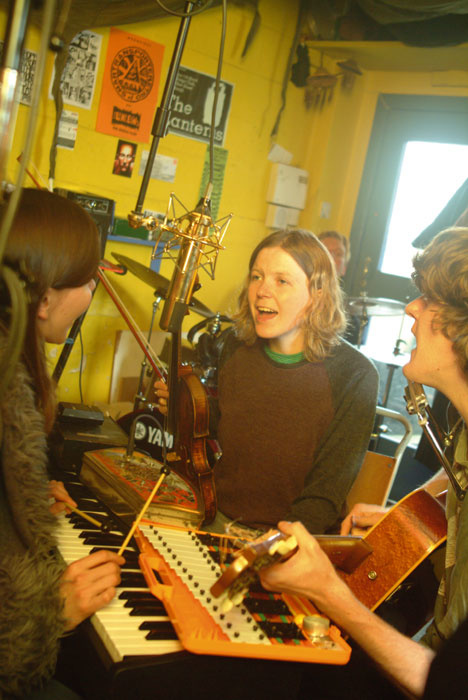 With only a single mic used to capture all the instruments, distances between the performers and the microphone were critical.Photo: Alan Mcready
Getting a suitably polished finished product would be far from straightforward. One thing that made that goal seem feasible enough to make it worth proceeding was Jim's realisation that although he couldn't mix the recording or replace individual parts within it, he could nevertheless achieve an awful lot in post-production. Dynamics processing, and multi-band compression in particular, allowed him a degree of control over the recording, and he's effusive in his praise for the Waves Masters Bundle plug-in suite. "I'd just started using the Waves gear and I found it incredibly useful — I couldn't have done without it really. I used the phase-linear EQ, followed by the multi-band and then the L2 limiter. The multi-band compressor is amazingly transparent. It's also phase-linear so there's no messing about where the crossovers are, and I found I was able to adjust the balance of the mix without any of the usual compression side-effects. I could totally sit in the snare transients whilst keeping the vocals at the front of the mix. Being able to focus in like that on five different frequency ranges of a one-mic recording almost lets you mix it!"
Jim also found out that although everything would be recorded on one mic, he could still edit the takes. "I'd been playing around with the demos we'd done and realised that it was possible to combine bits of different takes as long as I was careful about where I made the edits. I couldn't retune the vocal and whatever else, but I don't want to be doing that anyway — that's not really what music is about for me."
Colour Coding
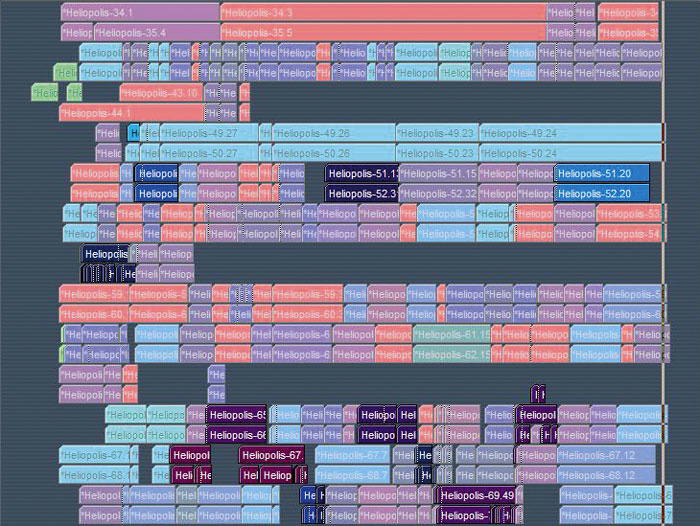 Jim Sutherland used Logic's colour-coding facility to identify the best parts of each take.
Jim Sutherland edited all of the tracks on the album in Logic. "I don't know how many people use Logic's colour scheme the way that I do. Most people just go, 'Right, I'll colour the drum track red, the bass blue...' and so on, and I do that as well. But I also have a particular colour scheme that I use for editing. The version of Logic I've got lets you colour in individual parts of the track differently, so I can go through each take and mark up which sections are good or bad and so on. Being able to do that is great because, instead of making copious notes, a year later I can go back to that track and I immediately know what's what and I can do a re-edit.
"Generally, I was working around one master take and just nipping in out of other takes for the odd word or line. Most of the finished tracks probably include sections from three or four different takes. It was really important that the band had stuck to the arrangements we'd decided on and worked so hard on playing consistently from take to take during the recording. If they hadn't, it would have made the editing even more difficult."
Although each take was a pair of tracks — one for the mic and one for the DI'd bass — in general they were treated as if they were a single track. "The bass was kept together with the mic track for pretty much all of it. Occasionally I would have a couple of notes from the bass part in one take hanging on under the take it was going to, so the edit points on the mic track and bass track would be very slightly staggered. I think it's good not to edit everything in the same place. For example, I might edit the microphone recording on a good, hard edit — just before a cymbal or a kick drum, say — then I'd edit the bass a little further on, so you'd have some continuity in the bass to keep it smooth."
With sometimes as many as 15 takes to go through, and as many as 30 edits in a single track, editing was a laborious process. "Yeah, the recording was the easy bit! Not for the band, of course — they end up doing lots of takes, but musicians often end up doing lots of takes. I don't know if it's possible to hear any edits, but I don't think so. It's hard for me to tell because, obviously, I know where they are!"
Finding A Balance
For the recording itself, the signal chain couldn't have been simpler: a Microtech Gefell UM92IS mic, fitted with a vintage Telefunken EF86 valve, went straight into a preamp in Jim Sutherland's ageing Yamaha 02R mixer then straight into Logic, running on a PC, recording 16-bit audio. While Sutherland is well aware that this setup is hardly state-of-the-art, he's unrepentant: "Let's be honest, a straightforward 16-bit recording using a nice valve mic, straight into a computer — there's nothing wrong with that." Indeed, he maintains that the most important factor in a recording of this kind is not so much the equipment you use but the room you record in. Thanks to comprehensive acoustic treatment (see box), his small studio space proved up to the job.
But while the room's well-balanced acoustics would clearly be an ally in the recording process, many other obstacles still stood in the way. Perhaps the biggest challenge was achieving the right balance between the instruments, which included a lead vocal, two backing vocalists, acoustic guitar, bass, a full drum kit, violin, glockenspiel, synths and, on occasion, a trombone too! Needless to say, arranging the instruments around the microphone was a lengthy process. "We spent hours figuring out the best positions for everything. This project has taught me so much about mic positioning, or, in this case, people positioning! I guess you can think of the microphone as being like a camera, and the mix comes together a bit like the way a photographer composes a wedding photo.
"The mic was set up towards one end of the room. Riley sang between six inches and two and a half feet away, moving in and out depending on his dynamics. He was also playing the guitar at the same time and had to be careful not to move it too much. Sarah [Macfadyen] and Ruth [Barrie] were in a triangle around the mic with Riley. They played a variety of instruments — including violin, glockenspiel and keyboards — and sang backing vocals. They had to really work to get the balance, leaning right into the mic when they were singing."
Recording the bass through the same microphone proved more problematic: "We tried to record the bass acoustically through the mic but we just couldn't get it to balance with the other instruments and still sound good. When it was clear that it wasn't going to work we decided to just DI it. But that wasn't really a compromise — the project wasn't about doing a one-mic recording to make some kind of point. It was about trying to get something that sounded good." So, in the end, bass player Ken McIntosh's basses — sometimes an upright electric bass and sometimes a conventional electric — went straight into the desk, though he was standing close enough to the mic that some string slap and fret noise could still be picked up.
As you might expect, the drum kit was placed some distance away. "With the drums, volume was always going to be a problem. The kit was set up around eight or nine feet away from the mic. Ian [Stoddart], the drummer, had a difficult job and did it very well. He had to control his dynamics whilst playing much more quietly than normal. There was a huge pressure on Ian as a drummer. A lot of the songs are quite delicate, and he was at a distance from everyone else. But I think he did a great job, especially in terms of being consistent."
In addition to modifying his playing, Ian had to modify his kit with all manner of damping apparatus. Jim, a percussionist himself, pulled out just about every trick in the book. "We had to try and bring down the level of the drums without changing their sound too much. We covered the top of the snare in cardboard and then, to get some of the initial attack back, taped a bit of plastic — one of those plastic CD blanks you get at the top of a stack of CD-Rs — on top of that. Of course, every couple of takes that would break and have to be replaced. We went through hundreds of the things! I taped coins to the bottoms of the toms to shorten the ring a little and to stop them ringing on every snare and kick. It's bad enough having all that mid-range washing about under normal circumstances, but with the single mic, it would have just destroyed the guitar sound. We stuck loops of gaffer tape to the undersides of the cymbals, too. If you just tap a cymbal, it makes a noise, but we had to make it so you could get power and attack out of the cymbals and play quietly at the same time. As for the bass drum, it actually sounded pretty much OK. We just added a bit of damping around the edge to kill some of the higher, slightly honky frequencies and that was it."
The sound of the kit on the album is impressive, especially if you consider that some people use five mics on the drums alone and end up with a less satisfactory sound. Again, Jim feels the room acoustics played a big part. "I think the drums sound great — quite big and fat, even though they were so far from the mic. That's the great thing about having a fairly dry room that's so even through the frequency spectrum — you can be a little further away from the microphone and it still sounds close."
 Only battery-powered amplifiers were used for the electric instruments, and included this home-made 'biscuit tin' amp.
Besides these acoustic instruments, the electronic keyboards used on the album — a Roland SH101 synth, a Travelpiano electric piano and a retro Charlie electric organ — are a key element of the Aberfeldy sound. "One of the problems we had was dealing with hum from the keyboards. I started off plugging them into proper amps [in this case Sutherland's beloved but aging Selmer Truvoice and Vox AC30 guitar amps], but when you add it all together you just end up with a racket. It sounds like a live band in a rehearsal room and that's no use!" The solution was to use small battery-powered amps, and adjust their volume and distance from the mic to blend in with the other instruments. "Ken brought in this fantastic battery amp he had built using a biscuit tin and an old Archer amp. We also used a little Dübreq battery amp which is pretty old. Ian was playing my Korg Wavedrum as part of his kit for some of the tracks, and that went through a battery amp too. There's no problem with hum with the battery amps and they really give the keyboards a certain character that they wouldn't have had otherwise. We did end up using the Selmer in the end, though. For the synth lead on 'Heliopolis At Night', we put the SH101 into it via an old Melos delay unit — I think that's about the only effect we used on the whole album!"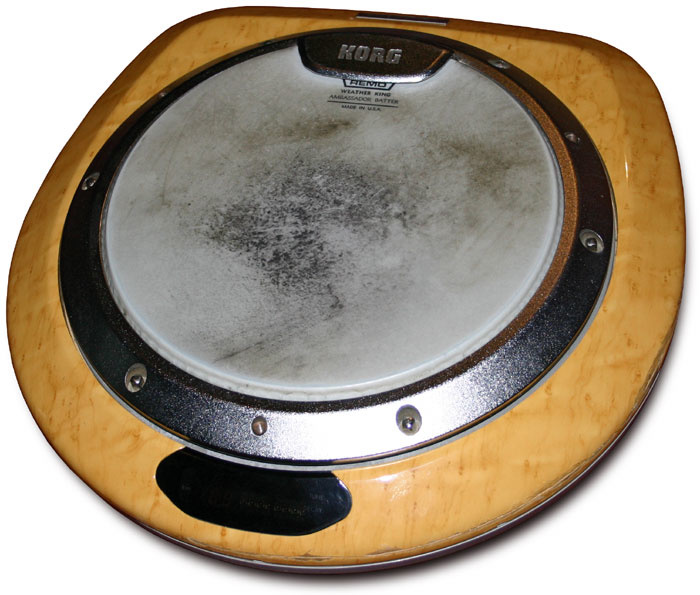 As well as a full drum kit, additional percussion included the Korg Wavedrum.
All Spill
Once a workable setup had been established, the process of arranging the instruments and musicians became less time-consuming. And it would be fair to say that time spent before recording began was time saved in post-production. For one thing, when you record with one mic, there's no mixing to be done, and it would take a good deal of time and no small measure of skill to mix a multitrack recording to sound as cohesive as Young Forever. "I guess in some circumstances people see spill as a real problem, but in this case, it was all spill! The sounds mix together naturally in the room and everything seems so much more connected — the room's acoustics act as a kind of glue for the sound. But that only goes for what was being recorded. When you were just in the room it didn't sound right at all. There was a real leap of imagination required on the part of the players, because, for them, it just sounded like a pile of nonsense. The drummer's way over on the other side of the room, the bass is being DI'd, everyone's facing different directions — it all sounds different depending on where you are in the room. The only perspective where it actually sounds anything like a mix is the perspective of the microphone, and what I have in my headphones.
"Ken, the bass player, had to wear headphones too so that he could hear what he was doing — he'd maybe have one headphone on and one off — and sometimes Ian, the drummer, would wear headphones as well, but no one else did. They could have all worn headphones, but I think it would have broken up that atmosphere and connectedness that I was trying to capture. I also found that, with Riley, when he was singing with headphones he found it more difficult to pitch the notes. I think it's the same with a lot of people, though you can get used to singing with headphones. But the way we did it, the three vocalists were right in front of each other, with no barriers between them.
"But there was an awful lot of faith required. They all worked really hard on being consistent — how hard Ian hit his snare, how close the singers were to the microphone, how they were holding their instruments — while not really being able to hear how it was all coming together. I did play back the tape from time to time, just to reassure everyone and so we could see how we were doing, but I didn't want to break everyone's concentration. We had to be confident in the arrangements too, because, obviously, they couldn't be changed later."
The Sutherland Sound
Jim Sutherland's studio, a fairly small rectangular room in a block of artists' studios just off Edinburgh's Royal Mile, has received extensive acoustic treatment. "There's no point going out and buying a great microphone — which the Gefell is, by the way — if your recording room sounds shit! My friend and collaborator Nick Kinloch and I planned the studio together and we worked very hard on the acoustic treatment, particularly for the mid-range and bottom end. Neither of us had ever done anything like that before so it was all a bit Heath Robinson — entirely Heath Robinson in fact! Having said that, it worked out very well."
The pair found the exact resonant frequencies of the room by playing a sine wave on a synth through a bass amp and noting down the notes which made the room 'ring'. Nick Kinloch then set about building some broadband absorbers and some Helmholtz mid-range traps, precisely tuned to these frequencies. The wedge-shaped traps, constructed from wood and half filled with rockwool, have holes or slits cut in them as dictated by the Helmholtz equations. The traps were hung from a dado rail which runs along the length of the walls, so that they could be moved and rearranged to find the right positions. A large bass trap, more broadband absorption and two large softboards, set at an angle to break up and absorb reflections, were attached to the ceiling and hidden by an old army parachute.
The pair also constructed a small vocal booth along one wall, which didn't find a use on this project. "I don't really use the booth — we did a great job of insulating it and it's really dry — too dry almost, right the way through the frequency range. It's great for voiceovers and things like that, but not really for music, whereas the room sounds great."
Keeping The Atmosphere
Building and maintaining this confidence and concentration was a big part of Jim Sutherland's job. "When you've got five different people sitting down to record like this, you have to get everyone to focus together and leave everything else behind. Whenever you go to the studio it's a bit like that anyway, whatever kind of recording you do. But in this situation it was especially important — with one mic, everyone has to do a good take at the same time. If someone had an issue or a problem it had to get dealt with. There was nothing major — we're all good pals, which was a great help — but sometimes tensions were running very high. People would get frustrated, or someone might come late — I had to be right on top of all those kind of things. Somebody coming late could be a major issue, because you totally lose the atmosphere if you're all just waiting around for one person.
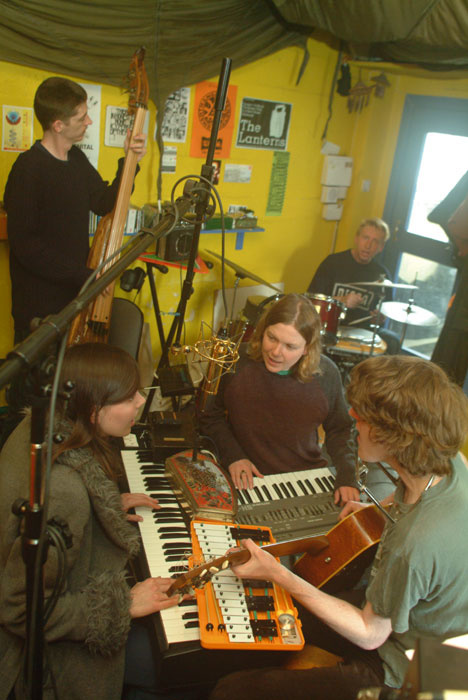 Aberfeldy in mid-take around Jim's Microtech Gefell valve mic.Photo: Alan Mcready"I tried not to put too much pressure on them in the early stages, but I'd have them in place, getting used to the slightly odd sitting positions they had to be in. Sometimes Riley would have to tilt his guitar up-the-way, for example, at the same time as trying to keep his distance from the microphone right for the vocal. So it wasn't easy on the band, who didn't have much experience of working in studios anyway. But I think the fact that people ended up in positions that weren't necessarily always comfortable for them had a psychological effect. I think it possibly makes you less nervous about playing when you've got to think about all these other things. And there's an incredible focus from having the one microphone — it's like having an audience. Everybody's united in their approach to that microphone.
"Riley had an especially difficult job, because he was the lead singer. Sometimes we'd record all day, starting at 10 in the morning, and there are certain tracks where we did 20 or more takes, so by the time the band were coming together and really sounding great, Riley'd be knackered. The rest of the group would be just beginning to peak and Riley would be on the edge of going over the other side. That's a real feature of the one-mic recording — you've got people right on the edge of that a lot of the time and you've got to keep them there. You're trying to get everyone to hit it at the same time, and that's exciting! It makes for exciting music too."
Although the aim was to keep the atmosphere focused but relaxed, even the producer was feeling the strain. "It was dead nervy! There was this incredible tension in the room. On some tracks I was playing a few bits of percussion — things like small bells and crotales, just to brighten up the top end. I'd be sitting by the desk with my headphones on, trying to keep an eye on everything and feed information back to the band, but also joining in as well. So there was as much pressure on me as anyone. You could be close to tears sometimes — any one of us could've been. But then you get to the end of the song and it's absolutely bonkers! It's a brilliant feeling.
"We established kind of a rule that I was the only person who could stop a take, because most of the time a wrong note or a word that you couldn't quite hear wasn't really a problem because it could be edited out. Tempo wasn't too much of an issue either, but then, as I've said, we had a very good drummer."
Although a take might start with a click or a count-in, playing to a click track throughout was out of the question. "You might think that you couldn't edit two takes together unless they've been played to a click, but, unless they're just miles apart, you really can. In the same way that I was saying singers can get used to using headphones, some drummers can play pretty well to a click track, but mostly you end up with these weird, rigid, careful performances. But when a drummer's just playing along with the rest of the band, and he plays a fill, he does speed up a little bit. In fact, the whole band will speed up and slow down going in and out of a chorus. There is some come and go in the tempo of natural playing. And, in a way, that's why some of the editing was made easy, because within the tracks there was a natural breathing of tempo, so you could find places, like on a fill, where it actually feels quite natural for the track to speed up slightly.
"I guess you could say that not having headphones, or a click track, or the safety net of multitrack parts and retakes made it harder for the band, but the musical benefits were huge. The way I look at it, it made it easier for them to play like a group of musicians and get a real good performance down."
Plate Polish
Once the finished tracks had been edited (see box), they were lightly treated with an old EMT gold foil plate reverb, a true mechanical plate reverb which used stretched gold foil plates instead of steel to achieve the same effect from a smaller plate. Jim Sutherland then took them to his friend Callum Malcolm's studio in North Berwick for a final polish. "We didn't have to do much, to be honest. It was more a question of getting the levels right from track to track and going somewhere else to check them on another set of speakers. I'd used the Waves L2 already and squashed things as much as I wanted to squash them. There were a couple of tracks that I took back a stage in terms of processing to change a few things — that's the beauty of working on a computer.
"That's the thing: the way we made the record wasn't supposed to be the antithesis of modern recording — we incorporated lots of modern techniques and technology — but the emphasis was on the music and the musicians. I think it would be great if people thought a little more about what their options are and didn't just throw away the past. I mean, this was recorded on one microphone, in 16-bit, in mono!"