

 Photo: Mike Cameron
Computer specifications have changed radically in the three years since Carillon launched their first music PCs, but the company's signature metal rackmount case still sets them apart. Their powerful Core 4 machine offers support for three monitors, plus a huge 400GB RAID 0 hard drive array for audio data.
I first reviewed a Carillon music PC in SOS July 2001, and the 866MHz Pentium III processor, 128MB of RAM, and single 20GB hard drive of that machine provide a reminder of just how rapidly PC technology moves onwards. However, the company's custom-designed rackmount case has stood the test of time, and I suspect will still be going strong for many years to come, its 2mm-thick steel sleeve making it one of the most rugged designs available.
Carillon have recently expanded their range to include cheaper tower case systems from £599, miniature shuttle systems from £669, and both Centrino and desktop replacement laptops, but the core of their range is still based on the AC1 (Audio Computer) rackmount case. Models in the AC1 range start at just £699 for the AC1 LE and move up through the Core systems 1, 2, 3 and 4 with faster processors and more hard drives. There are also more specialised machines such as the blue-panelled AC1HD — the only Digidesign HD-certified audio-specific PC in the world — and the AC1X, fitted with dual Xeon processors.
Core systems can be supplied without music hardware and software, but you can also select these on-line to add to your system before it's delivered, or choose from various pre-configured solutions for applications such as sampling, beat and loop creation, and recording guitar-based music. The subject of this review is the Core 4, which is the fastest single-processor PC in the range, fitted with a 3.4GHz P4 processor, 2GB of RAM and three hard drives: an 80GB EIDE model for system use, and twin 200GB SATA models set up as a RAID 0 array for audio purposes. With a Matrox P650 triple-head graphics card, a versatile DVD-RW writer and the usual Carillon extras, it has an impressive spec.
Heat And Noise
Because components such as the 3.4GHz processor and P650 graphics card generate a lot of heat, the Fanmate controller in the Core 4 is turned up beyond the minimum setting adopted by many retailers on other systems, while the AC1 case has large side intake vents that let some of the fan noise out, so it's not the quietest PC I've ever used. However, this system has the huge advantage that the majority of users will bolt it into a rack, which would render the remaining side and rear fan noise virtually inaudible, so in practice it will be blissfully quiet.
After some hours in active service, the processor stabilised at a slightly hotter than normal 57 degrees Centigrade, so the Fanmate controller setting seemed wise. I was however a little concerned at the 320 Watt capacity of the PSU, and while I ran into no problems during the review period, I think a 400W model might be more appropriate for a system fitted with three hard drives and a DVD burner.
Closer Inspection
The AC1 rackmount case was as impressive as I remembered it, and considerably sturdier than any PC tower case. Its aluminium front panel offers up to three 5.25-inch drive bays and two 3.5-inch ones; the three internal hard drives and NEC DVD-RW drive already fitted meant that only one of the (5.25-inch) bays was still free in the review system.
The handy extras are still there, including the modular front-panel options for transport controls or MIDI controllers, Sorbothane vibration-damped feet for desktop use, and the front-panel stereo jack Patch socket, which is routed through to an identical rear-panel socket so you can have permanent front-panel access to your choice of audio I/O. Carillon only sell this case as part of a complete PC system.
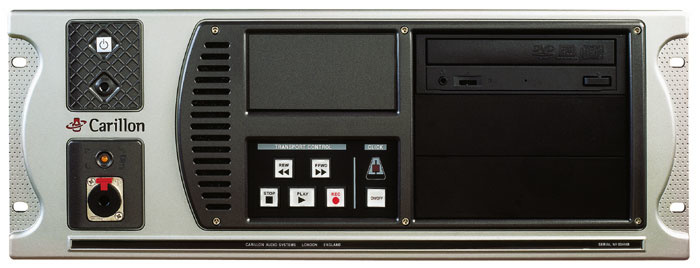 The Carillon AC1 case features built-in transport/MIDI controls, and an audio socket which is patched through to the rear panel.Photo: Mike Cameron
Inside, the interior was extremely tidy. Carillon are still staunch supporters of Intel's own motherboards, and while these may not have the range of overclocking features favoured by some enthusiasts, Intel boards are renowned for their rock-solid stability and reliability, which is far more important for the serious musician. The D875PBZ board fitted in the Carillon PC is well laid out, has a massive passive heatsink on its Northbridge chip set rather than a fan, and the various connectors are positioned such that there's still plenty of space left around the most critical component — the CPU.
In this machine a 3.4GHz Pentium 4 had been fitted, along with Zalman's popular Flower cooler. The cool air intake is provided by twin side vents, while a 80mm case fan sits adjacent to the CPU to extract the warm air via an adaptor tube to the 60mm exit grille. A 320 Watt version of Carillon's own Ultramute brand of quiet PSU completed the power and cooling arrangements.
The D875PBZ has one AGP and five PCI expansion slots. A Matrox P650 triple-head graphics card had been fitted in the AGP slot (see box) while PCI slot three housed a Conexant Systems 56k modem card. Many specialist music retailers don't fit modems to their music PCs, but Carillon rely on one for their Carillon Fix service (see Carillon Extras box). Slot four housed a VIA Technologies Firewire Controller with two six-pin and one four-pin Firewire ports, overcoming the lack of integral Firewire support that is this motherboard's only real limitation. Six USB 2.0 ports appear as standard on the rear panel, a total that's reached on many PCs only by installing a dummy backplate and thus losing a PCI slot. The motherboard supports eight USB 2.0 ports in total, and one of these was used for the optional RTM1 Transport Panel (£69) with its five large positive transport buttons and metronome clicker, which I described in detail in my original Carillon review. The remaining ports are one serial, one parallel, PS/2 mouse and keyboard, and LAN.
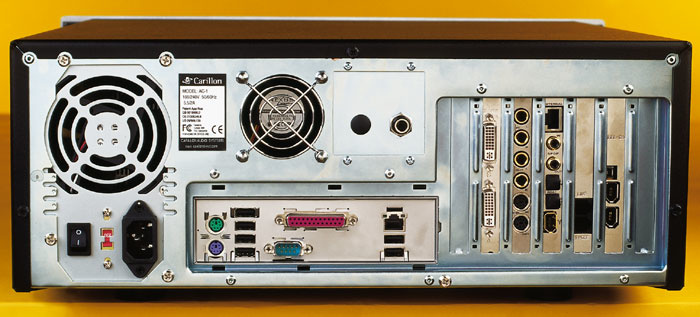 The Core 4 provides six rear-panel USB ports without using up a PCI slot, although there's no integral Firewire support on the Intel motherboard, meaning that a PCI Firewire card is included.Photo: Mike Cameron
The BIOS is proprietary to Intel, and while there are few overclocking options, there are still plenty of performance-related tweaks on offer for those who wish to delve deeper. Carillon had left hyperthreading disabled for maximum compatibility, but are happy for users to enable it if they wish, which I later did for my CPU tests. There's no onboard audio chip to disable on this motherboard, and for the review model Carillon had fitted one of Emu's new 1212M audio interfaces, with its 1010 PCI card in slot two and 0202 daughterboard in slot one. This left only slot five empty for future expansion, but the Emu cards do provide a Firewire port, so you could probably do without the separate Firewire card if necessary.
Drive-wise, there are two ATA100 headers and two SATA 150 headers on the motherboard. Carillon had fitted Seagate Barracuda hard drives throughout, with an 80GB PATA model connected as Primary Master for System duties, and a pair of 200GB SATA models connected as a RAID 0 array for audio work. All three drives had been fitted into Silentdrive sleeves inside a robust internal cage, using a small modification to accommodate the two SATA connectors.
In the topmost 5.25-inch drive bay a black NEC ND2500A DVD-RW drive had been fitted and connected as EIDE Secondary Master. This is apparently the first writer to manage 8x DVD-R and 4x DVD-RW speeds while also supporting DVD+R and DVD+RW formats for maximum compatibility, as well as providing good CD-R writing quality at a good price. Carillon had disabled the floppy drive controller in the BIOS, as no drive was fitted, and I suspect few users will miss one.
Finally, for the purposes of this review Carillon also provided me with three Viewsonic VP181b flat-screen monitors, along with Steinberg's Nuendo 2.0 software, so I could perform some practical tests of the P650 graphics card's triple-head capabilities (see box).
Matrox P650 Triple-head Graphics Card
For this particular system Carillon had fitted a Matrox Millennium P650 graphics card. Unlike its Parhelia stablemate, this model doesn't require a cooling fan, but still has dual-head support for two monitors with up to 1920 x 1440 pixel VGA displays, or 1600 x 1200 with digital connections. Moreover, once fitted with the upgrade kit (a one-foot DVI-to-dual-HD15 splitter cable) it provides triple-head support for the ultimate three-monitor display setup. Matrox unveiled this combination at the 2004 NAMM show specifically for audio professionals, and it's a good sign that we're being taken more seriously by the PC component industry.
With one or two monitors connected you can use any combination of analogue or digital models, with the added versatility that the second connection can also be to a TV or video recorder. With three monitors the first can again be digital or analogue, but you need to connect the dual-monitor adaptor cable for monitors two and three, which restricts them to analogue or TV. This latter restriction is slightly disappointing when you've been sent three digital-capable monitors, but it did give me the opportunity to compare the analogue and digital connections — the difference was subtle but noticeable, with the digitally connected monitor image being slightly sharper and clearer, but I managed to minimise this with a tweak of the analogue contrast settings.
The Matrox P650 also has various multi-display setups including a 'feature' option when using more than one monitor, accessible via the Matrox Powerdesk-HF utility. I could run the three supplied monitors as one 'Stretched' mode display, all using the same resolution and colour depth, which is ideal if you want to run your sequencer with a wide two-monitor arrange page and its software mixing desk on the third monitor. Alternatively you could choose the two-display Stretched mode for the sequencer, and use the feature display switched to PureVideo/DVDMax mode to run full-screen video in the third display. This could be ideal for anyone writing film or TV music, and worked really well with Nuendo. Finally, the two-display Independent mode lets you specify a different resolution, colour depth and relative virtual position for the first two monitors, and use the third as feature display. The Matrox card also provides a hardware-based video overlay feature to reduce CPU overhead when playing back digital video.
I also found the Multi-Display Zoom functions very useful. You can select any region in your main monitors and display a larger version in the feature screen, either leaving the original region fixed or having it move with your mouse — very handy to create huge audio level meters, for instance! There are also numerous other smaller features such as the ability to decide where dialogue and message boxes appear, to avoid them being split across two screens. I was well impressed with the Matrox P650 from a musician's point of view, and apart from the one-digital-plus-two-analogue restriction mentioned earlier, the only negative point I could find was that the P650's heatsink became the hottest item in the entire PC, forcing the system cooling fans to work a little bit harder.
Performance
As expected, all the tweaks for optimum Windows audio performance had been carried out; with 2GB of RAM, the page file had wisely been set to a custom Initial size of 2GB, with a Maximum size of 4GB. SiSoftware's Sandra test suite measured 4765MB/second and 4763MB/second for Integer and Float memory bandwidths, showing the slight performance boost of Intel's PAT technology over Asus' Hyperpath equivalent, which it beat by just a few percent.
However, for most musicians running loads of plug-ins and soft synths, the single most important parameter is likely to be CPU performance, and this 3.4GHz P4 system measured 34 percent with the Steinberg/Fivetowers performance test with 23ms latency in Play mode, and 41 percent at 4ms latency. These figures dropped to 33 percent and 38 percent once I'd enabled hyperthreading in the BIOS, all of which tie in fairly closely with the expected improvement over my own P4C 2.8GHz system dictated by the 21 percent increase in clock speed.
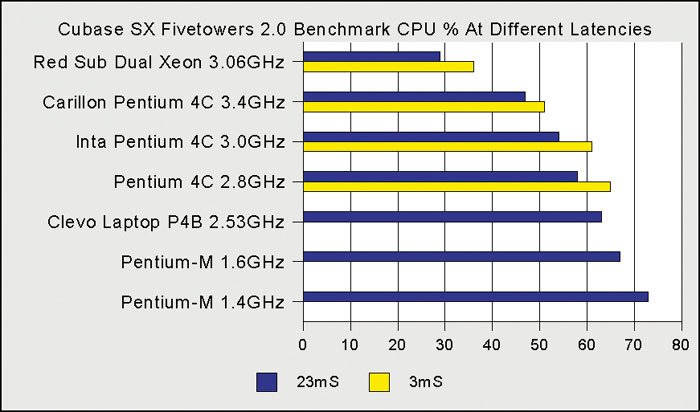 Carillon's Pentium 4C 3.4GHz PC is the fastest P4 system I've reviewed to date, and its result sits exactly in line with other P4C systems of different clock speeds, beaten only by dual-processor setups based on Intel's Xeon.
With the HT left enabled, Sandra 's CPU Arithmetic benchmarks measured 10477MIPS Dhrystone, 3444MFLOPS Whetstone, and 7428MFLOPS for iSSE2, while CPU Multimedia measurements were 26074it/s integer and 37157it/s floating-point. Once again these results tallied quite closely with my own 800MHz FSB 2.8GHz system multiplied by 3.4/2.8, proving that the increased performance is solely due to the higher CPU clock speed — in other words, you get about 21 percent better performance than a 2.8GHz P4C system, and about 13 percent more than a 3.0GHz P4C system. If you want even faster CPU performance then Carillon now have dual-Xeon systems in their range.
The PATA hard drive had been split into a 10GB C system partition, with the remaining 65GB or so devoted to a D partition for audio sample data, both being formatted with FAT32. Dskbench measured 55.6MB/second sustained read and write speeds for C and a slightly slower 50.3MB/second for the inner D partition. However, on this system I was far more interested in the results for the SATA RAID E drive, where the sustained read performance was a staggering 124.2MB/second, and the write a still-amazing 95.0MB/second, giving a potential 412 16-bit/44.1kHz playback tracks with a 128k block buffer size, which equates to 126 tracks at 24-bit/96kHz. Real-world figures are likely to be rather lower than this theoretical figure, but you ought to get a hundred tracks with few problems.
To complete my findings, I got on well with the cordless mouse/keyboard pair, even up to distances of three to four metres away from the base unit, although I did find the scroll wheel a little 'scratchy' in use, and due to an oversight someone at Carillon had mistakenly stuck the wrong overlays on the left Shift and Windows keys.
Specifications Of Review PC
- Case: Carillon AC1 4U rackmount, with die-cast aluminium front panel, 2mm thick steel sleeve and 320W Ultramute PSU.
- Motherboard: Intel D875PBZ socket 478, with Intel 875P 'Canterwood' chip set running 533/800MHz system buss, with four DDR DIMM sockets supporting up to 4GB of dual-channel DDR333/400 DDR SDRAM.
- Processor: Intel Pentium 4C 'Northwood' 3.4GHz 512k L2 cache, 4 times 200MHz front side buss.
- CPU heatsink and fan: Zalman Super Flower Cooler CNPS7000-AlCu with Fanmate controller.
- Case cooling & silencing: Nexus quiet rear 80mm case fan.
- System RAM: 2GB of Infineon PC3200 CAS3 SDRAM, running as DDR400 dual-channel.
- System drive: Seagate Barracuda ST380011A, 80GB, 7200rpm, 2MB buffer, Parallel ATA.
- Audio drive: two Seagate Barracuda ST3200822AS set up as RAID 0 array, 200GB, 7200rpm, 8MB buffer, Serial ATA.
- Graphics card: Matrox Millennium P650 triple-head with passive heatsink cooling and 64MB RAM.
- Floppy drive: none fitted.
- DVD-RW drive: NEC ND2500A, ATAPI Ultra DMA 33 Mode 2 interface, 40x CD-ROM, 32x CD-R, 16x CD-RW, 12x DVD-ROM, 8x DVD+/-R, 4x DVD+/-RW, 2MB buffer.
- System ports: PS/2 mouse and keyboard, serial, parallel, RJ45 LAN, six USB 2.0, two six-pin and one four-pin Firewire, modem line and phone, audio patch socket.
- Keyboard & mouse: black Logitech cordless desktop with custom coloured key caps to match installed audio software, ball mouse.
- Installed operating system: Windows XP Professional Edition plus Service Pack 1.
For this particular system:
- Monitors: 3x Viewsonic VP181b Thin Edge Ultraslim, black, with 18.1-inch diagonal, 1280 x 1024 native resolution, 30ms response time, Xtreme View 160 degree horizontal and vertical viewing angles, DVI-I and analogue input connectors.
- Soundcard: Emu 1212M with version 5.12.01.0488 drivers.
Silk & Steel
Carillon's heavy-duty aluminium and steel rackmount case will never be a cheap item to manufacture, but it means that their PCs are undoubtedly among the most rugged systems around. They have achieved an excellent reputation for quality in the three years since their launch, yet their cheapest rackmount system is just £699; and while £2199 may sound expensive for a 3.4GHz Pentium 4 PC without monitor, music hardware or software, this Core 4 system features a huge 2GB of RAM, a powerful Matrox P650 graphics card and a versatile DVD writer, plus three hard drives totaling 480GB capacity. Where I managed to find any other specialist retailer who could offer a computer with a similar specification, the price ended up quite similar.
Although you can buy quieter desktop systems now that other manufacturers are using acoustic foam case linings, this Carillon Core 4 PC is an extremely attractive proposition for anyone who wants a reliable, desirable, and quiet PC to bolt into a rack, and it comes with an impressive list of extras including a 6GB sample library. It doesn't have the fastest CPU I've tested (that crown currently belongs to Red Submarine's dual 3.06GHz Xeon system), and it's fair to say that if your budget is over £2000 and you're aiming to run the maximum number of soft synths and plug-ins, rather than hundreds of audio tracks, a dual-Xeon system might suit you better. However, the Carillon Core 4's 2GB of RAM and amazingly fast and vast 400GB audio RAID drives make this system a perfect partner for someone who wants to run bucketloads of 24-bit/96kHz audio and sampler tracks, particularly with synchronised video alongside. Keep on tracking!
Carillon Extras
With every Core system Carillon provide a Pinnacle software pack consisting of the Instant CD/DVD suite of burning and backup applications, Steinberg Clean 5 restoration and CD/DVD burning application, Wavelab Lite audio editor, and WinDVD 4 player. All systems also come with the Carillon Fix software that enables one of their engineers to remotely diagnose problems on your PC (I described a sample session in my July 2001 review), plus a full backup of your Windows OS and programs in the D partition along with a bootable Carillon recovery disc to restore the backup if you ever need to return your PC to its original shipped state.
Carilon also go to great trouble with their documentation. There's a 16-page printed Getting Started Guide, while Carillon How is a system-specific help file that provides a handy socket-by-socket guide explaining how to connect up your audio interface and how to test your audio software with it. It provides a string of tutorials explaining various aspects of using them together, and has an extensive glossary of terms. Carillon Help offers a handy set of audio FAQs, plus details of their support web site's on-line help facility.
In addition, you get the Carillon Loopstation 6GB sample library already installed on the Audio D partition. This is a big improvement over the original idea of letting registered users download samples free from the on-line version of the library, although this option is still available, and its contents will be growing in the months to come. Previewing and downloading samples is easy thanks to the supplied Loopstation search engine software, which lets you search by instrument or style. There's a huge range of multi-part acoustic, electric and synthesized instruments on offer, as well as loads of loops in a variety of styles and tempos. These are all of high quality, and the library should prove a valuable resource to dance and rock musicians, although there are no choral or orchestral sounds.
Pros
- Impressive build quality.
- Fast and vast 400GB RAID 0 hard drive array.
- Massive 2GB RAM.
- Versatile DVD/CD writer.
- Free 6GB sample library.
Cons
- Very quiet in a rack, but noisier than some other PCs when desktop mounted.
- 320 Watt PSU must be running close to its limit.
- No floppy drive option.
Summary
With the largest and fastest audio drive array I've reviewed to date, triple monitor capability, DVD writer, and loads of RAM, this Carillon Core 4 system should prove ideal for any musician who needs to work with video and loads of audio tracks.
information
Basic system as reviewed (without monitors, music hardware or software) £2199 including VAT.
Carillon +44 (0)20 7692 7628.