

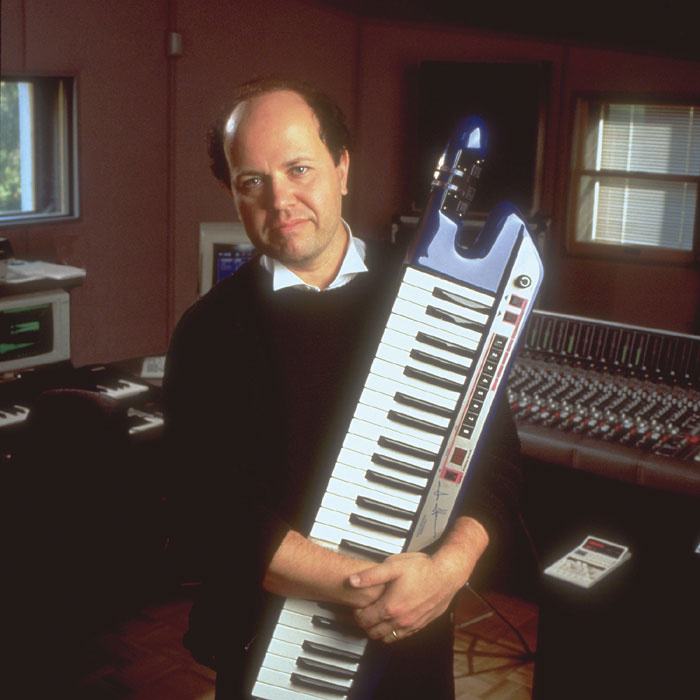
 This signature model Lync keyboard was created to meet Jan's requirements for a live performance controller. Photo: Mark McCarty
As a member of the Mahavishnu Orchestra, a composer for film and TV and a performer in his own right, Jan Hammer helped to define the role of the synth player in rock and jazz.
Born in Prague, Czechoslovakia, Jan Hammer began playing piano at age four and by the age of 14 was performing and recording throughout Eastern Europe with his own jazz trio. A scholarship at the Berklee School of Music in Boston prompted his move to the US where he became a citizen, but today Jan's name is far more closely associated with the synthesizer than with the piano. Indeed, it could be argued that Jan was almost single-handedly responsible for establishing the electronic synthesizer as a virtuoso performance instrument in its own right rather than as a substitute for traditional instrument sounds. Since 'going electric' Jan has played with a huge number of influential bands and musicians and has evolved a distinctive and instantly recognisable synthesizer style. Who can forget those wailing synth lines in Miami Vice or the seminal albums recorded with the Mahavishnu Orchestra and British guitar legend Jeff Beck?
Jan's project file reads like a Who's Who of music (Jeff Beck, Mick Jagger, Billy Cobham, Stanley Clarke, Tommy Bolin, Carlos Santana and Al Di Miola to name but a few), but a whole generation of TV viewers will remember him best as the composer and performer of the high-energy Miami Vice soundtrack with its thundering drums and searing, guitar-like synth lines. The theme hit number one on the Billboard Hot 100 Singles chart and picked up two Grammy awards. 'Crockett's Theme', from the series, became a huge hit in its own right.
 Numerous film and television projects followed, and UK viewers will have heard Jan's work on the TV series Chancer and more recently Red Cap. He's also done music for Tales From The Crypt and Knight Rider 2000 as well as a few major film releases. In January 2001, reruns of Miami Vice on US television made clear that there was still an audience for an album based on music from the series that had never been made available on record. Miami Vice: The Complete Collection was thus released in 2002 as a two-CD set, and Jan's 1975 debut album The First Seven Days has also now been reissued in a digitally remastered form.
True Expression
 So how did Jan originally make his transition from piano to synthesizer? "It was an ongoing process where the piano was eventually not enough. The piano is a great instrument, like an orchestra at your fingertips, but I was hearing things with more fluidity and more movement. I wanted the tonal quality of bending notes and adding vibrato and all that. I heard things that were more expressive in that sense — and you just couldn't do it with a fixed pitched instrument. So I played electric piano, organ and eventually the synthesizer. I got hold of one of the first ring modulators that allowed me to bend the sound of the electric piano in such a way that it hinted at some sort of movement, but at the same time I was hearing synthesizers on albums such as Switched On Bach. Even then, the synthesizer was being used more as an orchestral instrument rather than as a solo instrument, and even where glide was being used, it wasn't being used expressively like playing a violin or even a voice. When I first laid my hands on a Minimoog with its pitch-bend wheel, it was truly a Eureka moment — I thought 'Wow, this is it! This is what I'm looking for.'"
Most musicians associate the name Jan Hammer with the almost guitar-like synth tone that was used to great advantage on the Miami Vice theme music and underscores. Evidently much of this is down to controlling the pitch of the instrument using its pitch-bend wheel, but I wondered if there were any other special techniques or equipment involved. For example, was it necessary to play the synth through a guitar amplifier?
"I did all kinds of things, including playing the synth through a distorted guitar amplifier, but now all that can be done in software using things like Line 6's Amp Farm in Pro Tools so I don't use a guitar amplifier any more. Whatever I use, I'm going for the same end result — an exciting rock & roll-like sound. It really started in the Mahavishnu Orchestra when I was looking for something to cut through that incredibly busy sound that we were creating. I had to have a sound that would project, so I used guitar amps and that's when the sound got really exciting."
Just as many guitar players have traded in their huge stacks and racks of pedals for smaller, more technically advanced systems, Jan has also simplified his approach to recording and live performance. "For recording I use Amp Farm, though in the case of my Korg Triton Extreme, I use the onboard distortion effects. I've been using Korg synths for around 15 years now and the way their onboard effects are integrated is fantastic, to the point where I don't even use an amp on stage — I go straight out of the Triton Extreme into the PA and the sound is all there. On the current tour I'm doing with Jeff Beck, it's the only keyboard I'm using. I can set up my different sounds as keyboard splits or velocity switching and it does everything I need without the gymnastics of having to reach around multiple keyboards."
It's clear, then, that Jan is not a musician to get hung up on specific vintage instruments or even the analogue/digital divide. "All the hum and noise associated with analogue has been banished. Obviously it took a while for the digital sound to develop, but with modelling and the onboard effects, I think the new digital synths prove that digital sounds can have as much warmth and presence as analogue sounds. Between the Korg Z1 and the Triton, the sounds are all there for me. I'll occasionally use samplers when working on film and TV music, especially if I need some crazy loops or grooves, but mostly I use my Korg synths. When it comes to samples, I like things like Distorted Reality from Spectrasonics. A new patch can set you off writing a new piece of music — it's like the grain of sand that starts the creation of the pearl."
Going Soft?
When I met Jan he had a Mac G4 Powerbook setup in his hotel room, so I asked him whether he could envisage a day when he could tour with nothing but a master keyboard and a laptop. "It is definitely possible, but right now, for my peace of mind, I like hardware. I know that much of what goes on inside the hardware is virtual and runs on computers anyway, but there's something reassuring about a dedicated keyboard instrument.
"There are some extremely good software instruments and I particularly like the Access Virus plug-in that's available for Pro Tools. I use that a lot and it has a wonderful, solid sound. I've heard lots of other things that I've liked but it's hard to pick anything out specifically because I get such great sounds from the hardware instruments I'm using so I tend not to use many software instruments. As software processing goes, I like the Waves processing plug-ins and I have used their Maxx Bass to reprocess an album I recorded that I felt was lacking at the bass end, probably due to my monitoring environment at the time. I'm from the old school of outboard gear so I particularly like their Renaissance-series plug-ins and their new convolution reverb is just incredible. I use virtual effects much more than virtual instruments."
Given Jan's obvious fondness for Korg instruments, I wondered if he'd been tempted by their new Legacy Collection? "It's a bit too much like going back whereas I'm more interested in taking synthesis forwards — how far can this instrument take me? As much as I love the Minimoog — I have two of them — I tend not to use them any more. I don't have nostalgia towards everything old."
The Feel Of Wheels
Being a guitar player (or at least an owner who makes a noise with his possessions), I know how obsessed players are about the way their instrument feels and interacts with their fingers. By contrast, keyboards are basically levers with switches underneath, but performance controls such as wheels and joysticks allow the player to introduce a high degree of expression if they are used effectively. I've often wondered if keyboard players get as passionate about the feel of these performance controls as guitar players do about their guitars, and what happens when you switch between wheels and the joysticks.
"I used wheels on the Moog and the DX7, and even had wheels installed on some of the early Korg instruments such as the T3 because I couldn't deal with the joystick. It was the same with some of the portable synths I used because they often made them with ribbon controllers, which are completely useless, so I had to add wheels to those. Now I'm using the new Korg instruments with the new joystick design and getting better tactile feedback than I got from the wheels. In the studio I still use wheels for certain parts, but on this tour with Jeff, I'm using only a Triton Extreme and I'm very happy with it."
 A true supergroup: Jan Hammer (centre) with Jeff Beck, Ringo Starr and David Gilmour. Photo: Justin Thomas
While Jan obviously feels very comfortable with his present instruments, I couldn't help wondering what he'd ask for if he could influence the design of future keyboard synths. "I've always wanted a synthesizer that sounds as live as a string with all its convoluted cycles. A string is so dynamic, whereas a synth is so static, so you have to put flangers on it or some other processing to try to make it move and evolve like a natural sound. You try to make it respond like a living thing, whether you use velocity or aftertouch or whatever. I even tried one of those experimental keyboards where the keys moved sideways but that was too much — it was too easy to play out of tune if you put your fingers down and then they spread sideways a little. Keys were not meant to move sideways! I think that aside from mod and bend controls, velocity and aftertouch is about as much as you can do with the keyboard itself. The rest has to be done in software and it's getting better every year. I'm not in the business of thinking up new ideas, but when I hear it, I know what to do with it. I am the end user, not the designer, but I'm happy with the new instruments out there and I think modelling was the last big breakthrough."
These days, of course, synthesizers are predominantly associated with dance music, and virtuoso keyboard players are in a minority. Jan Hammer has no problem with dance music, but is disappointed at the lack of opportunity radio and TV provides for other styles of synth playing. "I have also produced dance music and I enjoy listening to some of it where there are stark sounds and imaginative programming, but with most of it there's a musician presence that's missing — where the musician has something to say," says Jan. "That used to matter, but now the concept of a solo is a no-no — they look at you as though you're from Mars — solos are distracting. They don't want anything with passion or anything that's burning, like the stuff we do with Jeff for instance. I think a market exists and I'm hoping that the Internet will prove to be a way of accessing that market by getting us back to the '70s FM radio paradigm, but it's still early days. The critical mass hasn't been achieved yet, but when everyone has broadband, I hope it will be different. At the moment, the music industry doesn't allow anyone who is musically inspired to be heard. There are only a couple of gatekeepers controlled by the big conglomerates and only three or four outlets for major, big deal music. Most people are barred from any access to it."
Sound & Vision
If the pop world is eluding Jan, the film and TV world is a very different story, as a brief visit to his web site at www.janhammer.com confirms — if I listed everything he'd done, there'd be no room left for this interview. His crossover from virtuoso keyboard icon to film and TV music writer interested me, as the disciplines involved seem very different to those needed to play with a band like the Mahavishnu Orchestra.
 Jan Hammer on stage in the 1970s.Photo: Scott Weiner
"Mahavishnu Orchestra was like the Olympic Games of music — higher, faster, stronger," says Jan. "It was all superlatives, so I wanted to back off and see what I could do with less. It was almost a visual approach, even though you don't see anything, but you can close your eyes when you are listening and imagine things. With my fist solo album, The First Seven Days, a lot of people heard it and thought about getting me to write music for visuals. At that time, all I had was a Scully analogue eight-track and I recorded everything the hard way, one track at a time. Now I use Pro Tools or Studio Vision depending on how much MIDI is involved.
"I've used Pro Tools from the very beginning, though I also use Opcode's Studio Vision, which was the first truly integrated MIDI + audio sequencing program, may it rest in peace! I'm very disappointed in what Gibson did to that product. I thought Opcode were the most exciting software company working in that field and they are sorely missed by many people. I'm still using the last version of Studio Vision on a Mac G4 dual-boot machine that I keep just for that purpose. But the Pro Tools MIDI side has developed enormously since the early days and as far as audio is concerned, they are it. In the old days, when you worked with multitrack tape, all the tracks were locked together in time, but now you can slip tracks, copy and paste — audio is arbitrarily movable. It means you can tighten up grooves and do incredible things. I don't agree with these people who say the sequencer is evil and only good for creating robotic music, because you can use it just like a tape recorder. It is nothing less, nothing more, and if you can play and have something musical to say, it will come out just the same whether it is on Pro Tools or on tape. Most of the people who make music today using copy and paste probably wouldn't have survived in the old days!
"When I'm recording, I tend to record my keyboard parts as MIDI, because if I have a great take but there's one dumb note in the middle, I want to be able to fix it and keep the great take. I play a bit of guitar and that goes down as audio, and if there aren't too many MIDI tracks, I might record the MIDI parts as audio when I'm done so I don't have to fish for the sounds next time — it's there."
From Stereo To Surround
Given that Jan is so immersed in film work, I thought he'd have some thoughts to offer on recording music in surround. "I have mixed some movie soundtracks where I monitored in surround via a Dolby matrixing system and then delivered a stereo master, but I'm not mixing in 5.1," he says. "I haven't being doing big-budget motion pictures so I haven't been asked to produce discrete surround mixes and it's not something I'm really interested in. When I did the music for the BBC Red Cap series, that was all in straight stereo. I'm not sure that surround will take off as a music listening format because I'm not convinced that the impact is as great as when we moved from mono to stereo. It's interesting, but I still think it's a bit of a novelty. It's more impressive for home theatre where you hear the aircraft fly over. I think it is much more interesting for hardcore classical music than for rock or pop where you want the music to hit you from in front. I'm not sold on surround yet and I don't think many home theatre surround systems are good enough for serious music listening anyway."
Home Sweet Home
With so much music to his credit, you might think that Jan spends most of his life in commercial studios, but nothing could be further from the truth. "I did all my records at home in my studio, which is a converted colonial New England house just north of New York City. I still live there, though the studio has since moved out into a purpose-built building in the grounds. Initially the studio was in the dining room, which we soundproofed and then we set up a control room next to it. This started with a Scully one-inch eight-track analogue tape machine, but by the time Miami Vice came round, I had a 16-track machine and later a 24-track. I was doing everything to tape, though there were some sequences set up on the Fairlight CMI which were also recorded to tape. I also had some early music programs running on an IBM PC — there was Roger Powell's Texture — but there was really no way to record all the MIDI parts in the way we do today, so all the keyboard parts were played in live. For the first year of Miami Vice, I didn't even have any sync setup so I just ran everything wild — I'd press Start on the video remote and then try to fly it in. If it didn't work, I'd have to start the take again. By the second year I got a proper SMPTE sync setup so it was all much easier after that.
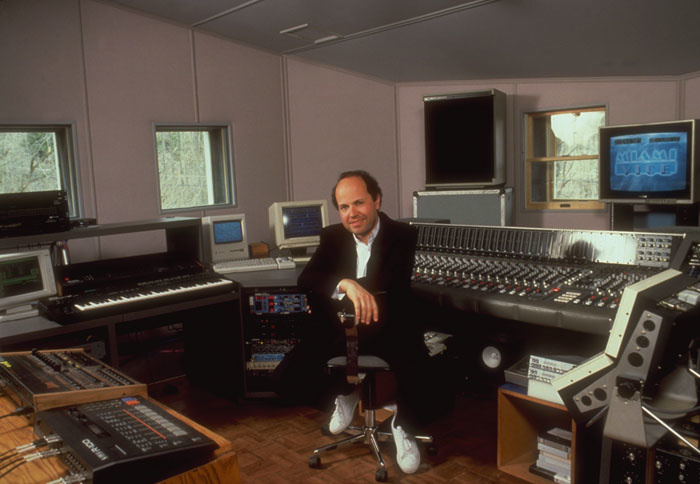 Jan in his studio, 1988.Photo: Ebet Roberts
"Gated drums were the fashion then, I suppose because of Phil Collins, and a lot of the sounds came from my own studio drum kit that were sampled into the Fairlight and then processed using heavy compression and gated Lexicon reverb. I still do all my own engineering — I'm very much a one-man operation really. I monitor for 80 percent of the time on NS10s because I'm used to the way they sound, though I also have a huge pair of JBLs the same as they used to have in the Trident studio, just to check out the bottom end."
Most of the Miami Vice soundtrack themes were not structured as complete pieces, so for the newly issued Complete Collection Jan had to write new parts, rerecord the original parts using his old Memorymoog and antique Fairlight, and in some case, knit cues together to create viable album tracks.
Swapping Roles
Currently, Jan Hammer is on tour with guitarist Jeff Beck, with whom he has played on numerous albums. It's an interesting partnership, because whilst Jan has often used synths to play guitar-like parts, Beck has developed some interesting playing techniques that make his guitar sound more like a synthesizer or Theremin, and the pair have now reached the point where, at times, Jeff is playing what appear to be synth lines and Jan is playing what sounds like a guitar part. "I think that is the secret to our compatibility," says Jan. "When we first met in 1973 we started talking and found we liked the same music, then he came to my house a couple of years later and we worked on Wired. It was amazing because I found I was going more and more into the guitar realm and he was doing some of those unique tonal things that he does that aren't quite synth-like and it was amazing. We almost overlapped into each other's worlds. Some of the things he does are unbelievable and I've no idea how he does it. I've never heard anybody else do it and he is just mind-bending — wonderful."
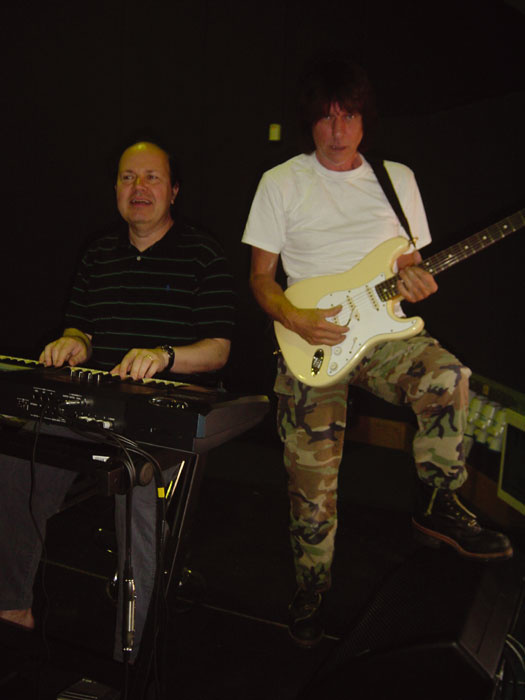 Jan today, in the rehearsal studio with Jeff Beck.
Did that mean their repertoire on the current tour was tightly orchestrated or was there plenty of room left for improvisation? "It's fairly organised — it's not a free-form fusion-fest. There are some tracks that Jeff did with Tony Hymas, a lot of my tunes and even one Mahavishnu Orchestra tune, so it's interesting. There are a couple of tunes where we can improvise rather more — places where we can let loose and the roof will come off — but overall the show is pretty structured and offers a lot of musical variety. There's no new material as such, but some of it is new for Jeff as we're playing arrangments of some of my album Beyond The Mind's Eye that he hasn't done before. On one of them, Jeff is actually playing a nylon-strung classical guitar, which is a first for him."
I was fortunate enough to attend one of the band's concerts at the Warwick University Arts Centre and as expected, it was exceptionally good, with virtuoso playing from everyone in the band and great front-of-house sound. Jan was clearly having a great time trading licks with Jeff Beck and even though he only had the one synth on stage, he swapped effortlessly between his hallmark lead synth sounds, tonewheel organ emulations and some nifty electric piano. He even had the sound of one of Jeff's hot rods being revved with some enthusiasm sampled into his keyboard for the opening of one number. Perhaps after the lonely confines of his studio, getting out on the road and playing is just what Jan needs right now, but he's destined to be back in his studio before long as he's been commissioned to write and record the music for a new feature documentary series about the rise of the cocaine cartels in Miami. This apparently covers the time period from the '80s up until the present day, so I think it's fairly safe to say that before too long, we'll once again be seeing boat chases through the Everglades accompanied by pounding drums and searing synth lines!