

Jim Abbiss decided to go back to basics and make records the way he wanted to make them. The result? The fastest-selling debut album in history...
Jim Abbiss has crept into the limelight in recent years as the producer behind a string of hit records. Most famously, he produced the Arctic Monkeys' Whatever People Say I Am, That's What I'm Not, the fastest-selling debut album in UK chart history. It's nominated for the 2006 Mercury Music Prize, as is another Abbiss production, the Editors' The Back Room. The man also co-produced Ladytron's Witching Hour (2005) and Kasabian's best-selling debut album (2004), and has worked with Placebo, Suede, Lamb, Unkle, Clearlake, Goldfrapp and more. In addition, he produced Kasabian's brand new album Empire, together with the band.
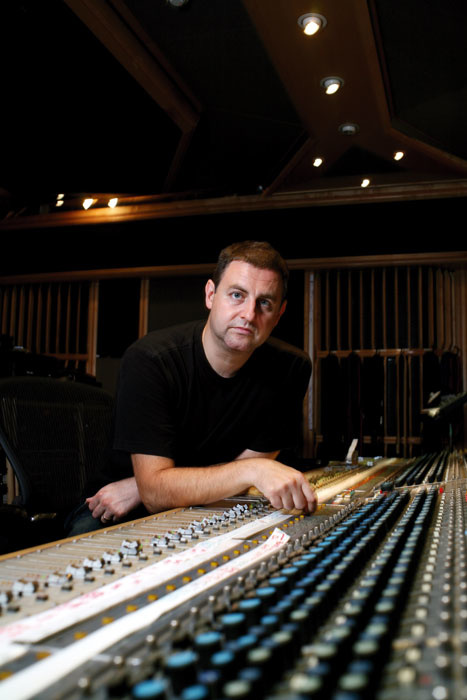 Jim Abbiss.Photo: Richard EcclestoneHowever, Abbiss's own profile has stayed relatively low, a situation he's happy with "because I consider what I do in the studio as the background to what the artists are doing. I loathe the way the industry has gone, with people justifying their roles as being more important than what we are all here for, which is somebody coming up with a great idea and getting that on a record. It's not about putting my stamp on a record. If I can help people to get their ideas coming out of a pair of speakers, so they want to race home and play it to their friends, that's what excites me.
"Apart from the songs, my main criteria in working with a band are whether that band has character and whether they believe in what they're doing. I can play a little guitar, a little bit of keyboards, a little bit of bass, I can program and I can write. But it doesn't inspire me to work with an artist whose ideas are no better than mine. I want to work with artists who I think are amazing, so to get the best out of them I have to raise what I'm doing as well. The Arctic Monkeys, for instance, are brilliant musicians, and Alex is a great singer. Like a lot of classic British bands, going back to the Beatles, they don't play complicated stuff when the singer is telling a story, but in the gaps in between they do really interesting stuff.
"I like working with young bands, because it takes me back to the excitement of when I was 14 and played in a band and wanted to get ideas on tape. Generally I find that young bands are more enthusiastic. They just want to see the red lights on and go for it."
Heading Into Space
Abbiss's exhortations reflect his musical beginnings — playing in guitar bands, getting into electronics, building himself a drum machine — as a teenager in the early 1980s. He felt inspired by the DIY approach of punk and "the original indie music explosion in the UK and early electro from the US". Finding that he didn't excel as a musician, he started work as an assistant engineer at Spaceward Studios in Cambridge, where Owen Morris, who would go on to produce Oasis, gave him his first grounding in the art of engineering.
 Photo: Richard Ecclestone
 "Almost all of the things that I own are toys for musicians to play with, like old tape delays, spring reverbs, weird guitar pedals, synthesizers and guitar synths." Jim Abbiss's toys include an Echoplex delay and Premier Powerpak drum synth.Photo: Richard EcclestoneAfter a year at Spaceward, Abbiss moved to London and climbed the ladder from teaboy through tape-op to assistant engineer at the Power Plant before becoming chief engineer at Maison Rouge. When the latter studio closed in 1990, Abbiss went freelance. For a couple of years he did "any session, just to pay the bills and get experience". He soon became successful enough to become more selective in who he worked with, and built up an impressive CV with credits ranging from Massive Attack to David Gray.
Yet by the end of the 1990s, Abbiss had that sinking feeling of his day job turning into drudgery. "I found myself doing endless sessions, some of which I didn't always want to do, and some I don't even remember any more. So in the late '90s I took a couple of years out from doing sessions to get back to writing and playing again, and signed a publishing deal with Chrysalis. It wasn't about climbing the ladder — engineering and mixing simply wasn't what I really wanted to do. I always wanted to be a producer. After having had a couple of years off, I came back to working in studios refreshed and looking for bands that I really wanted to work with and be more creative with."
Abbiss's change of direction instantly bore fruit with his involvement in Unkle's Psyence Fiction, which he calls a "watershed". He had joined the project for two weeks on the invitation of James Lavelle, and ended up working on it for nine months. In interviews, Lavelle and Unkle cohort DJ Shadow described Abbiss as Unkle's unofficial third member. "It was a fascinating project," remarks Abbiss, "and I found Shadow quite inspirational to work with. His attention to detail was incredible. For instance, he would want me to change the bass sound five times in a track. He did not know any technical terms, or how the desk worked, so he would ask for sounds that gave him a feeling. He'd say things like: 'When it comes to the middle section it should have the feeling of an aeroplane coming over and nearly deafening you.' The way he approached music made me completely rethink the way I did sound. The desk became a much more creative tool again for me."
Thinking Out Of The Box
Abbiss's involvement with Unkle, as well as the two years he'd spent writing, helped galvanise his ideas about how he wanted to work in the studio. "I've had four programming rooms over the years," he elaborates, "in which I did my own writing and a lot of dance music. But I got bored staring at a box. I realised that I was happiest in a studio with lots of equipment and being able to go with wherever the mood takes you and the band. Recording is supposed to be a creative process. Yet as an assistant I had worked on so many projects in which people would treat recording as a series of jobs. They would put up wall charts and it would be drums for three days and then bass for three days, and so on.
"That method is now taken even further, with people recording drums in a studio and then going into a small programming room in an industrial estate to do all their programming. I don't think anyone really enjoys that process. I understand that budget is a major issue now, but the idea of making a record is that people can interact with each other. I am not prejudiced against computers. I've spent years doing dance music. But the best use of my brain is not looking at a computer screen, it's getting musicians playing. Whether working with a drum machine or a band, people should be trying things and experimenting. Everyone can buy a computer and loads of plug-ins now, and that's great. I'm all for the DIY approach. But the result of everyone using the same equipment and the same presets is that many records sound the same.
"With the DIY approach in the past, people had many different collections of equipment, and they had to get the best out of what they had. They had to push what they had to its limits, whereas now you can buy a plug-in or effects bank with classic sounds, and it all kind of blands out. I find it depressing to go into a modern music equipment store, because every piece of gear there, whether a keyboard, or a drum machine, or a hard disk recorder, or a sequencer, will be have multi-effects, drum and keyboard sounds, a sampler, a microphone, and so on. They will have everything in them, and most of it is rubbish. That's not gear that interests me. What interests me is equipment that has been built with great care and has great character. This also means that I'll always prefer a dedicated hardware box over a plug-in."
No Monkeying Around
Jim Abbiss describes the setup he used to record the Arctic Monkeys' best-selling debut album at The Chapel Studio: "I had the whole band in one room, with the two guitar amps in a booth, and the bass amp in the corridor. All the musicians stood around the drums and had headphones and their own mini-mixers. For a few songs we baffled Alex, the singer, because he wanted to sing live, but for two thirds of the songs he just played guitar, and overdubbed his vocal afterwards.
"The microphone were pretty regular: AKG D112 inside of the bass drum; Elecrovoice RE20 outside of the bass drum; Shure SM57 on the top and bottom of the snare; Sennheiser MD421s on the tom-toms, again top and bottom; AKG C12s as overheads. There were a couple of tracks on which the ride or hi-hat needed to be a bit louder, so I had a Neumann 84 on each of them. I also placed an AKG C451 at the side of the snare drum, heavily compressed to give front end to bass and snare. We had a couple of room microphones up, but didn't use them much.
"For guitars I generally start with an SM57 and a Royer 121 together, placed slightly off-centre. It's the perfect combination: if I want to brighten the sound, I'll turn up the 57, if I want warmth, I'll turn up the Royer. This rather than EQ things. The bass went through my favourite amplifier, the [Ampeg] Portaflex B15, which is a beautiful valve combo, and it had a Sennheiser MD41 and I'll have a disused NS10 cone hanging from a stand, wired up to an XLR. Its frequency range is 20-30Hz to maybe 500Hz, which is good for picking up the low end of the bass. We used a Neumann valve M149 for the vocals, going through an 1176.
"Half of the microphones went through the Amek desk at The Chapel studio, the other half went through external mic pres, depending on what sound I liked. I used a Massenburg GML 2032 for the top-end stuff, because it sounds really clear, and the rest were old valve Telefunken pres or API's. Jamie [Cook] uses a really good Hiwatt 50 2 x 12-inch amplifier with a great spring reverb in it. A lot of his playing is very choppy, and the TG1 desk compression just brought that spring reverb up, which sounded fantastic. There's not a lot of reverb on the mix in general, it's all very straight and very direct. There's just a little bit of room ambience, and compression obviously brings up the tail end of the snare and so on."
Entertaining The Drummer
Having realised that he didn't like sitting in front of a computer screen, and that he preferred working with live musicians and hardware gear full of character, Jim Abbiss abandoned his programming room and focused on working at commercial studios, recording live in the studio whenever possible, and avoiding wall charts and note-taking. "I use a variety of studios," remarks Abbiss, "which makes it easier to stay inspired. Of course, the budget comes into it, and where a band feels comfortable is important. The first question I usually ask a band is whether they want to record in a city centre, or be locked away in a rural residential situation. Those things greatly affect how you work.
 Jim's favourite bass amp is the Ampeg Portaflex B15.Photo: Richard Ecclestone"I like to have the recording room set up for the whole band. There may be a few synths and effects in the control room to fiddle with, but for the whole time we're recording I have the entire band set up. This means that you don't have the drummer bored shitless after the first week, because he's got nothing to do any more. If at any point someone goes 'I'm not happy with the way we did so-and-so,' they can go and play it again. Everything is set up, and all we need to do is begin a new Session in Pro Tools, and have another go. But if you have invested a lot of time in organising things with wall charts and so on, you don't want to go back and redo things, because it's such a pain to do.
"With the whole band in the same room I try to make recording as much as possible as a performance. I always try to get a song to the stage where all main parts are recorded, including the vocal, before moving on to the next song. All the details may not be yet there, but when you put the song back on a couple of weeks later it makes sense as a song. Of course I do have a notebook, and when we feel that we need an additional part or something, I'll make a note of it. But I take less notes now than I have ever done, because when you put a track up again after you've had a couple of weeks' break from it, and everybody is there to listen to it, it will be evident to everyone if it needs something. And then you go and address it. And because everything is still set up, you can just try it there and then."
Monkey Tracks
The most famous beneficiaries of the Abbiss approach are the Arctic Monkeys. Whatever People Say I Am, That's What I'm Not was recorded over a period of 15 days ("one day per song, plus one day for setting up and one day for clean-up") at The Chapel Studio in Lincolnshire, by Abbiss and studio engineer Ewan Davis. The studio is about an hour's drive from Sheffield, where the band live. "It's a great studio for a live band and it has one of the best microphone and mic pre collections in the country," says Abbiss.
"I didn't do pre-production with the band," continues the producer, "because I didn't need to. I had seen them play a gig and they had done some recording with other people. So we discussed what they liked about demo and live versions of the songs. There was only one song that needed to be re-thought, 'Riot Van', because they changed quite a bit of the lyrical content and structure, and they were not sure how to go about it. But the rest of the songs were very well worked out, so it really was a case of them setting up and playing the songs through. They had done a lot of touring and were playing things very fast, so I generally tried to get them to play a bit slower, so you could hear the words."
As per Abbiss's preference, the Arctic Monkeys were all set up in one room and recorded very straightforwardly (see 'No Monkeying Around' box). "There was no trickery at all. It was very much about getting a sound that was punchy and gritty, and them concentrating on their playing and their performance." Everything was recorded to Pro Tools, which raises the question: didn't Abbiss aim to exclude computers from his universe?
"I love tape," the producer/engineer admits, "but it's just too time-consuming to use it. I use Pro Tools as a tape recorder, and for quick editing, very much in the same way people used razor blades years ago. I don't use things like Beat Detective, unless I'm desperate. I'll do several band takes, and will go through them and select the best sections from their best takes, so I don't need to drop in or do overdubs. The Pro Tools systems have become so much better in recent years that the sonic difference with analogue is tiny, and not worth the additional effort involved in using multitrack tape. I've always been more interested in the feeling you get from a piece of music and whether the take is great than with the technical aspects of things.
"My initial problem with Pro Tools and Logic when they first came out was that there was a perceptible difference between these systems and analogue tape. Let's face it, the early Pro Tools systems were bastardisations of computers with some hardware added that people had put together after a couple of years of development. That cannot be as good as 50 years of three or four major companies fighting to make the ultimate analogue tape machine. Not only that, analogue tape had other plusses, like tape saturation and hiss, that we grew to like. When I was mixing in the early days of Pro Tools I found that I didn't get the same depth of sound, whereas with tape it all seemed to glue together."
While Abbiss was happy to go down the modern digital route for recording, when it came to mixing he and mixer Barny ran into problems. "We were in Olympic Studio 1, which has a 72-channel SSL J-series, and it wasn't sounding right. We couldn't put our fingers on what it was, so we asked Olympic whether their old reconditioned 16-channel EMI TG1 desk was available. The desk is originally from Abbey Road, and has incredibly well-made early transistor circuitry. Per channel it has two tone controls, a compressor, a pan, and a line gain, and within an hour of getting some basic EQs it sounded much better than the SSL. Because we had only 16 channels we had to submix stuff inside of Pro Tools. It was very straightforward and all about the balance and not about mix tricks."
 Jim's vintage Oberheim OBXa synth.Photo: Richard Ecclestone
Editing The Editors
The sessions for the Editors' The Back Room were similar in many ways; it was also recorded at The Chapel, again with Ewan Davis sharing engineering responsibilities, and Barny mixing. There were, however, some important differences. "I was quite involved in the arrangements," explains Abbiss. "They had a lot worked out, but on some tracks they weren't happy with the demo or what they were doing live. For instance, the track 'Camera' was a straight-ahead fast rock tune, and they didn't think that worked. So we stripped it back to a four-to-the-floor, added an Oberheim OBXa keyboard drone, and then built it up from there. The OBXa and a Korg Mono/Poly were the only keyboards we used. The guitarist, Chris [Urbanowicz] only plays riffs, and he wanted a sound with a lot of character, so he used my X11 Korg guitar synthesizer to trigger a sound behind his riffs, resulting in a more soaring sound. We didn't want to overdub synth or other parts, because it ends up sounding too big and chorused."
 At work getting a new sound from a Roland RS09 synth.Photo: Richard EcclestoneJim Abbiss was credited with additional production and mix on Kasabian's 2004 debut album, but shares the production duties equally with the band on the brand new follow-up, Empire. (He also co-produced Kasabian's version of Bowie's 'Heroes', which was ITV's theme tune for the 2006 World Cup.) The recording of Empire took place over three and a half months at Rockfield Studios in Wales, and involved about every strategy in the recording book.
"The band hadn't worked out the entire album and arrangements before we started," says Abbiss. "There were some tracks that were maybe just an idea or a short demo, while other tracks were fully fledged songs, which then often evolved into something else. It was an ongoing process of writing, arranging and recording, sometimes overdubbing, sometimes recording the whole band together. We decided on a song-by-song basis what the best way was of doing things.
"Serge [Pizzorno] starts the songs on his guitar and creates demos on Cubase on a PC, programming drums and using an early Cubase soft synth called Neon. People haven't used it for years, but he knows it really well and gets fantastic sounds out of it. We transferred his Cubase demos over to Pro Tools, and quite often we found that redoing the main instrument from his demo didn't have quite the same feeling, so in many cases we used a crucial part of the demo. He does his demo on Cubase Audio on a PC. It is falling to pieces, but he knows it really well, and he gets good results out of it. It does not matter to me what people do demos on, I don't care what the equipment is, if it has a good idea, and it sounds good enough in the mix, then it stays."
Another unusual feature of the recordings was that Abbiss and engineer Barny set the band up in two rooms. "One was very ambient and the other very dead," explains the producer. "We had a drum kit set up in each room. The guitar and bass amplifiers were placed elsewhere, so they could jam in either room, with only the sound of the drums changing. We used similar microphones as with the Arctic Monkeys, although Rockfield have quite a few Neumann U67s, and we used a few of them. Rockfield also has a Neve with great-sounding preamps, and a rack with Rosser mic pres, and we used both. I also hired the TG1 and took it over to Rockfield and recorded the drums through that."
Software Versus Hardware
Jim Abbiss owns ARP 2600, ARP Axxe, Korg MS10 and Oberheim OBXa synths, and prefers hardware synths to the soft synth variety. "I think some soft synths are good, but I just have more experience plugging in synthesizers. Again it comes down to preferring that to having two or people sitting around a computer screen. Often when working out a part, it's easier to communicate with someone sitting behind a keyboard than working with a computer screen. Almost all of the things that I own are toys for musicians to play with, like old tape delays, spring reverbs, weird guitar pedals, synthesizers and guitar synths. I prefer to own those than pro audio gear, because I spend most of my time in studios that have decent audio gear. I do own some Royer 121 ribbon microphones, because not all studios have them. I also have a Smart compressor that's brilliant for putting across a mix or as an overall drum compressor."
Finding A Balance
According to Abbiss, a major difference between Kasabian's debut album and Empire is that on the former "almost every track was a combination of guitars and sequences, whereas the new album is very much an album of two halves. One half is more rock rock & roll, ie. traditional songs with guitars, and the other half is far more keyboard- and sequence-orientated. There are some bits where the two overlap, but the rest is almost done in two different styles. I loved David Bowie's Low, and the fact that on the second half of the album, once he has the pop songs out of the way, he goes off into this weird electronic territory.
"Between the band and I, we own quite a lot of synthesizers. In addition to Serge's Neon soft synth we used quite a bit of the old [Sequential Circuits] Pro One synthesizer, which is a great keyboard. I'm a big fan. We also used an old EMS guitar synth, the Synthi Hi-fly. It's a white, plastic, bulbous looking thing with 10 controls on it. Serge played the keyboard part on his guitar and it ended up sounding halfway between a guitar and a synth. Other keyboards that we used were the [Oberheim] OBXa and [Korg] Mono/Poly."
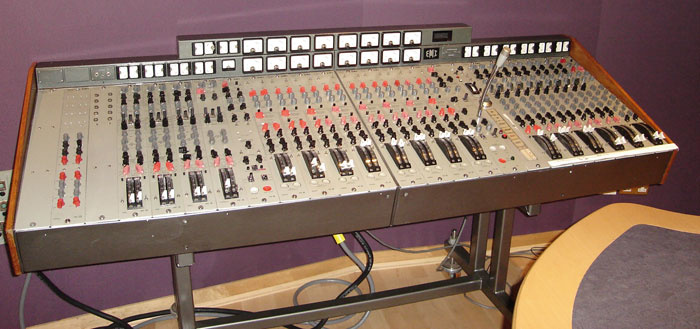 The ex-Abbey Road EMI TG1 desk at Olympic Studios which was used to mix the Arctic Monkeys album.Photo: Richard Ecclestone Empire 's electronic tracks were mixed by Barny at Olympic, but the rockier tracks were taken to New York where they were subjected to the skills of legendary mixer Andy Wallace, whose credits include Nirvana, Sonic Youth, Jeff Buckley, Rage Against The Machine and System Of A Down. "I was very surprised to be met by this small, gentle, 68-year old guy with white hair and glasses," recalls Abbiss. "He mixes in a very old-school way. He mixes the songs in about three to four hours, and it's all about subtle bits of EQ and where the faders are. He made sense of it, he would get the computer [for the desk automation] on very early on, so he could do lots of rides, he was constantly adjusting instruments that were playing with the vocals, so you could hear the vocal, and when the vocals stops you can hear the instruments... obvious things, which people do, but he did them quite extremely. It meant that he did not need to effect things as much or EQ things as much, because he made space with his balance. I found it fascinating. It was straightforward, and it made the songs make sense. He just sat there, listening at medium volume, and was adjusting things, very simple. It was an eye-opener watching somebody who is so experienced do what they do. The old adage of keep it simple is certainly the case with him. He hardly had any outboard gear plugged in at all: a plate, a short room [reverb], a stereo Harmonizer and a delay, and that was it, I think. I was expecting to walk into this room with piles of outboard, and there was nothing."
Abbiss clearly enthuses about Wallace because he feels he's found a kindred soul in the man. "It crystallised the things I have been thinking in the last few years about how records are made. He said that he really did not like mixing things were people had just thrown things onto the hard drive and he and his assistant have to spend the first half of the mix the sorting things. He commented that in the old days, mixing would be a small percentage of recording, because people made sure that everything on tape would be the best performance with the best sound. That's also the way I work, and I realise that I'm a dinosaur. I'm not a retro person; I like to think that I make records that are current. But I realise that in the current economic landscape studios are closing and it's getting harder and harder to work the way I do. But as long as I can work like this I will, because I think it is the best way."