


Knowing the right microphone for the job, from the huge variety of types and models available, is an essential skill for anyone who records regularly, and can make the difference between sub-standard and spectacular results. Follow our essential guidelines to ensure you always make the optimum choice.
Here at Sound On Sound, we're constantly being asked which mic is the best in any given price range, but in reality it's very difficult to choose just one, especially when it comes to vocal recording, as different mics suit different singers. In addition, there are factors other than the mic being used, such as mic placement and room acoustics, that have a significant effect on the end result achieved — so we thought it was time for a good look at the whole subject of choosing and using the appropriate studio mics in the right way. But first, a little background...
The Human Ear & The Recording Environment
If microphone technology is so advanced, surely the perfect mic would pick up sounds in exactly the same way as the human ear and all properly designed microphones should sound pretty much the same? It's a fair question. However, in reality, the human hearing mechanism involves a lot of psychoacoustic filtering and processing: so, for example, when we hear a change in the frequency spectrum of a sound because of a change in its position relative to our ears, we only pick up on the change in position, not the change in tonality. Another consideration is that if you take a direct and a delayed version of a sound and mix it to mono, you'll hear comb filtering caused by the delay giving the sound a phasey or flangey quality. By contrast, the human hearing system uses the small delay between signals arriving at the two ears to determine direction. It also takes advantage of the aforementioned spectral changes due to angle and the masking effect of the head itself, which has a profound effect on how the left ear hears sound approaching from the right, and vice versa.
 If you're lucky enough to have a great-sounding room at your disposal (this is the live room in New York's Power Station's Studio C), you can make the most of its character by capturing it, along with the source signal, via a mic that has an accurate off-axis response.What this amounts to is that the human hearing system is able to ignore or block out (to a certain extent) factors like room acoustics or frequency-spectrum skewing and inter-ear delays due to direction, whereas a microphone simply turns everything it hears into an electrical signal. In this respect, the microphone behaves very differently to the human ear: the outer ear imposes some fairly radical angle-related spectral filtering to enable us to judge direction, whereas a microphone has a much more simplistic 'polar pattern' that comes about as a function of the physics of capsule design.
Omnidirectional mics hear pretty evenly in all directions, but with so-called cardioid (unidirectional) models the acceptable angle of accurate reproduction tends to be narrower for high frequencies than it is for low frequencies. This might seem irrelevant if what you're recording is always directly in front of the microphone (such as studio vocals), but in fact that's only true if you are recording in an environment with no reflective surfaces, otherwise sound bounces back into the microphone at every possible angle, and this reflected sound is coloured by the off-axis characteristics of the microphone. In practice, even well-damped studios reflect some sound. In any case, it would be undesirable to record in a totally 'anechoic' room (one without any reflected sound at all), as everything would sound unnaturally dead. The trick is to record in a room that's adequately damped.
From the above, it can be deduced that there are two possible basic approaches to miking a voice or instrument:
- Choose an acoustic space that complements the sound, then select a microphone with a fairly accurate off-axis response, to accurately capture the room's character.
- Or try to arrange things so that your microphone picks up as little reflected sound as possible.
 These days, just because a mic doesn't cost much doesn't mean that it can't be used to produce decent recordings. Studio capacitors like this Red 5 model are even available at around the £100 mark.Allowing the room to become part of the sound is generally more relevant to choral or orchestral recordings than to pop music production, although recording drums in a live room, in order to use its character, is still popular. Altering the mic-to-source distance allows you to balance the amount of direct and reflected sound you pick up.
The second approach is the most common in small studios and usually translates to using a cardioid (unidirectional) microphone fairly close to the subject, with acoustic screens or blankets around the recording area to minimise reflections. The combination of using a cardioid mic and working fairly close improves the ratio of direct-to-reflected sound anyway, but in most project studios that have minimal acoustic treatment, hanging absorbing material behind and to either side of the player or singer often reduces room coloration significantly. Regular readers will have noticed that we often recommend duvets for this, as most homes have them. Where you need a bit of liveness, but not room coloration (such as when recording acoustic guitar), it can help to work on an uncarpeted floor or to place a reflective board over the carpet between the player and the microphone.
I know of a number of cases where musicians have spent a lot of money on a big-name capacitor mic and a high-end preamp, but still end up with boxy-sounding results. Often they call us to ask which even more expensive mic would fix their problem, but invariably the room acoustics are the real issue. Hang up enough duvets and you can make a decent vocal recording almost anywhere, with virtually any cardioid capacitor studio microphone. A boxy sound is pretty much always down to a boxy-sounding room. Home-made vocal booths are the worst culprit in this respect, as they usually have inadequate absorption at mid and low frequencies. Studio walls covered in carpet are particularly bad news, as only the high end is absorbed, making the sound boxier than before treatment.
Microphone Sound Character
As a rule, studio recording is undertaken using capacitor mics, because their moving parts are much lighter (and so lower in inertia) than those of dynamic mics, enabling them to handle high frequencies with greater accuracy. Even so, the strong mid-range of dynamic mics (normally used mainly for close drum miking and guitar amp miking) sometimes suits a particular singer better than a more accurate capacitor mic. In this case, what works is what's right, emphasising that choosing the right mic is once again more an art than a science.
In my experience, there are very few bad studio mics on the market and even the sub-£100 'me too' Chinese capacitor mics can produce perfectly good recordings if used carefully. The problem is that most vocal mics sound different to each other due to a number of factors, not least being the way in which the high-end response is modified to give the mic more or less 'presence'. If the boosted frequencies are in the upper-mid range, this can help some singers sound clearer, but those with harsh or aggressive voices may find the same presence peak makes them sound too strident. A higher-frequency presence peak will help add 'airiness' to a voice without making it sound harsh but may not offer enough help to the singer who needs more clarity of diction, and it can enhance sibilance. Then there are the so-called 'warm-sounding' mics, which tend to pump up the low end slightly, often combining this boost with a smoothed-off high end. These mics can sound superb if the singer has a harsh voice, or a thin voice that needs a fatter, less brittle sound, but stick one in front of somebody who already has a soft voice and it might sound as though they're singing through one of the duvets I keep going on about!
Choosing The Right Pattern
Mics pick up sound in different ways, dictated by what we call their 'polar' pickup pattern, as mentioned above, and it's important to know the pattern of the mics you have at your disposal or are considering buying.
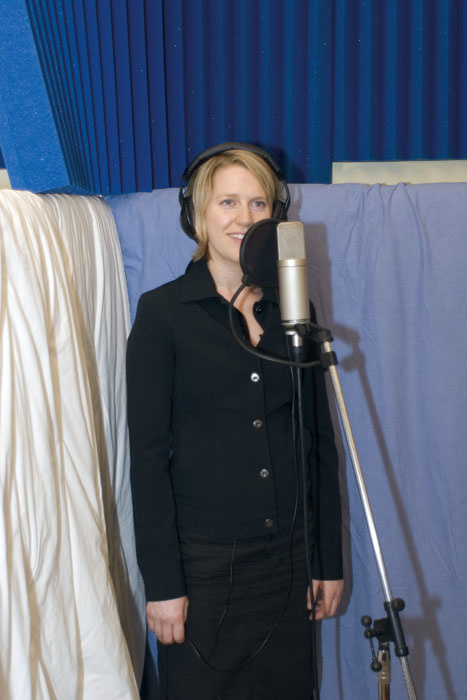 In the rather more likely event that the room sound is nothing special (or even has a character you'd rather conceal), the usual approach is to close-mic with a cardioid-pattern model, to pick up as much of the wanted signal and as little of the room reflections as possible, and to treat the space with sound-absorbing materials (in this case, duvets and soft hangings) to further minimise unwanted reflections.Mics with a cardioid pattern have the advantage of rejecting a high percentage of the sound arriving from behind them, which means that they provide good isolation for the person or instrument being miked up, but they can sound slightly nasal compared to omnidirectional (omni) models, which pick up sound equally from all directions. The imperfect 'off-axis' response of cardioids also tends to colour whatever room reflections they do pick up. On the one hand, omni mics might seem to have a disadvantage, in that they pick up sound from all the way around, but they are much more accurate off-axis than a cardioid mic and they also sound more open and natural. If you use an omni mic and hang a couple of blankets or duvets behind the mic, as well as behind the singer, you can reduce the room coloration to around the same level as it would be if you were using a cardioid mic, and you may also capture a more natural sound. Other than that, the main difference you'll notice is that you don't get the 'proximity effect' when working up-close with an omni that you do with a cardioid model. The proximity effect is a low-frequency boost that occurs when cardioid and figure-of-eight microphones (more on these in a moment) are used very close to the sound source. Both these microphone types work by sensing the pressure differential between the front and the rear of the diaphragm, and the proximity effect is built into the physics of how such microphones behave at close quarters. Omnidirectional mics, which sense only pressure (rather like an audio-frequency barometer) don't exhibit this effect at all.
The degree of proximity effect varies with how the capsule is built and also tends to be greater for narrower cardioid patterns than for wider cardioid patterns. Dedicated vocal mics often have a built-in low-frequency cut, rolling off gently below 200Hz or so to compensate for the proximity effect. This can limit their usefulness when you're attempting to record bass instruments. Where switchable low-cut filters are fitted, these usually operate at a lower frequency to minimise stand-borne vibration, although they still help counter the proximity effect to a useful degree.
Obviously, there are advantages to both omni and cardioid patterns and both are worth having. Fortunately, multi-pattern mics which allow you to switch between patterns are now fairly cost-effective. The figure-of-eight mic pattern is probably the least used one, other than for specialist stereo-miking applications, but it has the unique advantage of being totally deaf to sounds arriving from the sides (90 degrees off-axis), as any sound hitting the mic's diaphragm edge-on creates an equal pressure on both sides, resulting in no movement of the diaphragm. In situations where you need to separate sounds that are in close physical proximity, the figure-of-eight mic can be a useful ally, as you simply point its dead angle towards the sound you wish to exclude. A prime example of this is to help separate the acoustic guitar and vocal where both are recorded together. The exclusion of unwanted sound is never total, because of room reflections, but a figure-of-eight in this situation should be a significant improvement over using a cardioid. Of course, the figure-of-eight mic is just as sensitive at the rear as it is at the front, so it helps to put up some acoustic absorbers behind the mic if room reflections prove to be a problem.
Better By Tube?
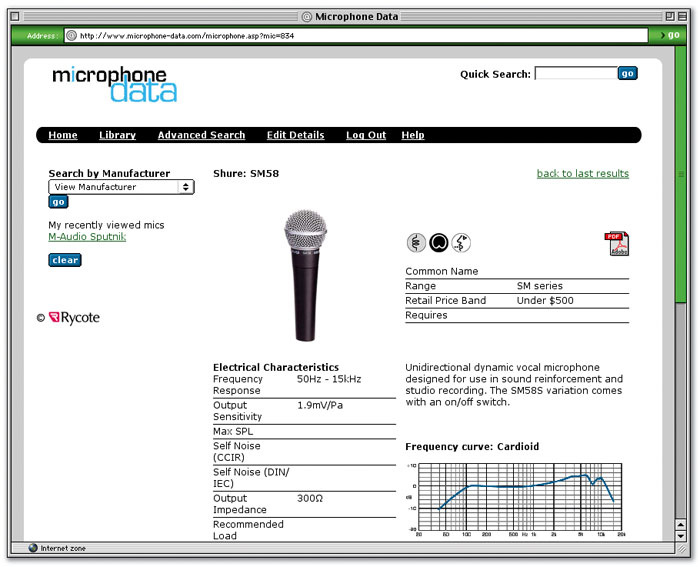 Knowing the frequency response of your vocal mics can help you to decide which singers they may suit: the frequency plot on the Microphone Data web site (www.microphone-data.com) for the classic Shure SM58 dynamic shows an upper-mid boost that can improve clarity for some singers. The other side of the coin is that it could make someone with an already harsh voice sound strident.Tube microphones use a valve as the preamplifier gain device rather than solid-state (usually FET) circuitry, and the vast majority also employ an output transformer. All early capacitor mics used tubes because transistors and FETs were invented rather later, and it turns out that tube microphones have a pleasing tonal characteristic that is a little different to that of most solid-state microphones — which are available both with and without transformers. Conventional wisdom has it that tubes introduce a very subtle distortion that flatters the sound, and they also overload more gracefully than solid-state circuits, although nobody has quite pinned down exactly why tubes sound as good as they do.
Modern tube mics can sound excellent, but there are some models that have had excessive amounts of distortion 'designed in', and (to my ears) these don't sound as good as the traditional tube approach, which is to make the microphone sound as clean as possible. There's also a tonal difference between tubes driven at their full operational voltage (often a couple of hundred volts or so) and so-called 'starved tube' circuits, where high-voltage tubes are run at much lower voltages, often in conjunction with some solid-state support circuitry. However, there are specialist miniature tubes designed to operate from low voltages that can sound good, and there's even one mic on the market that uses a tiny tube that can run from regular phantom power. All the other tube microphones come with a separate power supply, which means that they don't need phantom power — speaking of which...