

Producer and engineer Mark Endert not only mixed the lead single from Maroon 5’s second album: he also co-produced it and programmed many of the parts.
 Mark Endert at the SSL desk in Scream Studios.“Because I can play, I tend to really get into the tracks I produce,” says Mark Endert, when asked to explain how he ended up contributing so much to Maroon 5’s hit ‘Makes Me Wonder’. “I did additional production on and a mix of the song ‘Wake Up Call’ for Maroon 5’s new album [It Won’t Be Soon Before Long]. They really liked that, and then told me that they had cut this song, ‘Makes Me Wonder’, but didn’t feel like they had realised its potential. They were open to new ideas, so I had the freedom to go and look for a new approach.
“We discussed the new direction for Maroon 5 with the record company. The sound of the new album is much more contemporary and urban, while their first record, Songs About Jane [2004], has more of a classic neo–soul sound. So the discussion was: ‘Mark, we think that this song is very strong, so if you nail it, it could be the first single and could provide a great way to bridge the two albums together, and would help listeners that liked Songs About Jane to accept their new sound.’”
A factor that played a part in Endert being given the job of creating a bridge between the two albums was that he had previously done some additional production on and mixed the hit single ‘This Love’ from Songs About Jane. As it turned out, Endert did indeed ‘nail it’ with his version of ‘Makes Me Wonder’, which has become one of the biggest hits of 2007 so far. It has stormed to the top of dozens of charts around the world, resulting in a number one spot on the United World Chart. Endert also recorded, produced and mixed another track on It Won’t Be Soon Before Long, ‘Back At Your Door’, and mixed a further three, which had been produced by the album’s main producers, Mike Elizondo and British mix legend Mark ‘Spike’ Stent. 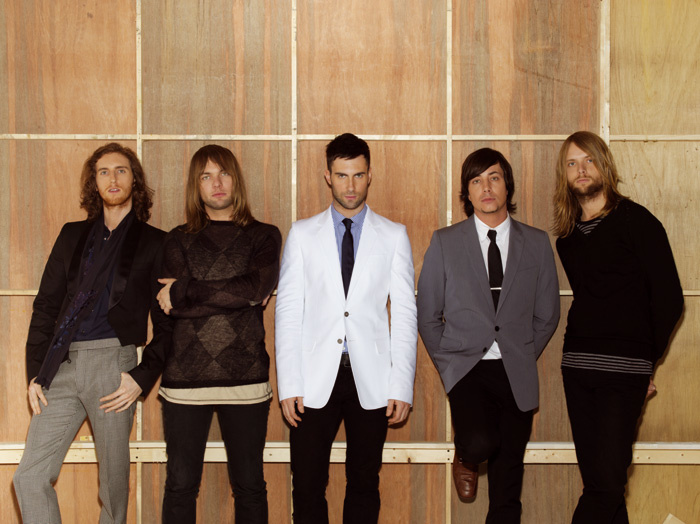 Maroon 5.
‘Makes Me Wonder’
- Written by Adam Levine, Jesse Carmichael, Mickey Fadden
- Produced by Mark Endert and Maroon 5
Mark Endert: “The idea with this track was to make it contemporary and urban, and also to make it kind of classic ’70s and early ’80s sounding, like their first album. So there is programming with live playing. I was referencing many records from the ’70s and ’80s before working on this track, and the pulse that makes your head go up and down has the disco–like feel that’s typical for that era. It’s derived from a four–to–the–floor drumbeat, accented by bass and guitar that are placed a 16th note ahead of the beat.
“What I normally do as a producer is make a mock–up of my entire arrangement for a track in my Logic system at Scream Studios, and I did that in this case. I programmed the drums and played the rest, keyboards, bass, guitars, on an old ’80s Roland MKB MIDI controller that’s connected to Logic via MIDI, not USB [he chuckles embarrassedly]. The whole feel for the track is derived from Logic. It would be very cumbersome for me to do this in Pro Tools. It’s far easier to build tracks in Logic. I apply Logic plug–ins as well during this stage. Logic has great EQ and great compression, and also a great delay. Everything is standard, I haven’t bothered getting VST plug–ins for Logic.
 The Pro Tools Session for ‘Makes Me Wonder’ contained over 80 tracks, some of which were submixed within the program.“In addition, I have an extensive sample library in Logic’s ESX sampler, as well as an Akai S6000. William Orbit made Ray Of Light on two Akai S3200s, and he convinced me that bass and drums are much better coming from an Akai than any other sampler, and I believe he is right. The cool thing about the Akai S6000 is that it locks to word clock, and so I can go AES out into Pro Tools directly. The bass synthesizer sound came from the ES2 in Logic. Once my mock–up was complete, I bounced everything down to 18 to 20 tracks and transferred things to Pro Tools.
“After I finished my mock–up I flew to Los Angeles and played the band the track, and they were like ‘Wow, let’s cut it!’ So we went into Sunset Sound and they added tracks and we replaced any parts in Logic that were considered band instruments. That really made it sound like Maroon. We wanted the feel of a band playing, even though there’s a lot of programming. I was pretty adamant about keeping the feel of the drums and bass, but they were allowed to embellish, of course.
“The fills are all Matt [Flynn], who is an awesome drummer. He actually plays all the way through on a complete kit, which for me is always 10 tracks: rooms left, right and centre, kick, snare, hi–hat, toms and overheads. There’s also a continuous machine drum loop, and they kind of flammed together with Matt’s drums. So I had the programmer tighten up the programmed drums, but the funny thing was that after we did that, the feel kind of went away, so we hit undo and just let the live and machine drums flam the whole way. It makes the drums sound extra fat. It certainly was a lesson in using Pro Tools. Just because you have so many editing options doesn’t mean you should always use them!
“I ended up with a pre–mix Pro Tools file of 80–odd tracks. In addition to the drums and percussion, that also featured Lenny Castro on congas, there were two tracks of bass — mic’d amp and DI — plus the Logic ES2 synthesizer track, that was not technically a bass sound, but did roughly double what the bass was doing — the ES2 track actually played some more notes. I realised that there was one guitar part that worked particularly well with the bass and drums. It was played by Adam and had a clean Telecaster sound, and so I looped that through the track. There are also heavy distorted guitars in the chorus that are there for support and of course to complete the signature Maroon 5 sound.
“As far as keyboards are concerned, there are probably about four stereo tracks of Juno 106, mainly pads for the choruses, and two stereo tracks of acoustic piano, one with eighth notes in the top end and the other with bass notes played in octaves. We also recorded a distorted Fender Rhodes and a Wurlitzer for the bridge. We played these two keyboards through James’ Orange guitar amp, and this was another element that tied this track to the previous Maroon record.”  A sampled handclap was made to stand out in the track by the application of heavy low-end boost, shelving cut above 12kHz and stereo widening.
Submixing In The Box
“Before mixing I tend to submix in Pro Tools. In the case of ‘Makes Me Wonder’ I did a lot of combining the background vocals, and the keyboards were submixed to stereo pairs and so on. I have 56 channels on the SSL for audio tracks, and the remaining 16 channels are returns and effect sends, so I need to bring my Pro Tools material down to 56 channels. I don’t actually bounce things, but instead I just combine outputs in Pro Tools. So six or eight tracks may all share output 31 and 32. This means that I can still do level rides inside of Pro Tools, like if someone wants to hear more of a backing vocal singing a third above the melody or something, and leave the settings on the SSL as they are. I tend to use plug–ins fairly intensively during this pre–processing stage, and ever since Pro Tools introduced delay compensation I run all the plug–ins live.
“There’s not much difference between mixing a track I have produced myself or one that’s sent to me purely to mix. I always begin with trying to figure out what makes a song tick, so I’ll shove everything up and down and see how the feel changes. I then focus on the vocal, bass and drums. Often you can tell the level of the drums relative to the vocals that way, and you can also follow the melody against the bass. Once I commit to a level on these elements, I’m very methodical about mixing the rest. The Lord–Alge brothers made quite an imprint on the industry by grabbing things on first instinct, and I praise them for it; however, I’m not an instinct grabber.
“If I’m mixing a singer–songwriter track I might lower the drums and raise the bass, but in the case of ‘Makes Me Wonder’, I decided to make the drums and bass the loudest thing in the track, and keep the vocals tucked, kind of like on a Prince record. Two of the tracks I had been listening to as a reference were ‘Billy Jean’ by Michael Jackson and ‘Kiss’ by Prince. I remembered them as drum–heavy, but I was shocked by how loud the drums actually were on those cuts. I decided that I wanted to go in the same direction, to keep the listener’s head going up and down. And so with the mix for ‘Makes Me Wonder’ I started with vocals, bass and drums, and I found myself turning the vocal in, and turning them in even more, and keep the drums really loud and heavily compressed.”  One of Mark Endert’s outboard racks at Scream Studios, featuring (from top), GML EQ, Empirical Labs Distressor compressor (x2), Teletronix LA2A compressor, Roland SDE3000 digital delay (x3) and Akai S6000 sampler.
- Drums: Alan Smart C2, SSL EQ, Lexicon 480L, Tube–Tech LCA 2B, Logic Compressor, Waves PS22 Spreader, Focusrite D2, Tech 21 Comptortion, URS A–Series EQ.
“Basically I wanted the drums to sound fat and loud. A lot of processing on the drums is done on the SSL, using EQ and compression. I also love the Alan Smart C2 compressor, and I bussed things like the kick and the snare to the C2 and returned them on two separate channels. They really are spanked pretty hard, so it really punches up the drums. The C2 is set to ‘crush’ mode, which completely annihilates all the transients and brings up the air. Like with most of my stuff, I’m sure the attack was set pretty fast, to probably 1ms, and the release was pretty fast as well, again to bring up the air. It was a completely crushed sound that I blended in sparingly. I used some Lexicon 480L reverb on the drums, and the three room mics were hit really hard with a Tube–Tech LCA 2B compressor to bring up yet more air. My drum loop also had serious compression, but I think that was done in Logic, using either their Platinum or their regular compressor. I didn’t add anything to the loop during the mix.
“I added a lot of bottom to all the drums, even before they hit the SSL. I had programmed a clap sample in Logic, but I felt that I couldn’t really hear it above the snare, so I put it through the PS22 Spreader and suddenly it was there. I also EQ’d the claps very severely with the Focusrite D2 plug–in, boosting around 80 and 134 and shelving some top off above 12K. I wanted the beats to be fat, without too much transience. I was trying to see whether the claps could withstand having lots of bottom added, and it sounded good.
“For the second verse we wanted congas, and Lenny Castro’s overdubs in Los Angeles. He’s such a good musician that we did just a couple of takes and we only used one of them, without editing, as you can see on the screenshot! Because I had made the drums so big, I had problems getting the congas to sound the way I wanted them to. The only way I could get his congas to really cut through was by taking the output of the track into my Re–Amp and then into my Comptortion [compression, distortion and EQ] pedal, which is made by Tech 21. I find myself using quite a few guitar pedals during the mix stage; sometimes there is a sound in a pedal that is just not available any other way. I had tried everything I could with plug–ins, but for some reason going out of Pro Tools and into a pedal and adding some distortion and EQ and compression and then bouncing it back into Pro Tools did the trick. One the screen shot you can see the return from the Comptortion that got printed. It was just a mono recording, very ’70s! [laughs]
 The conga part was routed through a Tech 21 Comptortion pedal, before being re-recorded back into Pro Tools.“I have four API 550A EQs, and I had inserted one of them on a 909 kick. During the mix I heard some crackling coming from the 550A, so I had to replace the EQ with the URS plug–in. I tried to set it to the same setting as the 550A, something like a +4 shelf at 50Hz, but that felt like a touch too much, so I took it back to +3, which is not available on the API, which has only +2, +4, or +6. The URS sounded remarkably close, and I thought it was funny that I called up a plug–in to reproduce a piece of vintage gear, and I then used settings that are not available on the original.”
- Bass: Teletronix LA2A compressor, SSL compressor, Tech 21 Sansamp
“I added a lot of compression from the SSL desk. I like to print effects while recording, so the bass already had EQ and compression, and I’ll add more during the mix stage. The bass was laid down using a Neve 1073 EQ/mic pre and an LA2A, and during the mix I added yet more compression using the desk. I also did a sub bus of the DI to a Sansamp to bring up some more grit. The ES2 keyboard sound that more or less follows the bass didn’t get any processing. Technically it’s not a bass sound, and my programmed bass was muted.”  URS’s A-Series EQ plug-in was used to boost the low end of a TR909 kick sample.
- Guitars: Lexicon PCM42, AMS 1580S, Eventide Orville, Focusrite D2
“Upon determining that Adam’s clean Tele part worked the best with the drums and bass, it was looped so that it did the same thing throughout the whole track. It sounded great being mixed loudly. When I have a loop like that without change, they way I can achieve contour is by changing the amounts of effects. So at the beginning of the song there are minimal effects on the guitar loop, then when it hits the first verse there are more delays, when it hits the chorus there is chorusing and delay and reverb on it — these are all outboard effects: PCM42s, AMS 1580S, and Eventide Orville. All the delays from the Lexicon PCM42 were timed, everything from eighth to dotted eighth to 16th notes. I love delays far more than reverb and I have eight discrete delays — five PCM42s and three Roland SDE3000s — and they are in use on every mix. In the verses it’s more like a 16th slap feel, and when it gets to the choruses, I harmonised with an AMS 1580S, pitch–changing and fattening the guitars. You can get a lot of contour out of a track that lacks dynamics just by changing the acoustic space around it.
 More of Mark Endert’s outboard gear, which featured heavily on ‘Makes Me Wonder’: from top, left, Alan Smart C2 compressor, Tube-Tech CB1B compressor (x2) and LCA 2B stereo compressor/limiter, Drawmer DS201 gate, Dbx 160XT compressor (x2); GML EQ, Eventide Orville multi–effects, Yamaha SPX2000 multi-effects, Lexicon PCM42 digital delay (x5), Tech 21 Sansamp amp simulator and AMS DMX1580S delay.“The distorted guitars are not featured in the track, but we needed them in the choruses to make it sound like Maroon 5. Something didn’t feel right, however, and I duplicated the distorted guitar tracks to separate tracks, and offset them by an eighth note later in time, filtered them to eliminate the bottom end and took out a lot of mid with the Focusrite D2, and then brought that back in separate faders. I mixed that in behind the original guitars and for some reason it sounded much fuller and also much cleaner, because it wasn’t a real delay. With just one filtered repeat the distorted guitars immediately sounded bigger, whereas when I tried outboard delays with repeats, it sounded too crowded and washy.”
- Keyboards: Urei 1176, Roland SDE3000, Lexicon PCM42
“The acoustic piano had a ton of 1176 compression on it and also some slap echo from an SDE3000. I definitely added timed delays from my PCM42s to the Juno 106 pads to keep them nice and full in the choruses. The great thing about the contour of the track is that there are moments when it’s big and then you get sucked down into moments that are tight and small. So when the keyboards change to distorted Rhodes and Wurlitzer in the bridge, they are much more dry than anything else. I don’t think I used plug–ins on the keyboards.
- Lead vocal: Waves De–esser, Sony Oxford EQ, Tube–Tech CL1B, Lexicon PCM42, Lexicon 480L
“I love using digital de–essing on the lead vocals. On about every track I mix, the first plug–in insert is probably the Waves De–esser. From there I will do fine–tuning with the EQ. If there’s a narrow band that I want to eliminate or boost, I often use the Sony Oxford EQ immediately after the de–esser. In this case I boosted a little bit around 300Hz, made a small cut around 2500Hz and rolled off some extreme high end. I really like the Oxford EQ for pinpointing frequencies, but as far as sonic shaping is concerned, I prefer the outboard, like the SSL EQ, the GML, or my Neve 1073 modules. You are never going to pinpoint a perfect frequency on a three–band Neve EQ.
“After being treated with the De–Esser and the Oxford EQ, the lead vocals came to the SSL desk, on which I also used EQ, and inserted a compressor. In this case it was a Tube–Tech CL1B, set to a ratio of 5:1. For some reason I like 5:1 on vocals. I added delays on the lead vocals in the choruses — PCM42, eighth note or something like that — and there’s a reverb, most likely a 480L, set to a short reverb time.”
- Backing vocals: SSL channel compressors, McDSP Filterbank
“I compressed the backing vocals with the SSL channel compressors, also set to a 5:1 ratio. When I tried to blend the backing vocals into the chorus, they immediately sounded too slick and too good and too adult. This often happens when the harmonies are lower than the lead vocal; they tend to weigh the track down. In trying to keep the track fresh and young, I combined all the background vocals into two outs from the master output of Pro Tools, and then I put one plug–in EQ on that. I sucked out all the frequencies that made it full, using the McDSP E6 Filterbank, cutting radically at 79.1Hz and 211.2Hz. This made the backing vocals sound transitory and thin, and when I blended them back into the track it sounded much better. In this way the backing vocals could cut through the track, and not weigh it down.
“Finally, I recorded the whole session in 24-bit at 44.1kHz, because most of my sample library sounds best at 44.1. If I try to convert the samples they don’t sound as punchy. But I do mix to 24-bit/88.2kHz, to an Alesis Masterlink ML9600. If someone wants to master digitally, 88.2 converts much better to 44.1. The record company creates all its different formats from my Masterlink master.”
That’s Endert–ainment
The common stereotype of engineers and producers is that they are frustrated musicians. By contrast, even as a teenager, Mark Endert already felt called to work as a producer and engineer, rather than a performer.
“The weird thing is, I never wanted to be a rock star,” recalls the 36–year old American, who grew up north of Los Angeles. “I was more a fan of records and the record–making process, rather than a die–hard fan of bands. I had a Jupiter 8 and a Juno 106, and played keyboards in bands during my teens, but I would follow producers rather than music groups. I’d wait for the next Mutt Lange–produced record to come out and I would buy that, regardless of who the artist was. Even when I was very young I wanted to work in the behind–the–scenes part of record making.”
So single–minded was Endert in the pursuit of his aim that he moved to LA the day after he finished high school in 1989, at the tender age of 17, and knocked on the door of The Village Recorder studio. In front of an apparently very impressed studio manager, he rambled off a list of all the legendary records that had been recorded there, from Supertramp’s Breakfast In America to Fleetwood Mac’s Tusk, and was hired on the spot for the usual beginner’s role as a tea–boy.
Endert’s career since then has followed a steadily upward curve. In 1992 he was involved in setting up Sony Music Studios in Los Angeles, where he eventually became chief engineer. His breakthrough came when he recorded and mixed Fiona Apple’s debut album, Tidal (1996) there, which resulted in his phone ringing incessantly, and him going freelance. He engineered and mixed a number of songs on Madonna’s 1998 Ray Of Light album, an experience he still cherishes, as it gave him the chance to work with one of his heroes, producer William Orbit.
Endert recorded two more albums for Madonna, and also engineered artists such as Melanie C, Ricky Martin and All Saints. Over time he gradually moved into production, working with Vertical Horizon, Ours, Gavin DeGraw, and Savage Garden. Then, around 2003, the mixing side of his activities began to take precedence, and he has mixed recordings for Howie Day, Five For Fighting, Anna Nalick, The Fray, Anastacia and countless others. “Producing became less interesting for me,” he comments, “and I really fell in love with mixing, especially on tracks that I had not produced. You haven’t heard the song 50,000 times before, and you can have a fresh perspective. This is better for the artist, the producer, and the mixer.”
In 2005, Endert moved from Los Angeles to Florida, because he felt that the Sunshine State was a better place to raise kids. He’d been the main customer at Scream Studios in Los Angeles, and when he informed the studio’s owner/manager of his plans, the man gave a new dimension to the already unashamedly deferential American approach to customer service: he moved Scream Studios, including its huge SSL 9072 J–series desk, to Florida, close to his main customer’s new home. The new facility was laid out exactly according to Endert’s wishes, and proudly boasts 105 square feet of hurricane–proof glass from which he can see the Space Shuttle lift–off from nearby Cape Canaveral.