

With no budget to hire a studio, Jacob Golden decided to record his album anywhere and any way he could. The resulting sound is a unique exercise in the use of ambience.
 "Some people have given me a bit of shit about using tons of reverb," admits Jacob Golden, and when you listen to his album Revenge Songs, you can see why. There's no shortage of confessional singer–songwriters with acoustic guitars, but what sets Golden's album apart from the crowd is its unique sound: wet to the point of drowning in spring reverb, delay, room ambience and other atmospheric treatments.
"When you're listening to a lot of modern records, you can almost hear the vocal booth," explains Jacob. "Everything is so perfectly contained. I really feel like I'm trying to shape the character of sound by using echo — it's not like I'm just slapping on some Lexicon reverb. For me, it's very musical–sounding. I think we're missing that in a lot of modern records. To me, you can hear a vacuum of ambience. There's not really any room character to the sound, and sometimes that can work, but I really like exaggerating the space."
No Frills
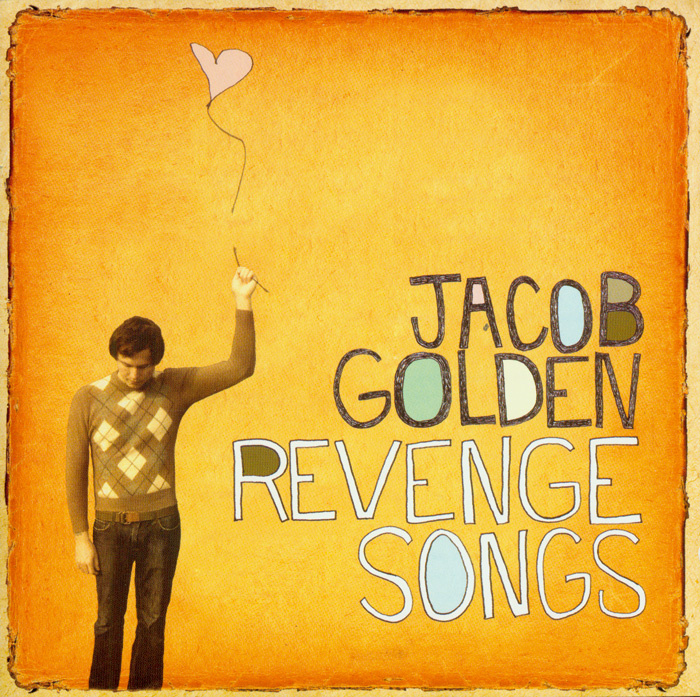 The unique exaggerated–space sound of Revenge Songs is one that was arrived at through long months of experimentation, and in many ways it is the product of the circumstances in which the album was recorded. "When I started to record this album, I wasn't signed, and I didn't have the resources to take it into a Neve studio and mix it. I just had to work with what I had, and I had the desire to work where I was and record songs as they were coming out, rather than demo things and wait for the chance to go into a proper studio. But as I started to record the songs, I got a bit more ambitious with wanting them to sound as good as the albums I'm influenced by."
What he had changed as time went on, but the core recording system was very basic. "The only thing I had when I started recording was an old G3 Powerbook, and I had to drag that around. I had a little micro input on that thing, and then at home I had a quite broken MOTU 828, so most of the recordings were put together on that old G3, which is completely dead at this point — it's been dropped way too many times. Fortunately, now you've got these awesome hi–res portable field recorders, which are great. I've only got a few nice pieces of kit: one of them is some Telefunken V672 preamps which I pretty much run everything through, and then I've got two [Empirical Labs] Distressors, which are the glue of all of my recordings."
As for the software part of the equation, explains Golden, "Most of it was actually recorded on a program called Tracktion [from Mackie]. I've since moved on, but I used Tracktion for a long time, because it was the closest thing to using a four–track. I kind of have a love/hate relationship with Tracktion. It was so simple as far as laying things out, but there were some things in it that made things over–complicated, like you'd get a lot of plug–in processing delays, and there wasn't a proper aux send structure. Those things were really difficult, and that's another reason why I ended up running a lot of things out of the computer to get my effects, and having those things printed.
"I really resisted Pro Tools for a long time, because the proprietary hardware thing that you get locked into when you get into Pro Tools is kind of annoying. I liked the open–endedness of something like Ableton Live, which I use a bit as well, and Tracktion. But now that I'm getting into the Pro Tools software, I'm realising that it's so smartly laid out, and a lot of the things I struggled with doing in very convoluted fashion with the other programs, Pro Tools just does. So I'm going over to the dark side a little bit."
Helping Hands
Top–flight equipment might have been in short supply, but what Jacob did have to fall back on was the experience and advice of producer David Korsten (Bat For Lashes, Faultline) and mixer John Smith (Blur), thanks to an earlier album he'd recorded as part of the band Birthday. "Working with John opened my mind to doing things in an unorthodox fashion. He was really big into miking up a drum kit and then running all of that through old distortion pedals, or running things through a speaker and putting it inside the piano and getting 'piano reverb'. That was really awesome, to look over the shoulder of someone like that and pick his brains. I took a lot of that home with me, and I had to go back to the John Smith way of working, running things through guitar amps, spring reverbs, taking the character of speakers, getting things out of the computer and getting as much character into the songs as I could. David Kosten was also my primary sounding board for the mixes, and did a lot of little touches to the final mixes, as well as mixing the song 'Pretend', where I sent him my stems from the bedroom recording of the song."
Without the budget to go to a 'proper' studio, and with no permanent base of his own, Jacob Golden decided to make a virtue out of necessity, and seek out interesting rooms in which to track the elements that would become Revenge Songs. "Some of the songs were recorded in bathrooms, and it's not a lovely, lush sound, it's a very tight and almost claustrophobic sound, and I really like that when it works with the lyrics. A lot of the songs were done in various phases — you'd have something that was done in a bedroom, and then go over to a friend's house and try some harmonies out in the stairwell, and then we'd go for what we call the 'vibe tracks'. Around Sacramento, California, where I did the bulk of the record, there's these great spaces. Josh Heinze, my brother in renegade recording sessions, assisted me with a lot of the field recordings. A friend of mine had an art gallery which was a big underground bunker, with the most gorgeous reverb, and she would let me go in there in the night and sing, and just enjoy the room. So quite a few of the actual recordings came from that space, just bringing in a couple of mics and the old G3, setting up mics at the far end of the room and playing with that ambience when I went to put the whole thing together. Then when I went to mix the album I was able to have those different voices and colours to work with. Sometimes a vibe track would be completely in the background, almost subliminal, but it gives just a bit of character to something that was recorded in a bedroom."
 Never was a studio more aptly named: recording in the bathroom at The Magic Closet.Ten days of recording sessions did take place at a Portland studio called The Magic Closet; owner Ian Watts was just setting the studio up, and was keen to offer Jacob Golden the chance to test–drive it. He took full advantage, but even then, found himself gravitating towards the unconventional spaces: "The claustrophobic–sounding 'I'm Your Man' and 'Revenge Song' were recorded in the bathroom of the studio, singing into an old tape–recorder microphone."
Headphone Microphones
 Jacob Golden's mixing was revolutionised by the purchase of a Mackie Control.Revenge Songs has a surprisingly dense sound, given the relatively sparse instrumentation. Many of the tracks feature just acoustic guitar and vocal, with the texture coming largely from multitracked harmonies. "A friend of mine got to record an album with Dave Sardy a few years back, so I picked his brains about cool things, and one of the things he likes to do is record vocals on instruments using a headphone as the microphone. So I picked up on this, and it's sort of become my signature sound, where I'll take a hi–fi vocal as the main vocal, and then I'll do a secondary vocal through a headphone. I just get an instant vibe out of the headphones, much more so than I can get through a straight–up microphone. There's something very intimate and soulful about the sound. There's a particular headphone set I like, they don't all sound the same! They probably sound so good because they've been dropped and stepped on and sat on for so many years, but they're an old pair of Sonys that just sound gorgeous when sung through. I've got a really nice pair of AKGs, which are open–backed, and singing through them doesn't work at all — they just sound quite nice — but the Sony ones have this crunchy quality. And also using Dictaphones as well, I really like that contrast of extreme hi–fi and extreme lo–fi, I find that really interesting. Some of those things you wouldn't want to hear soloed! The harmonies end up sounding really lovely in the end, I think, due to the fact that they're quite poor–sounding on their own. You put them together and you have this unique sound."
What sounds like some sort of crunchy delay on the backing vocals is thus, in many cases, the product of singing into headphones and manually offsetting the results. "I have used plug–in delays, but a lot of it is actually moving the waveforms, even copying the same waveform over and playing with moving that until I've got an echo that actually works. It's like old–school tape echo without the feedback."
Following the inspiration of John Smith, further layers of reverb were added by passing signals through a guitar amp. "Even if I turn the reverb all the way up so that there's really no direct signal coming through, then that will have its own track on the multitrack, and I can ride the fader. There's a few songs that have drums on them, and running the drums through the guitar amp really added to the character of the sound."
On top of that, says Golden, "There is some digital reverb. Sometimes I found that having all these different sounds, I needed something to pull it all together and put everything into one space, and at that point I would go into Altiverb or Wizooverb. They still don't totally do it for me, but there's something cool about the convolution stuff. I like to use a little bit of both, but I do like to put everything together in one space at the end of the day.
"I can spend way too long working on the reverb for a song! It's just like having different instruments: some instruments work together, and some don't, and it's about putting sounds together in the most musical way. There's a lot of stuff that didn't make it, and it gets weeded out. I don't like to have 50 channels of recordings, I like to weed things down to the essentials. It's like those older records where you had to commit, you had to bounce things down, because you only had four or eight tracks to work with. You had to make some hard decisions, and with digital, you don't have to make as many hard decisions, and that can really make for a lot of useless stuff in a mix. So I do like to be a bit ruthless, chopping things away and bouncing things down, and getting down to the simplicity of the sound."
Bubbles Of Ambience
 Another favoured location, this time a bedroom somewhere in Portland, Oregon.Overall, the coherent, and very unusual sound of Revenge Songs was arrived at by a fairly tortuous route, and reflects Jacob Golden's own development as a producer and mixer. "This album was basically built up and torn down multiple times as I learned different things. A lot of it was about experimenting and learning to mix: listening to other albums and then listening to mine and figuring out what I liked, studying Geoff Emerick and how he used echoes, especially on the vocals, and the timing on echo. That took me a while to really pick up on, but it was another thing that really enhanced my mixing. Rather than having just reverb, you can actually time it so that there's a rhythmic reflection to the whole mix.
"I used to mix everything with the mouse, and it was the most tedious thing. I finally got one of those Mackie controllers and it completely changed the way I mix, because I was able to approach the mix much more musically, and tickle things as the song went along. I really got into having various ambient tracks on different faders, so for half the song you don't even hear it, and then it bubbles up on a particular word, and during crescendos I can push those ambient tracks in a way that's much more musical than just turning on the reverb. I really found that that took my mixes to a whole new place.
"This album took me a long time, because I went through a lot of different phases of learning, but now I'm in the mood to work quickly. When I do my next album, fingers crossed, I want to go in there and try and have everything laid out in three weeks, and be really fast with the mixes. I think now that I have the technique and I know how to do the echoes and how to EQ things in a way that makes sense to me, I can actually do things a lot faster, and I'm really excited by that, because I did spend a long time on this record. And I can hear that in it: it's very thoughtful. There's a rawness in it, but it's very composed, almost like I sat down and composed it, and I'm much more in the spirit now where I want to just lay it out there."
Drums Without Tears
Several of the songs on Revenge Songs have drum tracks underpinning the layers of guitar and vocals, and these too were recorded in a variety of non–traditional locations. "You can get some excellent drum sounds in houses, especially in Portland, Oregon, because most every house has these hardwood floors and these really high ceilings," explains Jacob Golden. "You get this very natural, organic sound, so a lot of the drums were done in those sort of spaces with a couple of microphones, maybe put a microphone in the kitchen or the far bedroom and utilise that natural ambience."
Some of the drum parts were played by Gavin Bowes, the former drummer in Golden's band Birthday, but others were done by Golden himself, taking the DIY ethos to new heights: "I can't actually sit down and play a drum set together, so I'll do a ride cymbal and maybe a floor tom, and then overdub a snare and hi–hat. Like on 'Shine A Light', where I took a bass drum and turned it on its side and used it as a timpani, wrapped loo roll around a drum stick to get a softer sound."