

M-Audio's new interface is equipped with eight mic preamps, eight analogue outputs and an impressive range of digital I/O - all of which has been crammed into a 1U rack and given a very attractive price-tag.
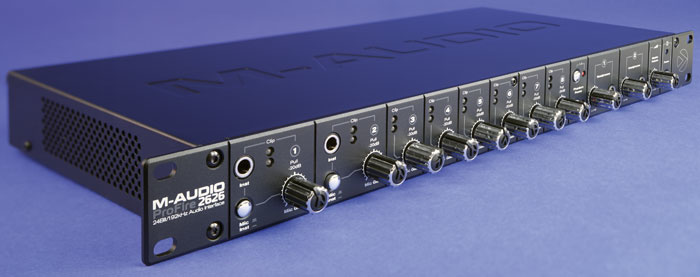 When M-Audio joined the Avid group a few years back, it was widely assumed that their product range would sit beneath that of their new siblings Digidesign. Since then, however, they've produced one or two pieces of kit that must have raised eyebrows at Digi HQ. The Project Mix I/O, for example, was more than a match for Digi's 002, despite costing little more than half as much, and a quick glance at the spec of the new Profire 2626 suggests that they might have done it again. With eight mic preamps built in, a sophisticated DSP cue mixer, and a comprehensive array of digital I/O, it offers all you need to record a typical band to your Mac or PC, and the UK retail price is a mere £479.
To put that into perspective, Digidesign's 003 Rack still officially retails at £834, despite lacking four of the Profire's mic preamps and eight channels of its ADAT digital I/O. Admittedly, Profire buyers also need to fork out for their recording software of choice, but it still looks like a very cost-effective way of putting together a multi-channel recording rig — and if your recording software of choice is Pro Tools, the M-Powered version offers almost all the functionality of Pro Tools LE.
Nor are M-Audio conceding any ground in terms of sound quality. In hosts that support it, you can record 24-bit audio at up to 192kHz, provided you accept the usual reductions in channel count associated with using ADAT I/O at high sample rates. The 'Octane' preamps in the Profire are said to offer excellent quality and a larger-than-usual gain range, while so-called 'JetPLL' technology is claimed to eliminate jitter in a "critically acclaimed" fashion. (Where do M-Audio find critics who spend their time acclaiming jitter elimination technologies?)
Vital Statistics
Firewire audio & MIDI interface
- Compatible with: Mac OS 10.4.10 and later, Windows XP SP2 and later, Vista.
- Analogue inputs: eight, balanced, on combi XLRs.
- Built-in mic preamps: eight, plus two front-panel high-impedance instrument jacks.
- Analogue outputs: eight, balanced, on quarter-inch jacks.
- Headphone outputs: two, on quarter-inch jacks.
- Digital inputs: 16 via ADAT, two via co-axial S/PDIF.
- Digital outputs: 16 via ADAT, two via co-axial S/PDIF.
- Other I/O: word clock, MIDI, optical S/PDIF (shares optical port with ADAT).
- Sample rates: up to 192kHz, with some limitations.
Getting Kitted Out
The Profire control panel software is a departure from previous M-Audio designs, and is centred around the ability to configure its built-in DSP mixer for low-latency monitoring. With all the digital I/O connected, a total of 26 mono inputs and outputs are available to recording software (eight analogue, 16 ADAT, two co-axial S/PDIF). Up to 18 of these sources are available for setting up cue mixes within the control panel mixer; so you could, for example, combine a stereo return from your recording software with up to 16 directly monitored input signals. These signals can be sent in varying amounts to up to seven different stereo aux sends, so if you have an additional eight-channel D-A converter, you can create seven different low-latency cue mixes for performers on top of the control room mix. (Only one aux is available at sample rates above 96kHz, though.)
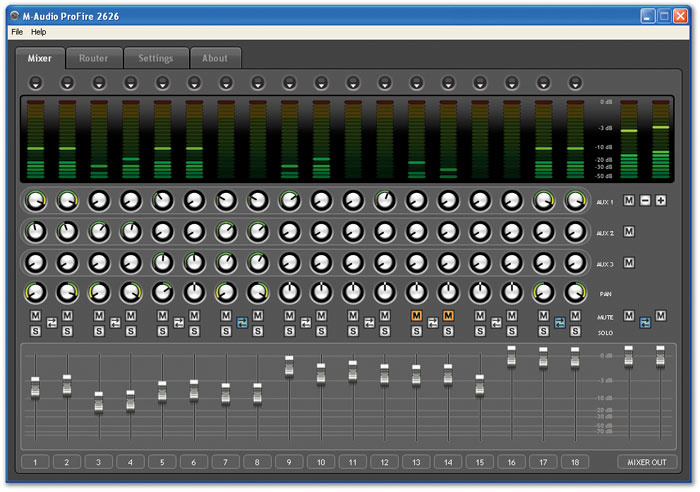 The Profire's control panel software is clearly laid out and it's quick and simple to use for setting up cue mixes.As well as the aux sends, the cue mixer offers the usual level faders, pan, mute and solo controls, but there's no EQ or other signal processing, so if your singer wants to hear reverb on his or her voice, you'll have to swallow the latency and set up a monitor mix within your recording application. Not that that's too much of a hardship: as you'd expect from a company who have been developing audio interfaces for many years, the Profire's drivers handled low-latency operation very well indeed in the review system.
The two front-panel headphone outputs are hard-wired to analogue output pairs 1/2 and 3/4 respectively, and one feature that will be familiar to users of other M-Audio products like the Firewire 1814 is the Master Volume knob. This operates in the digital domain, and the control panel is used to choose which outputs are affected by it. The Profire can also operate as a stand-alone device when not connected to a computer, and the control panel allows you to configure settings for this mode, too.
Profire & Pro Tools
Considering the close relationship between M-Audio and Digidesign, I was disappointed to find that Pro Tools M-Powered is somewhat the poor relation when it comes to software partners for the Profire. Sample rates above 96kHz aren't supported, which probably won't bother many users, but you also lose the second pair of ADAT ports, bringing the total I/O count down to 18. And, although you can still hear input signals with near-zero latency via the Profire's DSP mixer, if you choose to do so you'll spend a lot of time muting and unmuting tracks within Pro Tools.
For a long time, Pro Tools has offered two input monitoring modes: Input Only monitoring, where you always hear the input signal, regardless of any audio that might have been previously recorded on a track, and Auto Input monitoring. In this mode, the input signal is heard during recording and when the transport is stopped, but is muted during playback, so that you can hear previously recorded audio on the track in question. (This has obvious uses when you want to drop into a previously recorded take.)
However, if the input signal is being independently routed to the outputs, as it is when you employ the Profire 2626's cue mixer, neither of these monitoring modes is any help. What you want then is for the input signal within Pro Tools to be permanently muted, but playback of previously recorded material on a track to function as in Auto Input mode. This wasn't possible when the Digidesign M Box was launched in 2000, and it still isn't possible eight years later; you have to manually mute tracks for recording and then unmute them when you want to hear what you've recorded, and there's no neat way to drop in on an existing track when monitoring via the 2626's cue mixer. It's about time M-Powered users got something like the Low Latency Monitoring functionality that's available for 002, 003 and M Box 2 Pro users in Pro Tools LE.
Some control panel functions, such as the ability to change buffer sizes, are disabled while Pro Tools is running. Mostly this isn't a problem, but it's a little annoying that although you can make changes to the cue mixer and save its configuration, you can't load stored mixer settings without quitting Pro Tools.
In order to use the Profire 2626 with Pro Tools M-Powered, you need to download the v7.4cs5 update, which may necessitate Windows upgrades if you were running a pre-7.4 version. In the review system, this exhibited a really odd bug, which I hadn't experienced in previous versions. While recording some guitar overdubs to previously recorded drums, I occasionally heard snatches of what sounded like the wrong audio parts appearing in the playback. This didn't happen very often, nor for more than half a second or so at once, but it was disconcerting — not least because it sometimes seemed to be playing back audio parts that I hadn't yet recorded! Assuming Digidesign haven't discovered the key to time travel, it's possible that Pro Tools was somehow dropping in fragments of audio from different Sessions. It wasn't usually repeatable, but I did end up with one Session where a 'foreign' snippet of vocal was clearly audible in a recorded guitar track, even though it didn't show up in the waveform display, and I hadn't actually recorded any vocals in that Session. Not fatal, but bloody weird.
Digidesign say that to date they've had no reports of other users experiencing this problem.
In Use
M-Audio have a lot of experience behind them when it comes to designing audio interfaces, and it shows in the Profire 2626. Installation and getting started are straightforward, and the drivers threw up no nasty surprises or quirks in any of the recording applications I tried. The control panel software is an improvement over previous M-Audio efforts, somehow being clearer and easier to use despite also offering more functionality. Cue mixes and routings are dead easy to set up, even if the labelling could perhaps be more generous, and I experienced no problems doing anything I needed. My only real reservation is that it's a shame the cue mixer can't access all of the Profire's inputs simultaneously. After all, more inputs usually means more musicians, so the cue mixing would probably be most valuable in a situation where all of the Profire's I/O was earning its keep.
 The Profire's back panel is pretty packed, but space has been saved by using a breakout cable (the connection for which is on the left, by the Firewire ports) for MIDI, S/PDIF and word clock.Apart from the instrument and headphone jacks, all the Profire's socketry is on the back panel, which would be a pain if it was in a rack and you often needed to change connections, but it has to go somewhere! Likewise, some might cavil at the 'line lump' external power supply and the flying lead that is used to supply the Profire's MIDI, word clock and S/PDIF connectivity, but at the price, these seem like reasonable compromises.
One area where the Profire's front panel looks a little bare compared with higher-end products such as MOTU's 896 Mk3 is in hardware metering. All you get here are signal present and clip LEDs for each analogue input, and the only front-panel indication relating to the digital I/O is the blue power LED, which blinks when the Profire is unable to sync to an external device. For computer recording, I'm perfectly happy to depend on level metering in software, which is more precise than a typical LED ladder display anyway, but this might be an issue for buyers who expect to use the Profire as a stand-alone preamp and converter.
The much-vaunted preamps are said to provide "a 75dB gain range"; how much of that range is positive is not stated, but there is clearly more headroom here than on many of the Profire's rivals. It's not until the last few degrees of the gain knob's travel that noise suddenly creeps in. I was able to get a clean recording of strummed acoustic guitar from an SM57 positioned about 18 inches away, and likewise from a low-output Electro-Harmonix ribbon mic — a badged version of the Oktava ML52 — but this was about the limit of what was possible. Condenser mics all functioned perfectly and, as importantly, sounded fine, as did electric instruments DI'd via the front-panel instrument jacks. I think anyone who's used to previous-generation products like the Digi 002 will notice some improvement, and it's extremely unlikely that the Profire 2626's preamps or converters will be the weak link in any project studio's signal chain.
Summary
Overall, I like the Profire 2626 a lot. It does exactly what I want an audio interface to do: it captures input signals cleanly and accurately with no fuss, it offers plenty of inputs, plus sufficient routing and cue-mixing flexibility that many users won't need to pair it with a mixer or other outboard gear, and it has dependable and mature drivers that won't let you down in the heat of a session. And it offers all this functionality at a keenly competitive price. Most of the flies in the ointment, as far as I'm concerned, are to do with the current version of Pro Tools M-Powered (see box), and if there's a feeling that Digidesign's support for the Profire is a teeny bit grudging, that's understandable. After all, this is a product that could seriously dent sales of the 003 range...
Alternatives
If you want to use Pro Tools, the most obvious alternative is Digidesign's 003 Rack. The main advantage this unit offers is the proper integration of low-latency monitoring into the Pro Tools application; those who can live without that may well be swayed by the Profire's more impressive complement of I/O and preamps.
Outside the Pro Tools world, there are more contenders. The Presonus Firestudio matches the Profire's feature set almost exactly, and looks to have a slightly more comprehensive cue mixer and routing matrix, though it is a little more costly. It has its mic preamps on the front rather than the back, which will be more convenient for some. Echo's forthcoming Audiofire Pre8 also looks a worthy competitor, with eight high-quality preamps and eight channels of ADAT I/O, plus word clock and S/PDIF, though it too is expected to be marginally more expensive than the Profire, and lacks its second bank of ADAT channels.
Pros
- Excellent value for money.
- With eight preamps and a flexible cue mixer, many users won't need an additional mixer or other hardware.
- Solid driver support, plus compatibility with Pro Tools M-Powered.
- Good sound quality.
Cons
- Only 18 of the 26 possible inputs are available to the cue mixer.
- Operation is restricted in some ways with Pro Tools M-Powered.
- Minimal hardware metering.
Summary
The Profire 2626 packs a lot of functionality into a 1U rack unit, without ever making it over-complex or difficult to use, and will fulfil many project studios' requirements admirably.