

There are very few records whose influence can be so strongly felt after 45 years as the Kinks' 'You Really Got Me'. At the controls was Shel Talmy, who tells us the story of a song that changed pop music.
 The Kinks on the set of Ready Steady Go!, 1965.Photo: Redferns
It is the song that has been widely touted as the blueprint for hard rock and heavy metal, long before the likes of Black Sabbath and Led Zeppelin came along. And it is also a number that has been shrouded in rumours and controversy for more than four decades with regard to who actually played what, especially the jarring, distorted two‑chord riff that opens the track and continues behind the lead vocal, and the fierce, deliberately sloppy guitar solo that paved the way for punk rock.
A UK chart‑topper in September 1964, and a number seven hit in America at the height of the so‑called British Invasion, 'You Really Got Me' was not only the breakthrough number for North London outfit the Kinks, but also a landmark recording that inspired the Who's Pete Townshend to compose 'I Can't Explain', and whose influence resonates to this day. All of which was quite an achievement for a group of teenagers who had only formed the previous year, and their innovative producer, who hadn't been around a whole lot longer.
"I'm very proud of the fact that the recording does still stand up,” says Shel Talmy, who secured the Kinks' recording contract with Pye. "It has not dated, it has not aged, and it's as good as — if not better than — anything that's around today.”
In The Beginning...
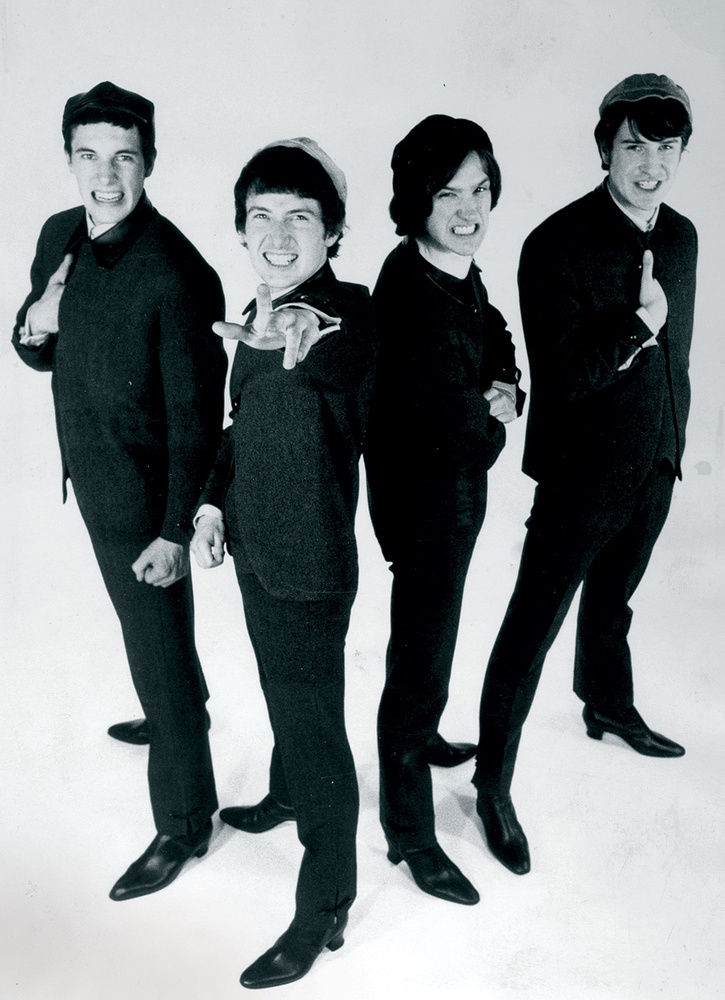 The Kinks in 1964. Left to right: Mick Avory, Pete Quaife, Dave Davies and Ray Davies.Photo: Getty Images
Born in Chicago in 1941, Talmy had an early interest in pop standards, folk and country music, as well as a love for rhythm and blues that was ignited by the Crows' doo‑wop hit 'Gee' when it charted in April 1954. That same year, his appearances as a contestant on the NBC‑TV show Quiz Kids helped him realise that he wanted to be in the entertainment business, although not in front of the camera.
"Even then I knew that I wanted to work behind the scenes,” he says, while acknowledging that, although he learned to play the guitar during his formative years, "I'm a good enough producer to never want to record myself.”
After his family relocated to Los Angeles when he was in his mid‑teens, Talmy began hanging out at Martoni's Italian Restaurant on Cahuenga Boulevard, a regular music business haunt whose parking lot housed an echo chamber that was used by the Wally Heider Recording facility across the street. This led to him meeting Phil Yeend, who owned Conway Studios, and who indulged Talmy's interest in technology by not only hiring him as a trainee engineer in early 1961, but also handing him his first solo session just three days later.
"Obviously, the boards then were a lot simpler than they are today,” Talmy says, "but it was still like being tossed off the pier, sink or swim. Conway was a three‑track facility with a fairly large room, as well as another one upstairs that we used from time to time because it belonged to one of Phil's friends, and while I was there I did everything from folk to jazz, orchestral to Latin.”
Thanks to working with such legends as guitarist/arranger René Hall, composer/producer Bumps Blackwell, session drummer Earl Palmer and jazz guitarist Tommy Tedesco, Shel Talmy learned quickly under the auspices of Phil Yeend, an Englishman who had previously engineered at IBC (International Broadcasting Company) Studios on Portland Place in Central London.
"He was a damned good teacher and allowed me a lot of latitude,” Talmy remarks. "That's why I spent a lot of time after‑hours experimenting with the isolation of instruments and different recording techniques. We were one of the first studios — and certainly the first one in town — to construct platforms that were backed with old carpet to isolate things like guitar amps. Nobody, at that time, was doing that, and neither were they experimenting with multiple microphones on drums. We were using up to a dozen when everybody else was using three or four, and when I did the same in London I was told I couldn't because it would phase. I said, 'Well, so be it,' and two or three months later everybody was using a dozen mics.
"Today, when engineers have unlimited tracks to work with, what a lot of them don't get is that decisions do have to be made at some point. We had to figure out how to balance things then and there, and if something worked out fine it was, apparently, because we had an ear for it. Certainly, with all of those extra mics the sound was infinitely better controlled than it would have been without them, and we were always breaking new ground because no one had done what we were doing back then. Anything went, and while a lot of things didn't work, a lot of things did. Of course, the equipment was primitive by today's standards, but we pushed it, and doing that was a hell of a lot more fun, quite frankly, than having everything at your fingertips.”
A Voyage Of Discovery
 Shel Talmy in the studio with the Who's Pete Townshend and Keith Moon.Photo: Colin Jones/Idols
It was this experimental approach to recording — along with a knowledge of how to handle artists and technical personnel, courtesy of watching his friend Nick Venet produce sessions at Capitol — that Talmy brought with him when, on 27th July, 1962, he arrived in England for what he thought would be a few weeks, as part of a European voyage of discovery. That and some acetates of Venet's signings that the producer generously told Talmy he could present as his own work in order to acquire some overseas gigs.
"When I turned up at Decca, the two things I chose to play for [A&R executive] Dick Rowe were the Beach Boys' 'Surfin' Safari' and Lou Rawls' 'There's Music In The Air', and I got hired the same day,” Talmy recalls, while pointing out that this was on an independent basis.
"During my short time in England I had already ascertained that no producers were getting royalties,” he explains. "They were all on a salary, and so I told Dick, 'This ain't gonna work. I need to be an independent producer.' Fortunately, Dick was very pro‑American and knew all about independent producers who earned royalties, and so [along with the likes of Joe Meek, Robert Stigwood and Tony Meehan] I was one of the first indie producers in London.”
Not that the UK was a hub of the worldwide recording industry in 1962.
"It wasn't yet known as anything,” Talmy remarks, "but timing is everything. In fact, I'd like to think that, if I had been at Decca a few months earlier, I wouldn't have turned down the Beatles!”
Instead, Shel Talmy soon found himself producing an Irish harmonica trio named the Bachelors, and after converting them into a singing group and rehearsing their harmonies he recorded their first hit, 'Charmaine', in 20 minutes. That was on 10th October 1962, just five days after the Beatles had released their debut single, 'Love Me Do'. In London for what he still thought was a short stay, Talmy eventually came to realise that he was very much in the right place at the right time, on the cusp of a cultural explosion in all facets of the British arts: music, film, fashion, you name it.
"Like a lot of kids back then, I gravitated towards [London's] Kings Road,” Talmy says. "There were about 400 of us who'd hang out there, and if there was a party we'd turn up en masse. What we did on the King's Road was what one was supposed to have done in college, staying up all night and talking about life. There was a huge energy, involving people who were in every conceivable section of the arts — Mary Quant, David Bailey, Michael Caine, they were all there, talking about what they wanted to do and how it was going to be done, and suddenly the whole thing exploded. I suppose we can credit the Beatles for enabling this to happen, but everyone else was poised to do whatever they wanted to do, and once there was an open window they all jumped right through it.”
The Ravens & The Kinks
 Shel Talmy today.
In December 1963, after running into Robert Wace in the offices of Mills Music on London's Demark Street, Talmy listened to a demo by the Ravens, a band that Wace was co‑managing with Grenville Collins and Larry Page. Comprising lead singer, songwriter, rhythm guitarist and pianist Ray Davies, his brother Dave on lead guitar, bass player Pete Quaife and drummer Mickey Willet, the Ravens' taped performances of largely original material impressed Talmy sufficiently for him to try to secure them a record deal, and within a month this had been achieved. Indeed, feeling less than indebted to Decca, after the company had declined his suggestions to sign both Georgie Fame and Manfred Mann, Talmy quickly persuaded Louis Benjamin at Pye to offer the band a contract.
That same month, January 1964, significant events followed one another in quick succession. Concert promoter Arthur Howes booked the Ravens for a package tour with the Dave Clark Five; co‑manager Larry Page suggested they change their name to the Kinks as a reference to their 'kinky'‑looking cloaks and leather boots; Shel Talmy helmed the recording of their debut single, an uninspired, Merseybeat‑style cover of Little Richard's 'Long Tall Sally', at Pye Studios in ATV House, near Central London's Marble Arch; that facility's Studio 2, where most of the Kinks' subsequent recordings would take place, opened later in the month; following Mickey Willett's December firing, session man Bobby Graham played drums in the studio, before Mick Avory became a permanent fixture; and when Larry Page heard the Kingmen's rendition of 'Louie Louie' (released in the UK on the Pye label), he reportedly encouraged the Kinks to emulate its raw sound. This advice seemed especially pertinent when 'Long Tall Sally' flopped. Yet, even though the follow‑up, 'You Still Want Me', went the same way, Pye kept trying to cast the band in the Merseybeat mould.
"Everybody was scared to death of Louis Benjamin,” remembers Talmy. "He had no musical background, he was a theatre manager, but he issued orders and that's why we did 'Long Tall Sally'. It was not my choice. We did a hasty session of four songs that I had no hand in picking, and none of them were memorable.”
It was actually booking agent Arthur Howes who, after the Beatles had performed the Little Richard classic during their opening night at the Olympia Theatre in Paris, suggested that the Kinks should record it. Nevertheless, while both band and producer were being forced to toe the company line, Ray Davies had other ideas. During the second week of March, inspired by an encounter with a female fan, he composed 'You Really Got Me' on the upright piano in the front room of the Davies family home in Muswell Hill.
"I wanted it to be a jazz‑type tune, because that's what I liked at the time,” he'd later recall. "It's written originally around a sax line... Dave ended up playing the sax line in fuzz guitar and it took the song a step further.”
According to Dave, "Ray was a great fan of Gerry Mulligan, and as he sat at the piano at home he sort of messed around in a vein similar to Mulligan and came up with this figure based on a 12‑bar blues.”
In a 2001 interview with the Austin Chronicle, Ray revised his earlier recollection: "When I wrote 'You Really Got Me', I wanted it to be a blues song, like a Leadbelly or a Broonzy song. But because I was a white kid from North London, I put in certain musical shifts that made it unique to what I did.”
Captain Of The Ship
After The Kinks unveiled the song at a club in Manchester, a demo of 'You Really Got Me' was tracked at London's Regent Sound on 18th March, yet it wasn't until 15th June that Pye finally relented and allowed the group to record it at Pye. This was because, since the Kinks' publishing company, Kassner Music, hadn't yet assigned its mechanical reproduction rights to Pye, the band could refuse to grant these until the number was re‑recorded. What's more, if Pye went ahead and released the existing recording, they might face legal action.
"We had a meeting,” Talmy recalls. "The band, the record company, everyone was present, and I made it clear that somebody had to be the captain of the ship, and that, because I had brought the guys in and had a contract and a royalty deal, the captain was going to be me. That meant we would do the songs we wanted to do in the way we wanted to do them. At this point, the question was whether Pye was going to drop the band or allow me to do it, and as things turned out I was allowed to do it. Why? Mainly because, as part of the wonderful deal that I'd made for myself, I was liable for the studio costs, which were going to be deducted from my pittance of royalties even though I didn't own the recordings. Instead of the band making a deal with me as an independent producer, they had been signed directly to Pye. So Louis Benjamin had nothing to lose... That's the last time I ever made that mistake.
"Ray always resented the fact that I was choosing the material and righting the ship. He was a wonderful songwriter, extremely prolific — he could go away and come back the next day with a dozen songs, most of them very good, with two or three nuggets. So, after the fiasco of the first four sides, he specifically wrote 'You Really Got Me'. He thought that was the best he could do in terms of a song for a single and I agreed. We all agreed. We thought it was a hit.”
Having entered the picture after Mickey Willett's dismissal, it was Shel Talmy who recruited session drummer Bobby Graham for the Kinks' studio sessions, and Graham was still around when they entered Pye's new Studio 2 to record an altogether slower and bluesier version of 'You Really Got Me' than that which would subsequently be released. This, of course, adhered to Ray Davies' vision of the song when he was composing it, yet he didn't like the echo‑laden end result.
"After it was done, I said it was over‑produced and I didn't want to put it out,” Davies later remarked. "[I thought] we should do it on one‑track and get the raw sound we wanted.”
"I actually think the slow, bluesy version would have also become a number one hit,” Talmy now says. "However, when we all listened to it, Ray wanted to try doing it faster and he was right.”
Which is why, on 12th July 1964, the Kinks recorded a second version of 'You Really Got Me' at IBC Studios, the UK's leading independent facility, where the indie producer could enjoy greater freedom.
"We wanted to get away from Pye Studios, where [the execs] would have been breathing down our necks,” Talmy explains. "IBC, which had the deserved reputation of being the progenitor of most of England's best engineers, was probably my favourite studio there. The live area had very good acoustics and great natural echo chambers, while the upstairs control room had IBC's own 24‑input board, Altec speakers, an Ampex three‑track machine and an Ampex mono machine.
"At Pye, where I was paying for the sessions because of good old Louis [Benjamin], there was a difference in price if you recorded in mono or stereo, and so that's why the first few records were mono. 'If I'm paying for it, fine — we'll do it the cheaper way!' At IBC, on the other hand, we worked three‑track, albeit that the tapes eventually got lost because Pye were a bunch of boobs.”
The Kink Kontroversy
None of those involved were exactly afraid to speak their minds, and if Dave Davies has since joked that Shel Talmy was "more like a referee than a producer,” it was for a good reason. After all, when personal and professional disagreements weren't provoking the band members to clash onstage — at Cardiff's Capitol Theatre in 1965, the usually mild‑mannered Mick Avory clobbered Dave with his hi‑hat pedal after Davies had kicked over his drum kit as revenge for Avory refusing to side with him in a drunken fight the previous night — they were duking it out in the studio, and Talmy was often caught in the crossfire.
"There was always tension between Ray and Dave,” he says, "and Pete would be the arbiter from time to time. In fact, if things got too heavy‑duty when we were recording — which did happen very occasionally — I would just call a 15‑minute coffee break and let them fight it out. Then again, from the get‑go Ray not only resented me choosing the material, but he also resented Robert Wace and Grenville Collins. For a while he buddied up with Larry Page but then wound up hating him, and so I just tried to stay away from all that shit and focus on their abilities as musicians.
"Pete Quaife was an excellent bass player, Dave was one of the great underrated guitarists of the rock era, and Ray was an adequate — though not great — guitarist, mainly on rhythm. That's why, when we finally got to record an LP after 'You Really Got Me' became a hit, I hired Jimmy Page to play rhythm guitar. Ray didn't want to play; he just wanted to concentrate on singing.”
All of which brings us to the main bone of contention about 'You Really Got Me': whether the 20‑year‑old Page's 1964 activities as a session musician also saw him fill in for Ray Davies on rhythm guitar or, indeed, Dave for the solo.
At various times, both Shel Talmy and future Deep Purple co‑founder Jon Lord — who played keyboards on 'You Really Got Me' — have asserted that Jimmy Page did provide rhythm, not lead guitar, on the track, before playing the same role on the Kinks' first album. However, Page and Ray Davies beg to differ.
"I didn't really do that much on the Kinks' records,” Page admitted in a 1972 interview. "I know I managed to get a couple of riffs in on their album, but I can't really remember. I know that Ray didn't really approve of my presence. The Kinks just didn't want me around when they were recording. It was Shel Talmy's idea.”
In Ritchie Yorke's 1976 book, Led Zeppelin: The Definitive Biography, Ray went a little further: "Jimmy Page played tambourine on 'Long Tall Sally' because he came into the studio as a friend of Shel Talmy's. Dave Davies did all those solos and Dave started that sound. The [version] of 'You Really Got Me' that was actually released was the third [recording]. There was a demo thing with Dave playing lead, a second cut which may have had Jimmy Page on it (and which Pye Records still have in their vaults) and a third which definitely had Dave on it. I know because I was standing right next to him when he played on it. And that's the one which was released. Jimmy Page did play tambourine on our first album. It's very good tambourine and he's a very good musician. I'd use him if I was producing a recording.”
Ouch. Page wasn't amused. "I never played tambourine on the damned records,” he fired back the following year. "I played guitar. But I didn't play on 'You Really Got Me' and that's what pisses [Ray] off.”
Today, Shel Talmy isn't sure whether or not Jimmy Page was on the session. Nevertheless, he and everyone else do agree that Dave Davies played lead on a Harmony Meteor guitar that was hooked up to an Elpico amp and slaved to a Vox AC30. Furthermore, its distortion was largely the result of him having already used a razor blade to slice the speaker cone of the Elpico — affectionately referred to as his "fart box” — and puncturing it with knitting needles so that the fabric contributed to the sound as it vibrated.
"It was there the first time they played that song in the studio and it was Dave's invention,” confirms Talmy, regarding the instantly identifiable riff that, according to Ray Davies, evolved while working out the chords to 'Louie Louie'.
"The shitty little amplifier made it raunchier, people used to kick it to make it sound even shittier, and I enhanced it by using a couple of mics and pushing it on the board,” Talmy continues. "I brought it up on a couple of faders and limited one like crazy while keeping its level just under the one that wasn't limited. That made it really raunchy, and overall the sound was my sound. That's what I came with from America. I was into doing R&B and rock & roll — or whatever passed for it at the time — and the meters were always in the red. At Conway, we had pushed things until we couldn't push them any further, and when I arrived in England I knew I was introducing something different. I think the way English music was described back then was 'polite', and so what I did was impolite.”
Pete Quaife's Fender bass was individually miked, as were the rhythm guitar (whoever it belonged to) and Jon Lord's keyboard, whereas Bobby Graham's drums were recorded with Talmy's innovative multi‑mic setup. And it was apparently Shel Talmy (not Jimmy Page) who made what he describes as a "Hitchcockian appearance” by playing tambourine on 'You Really Got Me'.
"I can't now recall which mics we used,” Talmy states, "but I do know that one was placed about three inches from the top of the snare, another was underneath, and then there was a mic inside the kick — cushioned to provide a nice thump — as well as mics on each of the toms, one on the hi‑hat, one on each ride cymbal and two overhead. Since all of these were compiled onto one track, I of course had to balance them before we began recording.”
The Faster The Better
When they did start recording, things proceeded fairly quickly, as was the MO back then. "Nobody messed around,” says Talmy. "In those days, if you spent a lot of time in a studio it meant you were a really shitty band and couldn't play very well. That was the philosophy, which of course did a 180 not all that long afterwards.”
According to Ray Davies' autobiography, X‑Ray, there were two takes of 'You Really Got Me', and on the second, "When Dave played the opening chords, Bobby Graham forgot the complicated introduction he had planned and just thumped one beat on the snare drum with as much power as he could muster, as if to say, 'OK, wimp, take that!'”
As they approached the guitar solo, Ray yelled encouragement at Dave "and spoiled his concentration momentarily. He looked over at me, as if he had done something wrong.” Then, realising he hadn't, "His face broke into that arrogant sideways smile that I had learned to love and hate over the years. The little runt hadn't even heard me shout.”
The second take was the keeper, and there were also three or four takes of Ray's typically disaffected lead vocal. Since this initially sounded too American, "I just sang the way I felt it and it sounded like me,” he remembered. "To double‑track, we just copied it onto another machine and did the vocals whilst they were copying it.”
In his 1984 book The Kinks: The Official Biography, author Jon Savage wrote, "What Shel Talmy and the Kinks did with this particular record was to concoct the perfect medium for expression of the adolescent white aggression that has been at the heart of white popular music. 'You Really Got Me' is that rare thing: a record that cuts popular music in half.”
Those involved in its creation apparently agree. "When I left the studio I felt great,” recalled Ray Davies, whose fruitful efforts on behalf of the song established him as the chief composer and — at least in his eyes — the leader of the Kinks. "It may sound conceited, but I knew it was a great record... I said I'd never write another song like it, and I haven't.”
This included 'All Day & All Of The Night', which was written and recorded specifically as a follow‑up to 'You Really Got Me', with its sliding power‑chord riff, as well as the similar beat, guitar solo and backing vocals. A UK number two, it, too, peaked at number seven in the States.
"After 'You Really Got Me' became a huge hit, Louis baby decided that Pye would pick up the charges for the studio, and that meant we could afford to record on three‑ and then four‑track and do true stereo mixes,” says Shel Talmy, who continued his collaboration with the Kinks until their agreement expired in 1967, selecting the material, helping to arrange it and producing hits that included 'Tired of Waiting For You', 'Dedicated Follower Of Fashion', 'A Well Respected Man', 'Sunny Afternoon', 'Dead End Street' and 'Waterloo Sunset'.
"When I occasionally listen to those old recordings, they still blow me away,” he concludes. "It was a golden time, and I feel privileged to have been involved.”
Shel Talmy & The Who
The Who's Pete Townshend wrote 'I Can't Explain' in homage to 'You Really Got Me', and it was as a result of hearing a demo of the former song played to him over the phone that Shel Talmy first became interested in the Who.
"I went to see them rehearse at a church hall and it must have taken me about 30 seconds to say, 'This is the best rock band I've heard since I've been here,'” Talmy recalls.
In signing the band to his own production company and securing them contracts with Decca Records in the US and its UK subsidiary Brunswick, Talmy had clearly learned his lesson following the deal that he'd obtained for the Kinks with Pye. This time around, in return for paying for studio time he owned the Who's recordings. The move proved to be highly profitable in light of the band's first three singles, all released in 1965: 'I Can't Explain', 'Anyway, Anyhow, Anywhere' — whose intentional guitar‑solo feedback initially caused Decca's execs to think they were listening to a faulty pressing — and the anthemic 'My Generation', which lent its name to the group's debut album, a collection of R&B covers and originals that included 'The Kids Are Alright'.
As with the Kinks, Talmy's American background and his own sensibilities resulted in taped performances whose raw edge and unbridled aggression — thanks to Townshend's slashing, high‑volume power chords, Keith Moon's manic drumming and Roger Daltrey's ballsy vocals — not only shook up the British music scene, but also laid the foundations for guitar rock in general.
"I never, ever had a problem with them in the studio,” Talmy remarks. "My favourite out of the whole bunch was Moony — he was great, I loved him. He's still the greatest rock drummer of all time as far as I'm concerned. Back then, personality‑wise, Pete had two chips on his shoulder — God knows why; Daltrey fought with everybody, including Townshend, and he certainly didn't get on with me; and Entwistle probably said six words during the entire time I recorded the Who.”
Unfortunately, Shel Talmy was out of the picture after the Who recorded their fourth single, 'Substitute' (1966), having received a letter from Kit Lambert informing him that his services were no longer required and that he should consider his contract null and void. Talmy didn't consider any such thing. Suing for breach of contract, he won the case, while Lambert, who managed the group with Chris Stamp, realised his intention of assuming the production reins.
"I always consider myself extraordinarily fortunate that I wound up working with two of the great rock songwriters of all time,” he says in reference to Pete Townshend and Ray Davies. "Maybe my mojo was in the right place or I was a great judge of talent — take your pick. Either way, my experiences with them were unforgettable.”
What Talmy Did Next: Bowie To Pentangle
In addition to his landmark collaborations with the Kinks and the Who, Shel Talmy's other production assignments during the 1960s included singer/songwriter Davy Jones (who would later change his name to David Bowie); Australian group the Easybeats, for whom he produced the hit single 'Friday On My Mind' (subsequently covered by Bowie on his Pin‑Ups album); British pop duo Chad & Jeremy; American acoustic folk‑rockers Pentangle; the Creation, a psychedelic‑mod outfit that, despite their lack of commercial success, would later enjoy a certain cult status; and Manfred Mann, after Mike d'Abo had taken over on lead vocals in place of Paul Jones.
"I couldn't have had much more variety,” comments Talmy, who returned to Los Angeles in 1979. "When I worked with him, I thought Bowie was brilliant. I thought he was the smartest rocker I'd ever met, and I still do. He was hugely talented, but unfortunately he and I were about six years ahead of where the market was [in the mid‑'60s], because what we did was in no way different to what he eventually scored with.
"Then again, the Creation should have been superstars. They had some hits in Europe and they were actually a huge influence on the Who, but they hated each other and, despite trying everything possible, I could not keep them together. I also own those recordings, and some of them have been used on TV and in the film Rushmore, but so what if they're now cult heroes? They should have been way bigger than that.”
These days, disillusioned by a music business that he considers to be devoid of the talent and the material to which he was once accustomed, Talmy steers clear of the whole scene.
"Believe it or not, I still get one or two submissions a month from bands that would like me to produce them,” he says, "but I have not heard anything in years that would make me want to spend time in the studio...”