

Intrusive sibilants can ruin an otherwise good-sounding vocal track, and conventional de-essers are often of limited use. Can Eiosis's radical new design do any better?
Over the last decade or so, the cutting edge in audio processing has belonged increasingly to the world of plug–ins. Advances in computer power have empowered developers to explore weird and wonderful new effects, and devise new and more effective problem-solving tools. It seems that everyone and their dog now makes a convolution reverb, or a sophisticated noise-reduction suite, or an intonation plug-in that can make Geri Halliwell sound like Aretha Franklin.
Yet in all the white heat of this technological progress, the humble de-esser has been largely overlooked. The industry standard, or at least the near-universal choice of mix engineers in our Inside Track series, is still Waves' Renaissance De-esser, a plug-in which dates from the very start of the century. It's done good service over the years, but if you want a modern, bright vocal sound without spitty reverbs and delays, I find it rarely gets you all the way there. Until now, the only way to really nail the problem has been to draw in automation curves by hand, a process which brings new meaning to the word 'tedious'.
I say "until now" because Eiosis's E2 De-esser brings some new thinking to the stale world of sibilant reduction. Existing software and hardware de-essers, including Renaissance De-esser, tend to work in much the same way: the side-chain of a compressor is heavily filtered so that the compressor responds only to bursts of energy in the sibilant region of the frequency spectrum (typically around 5kHz for a male vocal, rather higher for most female vocals). The compressor then ducks either the entire signal at those points or, in more advanced designs, reduces the level only of the sibilant frequencies. Used correctly, this kind of de-esser can make some reduction in the harshness or obviousness of 'S', 'T' and 'F' sounds, but you quickly reach a stage where they begin to sound lispy and unnatural; and using a high-frequency 'air' or shelving EQ to brighten the vocal then risks emphasising the very problem you were trying to get rid of.
Sibil Engineering
Formerly known as Eliosound, Eiosis are the French software developers responsible for the very fine Air EQ plug–in, which I've praised several times in these pages. Their de-esser is intended to be the first in a new 'E2' range, and is available in all the usual native Mac and Windows plug-in formats, and also as a TDM plug-in for Pro Tools. Refreshingly, you should be able to choose whether to authorise it to a Synchrosoft or an iLok key, but at the time of writing, the Windows version only supports the former.
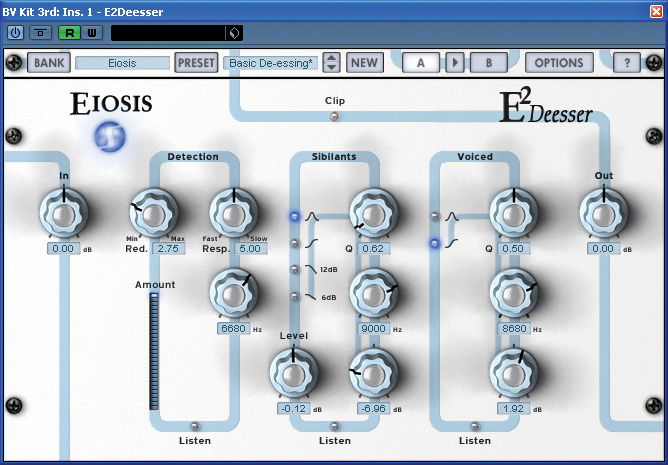
A glance at the plug-in window will tell you that E2 De-esser deviates from the traditional design described above. There is still a detection algorithm, which is somewhat akin to the filtered compressor side-chain you'll find in conventional de-essers, except that it is independent of input level. The radical part of Eiosis's design lies in how the information produced by the detector is dealt with. Following the detector, the signal path is split into two completely independent sections called Sibilants and Voiced. As long as no sibilants are detected, the input audio is routed to the Voiced section, but when an 'S' or 'T' comes along, the routing momentarily changes, and the audio is routed to the Sibilants section instead. Crossfading ensures that these transitions are not too abrupt, and (adjustable) look-ahead processing allows E2 De-esser to anticipate sibilants in time to 'switch tracks'.
Placing E2 De-esser on a vocal track and hitting either of the Listen buttons is a weird experience if you're used to conventional de-essers. Press the Voiced Listen button and you'll hear your vocal track with all the sibilants apparently snipped out; press the Sibilant Listen button instead and you'll hear silence, punctuated by occasional consonants appearing out of the ether. The misleadingly named Reduction knob in the Detection section sets the sensitivity of the detector. There's also a dial allowing you to fine-tune the detection by homing on the frequencies where the sibilance is most apparent, while a Response control tells E2 De-esser how swiftly to react when a sibilant is detected. Too fast a response may see transients treated as sibilants, while overly slow response times may miss the onset of sibilants.
Polish The Spit
The absolute distinction between sibilants and voiced sounds opens up lots of creative possibilities for adding other plug-ins into the mix (see box), and E2 De-esser provides its own tools for processing both paths. The most basic of these is the Level control. This simply adjusts the gain in the Sibilant path, so turning it down will make your sibilants quieter. Used on its own, this is of limited value, but it's paired with a flexible filter that allows you to equalise the sibilants in a variety of ways. The filter response can be a parametric curve, high shelf or choice of 6dB/octave and 12dB/octave low-pass algorithms, and its corner or centre frequency is set independently of that in the Detection section.
In conjunction with the separate Q parameter, this allows you to home in, in a very detailed way, on the most offensive aspects of the sibilance. If 'esses' and 'tees' are ringing at a particular frequency, a narrow but deep parametric cut might be appropriate, while if they are just over-prominent, a combination of level cut and gentle shelving EQ will de-emphasise them in a natural way. In some circumstances, where a swingeing high-frequency cut in the EQ section is causing the sibilants to disappear altogether, it's actually effective to use the Level control to bring their overall level up.
There's also a band of EQ in the Voiced section, which provides an easy way to add brightness to the rest of the signal. It uses the same algorithm as Air EQ, and sounds similarly impressive, with a choice of parametric or high shelving filter.
In Use
 Though there are more controls than on your average de-esser, the interface is very easy to use, with some nice additional touches.In action, the first thing that hits you about E2 De-esser is the accuracy of its sibilant detection. Eiosis recommend using it as the first stage of a signal chain, prior to compression, and even when the level of the incoming vocal fluctuates quite a lot, the detection algorithm tracks it very well. On all the vocals I tried, it triggered reliably and consistently across a wide range of sensitivity settings, and the two Listen options make it very easy to check this.
The next thing that strikes you is how effective it is at dealing with a variety of sibilance problems. For my first test, I threw it in at the deep end, on a male lead vocal which had caused me no end of trouble. The vocal sat best in the mix if I added a high shelving boost and used fairly prominent reverb and delay, but all of these compounded the original recording's tendency to exaggerate 'S' and 'T' sounds. I had already done what I thought was a finished mix, using Waves' Renaissance De-esser, but the results had been something of a compromise. Simply substituting E2 De-esser for the Waves plug-in was a revelation, even on the default setting. After some experimentation, I settled on a 5dB shelving cut at 5.8kHz, combined with a 2dB gain drop. These settings all but eliminated the harshness and spittiness of the sibilants, with almost no audible side-effects. Using the EQ in the de-esser's Voiced section to deliver a high shelving boost then made it straightforward to deliver the necessary overall crispness without undermining the sibilant reduction.
E2 De-esser faced an even sterner test on a collection of badly recorded female backing vocals I'd been sent, in which a general dullness of tone was complemented by nasty, over-prominent sibilants. Unsurprisingly, perhaps, it took rather longer to set up, but the results were still very impressive. On one particular track I ended up treating the sibilance with a brutal 12dB/octave filter turning over at 4.6kHz, and adding a 13dB level gain to compensate. The processing was audible when the track was soloed, but in context it sounded surprisingly natural, and made it possible to mix a vocal that had been borderline unusable.
Hip To E Squared
In short, with every source I tried, E2 De-esser was orders of magnitude more successful than any other de-esser plug-in I had available to me. There's a comprehensive preset library, but I generally found it easier to set up by ear, a process made easier by the Listen modes and the ability to A/B two sets of settings. Because sibilants are processed separately from the rest of the audio, you can treat them as aggressively as you like without affecting the overall sound of a vocal.
The plug-in interface is generally friendly and easy to navigate, although some of the parameter names and descriptions are a little misleading, and I did wonder whether the metering could have been organised better. There's a multi-segment meter labelled Amount, which lights up to varying degrees when sibilants are encountered, but it's not entirely clear what this represents. I don't think an all-singing, all-dancing FFT display is required, but more could be done to make it clear whether the audio is flowing through the Sibilant or the Voiced path at any given moment.
Beyond that, the only functional improvement I would like is the ability to set the attack, release and look-ahead or crossfade times of the detector independently. At present, the Response dial affects all three simultaneously, in a 'coherent' way, and for most purposes, this works well. However, unlike a conventional de-esser, the amount of sibilant reduction you can achieve tends to be limited not by the sound of the processed sibilants, but by the crossfades between sibilant and voiced sounds becoming noticeable. There were occasions when I'd have liked the sibilant reduction to kick in earlier and more gradually.
All in all, though, I'm hugely impressed with this plug-in. Eiosis have applied fresh thinking to an old problem, and their solution leaves existing de-esser plug-ins in the dust. Renaissance De-esser has had a long and distinguished career, but now that E2 De-esser is installed on my computer, I can't see myself going back. I don't know what Eiosis are planning next in the E2 series, but if it's as good as this, I can't wait to find out.
Alternatives
There are plenty of existing plug-in de-essers, but as far as I know, all of them use the conventional approach based on wide-band or multi-band compression. However, the recent NAMM show saw a couple of interesting developments which might provide competition for Eiosis. Like E2 De-esser, both Sonnox's forthcoming SuprEsser and McDSP's DE555 (geddit?) feature intelligent, level-independent analysis of the incoming signal, although neither seems to offer the same wholesale separation of sibilant and voiced sounds into different signal paths.
Doing The Splits
Because E2 De-esser divides the incoming audio up into sibilant and voiced sections, you can copy your vocal to a duplicate track within your DAW and use two instances of the plug-in in Listen mode, so that one track produces only voiced sounds and the other only sibilants (it's a shame there's no off-line AudioSuite version for Pro Tools that would allow you to apply these edits permanently). This would allow you to, for example, apply a high-frequency boost only to the voiced part, using the EQ of your choice, or to eliminate all sibilants from your reverb send, or to use different reverbs on the two components of your vocal. The manual suggests lots more interesting applications for non-vocal sources, such as processing the attack of a conga or other hand drum independently of its sustain.
Pros
- A big step forward from existing de-esser plug-ins in terms of transparency and effectiveness.
- Easy to set up and use.
- Very flexible.
Cons
- Metering could be more informative.
Summary
E2 De-esser is a very clever new solution to the problem of sibilant reduction, and is cabable of remarkable results.