


It's often necessary to work on headphones in the home studio, even when mixing. So what headphones should you choose, and how do you go about getting the best results?
At one time or another, we all resort to using headphones while trying to assess a mix. There are numerous occasions when such a tactic is required: we might be working late at night where monitoring on loudspeakers is too antisocial; or perhaps we are recording on the move with portable equipment, so using loudspeakers becomes impractical. It might even be that the monitoring room has poor acoustics or that the monitors are unfamiliar, and we either don't trust or can't rely on what we are hearing from the speakers. It may also be that we are recording in the same room that we are monitoring in, so loudspeakers are, again, inappropriate. Whatever the reason, working with headphones is a common practice, and in this article I will work through some of the techniques that can make using headphones more reliable and productive.
The Pros & Cons Of Mixing On Headphones
The first thing to say is that, generally, headphone monitoring is almost always only a 'second best' option. The vast majority of recorded sound is intended for listening via loudspeakers and it is important to recognise this fact. The simple amplitude differences we encode our stereo signals with to provide positional information (via the ubiquitous pan pot) only create a believable impression of spatial positioning when auditioned via a pair of correctly sited loudspeakers.
 Speaker listening is different from headphone listening, because not only can sound from each speaker reach the opposite ear, but there is also an important contribution made by reflected sound arriving at the listener's ears from different angles.The way in which our ears interpret sounds from loudspeakers is inherently very different to that from simple headphones. Stereophony is an auditory illusion — much as watching 25 still pictures each second in rapid succession creates the visual illusion of naturally moving images. When listening to a loudspeaker, its direct sound inherently arrives at both ears, and if the speaker is positioned off to one side (consider the left-hand speaker in a stereo pair, for example), then its sound will reach the closer ear slightly earlier than it reaches the more distant one. The fixed time-of-arrival differences for each ear combine with the variable amplitude differences encoded between the channels of the stereo audio material, and fool our sense of hearing into perceiving different time-of-arrival information for each reproduced sound, and thus discrete directions.
Headphone listening works in a very different way. When wearing headphones, each ear can only hear the sound from its own earpiece — there is no natural way in which the sound from the left earpiece can reach the right ear, for example. As a result, the recorded amplitude differences between the left and right channels don't create the required time-of-arrival differences. The consequence is that most of us perceive sounds coming from inside our heads, spaced roughly on a line running from ear to ear.
There are a few systems which attempt to overcome this deficiency by trying to introduce the crosstalk effects inherent in loudspeaker monitoring. However, emulating a loudspeaker listening environment on headphones is more complex than simply bleeding a little bit of each channel into the opposite earpiece. The crosstalk has to be delayed by an appropriate amount and be spectrally shaped to reflect the natural acoustic artefacts introduced when sounds pass around the human head. This combination of processing is often referred to as 'head-related transfer functions' or HRTF, but I am not aware of any commercial examples that work well enough to be considered for accurate mixing duties. Having said that, the increasingly sophisticated DSP process of convolution has a lot to offer in this context, and at least one extremely promising experimental system has been developed, as described in the 'Binaural Room Simulator' box, below.
The upshot is that if we are to use headphones for critical monitoring we are going to have to learn how to interpret what he hear and relate it to the effects portrayed over conventional loudspeakers.
Surround Mixing On Headphones: Developing The Binaural Room Simulator
If mixing stereo in headphones is difficult enough, how on earth can we hope to mix surround sound? Well, there is a solution, but at present it is impracticably expensive and remains a developmental project. The German research institute, the IRT and Studer have co-developed a Binaural Room Simulator (BRS). Essentially a pair of very accurate stereo headphones fitted with a positioning sensor which tells the apparatus which way the operator is facing. This is actually one of the most expensive elements of the system, but is crucial to its effectiveness.
The system involves two separate stages — a programming phase and a reproduction phase. In the programming phase, a dummy head (such as Neumann's KU100) is placed in the ideal listening position of a real control room. Special impulse test signals are then reproduced over each loudspeaker in turn and the signals captured by the two microphones placed in the 'ears' of the dummy head are stored for later analysis. This process is then repeated with the dummy head rotated in small increments (say, five degrees) over a ±45 degree range. The stored data is then translated into highly detailed convolution blueprints of how the specific monitoring room reacts to each surround sound channel.
The reproduction phase uses this convolution data to process each of the input surround channel signals to generate the corresponding stereo binaural sound field, and all of the binaural sound fields for each channel are combined before presenting them to the stereo headphone earpieces. The position sensor on the headphones tells the convolution processors which particular set of data to use, so that, as the user moves his or her head, the corresponding convolution data is applied, and the perceived sound stage remains stationary for the listener, just as it would in real life. Although this adds a huge amount of extra complexity to the system it was actually found to be an essential requirement if the illusion of listening to a real surround sound monitoring system were to work reliably.
The huge amount of processing power required to convolve six channels of audio with sufficient accuracy and resolution for high-quality monitoring currently makes this approach too expensive for a viable commercial application, but a number of research units have been constructed and I have been fortunate enough to audition the system for myself. While it was possible to identify minor defects in the audio quality of the early system I auditioned, its ability to portray a totally believable and stable surround sound stage was amazing, and clearly this approach has a great deal to offer in the years to come.
Apparently its most recent practical outing was for the New Year's Day concert broadcast from Vienna at the start of this year. The state broadcaster, ORF, decided to launch a new surround-sound transmission service with this event. However, the sound control room area of their Outside Broadcast truck was far too small to set up a proper surround-sound monitoring system. So, the balance engineer employed the experimental Studer BRS system during rehearsals to establish the surround sound mix, and with great success.
This is certainly one technology to watch. As the cost of DSP continues to fall, this will suddenly become a more viable commercial proposition, whether for stereo or surround-sound applications. When it does, headphone monitoring will suddenly become far more accurate and dependable than conventional loudspeaker monitoring for those of us with less-than-perfect control-room acoustics. After all, the system could be programmed with convolutional data gathered from one or more of the best studio control rooms on the planet, which we could then all share from the comfort of our own home studios!
Differences Between Headphone & Speaker Monitoring
The most obvious difference between monitoring via headphones and loudspeakers is the impression of stereo positioning, assuming the use of conventional pan-pot amplitude-difference techniques. If using one of the more complex panning systems that involves time-of-arrival differences and even HRTF functions as well (something which is really only practical in some of the high-end digital consoles) then the imaging may translate more easily. In general, though, when listening via headphones the spatial image will be spread along a line running between the ears, and most definitely inside the head. We all get used to this fairly easily, but the real problem is that the linearity of the panning proportions is rather different from that experienced on loudspeakers. There is no simple way to adapt to this other than by building experience.
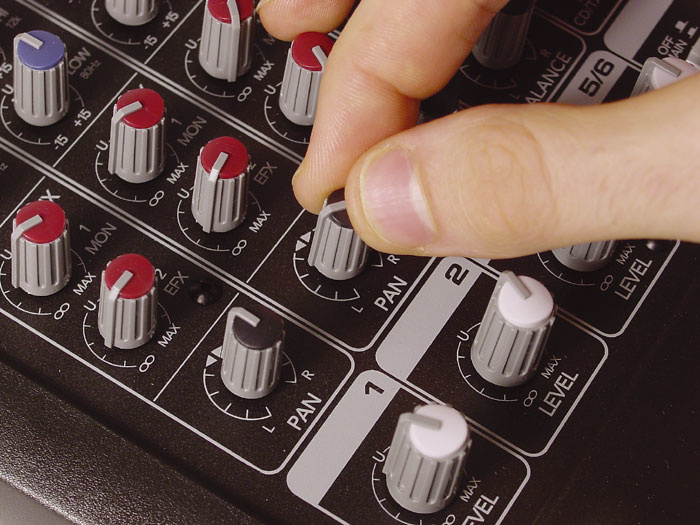 Panning in particular is very difficult to judge on headphones, so it's important to compare your perceptions of different panning amounts on headphones with the results on speakers in order to gain experience.It takes a considerable time to be able to judge panning amounts over headphones. It's not impossible to do, but it is very hard. To be honest, I think most of us probably rely more on our eyes when mixing on headphones, noting the positions of the pan pots visually rather than judging positions with our ears, as we would when monitoring on loudspeakers. Of course, extremes of panning aren't the problem — its the 'in between' settings which are vague and difficult to tie down precisely. Even deciding on an accurate centre position can prove difficult for some people!
The trick is to practice first with a single source (best to use a mono signal with a broad frequency spectrum) and compare the position you perceive when monitoring in headphones with the position as perceived over loudspeakers. Once you get used to how these two things relate, you can then relate them to the specific panning law of the mixer you're using — panning laws will vary with different equipment.
Another major difference between headphone and loudspeaker monitoring is the way the brain processes the information it receives through the ears. With loudspeaker monitoring, because both ears hear both sources, the brain processes the information it receives jointly and a kind of stereo masking function applies. However, when listening to headphones, the brain processes the data in a completely different way, handling information from each ear independently, so a degree of 'unmasking' occurs. The result is that certain elements in the mix — or abrupt changes to the mix — that may be inaudible when auditioned on loudspeakers become glaringly obvious on headphones. And, occasionally, the reverse is also true.
Finally, the obvious lack of any physical impact (or 'vibration' for the more genteel) from low-frequency signals may create the impression that the low end of the mix is lacking in some way — and this can be made worse by the rather odd character of bass frequencies in some headphones.
Using Headphones Safely
Obviously, listening to loud sounds over prolonged periods is not a good idea, because hearing damage is cumulative and can be permanent. To make matters worse, the better the monitoring equipment (in other words, the lower its distortion levels) the quieter it seems to be, so it's easier to end up listening at dangerously high levels. With loudspeakers, even really good ones, you tend to know when it's getting too loud, because your internal organs start being reorganised with each beat of the bass drum, the ornaments start falling off the mantelpiece, and the neighbours send for the Environmental Health officers! None of these side effects happen when using headphones, and even the blood spurting from ruptured eardrums is concealed by the headphone earpieces! (Only joking. The blood would drip, not spurt...)
 Canford Audio not only sell a variety of different models of headphone limiter, but also offer a service for fitting BBC-designed passive limiters into individual pairs of headphones.The basic point is that you need to be extra careful when using headphones. The source of sound is very close to the ear; you may be tempted to monitor at elevated levels to minimise the intrusion of external ambient noise; and you will not feel the physical effects of high sound levels which may, in turn, subconsciously encourage you to turn the level up even more. With the kind of high-output headphone amps now available in all manner of equipment, in combination with the use of low-impedance headphones, it is very easy to generate seriously high levels.
Naturally, a degree of common sense is required, but as human perception is easily misled I would recommend taking five- or ten-minute breaks every half hour or so to let the ear rest and re-establish a sensible reference level. Go and make a cup of tea, or go outside for some fresh air — whatever it takes to get you away from the studio for a while and let the ears recover. If, when you come back in, the headphones seem very loud, take that as a hint that you are monitoring too loud and are risking hearing damage! Obviously, there will be times, especially if you are editing audio tracks, that you need to crank the level up to make subtle artefacts more audible. Just remember to turn the level down again afterwards, both to get a realistic appreciation of the edit and also to preserve your hearing.
It is increasingly common in professional circles now to fit passive limiters to the headphones to ensure that the levels cannot exceed some predetermined level (typically between 85dBA and 110dBA, the actual figure being determined by the amount of time users are likely to be exposed to high-level sound). Canford Audio manufacture and fit such devices originally designed and implemented by the BBC. You can buy a few models of headphones with suitable units already fitted, including Beyerdynamic DT100s and Sennheiser HD480s, or can supply your own headphones to Canford, who will then test them, select the correct limiter device, install and calibrate it. I can thoroughly recommend these devices, although fitting the limiter can be as expensive as buying the headphones themselves on a one-off basis, so it may only be a viable proposition for those operating on a commercial basis, and with one eye on the Health and Safety regulations.
Choosing The Right Headphones
There are several variations on the theme of headphones, but the two principal types in use in studios and control rooms are closed-backed and open-backed. These terms refer to the mounting arrangement of the transducers within the headphones. A closed-backed headphone seals the transducer within its enclosure so that virtually no sound escapes to the outside world. Equally, little of the ambient sound gets in. This type of headphone is the best choice for the studio floor, enabling the musicians to hear what's going on without the headphone signal bleeding into the microphones.
 These Sennheiser HD600s provide extremely high-quality sound for mixing purposes, but their open-backed design makes them unsuitable for many studio recording tasks, and their 'Y'-shaped cable requires more care when taking them off.However, until relatively recently, most closed-backed headphones sounded pretty grim — boxy, dull, and lacking in air and openness. This is not really a problem when overdubbing or playing along with others, because it only has to provide a cue, after all, but making critical mixing decisions is almost impossible if the sound quality is poor. However, some of the more modern designs can produce a pretty respectable sound, and models worthy of consideration and auditioning include the AKG K271, Beyerdynamic DT150, Sennheiser HD250, and Sony MDR7506 and MDR7509. The last two models are particularly impressive, and I often use the MDR7509s myself when mixing on headphones.
The alternative open-backed headphone design has traditionally provided the best sound quality in headphone monitoring. The downside, of course, is that this kind of headphone spills quite a lot of sound into the local environment, and also provides little attenuation of ambient sound. Whether this is a real, practical problem depends on the particular circumstances. For late-night mixing, open backed headphones may be perfectly acceptable, whereas for location recording they probably won't be. The better options worth investigating here include the AKG K240, Beyerdynamic DT990, Sennheiser HD600, and Ultrasone HFI2000. I relied on the almost ubiquitous K240s for many years until replacing them with the HD600, but the Austrian model is still going strong in reserve!
It will come as no surprise that, in general, the better the headphone, the more it costs. For accurate mixing duties I would suggest pairs costing about £100 in the UK to be the practical minimum as far as quality is concerned, with the best models costing around twice that amount. While some may initially baulk at such a cost, in reality even £200 is trivial in comparison with a pair of decent studio loudspeakers and an amplifier of similar resolution.
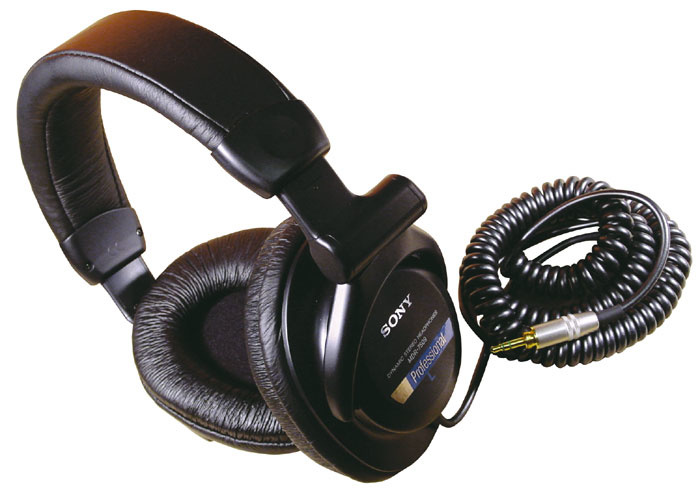 Although closed-backed headphones often suffer sonically, the Sony MDR7509s shown here buck the trend, and would be a good choice for mixing duties. The single cable from the left headphone makes this model easy to put on and remove, but some users may find the pull from the curly cable on that side uncomfortable.When purchasing headphones it is vital to bear in mind how comfortable they are to wear. When mixing you will be wearing the headphones for considerable periods of time, so it is worthwhile taking the trouble to wear the various models selected for your short list for a reasonable period of time, to get a true impression of what they will be like to work with. Also, make sure the headphones are adjustable to fit your head correctly. That they stay where you put them, and won't slide off when you look down. It can also be problematic if they are too heavy or if they squeeze the ears or sides of the head excessively. Models which don't make your ears hot and sweaty are worth seeking out, and replaceable earpads are a great advantage for cleaning purposes.
If you're investing in expensive headphones, then check that spare parts can be obtained easily, so that you can maintain your purchase should it become necessary in the years to come. Because headphones are pulled on and off, fall off the desk, and get stood on fairly frequently, some maintenance is only to be expected!
The reliability of the cable and connectors is obviously pretty important, although people disagree on what type of cable they prefer. Some people dislike curly extending cables on their headphones, mainly I think because they exert a considerable tension on the headphone when stretched and are heavier than ordinary fixed-length cables. However, I actually prefer this type of cable, provided that the curly section is long enough to remain unstretched during normal use. I find the extra stretch in the cable often comes in very handy should I have to move further away, and the plain cables always seem to form trip hazards for me!
 If you're investing a bit of money in a pair of headphones for mixing purposes, then it makes sense to go for something with a complete set of spares. After all, headphones often come in for a fair amount of abuse in the home studio, and you don't want to have to replace the entire headset if only a single component needs repairing.There's also a choice between single-sided or double-sided cable entry to the headphones. I prefer headphones where the cable connection exits from one side only, purely for practical convenience. However, there is an argument that says this may be technically inferior because of the need to run an extra section of cable through the headband to the earpiece on the opposite side, through additional connectors or cable joints. In contrast, models with a 'Y' cord are more easily damaged, because sliding the headphones off backwards often results in the cable catching under the chin and straining the connectors to the earpieces!
Practical Mixing Tactics
In practical terms, the most obvious requirement for mixing on headphones is to spend time getting used to your choice of headphones before mixing anything for real.
- Listen critically to a lot of commercial material.
- Get used to the different spectral balance of the headphones — many tend to sound a little brighter and thinner than conventional loudspeakers — and learn how to relate that to what you hear on the loudspeakers.
- Find out how the bass instruments sound on the headphones, in particular the way the fundamental and harmonics stand up and balance with the other instruments. Remember that some of the visceral low-frequency weight experienced with loudspeakers will be missing, so it's important to learn to appreciate the difference.
Because good headphones often have far lower distortion levels than loudspeakers, you may well find that low mid-range detail has far more clarity when auditioned in the headphones than over modest two-way loudspeakers. This may fool you into mixing critical mid-range instruments lower than they really need to be, or applying less equalisation than you would otherwise have done.
Mixing with headphones is a challenge, as they are inherently inferior to loudspeakers in many ways. However, these deficiencies are often outweighed by the practical considerations. With practice it is possible to create perfectly acceptable mixes from beneath the headphones, but, just as getting acquainted to the sound of an unfamiliar pair of monitors takes time and effort, headphone monitoring is an acquired skill that requires an alternative way of listening.