

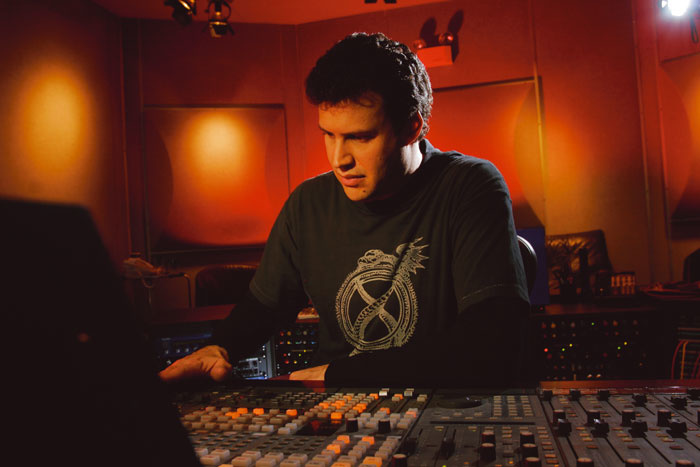
Craig Bauer has been part of Kanye West's career from the beginning, and as a mix engineer on the smash hit Late Registration album, he had to marry West's artistic perfectionism with his own technical standards.
Chicago, home to genre pioneers like Steve 'Silk' Hurley, and the sophisticated city blues of Buddy Guy, is a great source of innovation in urban music but often lacks the gravity to keep those innovators there. So the disappointment that Craig Bauer felt when Kanye West told him, in 2000, that he was headed for New York City to take his career to the next level was both understandable and predictable.
Bauer, a passionate musician from Cleveland who came up through the ranks of that city's studios in the 1980s before migrating to Chicago to set up his own facility, Hinge Studios, in 1992, had watched as West progressed from a promising but anonymous local beatmaker, brought to the studio in 1998 by local producer John 'Monopoly' Johnson. Johnson had cadged hours here and there over two years off the studio invoices for his protégé, and it was at Hinge that West learned to go beyond eight-bar loops on his MPC sampler.
The beat-making process might have seemed technologically primitive to Bauer, who by then had already established a successful niche as a mixer specialising in the much-maligned smooth jazz format. Bauer was drawing the leading artists of that genre, including Dave Koz, Brian Culbertson, Steve Cole and Peter White, out of their sunny colonies in California and into a studio in gritty downtown Chicago.
Just Another Client
Compared to the glossy tracks that Bauer was giving them through the Euphonix System 5 console and the Genelec 1034B/7072 sub array of monitors at Hinge, Kanye West must have seemed as much an exercise in cultural relativism as just another client. But that's exactly how Bauer treated West, and he believes that his respect for him as a client is what led to a strong bond of friendship developing between the two.
Bauer worked often with West during the two years that 'Monopoly' had installed him as a regular client in the studio, through the artist's stint in the Go-Getters, a Chicago rap group that West was a member of and produced. Bauer is candid when he says that there's little to talk about in terms of recording West's early work. "It wasn't what you'd call 'challenging'," he recalls. "If you listen back to the stuff now, which Kanye and I did not too long ago at the studio, it would not stand out and I doubt he'd disagree. It didn't suggest the genius you hear now on his records. It was all stuff that was sampled off of other records. He'd take a kick drum or a hi-hat where he could find them in the open on a track, sample them, and then 'flip' them — record them 'hot' to add a little distortion. If you could route a quarter-inch cable in a patchbay you could engineer those sessions. But what was there was there on the tracks was an attitude in the sound, grittiness. The talent was in the process of revealing itself."
And not only to Bauer. West's beats were quickly gaining the attention of artists on the coasts, including P Diddy, RZA of Wu Tang Clan, and Li'l Kim. "He was doing an increasing amount of 'ghost' beat work for other artists," Bauer says. "He'd bring the MPC in and we'd track it and lay it off to tape and it would get shipped off. The number of POs [purchase orders] to the studio kept going up, even though Kanye was not getting the credit for all of that work — I checked those records when they came out. But that's just part of getting yourself across in that genre. When you're young and new at it, lots of guys are happy just to get a few hundred dollars for a beat. I know, because they still ask me to help them sell them."
Credit Where Credit Is Due
Craig Bauer displays his annoyance candidly at the haphazard manner in which the credits appear on Late Registration — when they appear at all. Several of his mixes were credited to others, and he gets credit for others' mixes. When Bauer received an advance copy of 'Heard 'Em Say', he found his name nowhere on it. "I called and told [Kanye West's camp] they had fouled up on the credits and at first they argued that, then said that it would be corrected on the next pressing," he says. Nearly two million units later, the error is still uncorrected.
"When you put your heart and soul into a complicated project like this, you're doing it for more than money," says Bauer. "It's devastating not to get properly credited for it."
Credits on hip-hop recordings, which are already paperwork nightmares from logging hundreds of samples, are notoriously inaccurate. Multiple producers and engineers per track vie with dozens of studios, musicians, vocalists, guest artists and posse members in a stew of data that's nearly impossible to keep straight. And it's gone beyond urban music — the problems associated with such record-keeping prompted Trent Reznor to put the liner notes of his most recent CD on the Internet as a downloadable PDF file. As Bauer's case suggests, the hard work that goes into each record demands acknowledgement, both for emotional and professional reasons. "These are good and decent people," he says of West and his management. "They didn't do this on purpose. But it's frustrating."
Late Registration
The recognition his beats garnered eventually led to label deals out of New York, and when Kanye left Bauer was disappointed, but he understood. "In Chicago that happens a lot," he says. But by the same token, he was not surprised when he got a call less than two months later saying West needed studio time — in Chicago, at Hinge. The College Dropout (his mother headed up the English department at the University of Chicago) was headed home.
 Craig Bauer rigs up an AGC C12 for a vocal take with rapper Lupe Fiasco.Several of the demos that West recorded at Hinge were built into tracks on the College Dropout album, including the hit 'Kanye's Workout Plan'. For the follow-up, Late Registration, Kanye West came back to Chicago for mixing. Some of the tracks sounded familiar to Bauer when they arrived. "They were the demos we had cut when Kanye was here," he says, nodding towards a locked closet in the studio that holds scores of those Pro Tools Sessions, any of which are now worth thousands of dollars on eBay. The tracks were not necessarily more complex than in his early days, but there certainly were lots more of them. 'Bring Me Down', featuring guest vocals by Brandy, was a Pro Tools Session comprising 107 tracks, 48 of which were just Brandy. Bauer had to rent additional interfaces to make sure each track had its own analogue output to the Euphonix console.
The mix of 'Bring Me Down' took eight hours just to set up. Once it was, Bauer ran into often disorganised tracks that required a day's worth of editing, cleaning and crossfades. The thought of it makes him a bit cranky, and he suggests that it reflects an ongoing deterioration of engineering skills in an age of preset black boxes. "It's typical of hip-hop sessions but even more so of the whole business these days," he comments caustically. "There's no one to crack the whip, to make sure that the tracks being worked on are clean, with good punches and edits, and ready to be sent on to the next guy in the engineering chain."
The same loose technical attitude was apparent at the delivery stage. West and his crew were still working at Right Track Recording in New York City as Bauer was mixing in Chicago. When the first version of the mix was done, they requested Bauer send it as an MP3 file. He was appalled. "I didn't just spend three and a half days on a mix on a tight deadline to send it out as an MP3," he says. "Their thinking is that if it sounds good as an MP3, then it'll sound just as a good or better in a higher resolution. That just goes against everything I believe in as an engineer and a musician."
 Hinge Studios is based around a Euphonix desk and Pro Tools.Instead, Bauer burned a mix at 44.1kHz, 16-bit and sent it as an AIFF file attached to an iChat message, a method he says keeps the quality intact for Internet delivery. Kanye liked the mix, but sent back a laundry list of tweaks, including a request that the drums 'knock' more. "'Knock' is a big term in hip-hop these days that relates to frequency," Bauer explains. "When he first used it with me, I assumed it meant more low frequencies, but he said no, and he went over to my rack and rapped on it with his knuckles. 'That's knocking,' he said to me. I heard that and said OK, that's low-mids, around 800Hz to 1kHz. It's where you can get some more definition out of a kick drum, for instance. Hip-hop sessions generally don't use the conventional terminology of engineering. You just have to learn it and translate it."
For all its technical asperity, Late Registration revealed Kanye West's growing sophistication as a composer and producer, displaying new facets that had blossomed in his travels. "I guess that started happening the first time he went to New York and worked with Jay-Z on the Blueprint album," Bauer surmises. "On Late Registration, I was discovering a Kanye I hadn't known yet. There were treats on those tracks."
Co-producer Jon Brion, best known for producing precocious records by Fiona Apple and creating off-kilter soundtracks for unconventional Hollywood movies, brought complex string arrangements and sounds to the table from a huge arsenal of synths and samplers. "I was hearing live strings orchestrated by someone who knew what they were doing, intelligent licks on guitars — nothing was dumbed down, musically," says Bauer.
A Level Playing Field
Kanye West has an odd perspective on relative dynamics: once relative levels are established, he prefers to use compression rather than fader rides to control them. "We're using compressors" — GML 8900 dynamic controllers and Chandler EMI reissues, largely — "for level control," says Bauer. "Kanye doesn't like a lot of rides on the vocals. He'd rather have that done with compression." It's not just vocals that that technique is used on, either. Bauer recalls a celeste sound played by a keyboard with a dynamically uneven performance that he wanted to smooth out. "Normally, I'd use a touch of compression and then ride it, but that's not how Kanye wants it done. The trick is to compress it enough to get level control without having the compressor start pumping. You just experiment with settings and watch the meters till you get it right."
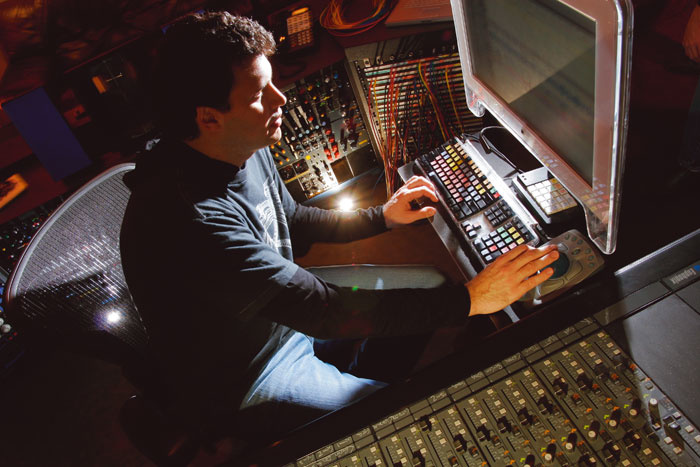 Bauer editing a Pro Tools Session.Compression had other purposes on the record. West's proclivity to twist sounds led Bauer to over-compress certain sounds using a McDSP Compressor Bank plug-in within Pro Tools, and then adding even more from the Euphonix's channel strip dynamics. More grit came from distortion from a Sansamp guitar amplifier emulator and the distortion effects from an Amp Farm plug-in. Bauer also tuned the sounds a bit using the GML 8200 five-band parametric EQ and an API 550 EQ module on many of the melodic instruments. "The vocals were generally well recorded and didn't need much," he says. "The drums — well, they're exactly the way Kanye makes them sound. That's his signature. There's always a certain grit to them. He pitches and EQs them in a certain way that goes back to when he was doing beats at Hinge. They're un-techy, but in a positive way. There's an art to that. Sometimes he'll overdrive the input from the MPC. He can play that like an instrument instead of a sampler. Kanye's a knob-turner — he knows what he's looking for and even though he doesn't necessarily know how to get there, he stays at it until he does."
Listening to Late Registration, it takes a minute to realise that it is dry as a bone. "There is not an ounce of reverb," on any of the five mixes of Bauer's that made it to the record, he says, another of West's quirks that tested Bauer's engineering chops but that in the end wound up a source of pride. "I had put a lot of reverb on the vocals on the Brandy track to make it sound really lush, like an R&B track. Reverb on the strings, too. Very rich-sounding. He sent it back and said 'Take it all off.' So I go back and I'm listening to this dry, stark orchestration and I keep listening until it dawns on me — Kanye doesn't want this to sound like a brilliant, lush R&B mix; he wants it gritty and street and hip-hop, even though the song isn't what you'd normally consider in that vein. That's really where the brilliance lies: in taking things — drum sounds, vocals — and putting them into other contexts."
 Craig Bauer at Hinge Studios with John Legend (left) and Kanye West.On 'Heard 'Em Say', for example, which features a guest vocal by Adam Levine of Maroon 5, Bauer found a stereo pair of acoustic guitars. "It was such a brilliant juxtaposition of elements for a hip-hop record — Kanye's groove against Adam's high, soulful voice and those acoustics in there," he says. "I pushed them up in the mix and sent it off to Kanye. He comes back to me and says 'I like the mix but get rid of the acoustic guitars.' He meant just pull them back so that they're more a suggestion than a presence. You have to listen to the track very carefully but they're in there. You never know what combination of elements he'll want."
Kanye West himself is on the record as citing influences ranging from Portishead to the Beatles to Pink Floyd and Stevie Wonder. Bauer found processing on some instruments that might not have seemed out of place at Abbey Road in 1966. On 'Addiction' West had treated the hi-hat heavily, adding his trademark distortion and a lot of phase shifting. Bauer's response was to automate a pan throughout the song as the hat tracked through two sweeping bands on a Focusrite D3 equaliser.
Dazed & Confused
The mixes — Bauer ultimately did five, including 'Addiction', 'Roses', 'Late', and 'Heard 'Em Say' — continued in a frenzy from June through August of last year. "Kanye has to experiment with every possible combination of sounds and levels, and that resulted in 15 to 25 recalls of every mix," says Bauer. Discs would arrive via Fed Ex and mixed tracks would get sent back as AIFF files (the requests for MP3s continued but Bauer turned a deaf ear to them). The endless remixes were probably were exacerbated by the fact that West and his entourage were constantly on the move between studios and in different monitoring environments — the recording's itinerary included stops at Right Track in New York, Ocean Way and Chalice in Los Angeles, and Circle House in Miami. "He moved around more than Saddam Hussein, never in the same studio twice," says Bauer. "It was like throwing darts in the dark — you knew they were never listening to the same mixes on the same monitors. On one system, the drums are 'knocking'; on the next, they're not. Like with the MP3, Kanye's logic is, if it sounds good on a whole bunch of different monitors, then it'll sound good anywhere. But as an engineer, I want to compare mixes on a consistent set of monitors."
Kanye West's compulsive pursuit of perfection put Bauer through a lot, and the engineer later discovered that he'd been mixing in competition: West had sent each of the songs to as many as three mixers simultaneously, even as he continued to record other songs for the 21-track CD. Was it worth it in the end for Bauer? Despite the madness, he unhesitatingly says yes. "It's rewarding to watch someone evolve creatively like that over time and see that talent rewarded and to be part of it," he says, adding that it has led to more work from emerging hip-hop artists, like Lupe Fiasco, who appears on Late Registration and whose first major-label solo outing is co-produced and mixed by Bauer. "Kanye's not an easy person, but he's a great talent. In this business, they rarely to go together. But if it was easy, it wouldn't be as good."