


A useful studio workhorse offering eight channels of mic pres plus ADAT I/O, that does just what it says on the tin.
The problem with audio interfaces, or digital mixers, for that matter, is that you often run out of input and output (I/O) channels, especially if you need to record a band with a fully mic'd drum kit. At the same time, making all users buy more channels than they may actually need risks making the product too expensive. Many manufacturers have therefore included ADAT support on their soundcards, so that the I/O can be expanded with separate multi-channel preamps that also support the ADAT format. ADAT lightpipe can carry eight channels of audio at sample rates of up to 48kHz, or four channels at up to 96kHz by utilising the widely adopted S/MUX protocol. It is important to note that to use S/MUX, the interface or mixer to which the Digimax FS is connected must also support the protocol (if you want to know more about this, you can read Hugh Robjohns' Digital Interfacing article in SOS February 2007).
The simplest way to expand a system that has ADAT connectivity is to add an eight-channel analogue-to-digital converter, followed by an ADAT-port chip set but, as most recordings are done using microphones, a practical product really needs to have the mic preamps built in as well. There are several such expansion devices already available, such as the RME Octamic D, Focusrite's Octopre and Octopre LE (with the optional ADAT card fitted), M-Audio's Octane and the Behringer ADA8000.
The PreSonus Digimax FS follows on from their popular Digimax LT. It offers eight channels of microphone preamplification routed to an ADAT output, as well as eight channels of 24-bit D-A conversion, fed from the ADAT inputs. Two sets of ADAT I/O ports (two in, two out) are included to allow the unit to operate in eight channel mode at up to 96kHz via the S/MUX protocol, but there are also direct analogue outs and analogue insert points available for each mic channel.
The Digimax FS includes JetPLL jitter reduction that allows the unit to sync to an external clock while at the same time reducing any jitter in the incoming clock source. This is an important inclusion, as clock jitter (rapid timing discrepancies caused by clock-frequency instability) — particularly if it lies within the audio frequency range — can lead to increased noise and distortion, as well as a deterioration in stereo imaging.
Construction
Housed in a 1U rack case and powered from the supplied external power adaptor, the Digimax FS features eight class-A, balanced mic preamps, for which 48 Volt phantom power can be switched in two independent groups of four channels. For ease of access, the mic inputs are all on the front panel and utilise Neutrik Combi connectors that also accept a balanced line-level jack source (high impedance, unbalanced instrument sources on inputs one and two) in the centre of the socket. All eight insert points are on TRS unbalanced jacks (ring-send, tip-receive, to carry both the send and return signals on a single socket) on the rear panel, and these allow additional outboard equipment, such as equalisers, de-essers or compressors, to be inserted into the signal chain prior to A-D conversion. All eight direct outputs are on balanced TRS jacks, as are the eight DAC outputs that allow the Digimax FS to provide eight additional line-level analogue outputs from your interface or mixer.
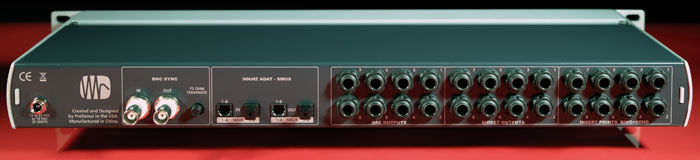 The rear panel of the Digimax FS. The ADAT and line outputs can be sent at the same time, which can be useful for splitting the signal to make backups.A front-panel switch with associated LED readout selects the internal clock source rate from 44.1kHz, 48kHz, 88.2kHz and 96kHz, and each of the preamps has its own rotary gain control with peak overload LED. Further metering shouldn't be necessary, as the meters in your DAW system will give you an accurate reading of the input level.
By switching to external clock mode, the Digimax FS can lock to an ADAT source or word clock via the rear-panel BNC word clock connectors. Word clock in and out sockets are fitted, along with a 75Ω termination switch (the last unit in a word clock daisy chain should always be terminated). The sync switch is illuminated by a coloured LED that shows blue for BNC sync or red for ADAT sync. In external sync mode, the sample rate of the source is used. At sample rates up to 48kHz, only the ADAT I/O ports labelled 1 to 8 are used. In S/MUX mode at 88.2kHz or 96kHz, the first ADAT ports carry channels 1-4 and the second 5-8.
Technically, the mic preamps have a similar specification to what you'd expect in a well designed mixer or mid-price stand-alone preamp, with -3dB points at 20Hz and 100kHz and only half a dB down at 40kHz. The unweighted distortion is a respectable 0.003 percent or better, with an equivalent input noise of -126dB and a signal-to-noise ratio of better than 101dB. Up to 55dB of mic gain is available — more than enough for most applications, though a little more might have been useful for working with ribbon mics or other insensitive sources (a typical stand-alone preamp or mixer preamp has around 60dB of gain). At unity gain, the mic preamps can handle up to +11dBu, which should be more than adequate for even the hottest mic or DI box signals.
Impressions
As with all PreSonus gear, the physical styling is confident without being overly fussy. The gently rounded front panel is finished in matte silver/grey with all the legends printed clearly in black. The knobs are metal, with an easy-to-grip splined surface, and all the button switches are illuminated. I'm not a fan of external power supplies, but they do help to keep the price down and are less of an issue in semi-permanent installations. This PSU also has the benefit of a locking connector and uses a universal switch mode circuit, allowing it to run from any standard mains supply worldwide.
Tested with my MOTU 828 MkII, I found that the Digimax FS locked very quickly and positively when used as a slave, typically taking well under a second to report stable sync. Unplugging and reconnecting the ADAT cable showed that it was equally happy to recover sync in under one second following a glitch (man-made, in this case). The same was true if I switched to another sample rate.
Running the Digimax FS as clock master was equally trouble free, and test recordings showed the mic amps to be clean, quiet and free from obvious coloration. Subjectively, they seemed quite similar to the preamps in my 828 MkII (at least with my voice and a capacitor microphone), and I've always thought the MOTU preamps worked pretty well given the price of the unit. There's nothing unusually fancy or esoteric about these preamps, they just do a good job, though, as I suggested, an extra 5dB of gain may have been useful when working with quieter sources or insensitive microphones.
I am also appreciative of that fact that the Digimax FS has eight DAC (word clock) outputs as well as mic/line/instrument inputs. The direct analogue outs from the mic preamps and the pre-converter insert points also add to the versatility of this unit. Such features make it very attractive as an expander to a digital mixer, as well as for adding more I/O to an existing audio interface.
Perhaps the best way to describe the performance of the Digimax FS is 'predictable'. This isn't a criticism — in fact, quite the opposite: equipment of this type has a job to do and, if it is correctly designed, it will do that job without drawing attention to itself. And that's exactly the impression I got from the Digimax FS. You just plug it in and it works — no hoops to jump though, no clocking tantrums, and a nice clean audio path. Really, there's not a lot more you can ask for. Having proper word clock facilities, a low-jitter clock and the ability to work at sample rates up to 96kHz just underlines its capability.
Alternatives
There are now several competitors in this category. At the cheaper end of the scale the Alesis AI3 and Behringer ADA8000 are great value but only operate at up to 48KHz, as does the more upmarket Focusrite Octopre LE (you need to pay extra for the digital option in the case of the last). M-Audio's Octane is perhaps the nearest in spec to the Digimax, both in terms of price and S/MUX support. From there, the quality and prices start to climb: the RME Octamic D and the Focusrite Octopre, with its optional ADAT card installed, are S/MUX compatible and the latter includes a hardware compressor/limiter on each channel.
Pros
- Very straightforward to use.
- Supports 96kHz via S/MUX.
- Good sync and word clock facilities.
- Clean mic preamps with line and instrument options.
- Direct analogue outputs and insert points, as well as eight balanced DAC outputs.
- Universal voltage power supply.
Cons
- Maximum mic gain is 55dB rather than the more usual 60dB.
- External PSU less convenient for mobile use.
Summary
The Digimax FS offers good value for money: you get eight good-quality mic amps in a package that's simple to use and provides eight extra analogue outputs, as well as the eight inputs. There's really not much more you could reasonably ask for at the price.
information
£589 including VAT.
Source Distribution +44 (0)208 962 5080
+44 (0)208 962 5050