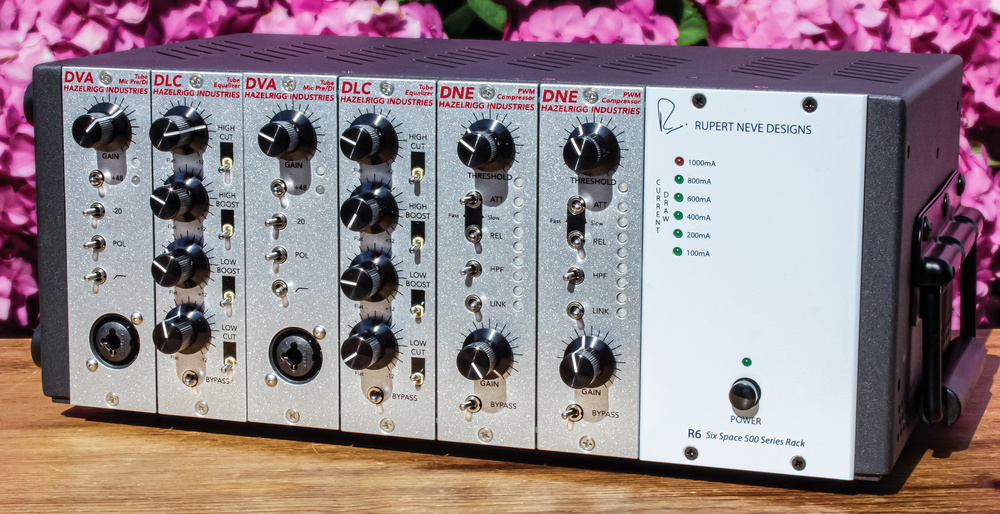
Is the Hazelrigg brothers’ first foray into the 500‑series format as impressive as their rack gear?
If you read our SOS 2022 reviews of Hazelrigg’s rackmount VNE compressor and VLC mic pre and EQ, you’ll know about the company’s close ties with DW Fearn: essentially, Hazelrigg manufacture and distribute Fearn’s products. But owners George and Geoff Hazelrigg design and build their own products too, and all combine high‑quality sound with simple, intuitive control. Their new D Series comprises a trio of 500‑series modules, based on the circuits in Hazelrigg’s and Fearn’s revered mic preamps, inductor‑based equalisers and PWM compressors.
The DVA Preamp
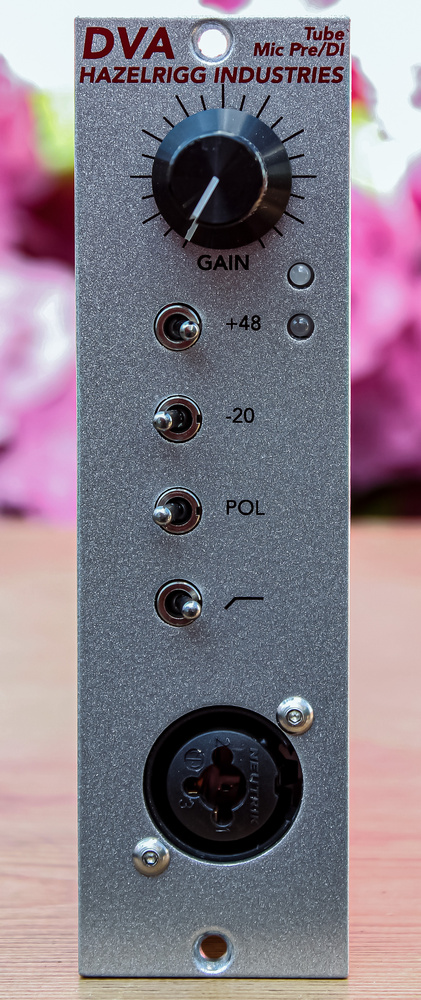 The DVA microphone preamplifier, a valve‑based design with the plate running on 150V.
The DVA microphone preamplifier’s input circuitry matches that of Hazelrigg’s VLC and DW Fearn’s VT‑2 preamps, and as with those models, both the input and output are transformer balanced. The input stage utilises a 6072A valve, a low‑noise twin‑triode type designed primarily for use in the low‑level stages of audio‑frequency amplification. The A suffix indicates a special‑quality valve, intended for use in critical industrial and military applications, and it differs from a standard 6072 (12AY7) in having controls on interface resistance (the build‑up of an oxide layer between heater and cathode) and a higher resistance to inter‑electrode leakage.
Unlike on the VLC and VT‑2, the output stage isn’t valve‑based, but instead employs a solid‑state signal path with low harmonic distortion and a high output. This hybrid valve/solid‑state configuration was necessary partly because of the 500 series’ physical size constraints, but also the format’s official power supply specifications. In the DVA, the 6072A valve’s plate voltage is set at 150V... which happens to be the value specified by the valve’s original manufacturer, General Electric, for the valve’s use in low‑level audio‑frequency amplification stages.
The DVA’s sparsely populated silver‑coloured front panel hosts a black gain control, similar in size to the mic/instrument combo XLR/jack socket below. (Inserting a jack switches the host chassis’ rear input out of circuit.) Between these, a column of four toggle switches activate 48V phantom power, a ‑20dB pad, polarity reverse and a gently sloping high‑pass filter, with a corner frequency of 150Hz to counter the proximity effect. Single LED indicators display the output level (green/red) and the presence or otherwise of 48V phantom power.
In terms of measured performance, the DVA delivers a frequency response of 20Hz‑20kHz (±2dB); maximum gain of 60dB; SNR of 79.5dB; EIN of ‑129.5dBm; THD+N of 0.04%; maximum input level of ‑20dBm (0.5% THD) / 0dBm with ‑20dB pad; and a maximum output level of +23dBm.
The DLC Inductor EQ
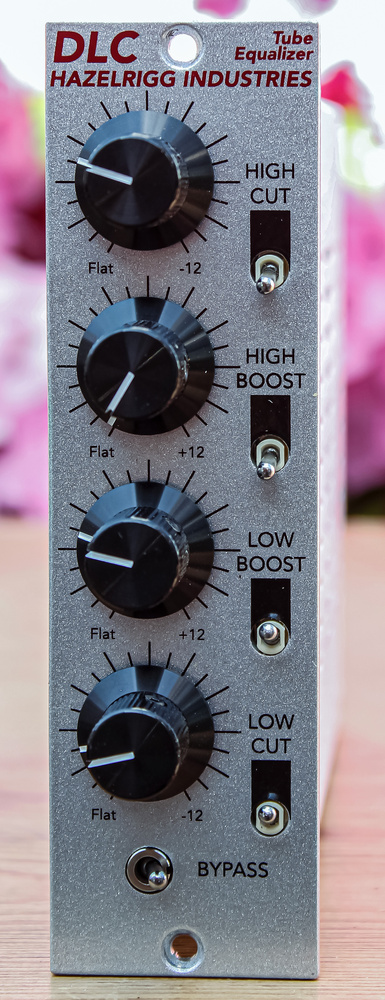 The DLC inductor EQ, which once again includes a valve‑based input stage.
The DLC is based on the passive inductor EQ circuit of Hazelrigg’s VLC, itself a design first seen in DW Fearn’s VT‑5. Although this new circuit uses the same capacitors and hand‑wound inductors as the VLC, the audio path isn’t identical; the differences give the DLC a slightly more linear performance. The audio input circuitry is the same as that of the DVA, again utilising a 6072A valve. The output gain stage also features a low‑THD/high‑output solid‑state signal path, and compensates for the gain loss that’s typical of passive filter stages. As in the VLC, the input and output are transformer balanced.
Being a two‑band EQ with separate boost and cut controls for each band, the front panel carries four control knobs identical to those on the DVA. Vertically oriented switches next to each knob toggle their 12dB bell curve boosts and 12dB shelving cuts between two corner frequencies: 5 and 10 kHz for the high boost; 1.5 and 5 kHz for the high cut; 500Hz and 1kHz for the low boost; and 250Hz and 1kHz for the low cut. A final, horizontally oriented toggle engages a relay‑controlled bypass. This time, no indicator LEDs are present.
The DLC’s published specs show a frequency response of 20Hz‑20kHz (±0.1dB); maximum gain of ‑4dB; THD+N of 0.07%; SNR of 80dB; a maximum input level of +12dBm (0.5% THD); and a maximum output level of +23dBm.
The DNE PWM Compressor
The DNE’s compression circuitry is based directly on DW Fearn’s VT‑7, whose gain reduction is based on PWM (pulse width modulation). This relatively rare form of analogue compression uses pulse width modulation to determine the energy in the audio signal over time: in essence, the signal is ‘sampled’ at a very high rate, but the duration (width) of the samples (pulses) is adjusted (modulated) to control the average energy over time, and thus provide signal attenuation. When implemented well, a PWM compressor can offer both very fast attack and release times, and very natural‑sounding gain reduction with relatively few audible artefacts. So a good option if you’re seeking transparent compression.
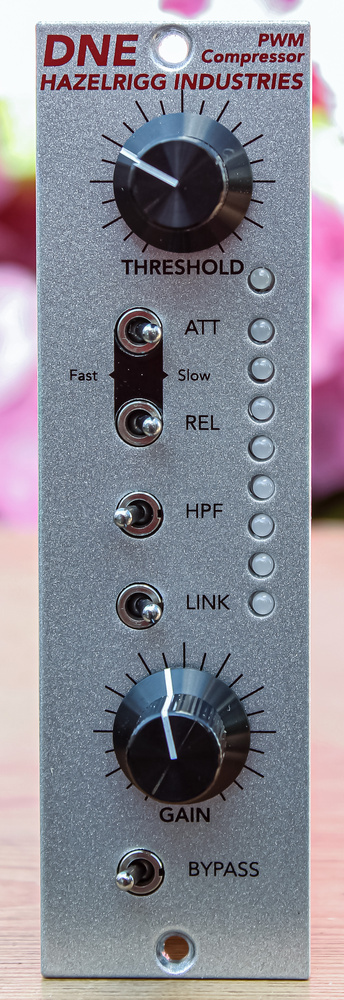 The DNE is a solid‑state PWM‑based analogue compressor.The DNE has two side‑chains, each with its own attack and release characteristics, and these control how aggressively or benignly the gain‑control element reacts to transients. As in the VT‑7, the two side‑chains are blended together to produce the single control voltage that drives the gain‑reduction element. However, unlike the VT‑7, on which the blend is a smooth, continuous transition from a softer to a harder compression, in the DNE it’s preset using fixed resistors. The values of these resistors were chosen to deliver a compression that the Hazelrigg brothers felt was most useful over a broad range of programme material.
There are no valves in this module — the DNE features low‑THD, high‑gain solid‑state devices throughout its signal path — but, again, both the input and the output are transformer‑balanced. Its black Threshold control is actually an input gain that puts more or less of the signal above a fixed threshold. Below this knob sit four toggle switches, the top pair of which switch the attack and release between fast and slow settings. The preset timings were chosen after careful listening tests, to (in Hazelrigg’s words) “work well universally”. The third switch activates a 200Hz, 6dB/octave side‑chain high‑pass filter, which helps to avoid the triggering of unwanted compression by low frequencies.
A fourth switch activates the side‑chain link function, to enable two DNEs to act on stereo material, for example on the stereo mix bus. As is common practice, this linking is available only when two DNEs are mounted in adjacent 500‑series slots in a host rack with the facility to link those slots’ pin‑6 edge connectors. When two DNE modules are linked in this way, their side‑chain control voltages are averaged. This makes more attack and release variations available to you, since, for example, when a stereo track is sent to a pair of DNE and one attack switch is set to fast and the other to slow, the result is a medium attack time; the release time behaviour is the same. Similarly, if only one unit’s HPF is turned on, the filter will be gentler.
That fourth switch is followed by a control knob for the DNE’s 15dB of make‑up gain control. Beneath that, a fifth switch activates the bypass relay. As in the DLC, the DNE carries a bi‑colour output‑level LED, and below that is an eight‑LED gain‑reduction ladder meter, displaying up to the DNE’s maximum of 15dB compression.
The DNE’s performance specifications are up there with its siblings, with a frequency response within 0.1dB of 20Hz‑20kHz, THD+N at 0.07%, an SNR of 90dB, a maximum input level of +22dBm (0.5% THD), and a maximum output level of +24dBm.
In Use
UK distributors ASAP Europe, who supplied the units for review, generously sent over two of each D Series model in a host chassis. Happily, this meant that I could construct two complete ‘input channels’, each comprising a DVA and DLC, and a two‑channel compressor that could either be used with these channels or as a stereo bus compressor — so I was able to put them through their paces on a wide range of material.
The DVA is a really high‑quality but minimalist microphone preamplifier. That’s precisely the sort of preamp I like, especially with the valve and good transformers on board — there’s a directness in the recording experience and a precision in its sonic character that really resonates with me. To my ears, it possesses warmth and fullness in the low end, and clarity and openness in the mids and highs. But all of this is underscored by a sense of meticulous detail. With the right mic for the job put in the right place, the DVA delivered an absolutely stellar performance on vocals, acoustic guitar, double bass, strings, piano and percussion. But miking isn’t the only string to its bow: engage the ‑20dB pad (which doesn’t affect the DI input by the way) and play the incoming signal level off against the module’s gain control, and you’ll find some rather beguiling saturation awaiting you. It’s not inexpensive as preamps go, but it’s an absolute delight to use nonetheless.
Moving on to the DLC inductor‑based EQs, I found these similarly delightful. Their valve and transformers obviously make a contribution to the character, but it’s definitely the two‑band passive EQ, with those separate, dual‑frequency high and low boosts and cuts, that’s the main attraction. It’s an EQ that forces you to use your ears, and which rewards experimentation — balancing cuts and boosts at different or identical frequencies, in the classic Pultec‑style ‘dip and peak’ fashion. As you experiment, you’ll find yourself creating somewhat more complex and distinctive curves that are different from the results you could achieve with a conventional ±12dB bass and treble active EQ.
Wonderful though both the DVA and the DLC are, the DNE PWM compressor is the brightest star in Hazelrigg’s D Series. The first thing that struck me was the sheer ease of operation: turn the threshold until you hear broadly the amount of compression that feels right, switch the attack and release times to give you the dynamic response you’re looking for, adjust the make‑up gain to taste... and the job’s pretty much done. The preset attack and release times really have been well chosen: fast is speedy enough to catch percussive transients, and the release is almost immediate to avoid intruding on the body of a sound; slow allows initial transients through during the attack/note‑onset phase, with the release starting quite quickly but with the last few dB slowing considerably, especially during recovery from heavy compression.
The DNE really is an outstanding compressor. It did a superb job of subtly controlling the dynamics of vocals, acoustic guitar, double bass, piano and percussion instruments. With highly dynamic programme material, where larger amounts of gain reduction were needed, the DNE’s low‑ratio, soft‑knee compression never became aggressive, or even obvious. More impressively, the tonal character of the source didn’t change as gain reduction increased considerably — the high frequencies came through undiminished, contributing to an impression of incredibly transparent control.
The stellar heritage is very evident here — each and every one of these modules sounds sublime...
To D Or Not To D?
It’s an inescapable fact of life that, even in the 500‑series format, hand‑built, high‑performance preamplifiers, EQs and compressors have significant price tags, and these particular modules cost more than most. Mitigating that, the stellar heritage is very evident here — each and every one of these modules sounds sublime, and if you can afford to splash the cash I’d say that the price‑to‑performance ratios justify the asking price. If you have the chance, I highly recommend that you audition Hazelrigg’s D Series modules. I’ll have to return the review units for now, but I’ve already started saving up!
Pros
- A wonderfully warm yet detailed mic preamp.
- A simple but effective inductor EQ.
- A compressor capable of incredible transparency.
Cons
- This sort of quality costs!
Summary
With circuitry based on that of their Hazelrigg and DW Fearn rackmount counterparts, the D Series modules deliver an extremely high level of audio performance via a simple and effective set of controls that encourage the user to focus on the result, not the methodology.
Information
£1199 each, including VAT.
ASAP Europe +44 (0)20 8672 6618.
When you purchase via links on our site, SOS may earn an affiliate commission. More info...