Bob Katz: Mastering Audio
One of the most famous mastering engineers in the world has written the definitive work on mastering, and in the process has created an indispensable resource for anyone working with audio.
To find the exact phrase, put the words in quotes or join them together with a plus sign e.g. live+recording or "live recording".
To find, say, all live recording articles that mention Avid, enter: live+recording +avid - and use sidebar filters to narrow down searches further.

One of the most famous mastering engineers in the world has written the definitive work on mastering, and in the process has created an indispensable resource for anyone working with audio.

Widely admired for their hardware synths, Novation have now taken the bold step of releasing a software plug-in synth. But is it the wave of the future, or a software pirate's delight?

Ubiquitous though Roland's long-lived range of sound modules appear to be, not many users get the best out of the vast synthesis and processing potential they offer. So here's how to coax circus-pony tricks out of your studio workhorse.

In Part 1 (of 2) last month, we finished with the question: 'What is the Quadra? Is it a turkey of the first order, or a misunderstood and overlooked masterpiece?' This month, we'll take a closer look at the instrument itself to find the answer.

Vintage synth collector and self-confessed Korg fanatic Alex Clarke waxes extremely lyrical about the early '80s Trident — a hybrid of polysynth and string machine.

There's a drum & bass revival going on, and London Elektricity are taking the genre in new directions — including live stages across Europe.

Native Instruments' latest plug-in combines up to 1024 bands of vocoding with frequency-domain effects and a neat granular synth.

The latest addition to Waldorf's Microwave family certainly advertises its presence. Paul Nagle finds out if the future's bright as well as orange.

It's the dream of many an SOS reader to have a multimillion-selling worldwide hit with a track recorded in your bedroom — but as Crewe-based Dario G found out, it can create more problems than it solves. Matt Bell finds out how the group came through the turbulent waters of success to produce a fine debut album.

Paul White packs away the keyboard and plugs Roland's new guitar-MIDI interface into his sequencer.

The high quality converters and resonant filter imbue the 16-bit Emax II with a musicality and sonic character second to none.

Looking like a star cruiser, or something from the film 2001 (rather than just the year), Alesis' Andromeda is the first analogue polysynth that approaches the complexity of a digital workstation. But does analogue necessarily equate to quality?

FM synthesis was the success story of the mid-'80s, and synth based on its principles, like Yamaha's DX7, sold by the bucketload — until affordable sample-based synths arrived at the end of the decade. Now, with their new FS1R, Yamaha have updated the technology for the late '90s.

Janet Harniman-Cook goes great guns with the latest version of Twelve Tone's popular MIDI + Audio recording software for PC owners.

We hear from more surround producers working at very different ends of the music business to see how they've created working surround systems, and how they make use of 5.1 at the mixing stage.

Paul Wiffen has a sleep problem, sees the mLAN light, and rounds up the best of the Frankfurt launches for Apple musicians.

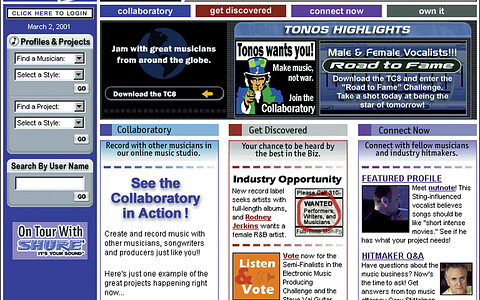
With music professionals at the helm and software from Emagic, Tonos.com is another way for musicians to collaborate online. Mark Wherry makes some connections.

Emu's multi-coloured assault on the sound module market continues with the Planet Earth, which houses a brand new set of ethnic and world sounds. Confirmed tree-hugger and Emu preset basher Paul Farrer takes time out from boiling a mixed-lentil casserole to check it out...

Producer Stuart Epps began his music business career in 1967 at Dick James Music before going on to work with Gus Dudgeon, Elton John, Jimmy Page, Chris Rea and other top names. He now runs his own commercial studio, situated in the old Mill Studio complex, and is working on a number of projects, including one with Bill Wyman. Here he explains why he preferes 'live' music to almost anything else...

Will Mowat made his name first as a sequencer expert and then as a writer with Soul II Soul. As a world music producer, his recent projects provide inspirational examples of how to combine performance with programming and overcome the limitations of a bare-bones budget.