Using Reason: Part 2
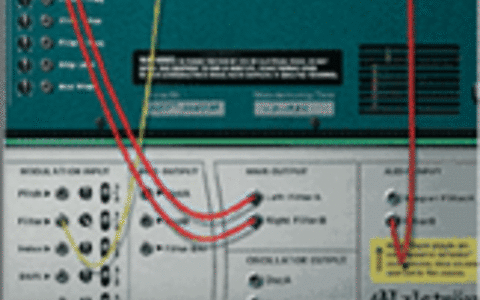
In the second half of this two-part series, we pass on tips that make sequencer use easier, explain device layering, and add some hints for the new devices added to Reason in the v2 update.

In the second half of this two-part series, we pass on tips that make sequencer use easier, explain device layering, and add some hints for the new devices added to Reason in the v2 update.

How did they make that sound on a subtractive synth? We continue to dissect the analogue 'Acoustic Piano' Performance from Roland's 1986-vintage JX10.

Your computer's most fundamental system settings are stored in its BIOS. Modifying them can help increase performance and eliminate glitches, but it's not something to approach lightly...

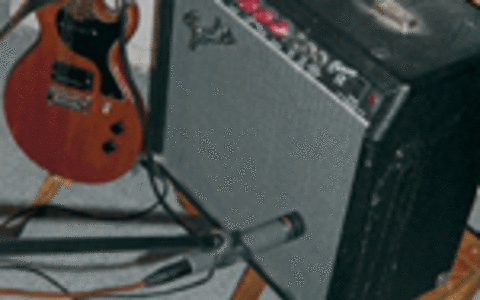
There are now many different ways to record electric guitars, from miked-up valve amps to physical modelling preamps. So how do you decide which to use?

All modern sequencers make it easy to enhance your arrangements with subtle tempo variations, but these facilities are often ignored.

Is it possible to link multiple Tascam 788 recorders? How can I move files between my computers? How do I use a degausser to demagnetise tape heads? What's the difference between the Sennheiser MD421 and MD421 MkII microphone? Can you suggest a good weighted keyboard? Can I copy vinyl to CD via an S/PDIF connection? Can I use my Logic plug-ins with another sequencer? How do digital errors affect the stereo image?

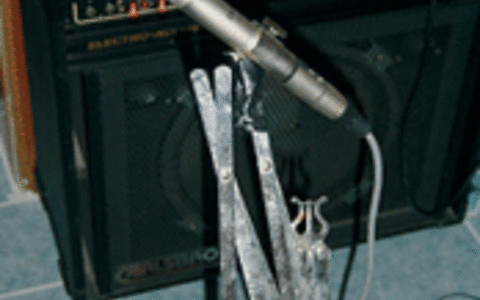
A special holiday edition of our hands-on troubleshooting column comes direct from sunny Turkey, where Paul White forsakes the beach to help Murat Yucel refine his band's recording setup.

Propellerhead Software's flexible studio package can take you in all kinds of new creative directions if you know how to get the best out of it. Let us be your guide...

As explained last month, synthesizing the sound of an acoustic piano is difficult, but it can be done reasonably realistically, as the 1986-vintage Roland JX10 shows. We find out how Roland managed it...

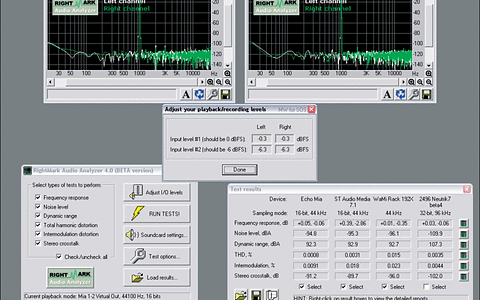
An hour spent fine-tuning the performance of your soundcard can yield permanent improvements in background noise, distortion levels and frequency response.

Suffering from signal degradation or mains hum on your audio lines? The chances are that you're having problems with impedance matching or earth loops. However, with a little understanding and some careful planning, these gremlins can be successfully eliminated.

The SOS team rushes to the rescue of a reader in Somerset suffering from boxy vocals, a weedy mix, and a dodgy tweeter.

Nashville is still a place of legend when it comes to music. Although overall sales of the city's flagship genre, country music, have dipped somewhat from their mid-'90s peak, Nashville still has a recording legacy matched by few cities in the world.

Surely the only convincing synth pianos are sample-based ones? A sound as rich and expressive as that of an acoustic piano is far too complex to be rendered by subtractive synthesis... isn't it? Let's find out...

In the second part of our investigation into the real-world delays caused by PC hardware and software, we consider the differences between different MIDI applications and versions of Windows. Are some sequencers really 'tighter' than others?

Most SOS readers seem either to be setting up a studio or refining their existing setup, and could save money and hassle by doing much of the wiring and installation themselves. We explain how.

Theoretical figures and manufacturers' measurements may suggest that the latency of your soft synths is negligible — but that's no use if their timing is all over the place when you actually play them. Our real-world results give you the true picture.

Another reader's studio gets the benefit of expert SOS staff attention. This month, it's the turn of Tim Way, whose mixes sound fine in his own studio, but don't travel well.

As Intel and AMD continue to push the clock speeds and architectures of PC processors, music software developers are taking advantage of the optimisations possible, as demonstrated by Waves with the latest update to their native plug-ins.

Having learned last month how to synthesize tuned bells, we turn this time, in the last of this series on the subject of percussion, to untuned bells — in the form of the humble cowbell — and claves.