beyerdynamic’s first ever in‑ear range comes in multiple flavours, including an explicitly studio‑focused model, the DT 70 IE.
Like full‑sized headphones, in‑ear monitors can be designed using several different technologies, all of which have their own strengths and weaknesses. Balanced‑armature drivers are now very popular, and can achieve impressive technical specifications when multiple drivers are used to handle different regions of the frequency spectrum. The flip side of this is that crossover artefacts can introduce a slightly unnatural quality to the sound. Elsewhere, manufacturers such as Audeze have experimented with planar magnetic drivers, to good effect.
Given beyerdynamic’s heritage as one of the world’s oldest manufacturers of dynamic microphones and headphones, it’s no surprise to see that they have kept faith with the more traditional moving‑coil driver in their first‑ever range of IEMs. But that’s not to say that they aren’t innovating. The DT 70 range uses a new TESLA.11 driver that achieves a total harmonic distortion figure of less than 0.2% at 1kHz, which is impressive, and beyerdynamic are also offering what is outwardly the same model in four variants, with different ‘voicings’ intended for different applications. The DT 71 IEs are tagged ‘drum & bass’, the DT 72 IEs ‘guitar & voice’ and the DT 73 IEs ‘classic instruments & keys’, whilst the DT 70 IEs are said to be intended for studio uses such as mixing and critical listening. Appropriately enough, the DT 70s were supplied for review.
Moderation In Everything
If you’re curious as to what differentiates these four variants, beyerdynamic make available a handy PDF document which attempts to characterise them in terms of four frequency bands labelled ‘bass’, ‘fundamental tones’, ‘midrange’ and ‘treble’. The DT 71 IEs, for example, are ‘very strong’ in the bass and treble, but ‘soft’ in the midrange, whilst the DT 73 IEs are ‘moderate’ in all bands except the treble, where they are ‘strong’. Perhaps surprisingly, the studio‑focused DT 70 IEs are portrayed as having quite a scooped response according to this scale, with a ‘strong’ response in the bass falling through the ‘fundamental tones’ region to a ‘soft’ midrange before shooting back up to ‘strong’ again in the treble region.
The DT 70s are supplied in a robust and practical soft‑shell case. They are very compact, and connect to a removable Y‑shaped cable using MMCX connectors. At the business end, both branches of the cable are reinforced by a semi‑rigid sheath that retains its shape. The user can thus bend this to form appropriately shaped earhooks to hold the DT 70s in place. As the DT 70s are ‘universal’ IEMs, there’s no option for custom moulds. Comfort, sound quality and isolation are all therefore dependent on your choice of tips. Unless your ears are particularly unusual, you should be able to find something suitable among the included complement of five silicone and three Comply foam tips in various sizes. I had no difficulty achieving a setup that stayed in place confidently.
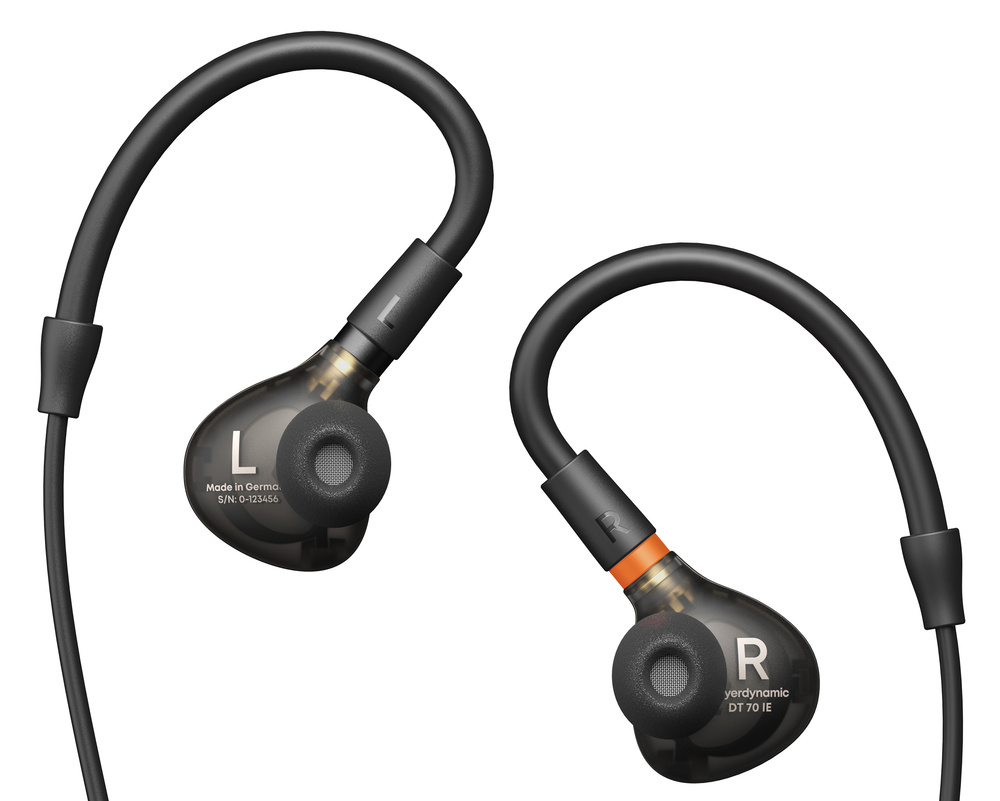 The Y cable for the DT 70s incorporates earhooks that can be moulded to achieve a secure fit around the user’s ears.
Driving The DTs
With a quoted 16Ω nominal impedance and a sensitivity of 113dB SPL for a 1mW signal at 500Hz, the DT 70s should be as easy to drive as any modern pair of passive headphones, and I had no problem getting them up to ‘ouch’ levels on a laptop headphone socket. The specifications claim a frequency response of 5Hz to 40kHz, but as ever, this is pretty meaningless in the absence of any tolerances.
Having seen beyerdynamic’s own characterisation of their tonality, I was a little apprehensive about how the DT 70 IE would sound. I’m not generally a fan of scooped playback systems, and the thought of having ‘strong’ bass and treble frequencies blasted directly into my ears didn’t appeal. In practice, however, I found it hard to relate this description to the actual sound, which struck me as mostly well balanced. There is an audible low emphasis, true; but to my ears, this is relatively restrained, and occupies the 100‑200 Hz range rather than the true bass region. Below 100Hz the response seemed to fall away somewhat, but this is the region most affected by the fit of the IEMs, so I suspect other people’s experience might be different.
 Like all of beyerdynamic’s high‑end products, the DT 70 is manufactured in their factory at Heilbronn, Germany.Isolation is also directly affected by the fit, and the specifications claim that the DT 70s offer “up to 39dB” of noise attenuation. This, inevitably, is quite frequency‑dependent, but they seem to do a decent job of keeping out external noise. Subjectively, I’d say they offer a fair bit more isolation than a typical pair of passive closed‑back headphones, but less than you can achieve with active noise cancelling. This would certainly be a boon in those circumstances where, for example, you have to get sounds on location whilst setting up in the same room as the musicians.
Most importantly, despite their alleged strength in the treble region, I didn’t find the DT 70 IEs at all over‑bright or fatiguing. In fact, compared to models that use multiple balanced‑armature drivers, the upper midrange is quite smooth, and the ‘air’ frequencies a little subdued. If anything, the DT 70 IE’s most prominent characteristic is a slight emphasis somewhere in the 1kHz region that can occasionally exaggerate the ‘knock’ of snare drums and the like. All in all, they are as flat as any other in‑ear models I’ve heard in the same price bracket.
Given that the obvious use cases for in‑ear monitors mostly concern live music, it’s interesting that beyerdynamic’s first ever range includes a model specifically targeted at studio applications.
Given that the obvious use cases for in‑ear monitors mostly concern live music, it’s interesting that beyerdynamic’s first ever range includes a model specifically targeted at studio applications. Would I choose to mix on them if I had the choice of using either studio monitors, or a high‑end pair of open‑backed headphones such as beyerdynamic’s DT 1990 PRO MkII? Possibly not, but that’s hardly the point. IEMs will go where conventional monitoring systems won’t, and the DT 70 IEs will let you get useful editing and mixing work done in circumstances where nothing else will. And, of course, although they’re intended for mixing and critical listening, there’s nothing to say you can’t use them on stage!
Summary
beyerdynamic’s entry into the IEM market is typically classy, and the DT 70 IEs make a powerful case for the idea that in‑ears can be a valuable tool in the studio.
Information
£429 including VAT.
Polar Distribution +44 (0)1444 258 258.
When you purchase via links on our site, SOS may earn an affiliate commission. More info...

When you purchase via links on our site, SOS may earn an affiliate commission. More info...