

Focal’s new Utopia speakers are their biggest and most ambitious yet.
We’ve reviewed numerous Focal monitors over the decades, but they have always fallen into the nearfield or midfield category — until now. With the launch of the Utopia Main 112 and Utopia Main 212, Focal have ventured into fully fledged ‘main monitor’ territory. The 112 is a substantial three‑way reflex‑loaded active system comprising a 13‑inch bass driver, a 5‑inch dome midrange driver and a 1.5‑inch dome tweeter. The 212 adds a second 13‑inch bass driver and a second midrange driver to create a 3.5‑way system that builds on the 112’s substantial dimensions and weight to become genuinely imposing and ambitious.
The Utopia Main 112 reviewed here is too big and heavy for my modest studio space, but I was able to spend a few hours listening and generally getting to know the monitors in the listening room at Focal’s professional retailer in London, KMR Audio.
Both the Utopia Main monitors are fully active, but rather than containing the necessary electronics within their speaker cabinets, each monitor of a pair is driven from a separate active crossover and power amplifier unit. The entirely analogue unit comprises a 4U rackmountable case with a top‑panel heatsink. It provides 500 Watts of Class‑D power for the low‑frequency band and 180/90 Watts of Class‑H power for the midrange and high‑frequency bands respectively. Connection facilities on the rack’s rear panel comprise mains power, balanced XLR analogue audio and two multi‑pole Speakon socket outputs. Also on the rear panel, behind a removable sub‑panel, is a variety of trim pots and DIP switches. These provide some configuration options (adjusting the input sensitivity and turning auto‑standby mode on or off) and EQ facilities (see box).
 Although the Utopia speakers are active, their electronics reside in a separate 4U rack, which also houses a set of configuration DIP switches.
Mid Journey
The design and technology of the Utopia Main 112 fully reflect the distinctive approach Focal have traditionally taken to electro‑acoustics. I’ll start with its midrange driver. In removing the requirement for a midrange driver to play bass, a three‑way speaker like the 112 enables special emphasis on midrange driver design. It’s pretty obvious just from glancing at the 112’s midrange driver that it’s had some serious attention. It looks like few midrange drivers that have gone before and appears to be a genuinely innovative and impressive example of contemporary transducer design.
Conceptually, it’s a dome rather than a cone‑diaphragm driver, although in this case the dome, rather than being fully convex, has a concave section in the middle. Focal describe this as an ‘M‑shaped’ cone and hold a patent, first granted in 2020, that protects elements of its design — particularly the way it provides benefits in terms of manufacturing consistency, and in helping stop the diaphragm/voice‑coil assembly from rocking laterally (because the centre of gravity of the voice coil and diaphragm are closer together than would be the case with a conventional dome). The concave section of the M‑shaped dome also helps, say Focal, to reduce a form of time‑domain distortion that’s inherent to any non‑flat radiating surface. To explain: a fully convex dome results in acoustic radiation from the periphery being slightly delayed in comparison with radiation from the apex, which, at higher frequencies, can produce a comb filtering effect. Pushing the centre of a convex dome back to create a concave section reduces this effect.
Around the periphery of the diaphragm, the compact surround/suspension component incorporates a tuned mass damper (TMD), a feature I also encountered in my review of the Focal Shape Twin (SOS September 2018). The TMD technique involves adding a localised circumferential thickening of the surround material to increase mass at a specific location. The combination of the localised mass and the compliance of the surround introduces a targeted resonance that serves to dissipate vibrational energy that might otherwise be reflected back into the diaphragm.
Behind its M‑shaped diaphragm, the midrange driver features a motor system arrangement incorporating a radial neodymium‑iron‑boron magnet that leaves an unusually large open space directly behind the diaphragm. This means that energy radiating from the rear of the diaphragm is able to be dissipated backwards rather than being reflected forwards and interfering with the forward radiation.
Big W
The material from which the midrange diaphragm is made also has a single‑letter designation. The ‘W’ diaphragm material is a Focal‑developed solution to the unending challenge of speaker design: hunting diaphragm materials that are unfeasibly light, remarkably rigid and appropriately damped. Focal’s W material is a composite sandwich comprising a sheet of resin‑impregnated glass fibre either side of a structural thermoplastic foam core. The glass fibre provides the necessary rigidity and the foam provides damping, while the low density of both materials means the construction is inherently light. The W material is not new (it has been previously employed on numerous higher‑end Focal hi‑fi speakers and pro‑audio monitors). It has proved its effectiveness many times over.
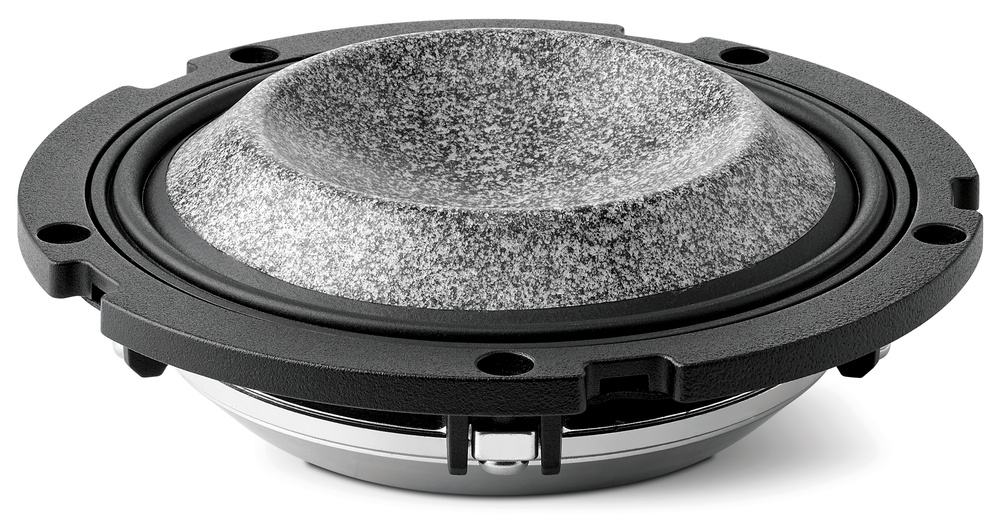 Focal’s unusual M‑profile midrange dome.
The W diaphragm material also finds employment in the bass driver (‘light and rigid’ is equally important in bass driver diaphragms). While the bass driver looks relatively conventional from the front, behind its diaphragm and surround is a motor system designed to remain linear in its response to input signals over an unusually large, ±15mm excursion capability. Linear excursion for similarly dimensioned bass drivers typically maxes out at between 10mm and 12mm, so the Utopia Main 112 driver is clearly engineered to offer ‘main monitor’ worthy levels of low‑frequency bandwidth and volume.
Ports Direct
Perhaps as interesting as the bass driver is the reflex port. The 112’s port has possibly the largest and most generously flared exit I’ve ever seen on a monitor. One implication of such a large port cross‑sectional area is that to achieve the necessarily low tuning frequency (the port is tuned to around 30Hz), the interior port length required is too long to fit in the Utopia Main 112 cabinet depth. So the port tube bends upwards within the cabinet to a flared entrance behind the bass driver magnet. Focal say that the port profile and entrance/exit flares were optimised for maximum linearity using FEA (Finite Element Analysis) airflow modelling.
Perhaps surprisingly, after all that, the reflex port is optional. It can be sealed using an accessory foam plug to convert the Utopia Main 112 into a closed‑box monitor. An EQ option, engaged using a switch on the amplifier unit, compensates the frequency response for closed‑box loading so that the system displays the same ‑3dB cutoff as in its reflex configuration. However, below the cutoff frequency the closed‑box option displays a 12dB/octave roll‑off rather than the 24dB/octave characteristic of the reflex option, and this is reflected in significantly lower group delay (latency that varies with frequency) in closed‑box mode. Focal say that Utopia Main 112 group delay at 30Hz is reduced by about half in closed‑box format compared to the reflex option. The potential down side of the closed‑box option is significantly reduced maximum sound pressure level, with a theoretical maximum about 8dB lower than in reflex mode (theoretical because, in practice, the maximum SPL will very much depend on the frequency balance of the programme material). This is simply because, without the reflex port adding its low‑frequency contribution, the Utopia Main 112 bass driver will run out of diaphragm excursion at a lower volume level.
Top End
The tweeter employs similar technology and design ideas to the midrange driver. It incorporates a similar M‑shaped diaphragm and, once again, a motor system configured around a radial neodymium‑iron‑boron magnet that results in the absence of any reflective bulk behind the diaphragm. The tweeter also incorporates a detail in its diaphragm surround profile christened a ‘Damping Hook’ that, like the midrange driver’s TMD, modifies the surround’s vibrational behaviour to ensure that it doesn’t reflect energy back into the diaphragm.
The one element of the Utopia Main 112 tweeter that diverges conceptually from the midrange driver is in its use of beryllium. Beryllium is one of the most rigid and light elements, and despite the difficulties it presents in manufacturing, Focal have long experience of its use for tweeter diaphragms.
Cabinet Meeting
Before I move on to the electronics, there’s an interesting element of complexity in the 112’s cabinet (which is constructed from 30mm‑thick panels) that is completely hidden from view. The usual practice inside a speaker cabinet is to absorb and dissipate the acoustic energy radiated from the rear of the drivers by filling the volume with wadding and/or lining the internal walls with foam. This generally works pretty well except that with reflex‑loaded speakers, the more you fill the enclosure with wadding, the less well the reflex loading works (wadding damps the reflex port Q).
To avoid this issue, Focal have implemented the unusual technique of installing a couple of discrete tube absorbers within the enclosure. The Utopia Main 112’s enclosure effectively has its own internal ‘bass traps’. I’ve seen this idea implemented once or twice before (in particular in the Pioneer RM07 active nearfield monitor) and it’s one that I rather like. The reason it’s not seen more often is, no surprise, that it’s complex to design and expensive to implement — much more so than stuffing a bag of polyester wadding into the speaker cabinet. Its use in the Utopia Main 112 is a good indicator, if any more were needed, that Focal are very serious in their engineering intent with the Utopia monitors.
Current Affairs
The Utopia monitors employ a ‘current drive’ technique for their midrange and high‑frequency amplifiers that effectively includes the driver voice coils in the amplifier feedback structure. I’ve written about this kind of technique before, but the following general point bears repeating, I think: one of the huge potential advantages of the active loudspeaker principle is that the speaker drivers and amplifier can be considered a holistic system and so be designed such that their dynamic electrical relationship is more effectively integrated than is the case when the amp and the driver remain entirely discrete elements. This doesn’t often happen; in the majority of active systems the amplifiers and drivers are really integrated no more intimately than being housed in the same box.
The current‑drive system of the Utopia Main monitors is founded on the fact that a speaker driver diaphragm moves in response to the current flowing in its voice coil, and not to the voltage across its terminals. At first reading that might sound like splitting hairs, but imagine what typically happens when a driver voice coil gets warm in response to heat dissipation; its electrical resistance increases, so less current flows and acoustic output falls. This is the phenomenon behind thermal compression.
In a basic implementation of current drive, a low‑value resistor is placed in series with the driver, and a signal that represents the current flowing in the voice coil is established by ‘measuring’ the voltage across said resistor. The measured voice‑coil current signal is fed back to the amplifier input and compared to the input signal, with the idea that any differences between the two represent driver non‑linearities. This ‘error’ signal can then be used to modify the input signal so that the non‑linearities are compensated for. Returning to the simple case of thermal compression, the error signal identifies that the current flowing through the voice coil is not as high as it should be considering the input level, so the amplifier gain is increased to compensate. And just like that, thermal compression is fixed. But it’s not only thermal compression that can be corrected: the technique can in principle alleviate motor system non‑linear phenomena such as magnetic hysteresis and voice‑coil inductance variation.
Current drive is not the only unusual amplifier technique employed in the mid‑ and high‑frequency amplifiers; they both also incorporate Focal’s proprietary Class‑H principle. Class‑H is a variable power supply technique in which the amplifier supply voltage rails are dynamically adjusted in response to signal level. The result is significantly lower heat dissipation than typical Class‑A/B amplification.
Listening In
Focal say that the Utopia “inherits over 40 years of Focal know‑how and 20 years of innovation in the development of studio monitors”, and having spent some time with the monitor I don’t think that’s hyperbole. Focal really have thrown everything at the Utopia Main 112 (and 212). But how does it sound?
As with previous reviews conducted outside my own studio, there’s a slight health warning in that listening to a new monitor in an unfamiliar room is a somewhat different experience to listening in my familiar environment, although I was of course able to play numerous reference tracks that I know better than the back of my hand. The Utopia Main 112s had been installed and set up in reflex‑loaded mode by Focal’s UK representatives, and I felt no need to modify the EQ settings. The KMR listening room is acoustically treated and relatively well damped, but it is also relatively compact — a little smaller than I’d imagine would be the case for most Utopia Main 112 installations.
My first impressions were of a relatively dry (restrained) bass balance combined with immense levels of midrange and high‑frequency clarity, and striking stereo image focus. In describing Utopia Main 112 bass as restrained I don’t mean to imply that it is at all lacking; rather that it plays bass only when it should. It sounds notably precise, tuneful, powerful, and wonderfully revealing of what’s actually going on at low frequencies, and that, for any monitor, is a very good foundation on which to build. I would have liked to hear them in closed‑box mode, but without the necessary port plugs available I was unable to. I would expect to hear yet more precision and accuracy.
In terms of detail and accuracy, the HF performance is subjectively at an extremely high level. The design and engineering skill invested in the tweeter clearly pays off. That said, I found the high‑frequency balance a little bright for my tastes, though this would be easily fixable with the EQ facilities on offer. I also became aware of a slight sensitivity to vertical listening position, but this was probably a result of the relatively small listening space constraining the listening distance, so in a larger space (one more suited to the scale of the monitor and hence allowing greater listening distance) I suspect I wouldn’t have been aware of it.
The way the 112 presents and reveals midrange detail in complex instruments and voices is exceptional and, to my ears, lifts the performance to a level that not many monitors reach...
The low‑ and high‑frequency bands of the Utopia Main 112 are genuinely capable and certainly, to my ears, operate at a performance level commensurate with Focal’s main monitor aspirations, but it’s in the midrange where I think some magic happens. During a conversation I had some time ago with the hugely experienced CEO of a well‑known Scandinavian audio company, he described his speaker design philosophy as concentrating on the midrange and then engineering the midrange bandwidth to be as wide as possible. The Utopia Main 112 midrange sounds like it might have been conceived along such lines: all that engineering effort invested in the midrange driver (plus the implementation of current drive) has delivered huge results. The way the 112 presents and reveals midrange detail in complex instruments and voices is exceptional and, to my ears, lifts the performance to a level that not many monitors reach. Complex quirks in vocals, the wood and string interplay of acoustic guitars or bowed strings, the breath and embouchure of horns and woodwind... the Utopia Main 112 has an exceptional ability to reveal it all.
I wasn’t able to spend a hugely extended period with the Utopia Main 112, but its performance and quality is so immediately and obviously apparent that, to be honest, if I’d spent much longer with it I would have simply been listening for pleasure as much as for work. Focal’s first foray into the world of main monitors has resulted in a genuinely exceptional speaker.
EQ Options
Being implemented entirely in the analogue domain, the Utopia Main 112 EQ facilities are not as generous as we’ve all perhaps come to expect from DSP‑based EQ, but honestly, who ever uses more than two or three parametric bands to implement broad‑brush room or personal preference equalisation of a monitor?
So, the amplifier unit’s EQ comprises high‑ and low‑frequency shelf functions offering up to ±3dB at 120Hz and 7kHz, a single 100Hz‑1kHz band offering +2.5dB/‑6dB with a fixed Q, and two variable‑Q low and low‑mid band intended primarily for the compensation of room modes. The power amplifier unit also includes some preset EQ options for the closed‑box low‑frequency option and for soffit‑mounted monitor installation.
Alternatives
The Utopia Main 112 falls into a market position alongside products such as the ATC SCM150A, the Barefoot MiniMain12, the PMC IB2S, the HEDD Tower Main, and the Dynaudio M3 MkII. All, and maybe others too, should be on your audition list.
Pros
- Exceptional wide‑band performance.
- Truly glorious midrange character.
- Reflex or closed‑box option.
- Serious commitment to electro‑acoustic engineering really delivers the goods.
Cons
- Hint of vertical listening axis sensitivity.
- Nothing else.
Summary
With the Utopia Main 112, Focal have well and truly arrived in the main monitor sector.
Information
When you purchase via links on our site, SOS may earn an affiliate commission. More info...