


I’ve looked at several of Lake People’s headphone amps in these pages before, and I have been impressed by their no‑nonsense, engineering‑led design. The G103 and G105 MkII models reviewed back in SOS August 2022 were all‑analogue devices, with inputs on XLRs and RCA phonos, and were designed to be powered directly from a mains supply. But the latest variant to join the range is a bit different.
The ‘D’ in the G103‑D‑4 stands for Dante, and you’ll find neither analogue inputs nor an IEC connector on its rear panel. Instead, there’s an RJ45 connector and a pair of USB sockets. The former is the only option for getting audio into the unit, and if you connect it to something capable of supplying Power over Ethernet (PoE), then a single Cat5 or Cat6 cable is all you’ll need. However, PoE is far from standard on Dante gear, so you also have the option of using either the Type‑B or Type‑C USB socket to deliver the necessary DC voltage. (Neither of these can be used to pass audio, by the way).
The G103‑D‑4 is in effect two completely independent headphone amps, each offering a volume control plus mini‑jack and quarter‑inch headphone sockets. Plug it into a Dante network and you’ll see two separate pairs of receive channels, so you can send different signals to each if you wish.
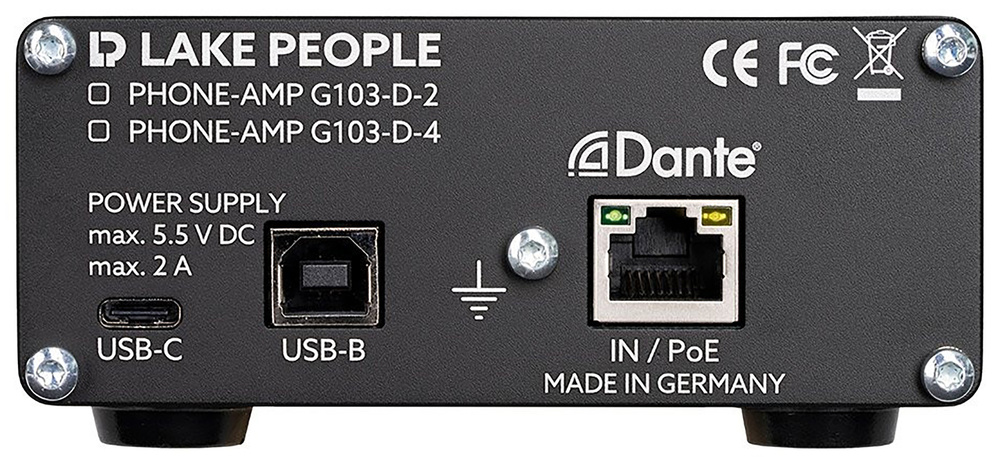 Power can be received over the Ethernet connection, or via the USB A or C ports.
Although the other G‑series headphone amps can drive two pairs of cans at once, they are stereo‑only devices that feed the same signal to both pairs, at the same volume. The G103‑D‑4, by contrast, is in effect two completely independent headphone amps, each offering a volume control plus mini‑jack and quarter‑inch headphone sockets. Plug it into a Dante network and you’ll see two separate pairs of receive channels, so you can send different signals to each if you wish. (If you only need a single stereo feed, there’s also a smaller model called the G103‑D‑2.)
Like the other G‑series models, the G103‑D units feature Lake People’s ‘pre‑gain’ options, accessed by opening up the unit and making selections on DIP switches. These allow the gain level to be optimised for different impedances and sensitivities, so that the volume control operates in a sensible range for your headphones. Why Lake People use Allen bolts at one end of the unit and Torx at the other I don’t know, but a Torx driver did the job with both.
If your network carries PoE, the convenience of having the entire thing driven from one Cat5 cable is hard to beat.
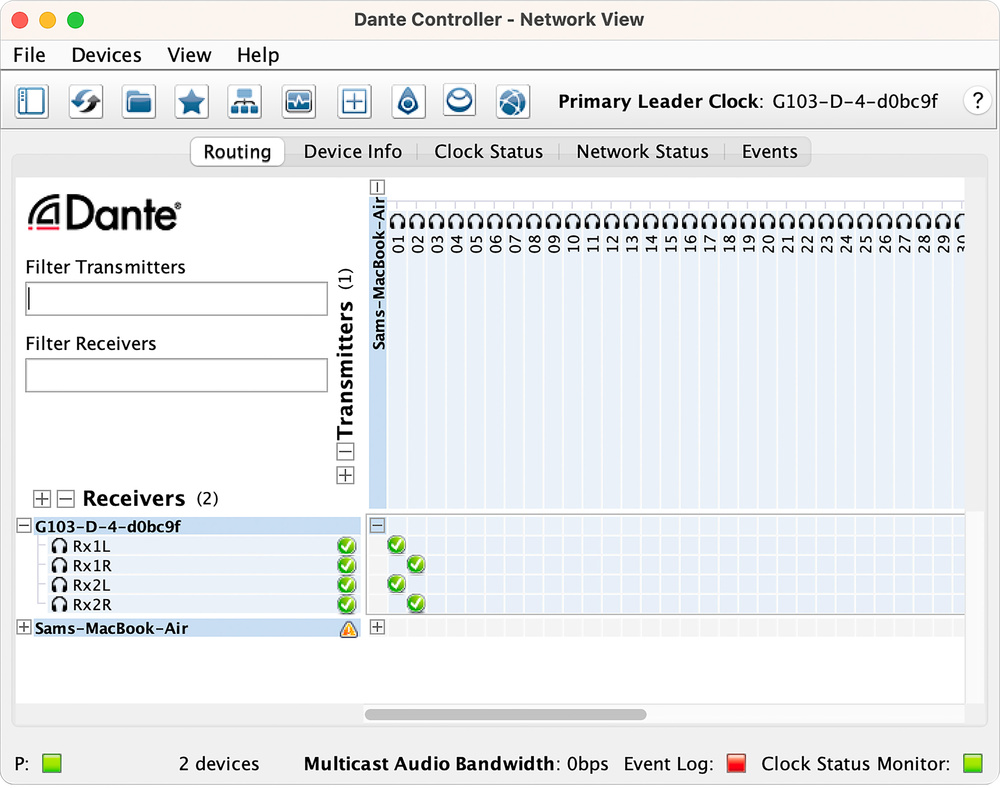 The headphone amp’s appearance in Dante Virtual Soundcard.
I tested the D103‑D‑4 with Dante Virtual Soundcard. The experience was completely trouble‑free, latency was imperceptible, and the sound quality was as good as I remember from the other G‑series units. Powering the G103‑D‑4 over USB doesn’t seem to compromise its ability to put out the sort of ear‑melting levels that some drummers require, and if your network carries PoE, the convenience of having the entire thing driven from one Cat5 cable is hard to beat.
The adoption of audio‑over‑IP in music recording still seems quite slow compared with adjacent businesses such as broadcast and live sound, and I think one of the factors in this has been a dearth of useful utility devices. If you can’t find a simple headphone amp or monitor controller that works for you, the ability to carry millions of channels over a single cable is somewhat redundant. The G103‑D‑4 fills a gap very neatly.