

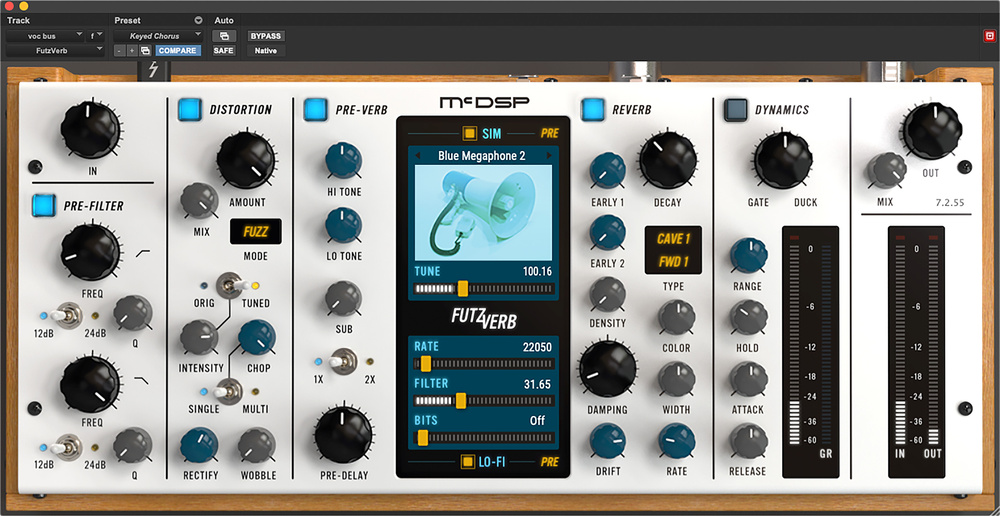
McDSP’s new distortion‑cum‑reverb promises to put your audio through the wringer.
Some plug‑in names capture what the plug‑in does so perfectly that it almost seems redundant to write a review. Available in all the usual native formats and authorised using an iLok licence, McDSP’s FutzVerb is a case in point. It adds reverb; and it futzes with your sound.
Its core futzing mechanism is a technique, previously used in McDSP’s FutzBox plug‑in, which they call Synthetic Impulse Modelling. This, it’s claimed, offers the realism of convolution, but with a much lower CPU overhead and the ability to adjust parameters in real time. The supplied library includes around 100 SIMs, recreating devices such as portable radios, cellphones, electronic toys, metal buckets and vacuum‑cleaner pipes. Each of these has a Tune parameter that seems to scale the spectral characteristics of the device up and down the frequency range.
Additional futzing power is provided through a filter module, with resonant low‑ and high‑pass bands that can be set to 12 or 24 dB/octave response, and an innocuous‑looking module labelled Distortion. As well as the expected choice of saturation types and an Amount dial, this has numerous more obscure controls. Some of these are relatively ‘normal’, like Intensity, which somewhat resembles a tone control for the added harmonics. Others are anything but, such as Chop, through which “audio waveform inter‑cycle signal level ranges are eliminated (chopped) to create a new kind of distortion,” and Wobble, which uses low‑frequency content in the signal to modulate the distortion characteristics.
There’s probably some further futz potential in the Pre‑verb module, which features simple high and low tone controls, a pre‑delay knob and, more unusually, a variable subharmonic generator. The pre‑delay can be negative as well as positive, which opens up some interesting sonic possibilities. And finally on the futzing side of things, the SIM module has a switchable lo‑fi section that allows you to reduce the word length and sample rate. Both the SIM itself and the lo‑fi processor can independently be switched to different positions in the signal chain, processing the whole signal either pre‑ or post‑reverb, or ‘within’ the reverb.
Whilst not technically an agent of futz, moreover, the reverb itself certainly isn’t your run‑of‑the‑mill room simulator. It’s algorithmic rather than convolution‑based, and offers a choice of 22 algorithms and 12 “reflection types”. You won’t find comfortingly familiar plates or ambiences among the former list, which instead includes ‘canyon’, ‘abyss’ and multiple caves, waves and silos. It’s paired with a relatively conventional dynamics section offering variable gating or ducking.
Playing In The Dirt
I’ve come across reverbs that offer distortion and other unconventional sound‑shaping possibilities before, notably Overloud’s Rematrix and HOFA’s IQ‑Reverb. However, those plug‑ins are primarily reverbs that allow you to dirty up the sound a little if you want. It doesn’t take much experimentation with FutzVerb to see that the emphasis is the other way around here. This is a plug‑in that is primarily designed to screw with the sound, but which also allows you to add reverb if you want. So if your goal is to lend a little bit of character to your vocal sound by introducing some valve distortion to a vintage plate emulation, this probably isn’t the reverb for you.
If, on the other hand, fearless sonic experimentation is your thing, FutzVerb comes highly recommended. It’s possible, though not always easy, to get a ‘normal’ reverb from it; but its strengths lie far from the normal. Whereas you’d usually use a reverb plug‑in as an auxiliary effect and send to it from multiple sources, this is very much the sort of plug‑in you’d use on an insert to transform a single source. (I’d still like it to have the ability to lock the wet/dry mix when loading new presets, though, and it’s also a little surprising there’s no mono‑to‑stereo version.) Only about half of the presets feature reverb as the most prominent effect, and even there, it’s almost always churned‑up, metallic, gritty or downright nasty. Elsewhere, distortion and filtering come to the fore.
If you want to create the effect of a computer announcing ‘Self‑destruct in 30 seconds’ over a broken PA system on a burning spaceship, this plug‑in makes it almost too easy.
Having A Futzball
FutzVerb is a plug‑in that has at least as many applications in post‑production and sound design as it does in music. If you want to create the effect of a computer announcing “Self‑destruct in 30 seconds” over a broken PA system on a burning spaceship, this plug‑in makes it almost too easy. In a music context, I found it particularly rewarding on background sounds such as pads, where it can turn a cheesy synth drone into something ominous, wobbly and less demanding of space in the mix. At the other end of the scale, there is also endless fun to be had on drums and drum machines, particularly if you want to stop them from sounding like drums and drum machines!
Like all the best plug‑ins, FutzVerb packages its enormous potential within a relatively simple user interface. Each of its individual processing modules is a powerful effects generator in its own right, so the sum of the parts is extremely versatile. It takes some self‑restraint to acknowledge that you don’t have to use more than one or two of them on a given source, and it helps if your tastes lean towards the characterful rather than the pretty, but in a world where we all have eleventy million distortion and reverb plug‑ins already, FutzVerb does offer something new.
Summary
FutzVerb does exactly what the name suggests!