

Rating: ★ ★ ★ ★ ★ 5/5 Stars
If you’re vaguely familiar with Sound Dust’s previous instruments, you’ll probably have a pretty good idea of what to expect from their latest release, Seeker. At its most basic level, it is an instrument that acts somewhat like a wavetable synth, shipping with 1.9GB of sampled content, from the extraordinary mind of creative leader Pendle Poucher. However, this is far from a hard sell, because it’s the incredibly interesting nature of the included sample content, along with its capacity for considerably warped playback manipulation, that really brings this instrument to life, both from the keyboard and through on‑screen or CC control.
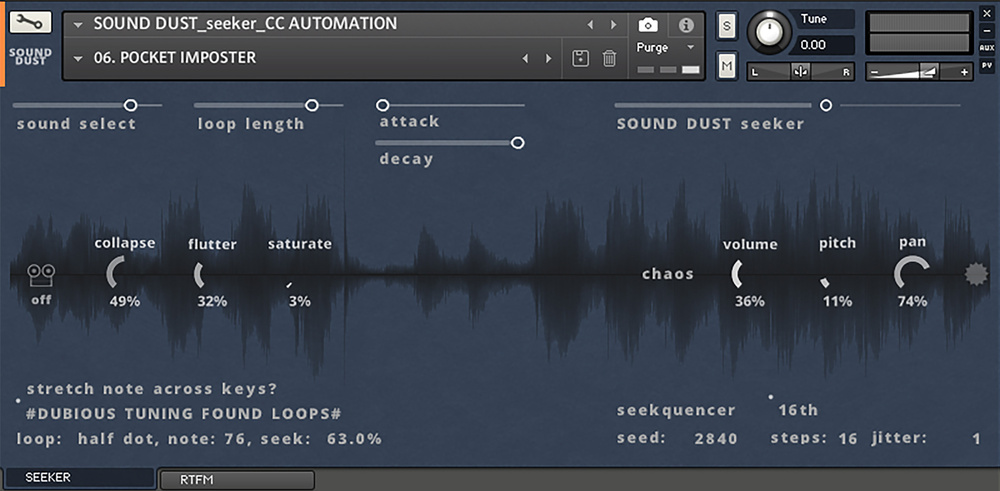
Seeker hosts up to 12 sample patches at a time, these being selectable from a drop‑down menu, or from the Sound Select horizontal fader. The latter is open to live or DAW‑based automation, so you can create merry mayhem by switching samples/wavetables on the fly.
Manipulation occurs at the playback level through a number of parameters, beginning with the Seeker control, which scans across the entirety of the displayed waveform. Some samples, such as the Leslie FastSlow wave, don’t bear fruit initially, as the sample is fairly constant, but other waves such as Pocket Imposter provide considerable variance as the sample unfolds over a fairly lengthy amount of time.
The more stable content immediately becomes more interesting while adjusting the Loop length control, in conjunction with basic Attack/Decay envelope controls. Even the most basic of waves can then provide gated movement, with further layers of interest being added through the Chaos section, which induces random volume, pitch and pan modifications, with each repeat of the sample. All of this, while using the Seeker control to shift your start position, in real time. It’s also worth noting that in this mode of operation, samples are multisampled at the per‑note level, with subtly different iterations available for each note that is triggered.
There are some beautiful harp‑like glissandi too, all culled from Pendle’s personally sampled collection, and sync’able within Seeker to your DAW.
By contrast, further sampled content is available in looped form, from three further patches, located at the bottom of the menu. The loop content is incredibly diverse, from mallet and bell‑like instruments, through to constructs with rhythm and drums at their core. There are some beautiful harp‑like glissandi too, all culled from Pendle’s personally sampled collection, and sync’able within Seeker to your DAW. It’s a real treasure trove, particularly with different loops being assigned to each note, but when you find a loop that you want to engage with, there is an option to stretch the sample across the whole keyboard, in a tuned state, allowing use harmonically or even melodically.
If none of that gets your creative juices flowing (and if it doesn’t, you must be made of stone) then you can always use the Seeker engine with your own samples.
Seeker requires the full Kontakt to load and use, but the quality of the content and the uniqueness of its engagement make this a beguiling instrument for new, interesting, micro‑sampled and lo‑fi content. It’s very cool indeed!