These modules pair a vintage‑style EQ with a clever saturation feature — and the stereo MQ‑2 also brings controllable compression to the table.
Forty‑three years since the late Ivor Drawmer (1943‑2023) founded his eponymous company and introduced the first frequency‑conscious noise gate, the DS201, Drawmer have released what I believe to be the world’s first Motown‑inspired 500‑series analogue EQs. One is a single‑slot, mono, seven‑band EQ called the MQ‑1, and its sibling, the MQ‑2, is a larger double‑width stereo device that pairs the same EQ circuit with a compressor. The EQ sections are based on the frequency bands and bell‑shaped EQ curves of a passive EQ that was developed by Mike McLean of Motown’s Engineering Department in the 1960s: a proportional‑Q, seven‑band design. But neither module is a direct clone, and both have a neat trick up their sleeve that could well extend their usefulness today.
Design & Construction
Largely, these modules adhere to Drawmer’s long‑established black, yellow and white livery, although I noticed that the classic black knobs first seen on the DS201, which had yellow pointers, have been replaced with plain black knobs in yellow circles. To help you navigate the photos, both units’ seven cut/boost frequency knobs have light‑grey inserts with black position indicators, while the other level controls (gain only on the MQ‑1, and gain and compression level on the MQ‑2) have black inserts with white indicators. Black buttons with associated LED indicators control the hard bypass on both units and the signal path on the MQ‑2 (EQ pre/post the compressor).
Lastly, red buttons with LEDs switch in Drawmer’s unique Crush circuit, a harmonic saturation feature that’s been borrowed from their own 1971 four‑band parametric EQ. It’s the same circuit on both modules, but the MQ‑1 has an additional Harmonics LED that gets progressively brighter as the amount of saturation in the output signal increases. Other than that last LED, the MQ‑1 offers no indication of the signal level, whereas the wider MQ‑2 lacks the Harmonics LED but is equipped with three eight‑LED bar meters. The first displays up to 20dB of gain reduction, whilst the other pair indicates the level of the stereo output’s left and right channels.
Like all Drawmer hardware, the all‑analogue MQ‑1 and MQ‑2 are designed and hand‑assembled in Yorkshire, in the UK. All of the components are full‑size, through‑hole types, and the standard of workmanship is of the highest order. The ingenious mechanical design of both units creates a very stable structure, too.
The Equaliser
In both the MQ‑1 and MQ‑2, the centre frequencies of the seven bands are preset at 12.5, 5 and 2 kHz, and 500, 320, 132 and 50 Hz, just as in the original Motown equaliser. Although those centre frequencies are spread too far apart for detailed, precise tonal correction, their sizeable overlaps make them very effective for broader tone‑shaping right across the audible spectrum. Each band offers ±10dB of adjustment, by the way, whereas in the Motown design it was ±8dB.
To replicate the bell curves and centre frequencies of the inductor‑based Motown EQ, Drawmer’s engineers have employed active gyrator‑based circuits, to create virtual inductors. If you’d like to know more about the active gyrator approach, our Technical Editor Hugh Robjohns provided a good overview in this SOS Forum post: https://sosm.ag/gyrators-v-inductors.
In the Motown equaliser, the level loss caused by its passive equaliser circuitry was compensated for using a post‑EQ gain stage. In the MQ‑1, the gain stage sits pre‑EQ, whilst in the MQ‑2, it sits post the EQ/compressor Order switch. Although these gain stages act primarily on the incoming signal level (MQ‑1) and the output signal level (MQ‑2), each has a secondary role in controlling the level of the signal going into the Crush circuitry.
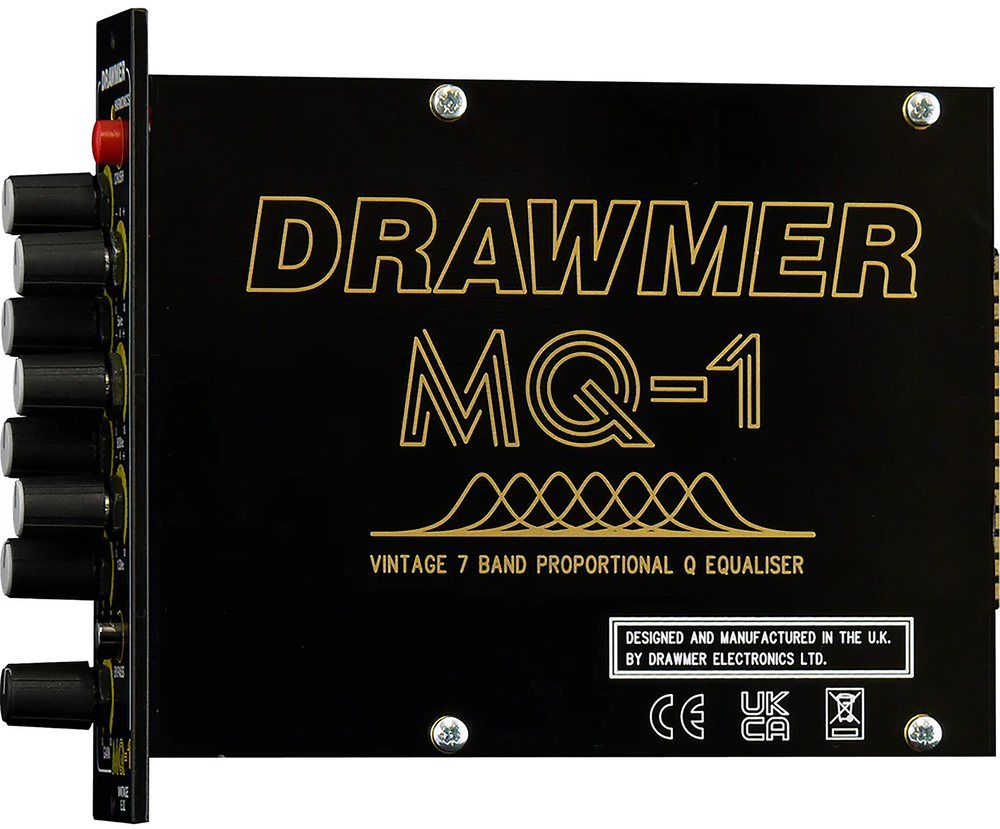 The side panel of the MQ‑1, with a graphic indicating how the seven EQ bands overlap and can thus interact.
Lying at the heart of the Crush feature is a compressor with a fixed attack and automatic make‑up gain, and it’s been designed to introduce warmth and musically pleasing second‑order harmonic saturation to the EQ’ed signal. This compression/saturation is threshold‑based, of course, so applies only to the frequencies that are highest in level — in practice, that typically means you saturate the bands you’ve boosted, and not those that have been cut. The results obtained from this function, then, depend on the interaction between the frequency characteristics of the instrument or voice that’s being EQ’ed, the frequencies being boosted and the overall signal level, including any contribution from the gain control.
As the EQ boost increases, the more apparent the Crush contribution becomes at the frequencies being boosted, and the brighter the MQ‑1’s Harmonics LED illuminates. Note, though, that if you want to dial in a particularly high level of Crush by boosting a band or bands, you may actually find yourself having to reduce the signal level coming into your MQ‑1, or that leaving your MQ‑2, so as to avoid clipping the units’ output stages.
The Compressor
In addition to its EQ stage, the MQ‑2 features a one‑knob, programme‑dependent stereo compressor that can deliver up to 20dB of compression. The single knob controls the overall amount of compression, influencing both threshold and ratio in the process. Being programme‑dependent, the compressor automatically adjusts its attack and release times in response to the amplitude and frequency content of the incoming signal. This automatic optimisation alters the compression envelope to suit the signal, and can help to deliver a more natural‑sounding compression. The one‑knob approach makes dialling in the desired amount of compression really intuitive. The post‑compressor gain knob then allows you to make up for any loss in the signal level that results from the gain reduction.
As I alluded to above, the MQ‑2’s compressor can be placed either pre or post EQ and this is done using the Order button. The position you choose will depend entirely on whether you want to, for example, reduce a track’s low‑end level before it gets to the compressor (which might prevent unwanted compression), or to adjust the EQ to mitigate any of the reduction in high‑frequencies that can be a side‑effect of compression. There’s no right or wrong, just what works and sounds best for the source you’re processing and the track that you’re working on.
Crush & Clarity
To me, the defining quality of both the MQ‑1 and MQ‑2 is the clarity and detail of their audio performance, which is reflected in their 20Hz‑20kHz (±0.5dB) frequency responses. Specification‑wise, the MQ‑2 has slightly higher noise levels, but only because its compressor is always in circuit — this didn’t create any issues for me. A more consequential difference is that the MQ‑1 can accept input levels of up to +21dBu, whereas the MQ‑2 tops out at +16dBu, and that should be kept in mind when gain‑staging signal chains.
Operating the MQ‑series equaliser is intuitive, and it’s very effective too. Its wide bandwidth at lower boost/cut levels enables you to gently sculpt a source’s tonality. Although this EQ is, to me, more paintbrush than scalpel, it can definitely reward a more aggressive approach when necessary because there’s sufficient focus available to help deal with an issue in one frequency band without creating insurmountable problems in neighbouring ones.
The EQ’s clarity means that it doesn’t change the sonic character of a source too much, of course — but that’s what Crush is for, and Crush is highly effective and pretty addictive. Given its interaction with gain and EQ boost, it rewards experimentation too, and when you become accustomed to the interaction, you’ll be able to find the ideal level of harmonic saturation for the task at hand quickly. For example, in the lower frequencies, Crush can be used to help thicken up drums and bass guitars. In the mids it can add presence and warmth to a mix or put an edge on vocals, piano or percussion. Up in the highs, you’ll find Crush useful for enhancing cymbals and string instruments. Should you want to explore the outer limits of its capabilities, the results can get quite crunchy, but avoid clipping the signal and you can certainly head on out there.
The MQ‑2 boasts one of the most effective one‑knob stereo compressors I’ve encountered to date. Perhaps the most effective.
The MQ‑2 boasts one of the most effective one‑knob stereo compressors I’ve encountered to date. Perhaps the most effective: it just works. Turn the knob slightly and you get light compression, turn it further and there’s more; it’s that simple. At lower compression levels this compressor is perfectly suited to levelling vocals, strings, other acoustic instruments and percussion. With the compression wound up, the MQ‑2 is a very effective stereo drum‑bus crusher. To modify the frequencies that trigger compression, just position the EQ pre compressor and boost or cut as desired. Any drop in level due to heavy compression can be made up with the output gain control, and any loss in high‑frequency content can be addressed easily if you make the EQ post compression.
Verdict
Like so many Drawmer units, the MQ‑1 and MQ‑2 are excellent value for money. Both offer an intuitive workflow and performance that are well above what you’d expect given their relatively modest price — but especially so the MQ‑2. If you use a 500‑series rack as a single or double‑mono recording channel (or are considering doing so), the MQ‑1 would be a great choice as your main or supplementary EQ. Its tonal flexibility and the Crush feature will give you a wider sonic palette to work with than a conventional parametric or semi‑parametric equaliser. Should you, like me, prefer a stereo setup to handle, for example, analogue synths, pedalboards, amp modellers, drum machines and stems, then the two‑slot stereo MQ‑2 should get your vote. Because it could turn out to be the only EQ/compressor you’ll need.
Summary
These great‑sounding 500‑series units deliver the essence of the famous Motown EQ, and add some very useful functionality.
Information
MQ‑1 £298.80, MQ‑2 £454.80. Prices include VAT.
Drawmer Electronics +44 (0)1709 527574.
MQ‑1 $369. MQ‑2 $565.
TransAudio Group, Inc +1 702 365 5155.
When you purchase via links on our site, SOS may earn an affiliate commission. More info...